
Types of Writing: Understanding the Main Writing Styles
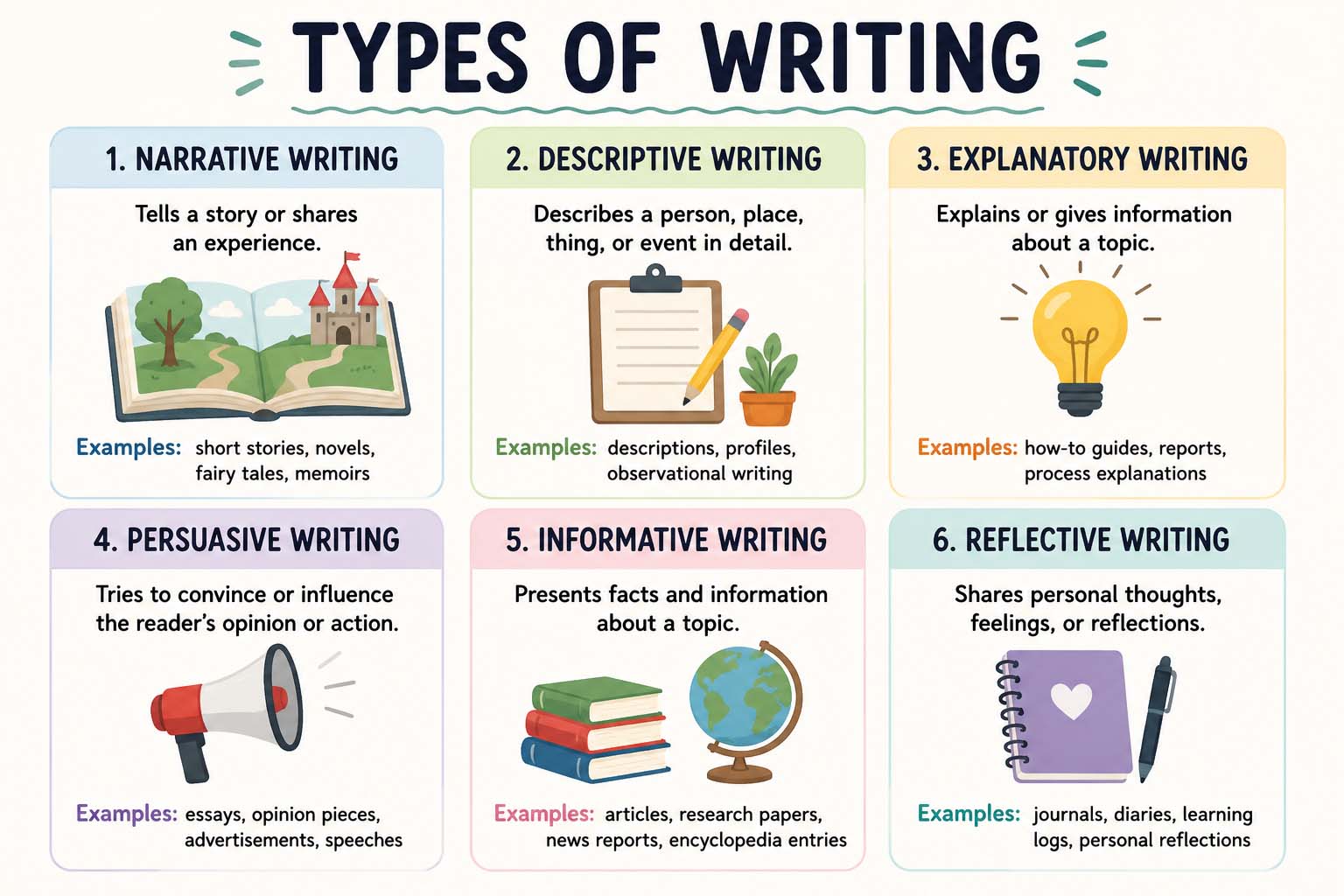
Types of Writing: Understanding the Main Writing Styles
Whether you’re writing a school essay, a business email, or a creative story, knowing the types of writing can help you communicate your ideas more effectively. Every writing task has a different purpose, and choosing the right style makes your message clearer for your audience.
Students often learn several writing formats throughout school. Although they may seem similar at first, each one follows its own structure, tone, and goals. Once you understand when and why each style is used, writing becomes much easier and more enjoyable.
What Are the Types of Writing?
Writing can generally be grouped into four main categories:
- Narrative writing
- Expository writing
- Persuasive writing
- Descriptive writing
These are often called the four primary types of writing styles because they cover most classroom assignments and professional writing situations.
Each style serves a different purpose, even though many writing pieces combine elements from more than one category.
Types of Writing and Their Main Purposes
The table below gives a quick overview.
| Writing Type | Main Purpose | Common Examples |
|---|---|---|
| Narrative | Tell a story | Short stories, novels, personal essays |
| Expository | Explain or inform | Textbooks, reports, research papers |
| Persuasive | Convince readers | Opinion essays, advertisements, editorials |
| Descriptive | Create vivid images | Poetry, travel writing, creative scenes |
Understanding these differences helps you choose the best approach before you begin writing.
Narrative Writing
Narrative writing tells a story.
It may describe real events or fictional ones, but it always includes characters, events, and a sequence of actions.
Common features include:
- Characters
- Setting
- Plot
- Conflict
- Resolution
Narrative writing focuses on entertaining readers or sharing experiences.
Students learning What Is a Narrative Essay will notice that this type of writing often combines storytelling with personal reflection or a central message.
Example
Emma opened the old wooden door and stepped into the quiet library, unaware that one forgotten book would change her summer forever.
Rather than simply presenting facts, narrative writing draws readers into a story.
Expository Writing
Expository writing explains a topic clearly and logically.
The goal is to educate readers using facts, evidence, and organized information.
You’ll often see expository writing in:
- School textbooks
- News articles
- Instruction manuals
- Research papers
- Encyclopedia entries
Unlike narrative writing, expository writing avoids personal opinions unless they’re supported by evidence.
Example
Photosynthesis is the process plants use to convert sunlight, water, and carbon dioxide into glucose and oxygen.
The emphasis remains on explaining rather than entertaining.
Persuasive Writing
Persuasive writing aims to convince readers to accept an idea or take action.
Writers support their opinions using:
- Facts
- Statistics
- Expert opinions
- Logical reasoning
- Real-world examples
Students studying Argumentative Essay Examples often discover that persuasive writing depends on strong evidence rather than emotional opinions alone.
Example
Schools should start later because research shows students perform better after getting enough sleep.
Effective persuasive writing considers opposing viewpoints before presenting stronger supporting arguments.
Descriptive Writing
Descriptive writing helps readers picture people, places, objects, or experiences.
Instead of focusing mainly on facts, it creates vivid mental images.
Writers frequently use:
- Sensory details
- Strong adjectives
- Figurative language
- Imagery
For example:
The mountain lake reflected the golden sunrise while cool morning mist drifted across the still water.
This style encourages readers to imagine the scene instead of simply learning about it.
Can One Piece of Writing Use More Than One Style?
Absolutely.
Many assignments combine several writing styles.
For example:
- A travel article may describe beautiful scenery while explaining local history.
- A research paper may present facts before arguing for a particular solution.
- A memoir may tell personal stories while explaining important life lessons.
Strong writers know when to blend styles without confusing the reader.
Different Types of Writing in Everyday Life
You use writing more often than you may realize.
Examples include:
| Situation | Writing Style |
|---|---|
| Text message | Informal narrative or descriptive |
| School report | Expository |
| Product review | Persuasive |
| Personal journal | Narrative |
| Travel blog | Descriptive and narrative |
| Business proposal | Persuasive and expository |
Recognizing these different types of writing helps you adjust your language depending on your audience.
Choosing the Right Writing Style
Before you begin writing, ask yourself one simple question:
What do I want my reader to do or understand?
If your goal is to:
- Tell a story → Use narrative writing.
- Explain something → Use expository writing.
- Change someone’s opinion → Use persuasive writing.
- Paint a picture with words → Use descriptive writing.
Answering this question first makes organizing your ideas much easier.
Why Organization Matters
No matter which writing style you choose, organization plays a major role.
Readers should always understand:
- What the main idea is.
- How ideas connect.
- Where the discussion is heading.
Studying Text Structure Examples can help you organize paragraphs in a logical order, making your writing easier to follow and more effective.
Writing Improves With Practice
Many students believe good writers are naturally talented.
In reality, writing is a skill developed through regular practice.
Simple habits such as reading often, revising drafts, and asking for feedback can improve your writing over time.
The more different writing styles you practice, the easier it becomes to recognize which one best fits each assignment.
Types of Tones in Writing
While writing style explains how a piece is organized, tone reflects the writer’s attitude toward the subject or audience.
Choosing the right tone can make the same message sound professional, friendly, serious, or even humorous.
Some common types of tones in writing include:
| Tone | Best Used For | Example |
|---|---|---|
| Formal | Academic papers, business reports | “The results indicate a significant improvement.” |
| Informal | Blogs, personal emails | “Here’s what I found after trying it myself.” |
| Friendly | Newsletters, educational content | “Let’s look at a simple example.” |
| Persuasive | Opinion pieces, advertisements | “This solution offers the best value.” |
| Objective | Research and factual writing | “The survey included 500 participants.” |
| Humorous | Entertainment and creative writing | “The alarm clock clearly had other plans for my morning.” |
A writer may adjust tone depending on the audience. For example, a school essay usually uses a more formal tone than a personal blog.
Types of Evidence in Writing
Strong writing relies on evidence, especially in academic and persuasive assignments.
The most common types of evidence in writing include:
Facts
Facts are statements that can be verified.
Example:
Water freezes at 0°C (32°F) under standard atmospheric pressure.
Statistics
Numbers help support claims with measurable data.
Example:
A survey found that 78% of participants preferred online learning.
Expert Opinions
Quoting qualified professionals adds credibility.
Example:
A medical researcher explains why regular exercise improves heart health.
Examples
Specific examples help readers understand abstract ideas.
Example:
Recycling programs in many cities have reduced landfill waste.
Personal Experience
Personal experiences are common in narrative writing and some opinion pieces.
While useful, they usually carry less weight than factual evidence in formal academic work.
Using several kinds of evidence together often creates the strongest argument.
Common Mistakes Students Make
Learning the different writing styles takes time, so mistakes are normal.
Here are a few of the most common ones.
Mixing Writing Styles Without a Purpose
A research report shouldn’t suddenly become a fictional story.
Likewise, a persuasive essay shouldn’t spend most of its time describing scenery.
Using one primary style while adding supporting elements from another keeps the writing focused.
Weak Organization
Ideas should flow naturally.
Readers should never have to guess how one paragraph connects to the next.
Planning an outline before writing makes organization much easier.
Ignoring the Audience
A classroom assignment and a social media post require different language.
Always think about who will read your work before choosing your words and tone.
Forgetting a Strong Ending
Many students spend most of their effort on the introduction but rush the final paragraph.
Reviewing Conclusion Paragraph Examples can help you learn how to end your writing with a clear summary instead of simply stopping.
Simple Ways to Improve Your Writing
Good writers continue learning with every assignment.
Here are a few habits that make a big difference.
Read Regularly
Reading exposes you to:
- New vocabulary
- Sentence structure
- Organization techniques
- Different writing styles
The more you read, the more naturally these skills appear in your own writing.
Practice Every Week
Writing improves through repetition.
Try writing:
- Journal entries
- Book reviews
- Opinion paragraphs
- Short stories
- Article summaries
Even 15 to 20 minutes of regular practice can strengthen your confidence.
Revise Before Submitting
Your first draft is rarely your best.
Before turning in any assignment:
- Check spelling.
- Improve awkward sentences.
- Remove repeated ideas.
- Make sure each paragraph supports your main point.
Editing often makes the biggest difference in overall quality.
Ask for Feedback
Teachers, classmates, and family members may notice things you’ve missed.
Constructive feedback helps you recognize both strengths and areas for improvement.
Quick Checklist Before You Start Writing
Use this checklist for almost any writing assignment.
- Identify your purpose.
- Understand your audience.
- Choose the correct writing style.
- Create a simple outline.
- Support ideas with evidence when needed.
- Use clear transitions between paragraphs.
- Edit before submitting.
Following these steps makes writing more organized and easier to read.
Frequently Asked Questions
What are the four main types of writing?
The four main types are:
- Narrative
- Expository
- Persuasive
- Descriptive
Most school assignments fit into one or more of these categories.
Can one piece of writing include multiple styles?
Yes.
Many articles, essays, and books combine different writing styles. The key is making sure one style remains the primary focus.
Which writing style is most common in school?
Expository writing is one of the most common because students regularly explain ideas, summarize information, and write research papers.
Persuasive and narrative writing are also widely used depending on the assignment.
Why is organization so important?
Clear organization helps readers follow your ideas from beginning to end.
Without a logical structure, even good ideas become difficult to understand.
How can I become a better writer?
Practice consistently, read widely, revise your work carefully, and learn from feedback. Over time, you’ll become more comfortable using different writing styles for different purposes.
Keep Practicing Every Type of Writing
Understanding the types of writing gives you a strong foundation for success in school, college, and the workplace. Each style has its own purpose, and knowing when to use narrative, expository, persuasive, or descriptive writing helps you communicate your ideas more effectively.
As your skills grow, you’ll also become more confident choosing the right tone, organizing your thoughts, and supporting your ideas with reliable evidence. The more you write and revise, the more natural these techniques become. Every assignment is another opportunity to strengthen your writing, build confidence, and develop communication skills that will benefit you for years to come.