
Types of Multiple Choice Questions: A Student-Friendly Guide
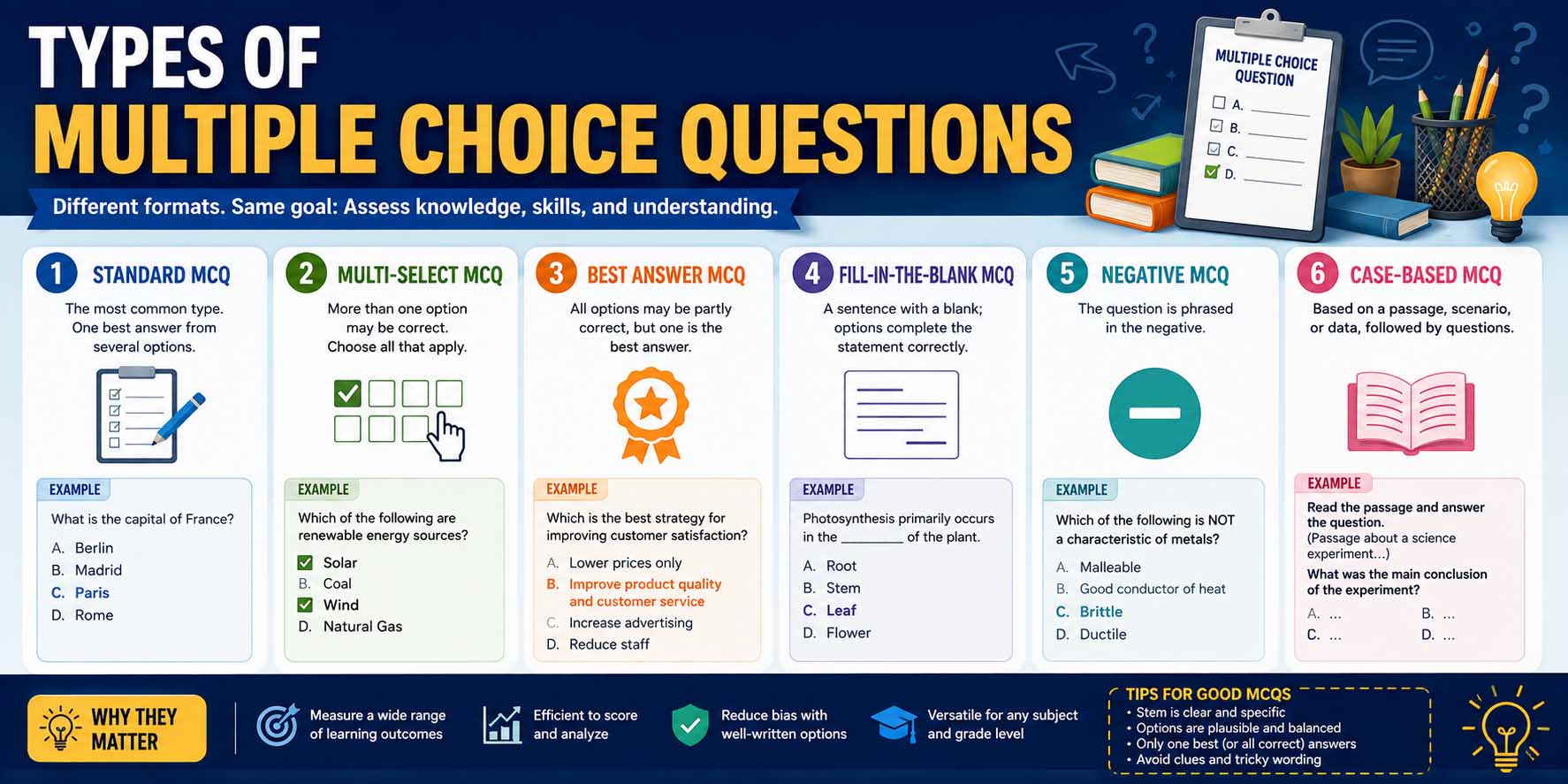
Types of Multiple Choice Questions: A Student-Friendly Guide
Have you ever noticed that not all multiple-choice questions look the same? Some ask you to choose one correct answer, while others require selecting several answers or matching information. Understanding the types of multiple choice questions can make exams feel much less intimidating and help you choose the best strategy for each question.
Teachers, schools, universities, and professional certification programs use multiple-choice questions because they measure knowledge quickly and consistently. Whether you’re preparing for a classroom quiz, a standardized exam, or a professional certification test, recognizing different question formats helps you answer more accurately and confidently.
What Are Multiple-Choice Questions?
Multiple-choice questions are assessment items that present a question or statement followed by several possible answers.
The student must identify the correct answer or, in some cases, the best combination of correct answers.
Most multiple-choice questions contain three parts:
- The stem, which asks the question.
- The options, which provide possible answers.
- The correct answer along with incorrect options, often called distractors.
These questions assess factual knowledge, understanding, critical thinking, and problem-solving skills across many subjects.
Many instructors include multiple-choice items in quizzes because they work well alongside other Summative Assessment Examples that measure student learning at the end of a lesson or course.
Why Understanding the Types of Multiple Choice Questions Matters
Learning the types of multiple choice questions helps students do more than memorize facts.
It allows you to:
- Understand what each question is asking.
- Avoid common mistakes.
- Apply better test-taking strategies.
- Manage exam time more effectively.
- Feel more confident during assessments.
Instead of treating every question the same way, you can adapt your approach based on the question format.
Common Types of Multiple Choice Questions
When students ask about the different types of multiple choice questions, they usually refer to the common formats used in schools, colleges, and certification exams.
Let’s look at each one.
Single-Answer Questions
This is the most familiar format.
Students select one correct answer from several options.
Example
Question: What is the capital of Canada?
A. Toronto
B. Ottawa
C. Vancouver
D. Montreal
Correct answer: Ottawa
Single-answer questions work well for testing definitions, facts, vocabulary, and basic concepts.
Multiple-Answer Questions
Unlike single-answer questions, these require selecting more than one correct option.
Instructions usually say:
- Select all that apply.
- Choose two answers.
- Choose all correct responses.
Example
Which of the following are renewable energy sources?
- Solar
- Wind
- Coal
- Hydroelectric
Correct answers:
- Solar
- Wind
- Hydroelectric
Students often lose marks by choosing only one answer, so reading directions carefully is essential.
Best Answer Questions
Sometimes more than one option appears reasonable.
However, only one represents the best answer based on the information provided.
These questions measure understanding rather than simple memorization.
Example
Which study strategy is most effective before an exam?
A. Reading notes once
B. Practicing active recall and reviewing mistakes
C. Studying only the night before
D. Skipping difficult topics
Although reading notes helps, active recall provides the strongest learning outcome, making option B the best answer.
Types of Questions Multiple Choice Exams Often Include
Many classroom and standardized exams combine several question formats within the same test.
Common examples include:
- Knowledge questions
- Application questions
- Analysis questions
- Scenario-based questions
- Problem-solving questions
Each format evaluates a different level of learning.
Students preparing for competitive exams often find that creating review materials with How to Make a Study Guide helps them practice these different question styles before test day.
Scenario-Based Multiple-Choice Questions
Scenario-based questions describe a situation before asking students to choose the best response.
These questions measure whether students can apply their knowledge in practical situations.
Example
A student forgets to save their assignment before the computer shuts down unexpectedly. What is the best way to reduce this risk in the future?
A. Use automatic cloud backups.
B. Restart the computer every hour.
C. Print the assignment every 10 minutes.
D. Disable automatic updates.
The correct answer requires applying knowledge rather than recalling a simple fact.
Many professional certification exams use this format because it reflects real-life decision-making.
Negative Questions
Negative questions ask students to identify the incorrect option.
Common wording includes:
- Which statement is NOT correct?
- Which option is NOT an example?
- All of the following are true EXCEPT…
These questions require extra attention because students often overlook the word “not.”
A useful strategy is to underline or mentally emphasize the negative word before reading the answer choices.
Assertion and Reason Questions
These questions present two statements.
Students decide whether:
- Both statements are true.
- Both are false.
- One is true and the other is false.
- The second statement correctly explains the first.
Example
Assertion: Plants produce oxygen through photosynthesis.
Reason: Photosynthesis converts sunlight into chemical energy.
Students must evaluate both statements rather than focusing on only one.
Matching Concepts Through Multiple Choice
Some exams combine matching with multiple-choice options.
Instead of matching items directly, students choose the correct combination.
For example:
Which pair is correctly matched?
A. Earth — Largest planet
B. Mars — Red Planet
C. Venus — Coldest planet
D. Mercury — Largest moon
Students must compare several relationships before selecting the correct answer.
Comparison of Common Multiple-Choice Question Types
| Question Type | Main Purpose | Typical Difficulty |
|---|---|---|
| Single Answer | Test factual knowledge | Easy |
| Multiple Answer | Assess broader understanding | Moderate |
| Best Answer | Evaluate judgment | Moderate |
| Scenario-Based | Measure application skills | Moderate to High |
| Negative Question | Test careful reading | Moderate |
| Assertion and Reason | Evaluate logical thinking | High |
| Matching Style | Compare relationships | Moderate |
This comparison helps students recognize each format before an exam.
How Teachers Choose Different Question Types
Teachers don’t use one format for every assessment.
Instead, they select question types based on the learning objective.
For example:
- Vocabulary quizzes often use single-answer questions.
- Science exams may include scenario-based questions.
- Professional certification tests frequently use application questions.
- Critical thinking assessments often rely on best-answer formats.
If you’re using resources such as a Permit Test Study Guide, you’ll likely notice that practice tests mix several question types to prepare learners for real exam conditions.
Classroom Benefits of Multiple-Choice Questions
Although some students think multiple-choice questions only test memorization, well-designed questions can measure much more.
Teachers use them to evaluate:
- Reading comprehension
- Problem-solving
- Data interpretation
- Logical reasoning
- Decision-making
- Concept application
When written carefully, multiple-choice assessments provide valuable information about student understanding while allowing exams to be graded fairly and consistently.
Types of Distractors in Multiple-Choice Questions
Understanding the types of distractors in multiple-choice questions can improve your test performance. A distractor is an incorrect answer designed to look believable. Good distractors encourage students to think carefully before selecting an answer.
Teachers create distractors to identify whether students truly understand a topic or are simply guessing.
Here are the most common types.
Plausible Distractors
These answers seem correct at first glance but contain a small error.
For example:
Question: Which planet is known as the Red Planet?
A. Venus
B. Mars
C. Jupiter
D. Saturn
Students who are unsure might choose Venus because it is another well-known planet, even though Mars is the correct answer.
Opposite Answers
Some distractors present the exact opposite of the correct concept.
This format checks whether students understand the meaning rather than recognizing familiar words.
Partially Correct Answers
A partially correct answer includes accurate information but fails to answer the question completely.
These options are especially common in higher-level exams because they test careful reading and critical thinking.
Common Misconceptions
Teachers sometimes use answers based on mistakes students frequently make.
For example, in mathematics, a distractor may reflect a common calculation error. In history, it may include the wrong date for a well-known event.
Recognizing these patterns helps students slow down and evaluate every option instead of choosing the first familiar answer.
Smart Strategies for Answering Multiple-Choice Questions
Knowing the types of multiple-choice questions is only part of the process. Good test-taking habits can improve your accuracy even when you’re unsure of the answer.
Read the Entire Question First
Many mistakes happen because students stop reading too early.
Pay close attention to words such as:
- Best
- Most
- Least
- Always
- Never
- Except
- Not
These words can completely change the meaning of the question.
Predict the Answer Before Looking at the Options
After reading the question, think of the answer before reading the choices.
This reduces the chance of being influenced by misleading distractors.
Eliminate Clearly Incorrect Choices
Even if you don’t know the correct answer immediately, removing impossible options increases your chances of selecting the right one.
Avoid Overthinking
Students sometimes change correct answers after second-guessing themselves.
Unless you discover new evidence while reviewing the question, your first carefully considered answer is often the best choice.
Common Mistakes Students Make
Even well-prepared students can lose marks because of avoidable errors.
Ignoring Instructions
Some questions ask students to choose one answer, while others require selecting multiple answers.
Always read the directions before responding.
Rushing Through Easy Questions
Easy questions deserve the same attention as difficult ones.
Simple wording can sometimes hide important details.
Focusing on Familiar Words
An answer isn’t correct just because it contains familiar vocabulary.
Instead, compare every option carefully with the question.
Leaving Questions Blank
If there is no penalty for guessing, answering every question usually gives you a better chance of earning additional marks.
Check your exam instructions first because some tests have different scoring rules.
How to Practice Multiple-Choice Questions Effectively
Practice is one of the best ways to improve test performance.
Try this simple routine.
Step 1: Learn the Concept
Understand the topic before attempting practice questions.
Memorizing answers without understanding the material rarely leads to long-term success.
Step 2: Complete Timed Practice
Working under realistic time limits helps you build confidence and improve pacing.
Students preparing for history exams often benefit from using an APUSH Study Guide because it combines content review with multiple-choice practice similar to classroom assessments.
Step 3: Review Every Mistake
Don’t just check whether an answer was wrong.
Ask yourself:
- Why was the correct answer right?
- Why were the other options wrong?
- Which clue did I miss?
This process strengthens critical thinking and helps prevent repeated mistakes.
Step 4: Practice Different Subjects
Multiple-choice questions appear in many courses, including:
- Science
- Mathematics
- History
- English
- Business
- Healthcare
- Driver education
For example, learners preparing for licensing exams often use a Tennessee Permit Test Study Guide 2026 to become familiar with realistic multiple-choice formats before taking the official test.
Tips for Teachers Writing Better Multiple-Choice Questions
Students aren’t the only ones who benefit from understanding question design.
Teachers can improve assessments by:
- Writing clear question stems
- Avoiding unnecessary wording
- Creating realistic distractors
- Testing understanding instead of memorization
- Keeping answer choices similar in length
- Avoiding clues that reveal the correct answer
Well-designed questions measure learning more accurately and create fairer assessments.
Frequently Asked Questions
What are the most common types of multiple choice questions?
The most common formats include:
- Single-answer questions
- Multiple-answer questions
- Best-answer questions
- Scenario-based questions
- Negative questions
- Assertion and reason questions
- Matching-style multiple-choice questions
Each format measures different learning skills.
Why do teachers use different types of multiple-choice questions?
Different formats assess different abilities.
Some questions measure factual knowledge, while others evaluate problem-solving, reasoning, or the ability to apply concepts in new situations.
What are distractors in multiple-choice questions?
Distractors are incorrect answer choices designed to appear believable. They help teachers determine whether students truly understand the material.
Are multiple-choice questions only for school exams?
No. They are widely used in:
- Professional certification exams
- Driver’s license tests
- College entrance exams
- Employment assessments
- Workplace training programs
What’s the best way to improve at multiple-choice tests?
The most effective approach is to understand the material, practice regularly, review mistakes, and become familiar with different question formats rather than memorizing answers.
Key Takeaways for Better Test Performance
Understanding the types of multiple choice questions gives you an advantage before you even begin an exam. Once you recognize how each question is designed, it’s easier to identify what the examiner is asking and avoid common traps.
Instead of focusing only on finding the correct answer, pay attention to the wording of the question, eliminate weak answer choices, and think critically about every option. Regular practice with different formats will strengthen your confidence and improve your accuracy over time.
Whether you’re preparing for a classroom quiz, a college exam, or a professional certification test, learning how multiple-choice questions work is a skill that will continue to benefit you throughout your education.