
Conclusion Paragraph Examples: How to Write Strong Endings for Essays and Assignments
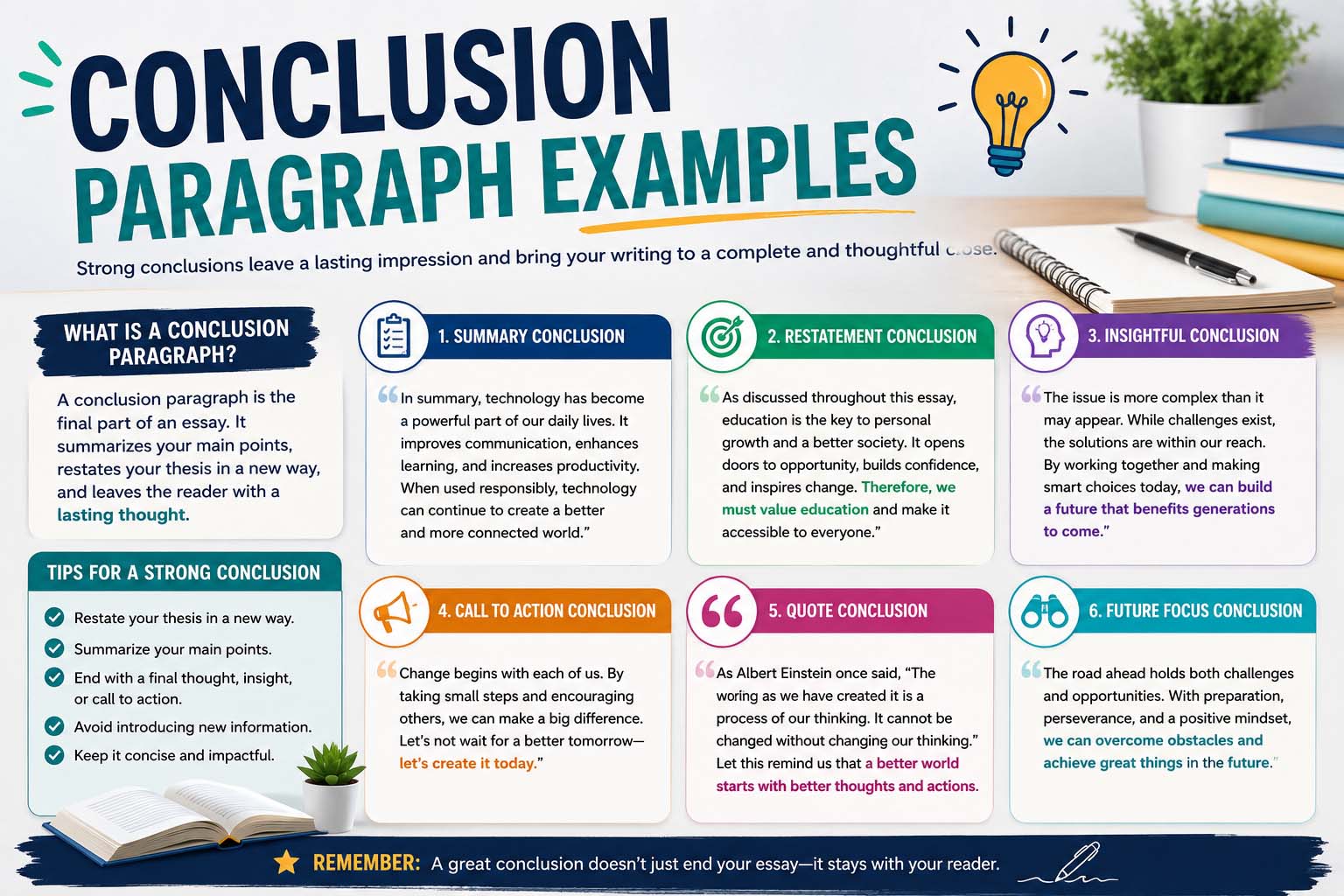
Conclusion Paragraph Examples: How to Write Strong Endings for Essays and Assignments
Conclusion paragraph examples can help students understand how to end an essay clearly without simply repeating the introduction. A strong conclusion reminds readers of the main idea, connects the most important points, and finishes with a meaningful closing thought.
Many students find introductions easier to write than endings. However, once you understand the basic structure of a concluding paragraph, writing one becomes much simpler.
This guide provides examples of concluding paragraphs for essays and assignments. In addition, you will learn how to structure a conclusion, write a strong closing sentence, avoid common mistakes, and adapt your ending to different types of writing.
What Is a Conclusion Paragraph?
A conclusion paragraph is the final section of an essay, article, report, or similar piece of writing. In simple terms, it brings the discussion to a clear and logical close.
Understanding the main message of a text is also useful when writing conclusions. Therefore, learning about the central idea can help students create clearer summaries and stronger endings.
A conclusion usually has three main purposes:
- Restate the main idea
- Summarize the most important points
- Bring the writing to a satisfying close
However, a conclusion should not simply copy sentences from the introduction. Instead, it should bring the ideas together in a fresh way.
Why Are Strong Concluding Paragraphs Important?
Your conclusion is one of the final parts readers remember. Therefore, a weak ending can make an otherwise strong essay feel unfinished.
A good concluding paragraph can:
- Reinforce your message
- Improve clarity
- Connect important ideas
- Show organization
- Leave a positive impression
- Strengthen the overall writing
For example, an essay may present excellent evidence throughout the body. However, if it suddenly stops without connecting those ideas, readers may feel that something is missing.
As a result, the conclusion provides an opportunity to show how the major points fit together.
Conclusion Paragraph Structure for Essays
Recognizing different writing patterns through text structure examples can help students understand how essays move from an introduction through body paragraphs to a conclusion.
Most concluding paragraphs can follow three basic steps.
| Step | Purpose |
|---|---|
| Restate the Main Idea | Remind readers of the central argument or message |
| Summarize Key Ideas | Briefly connect the strongest supporting points |
| End with a Final Thought | Leave readers with something meaningful to remember |
First, return to the central idea of the essay. Next, connect the main supporting points. Finally, finish with a sentence that gives readers a sense of completion.
As a result, even a short conclusion can feel organized and purposeful.
Conclusion Paragraph Examples for Essays
The following conclusion paragraph examples show how different topics can be brought to a natural close. Instead of copying them directly, pay attention to how each example restates the topic, connects important ideas, and provides a final thought.
Example 1: School Uniform Essay
School uniforms can help create a more focused learning environment by reducing distractions and encouraging equality among students. Although opinions about uniforms may differ, clear policies can promote school pride while keeping attention on education. Therefore, schools that balance consistency with reasonable individual choice can create a more positive learning environment.
Example 2: Healthy Eating Essay
Healthy eating supports both physical and mental well-being. By choosing nutritious foods regularly, people can improve energy levels, support healthy development, and build better long-term habits. As a result, even small improvements in everyday food choices can contribute to a healthier lifestyle.
Example 3: Technology Essay
Technology has transformed how people learn, communicate, and work. When used responsibly, it can provide valuable opportunities for education, creativity, and problem-solving. However, maintaining a healthy balance between technology and offline activities can help people benefit from digital tools without allowing them to dominate everyday life.
Example 4: Environmental Essay
Protecting the environment requires both individual responsibility and broader community action. Reducing waste, conserving resources, and making thoughtful everyday choices can all contribute to environmental protection. Therefore, consistent small actions can become meaningful when many people participate.
Good Concluding Paragraph Examples
Students often review conclusion paragraph examples because they want endings that sound natural rather than repetitive. Therefore, it helps to compare conclusions from several types of essays.
Reading Essay Example
Reading regularly can improve vocabulary, strengthen critical thinking, and encourage lifelong learning. Although developing a reading habit requires consistency, even a small amount of daily reading can provide meaningful benefits. As a result, making time for books can support both academic success and personal growth.
Exercise Essay Example
Regular exercise supports physical fitness while also encouraging healthier daily habits. Whether someone chooses walking, cycling, swimming, or another activity, consistency matters more than choosing a complicated routine. Therefore, finding an enjoyable form of exercise can make an active lifestyle easier to maintain.
Education Essay Example
Education provides more than academic knowledge. It can also develop communication, problem-solving, and independent thinking skills. For this reason, meaningful learning can prepare students not only for examinations but also for future responsibilities and opportunities.
Notice that these examples summarize the central message without copying an introduction word for word.
How to Write a Concluding Paragraph Step by Step
Writing a strong ending becomes easier when you follow a clear process. In fact, you can use the same basic method for many essays and school assignments.
Step 1: Restate Your Main Idea
First, return to your thesis or central message.
However, do not copy the original sentence. Instead, express the same idea in different words.
For example:
Original thesis: Regular reading helps students improve important academic skills.
Restated idea: Developing a consistent reading habit can strengthen several skills that support academic success.
The meaning remains similar, but the wording feels fresh.
Step 2: Connect Your Main Points
Next, briefly connect the strongest ideas discussed in the essay.
You do not need to repeat every example or detail. Instead, show readers how the major points support the central message.
For instance, if an essay discusses exercise, nutrition, and sleep, the conclusion can connect all three to the broader idea of maintaining a healthy lifestyle.
Step 3: Write a Strong Closing Thought
Finally, give readers a clear sense that the discussion is complete.
Depending on the assignment, you might end with:
- A recommendation
- A lesson
- A prediction
- A reflection
- A broader implication
- A thoughtful call to action
However, avoid introducing an entirely new argument at this stage.
Conclusion Sentence Examples for Strong Endings
Sometimes students have already written most of the conclusion but struggle with the last sentence. Therefore, reviewing closing sentence examples can provide useful inspiration.
Consider these examples:
- Every small effort can make a positive difference.
- As a result, today’s choices can influence future opportunities.
- With careful planning, difficult goals can become more manageable.
- Therefore, understanding this issue can lead to better decisions.
- In the end, meaningful change often begins with consistent action.
- For these reasons, the topic deserves continued attention.
- By making informed choices today, people can create better outcomes tomorrow.
However, the final sentence should always fit the topic and tone of your assignment. A serious academic essay, for example, usually needs a different ending from a personal narrative.
Paragraph Conclusion Examples
Body paragraphs also benefit from effective closing sentences. In this case, the final sentence usually reinforces the paragraph’s main point while creating a smooth connection to the next idea.
Science Paragraph Example
Regular physical activity can improve endurance, strength, and overall fitness. Therefore, consistent exercise plays an important role in supporting physical health.
History Paragraph Example
The event changed political relationships and influenced decisions made in later years. As a result, its effects continued long after the event itself had ended.
Literature Paragraph Example
The author’s use of symbolism reveals ideas that are not stated directly. Consequently, these details help readers better understand the story’s central message.
Opinion Paragraph Example
Recycling can reduce waste while encouraging more responsible use of resources. For these reasons, community recycling programs can support broader environmental goals.
Each example closes the paragraph while reinforcing its central point.
Examples of Conclusion Paragraphs for Different Assignments
Different assignments require different conclusion paragraph examples and approaches. Therefore, the tone and structure of your conclusion should match the purpose of the writing.
For persuasive writing, reviewing argumentative essay examples can also help students understand how claims, evidence, and concluding statements work together.
Narrative Essay Conclusion Example
Although the trip did not go exactly as planned, it became one of my most memorable experiences. Along the way, I learned the value of staying calm and adapting when unexpected problems appear. Looking back, the difficulties made the experience more meaningful because they taught me lessons I could not have learned from a perfect journey.
Informative Essay Conclusion Example
Renewable energy technologies offer different ways to generate power while reducing dependence on limited resources. As these technologies continue to develop, their role in energy production may continue to grow. Therefore, understanding their advantages and limitations can help people make more informed decisions about future energy choices.
Persuasive Essay Conclusion Example
Local parks provide space for recreation while also supporting plants, wildlife, and community activities. However, these areas require protection and responsible use. By supporting conservation efforts today, communities can help preserve valuable public spaces for future generations.
Compare-and-Contrast Essay Conclusion Example
Online and traditional classroom learning both provide valuable educational opportunities, although each offers different advantages. Online courses can provide flexibility, while classroom learning can offer more direct interaction. Therefore, the better option often depends on a student’s learning style, schedule, and individual needs.
Research Assignment Conclusion Example
Research can reveal both the complexity of a topic and the relationships among different pieces of evidence. By reviewing reliable information and comparing different perspectives, students can develop a clearer understanding of the subject. As a result, a well-organized research assignment should leave readers with a focused summary of what the evidence shows.
What Does a Good Conclusion Paragraph Look Like?
A good conclusion paragraph usually feels connected to the rest of the essay. In other words, readers should recognize the main argument while also seeing that the discussion has reached a natural ending.
For example, a strong conclusion often:
- Returns to the thesis without copying it
- Connects the most important ideas
- Avoids unnecessary details
- Matches the tone of the essay
- Ends with a purposeful sentence
In contrast, a weak conclusion may suddenly stop, repeat the introduction exactly, or introduce a completely different argument.
Therefore, when revising your ending, ask whether it gives the reader a genuine sense of completion.
Common Conclusion Paragraph Mistakes to Avoid
Even a good essay can lose strength because of a poorly written ending. Fortunately, several common problems are easy to correct.
Repeating the Introduction Word for Word
First, avoid copying your thesis exactly.
Instead, restate the central idea using fresh wording. As a result, the conclusion reinforces your message without sounding repetitive.
Adding New Evidence
A conclusion should bring existing ideas together rather than introduce major new evidence.
Therefore, important facts, examples, quotations, or arguments should normally appear in the body of the essay.
Ending Too Suddenly
A sudden ending can make an assignment feel incomplete.
Instead, connect your main points and provide a final thought before finishing.
Using Weak Closing Phrases
Avoid phrases such as “That’s all” or “The end.”
Instead, finish with a sentence that reinforces the message and gives readers something meaningful to remember.
Making the Conclusion Too Long
A conclusion should summarize and connect rather than repeat the entire essay.
Therefore, keep it focused on the information readers most need to remember.
Transition Words for Concluding Paragraphs
Transition words can help connect ideas naturally. However, they should fit the meaning of the sentence rather than appear simply because the paragraph is ending.
Useful options include:
- Overall
- As a result
- Therefore
- For this reason
- In the end
- Looking back
- Consequently
- With these ideas in mind
- Taking everything into account
For example, “As a result” works well when the final sentence explains an outcome. In contrast, “Looking back” may work better in a reflective or narrative conclusion.
Therefore, choose transitions according to the relationship between ideas.
Conclusion Paragraph Template
Students who struggle to begin a conclusion can use a simple framework. However, the wording should always be adapted to the actual assignment.
Restate the main idea:
[Topic] remains important because [reworded central point].
Connect the supporting ideas:
By considering [point one] and [point two], it becomes clear that [connection].
Final thought:
Therefore, [meaningful recommendation, reflection, implication, or closing idea].
For example:
Regular reading remains valuable because it supports several important learning skills. By improving vocabulary and encouraging critical thinking, reading can strengthen both classroom performance and independent learning. Therefore, making reading part of a daily routine can provide benefits that continue beyond school.
Sample Conclusion Paragraph Format
Another useful approach is to think of the conclusion as moving from specific ideas back to the broader message.
A simple format is:
- Restate the thesis in new words.
- Connect two or three important supporting points.
- Explain why those ideas matter.
- Finish with a meaningful closing sentence.
For example, suppose an essay discusses the benefits of public libraries. First, the conclusion could restate the importance of libraries. Next, it could connect access to books, educational resources, and community services. Finally, it could explain why maintaining accessible libraries benefits communities.
As a result, the conclusion does more than summarize—it shows why the discussion matters.
Quick Checklist for Writing Better Conclusions
Students can improve their preparation process by learning how to make a study guide that organizes writing concepts, examples, and revision tips in one place.
After reviewing conclusion paragraph examples, use this checklist before submitting an assignment:
- Did I restate the main idea?
- Did I connect my strongest points?
- Did I avoid introducing a new argument?
- Does the ending match the essay’s tone?
- Does my final sentence feel complete?
- Did I avoid copying the introduction?
- Is the conclusion focused rather than repetitive?
If the answer to each question is yes, the conclusion is likely doing its job effectively.
Tips for Writing Strong Conclusion Paragraphs
Strong conclusions usually come from careful revision rather than complicated techniques. Therefore, focus on clarity before trying to make the ending sound impressive.
First, keep the conclusion focused on the main topic. Next, use your own words rather than repeating sentences from earlier sections.
In addition, read the ending aloud. If it sounds abrupt or repetitive, revise the transition between sentences.
Finally, compare the conclusion with the introduction. The two sections should clearly discuss the same central idea, but they should not sound identical.
For additional academic writing guidance, students can review the Purdue OWL guide to conclusions.
Conclusion Paragraph Examples: Frequently Asked Questions
What is a conclusion paragraph?
A conclusion paragraph is the final section of a piece of writing. It usually restates the central idea, connects important points, and gives readers a clear sense that the discussion has ended.
How do you start a conclusion paragraph?
First, return to the essay’s main idea without copying the thesis word for word. Then, use wording that naturally connects the central argument with the most important supporting points.
How long should a conclusion paragraph be?
The appropriate length depends on the assignment. However, many shorter school essays can use a concise conclusion of several sentences, while longer papers may require a more developed ending.
What makes a good concluding paragraph?
A good concluding paragraph reinforces the central idea, connects the main points, avoids introducing unrelated evidence, and finishes with a purposeful final thought.
What should you avoid in a conclusion paragraph?
Avoid copying the introduction exactly, adding major new arguments, repeating every detail from the body, or ending suddenly. Instead, focus on bringing the existing discussion together.
Can I use the same conclusion for every essay?
No. Each conclusion should reflect the specific topic, argument, purpose, and tone of the assignment. Therefore, templates should serve as frameworks rather than text to copy exactly.
What is an example of a conclusion paragraph?
For an essay about reading, an example could be:
Reading regularly can strengthen vocabulary, comprehension, and critical thinking. Although developing a reading habit takes consistency, even a short period of daily reading can support long-term learning. Therefore, making time for reading can benefit students both inside and outside the classroom.
How do I write a closing paragraph?
First, restate the main idea in fresh language. Next, connect the most important supporting points. Finally, finish with a sentence that explains the significance of the topic or leaves readers with a clear final thought.
Write Stronger Conclusions with Practice
Reviewing conclusion paragraph examples is useful because it shows how effective endings work in different situations. However, the best way to improve is to practice writing your own conclusions and revise them until they sound clear and natural.
First, return to your main idea. Next, connect your strongest supporting points. Finally, end with a thoughtful sentence that fits the purpose of the assignment.
As a result, your essay will feel complete rather than unfinished. More importantly, readers will finish with a clear understanding of the message you wanted them to remember.