
Text Structure Examples
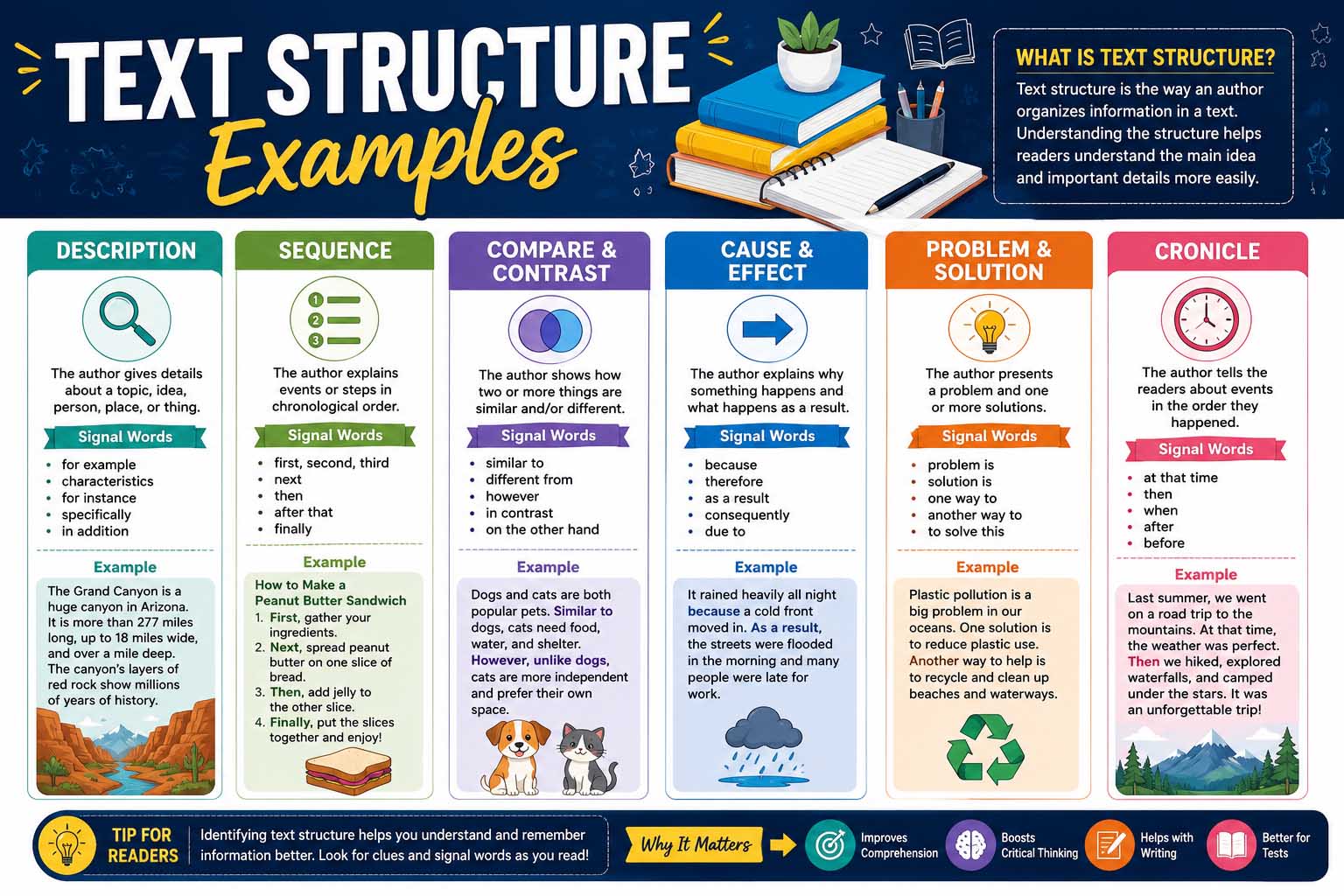
Text Structure Examples
Have you ever read two passages about the same topic but noticed they were organized completely differently? One might tell events in order, while another compares two ideas or explains why something happened. That’s because writers use different text structures to organize information.
Learning text structure examples helps students understand reading passages more quickly and write clearer essays, reports, and assignments. Once you recognize a text structure, you can predict how information will be presented and identify the author’s main idea more easily.
This guide explains the most common text structures, provides simple examples, and shares study tips that can improve reading comprehension and writing skills.
What Is Text Structure?
Understanding text structure also helps readers identify what is a central idea because the organization of information often reveals the author’s main message.
Text structure is the way an author organizes ideas in a piece of writing.
Instead of placing information randomly, writers arrange details in a logical pattern that helps readers understand the topic.
Each structure has its own purpose. Some explain events in order, while others compare ideas, describe something, or explain causes and effects.
Students often begin learning text structures in elementary school and continue using them throughout middle school, high school, and college.
Quick Reference Table
| Text Structure | Purpose | Signal Words |
|---|---|---|
| Description | Explains a topic with details | for example, such as, includes |
| Sequence | Shows events in order | first, next, then, finally |
| Compare and Contrast | Shows similarities and differences | both, however, unlike, similarly |
| Cause and Effect | Explains why something happened | because, therefore, as a result |
| Problem and Solution | Presents an issue and its answer | problem, solution, solve, improve |
Learning these five structures makes reading much easier.
Examples of Text Structure
Students searching for examples of text structure usually want to see how each pattern looks in real writing.
Here are the most common types.
Description
A descriptive structure tells readers about a person, place, object, or idea using details.
The goal is to paint a clear picture.
Example
“The rainforest is home to thousands of plant and animal species. Tall trees block much of the sunlight, while colorful birds, insects, and mammals live throughout the forest.”
The paragraph focuses on describing one topic with supporting details.
Common Signal Words
- such as
- for example
- includes
- consists of
- characteristics
- features
Sequence or Chronological Order
Sequence explains events or steps in the order they happen.
This structure appears in:
- Instructions
- Recipes
- Science experiments
- Historical events
- Procedures
Example
“First, gather all of the materials. Next, mix the ingredients together. Then pour the mixture into the container. Finally, allow it to cool.”
The order matters because each step follows the previous one.
Signal Words
- first
- next
- after
- before
- finally
- last
Compare and Contrast
This structure explains how two or more things are alike or different.
Example
“Dogs and cats both make excellent pets. Dogs usually enjoy outdoor activities, while cats often prefer independent indoor lifestyles.”
The paragraph compares similarities and differences.
Helpful Signal Words
- both
- unlike
- similarly
- however
- although
- on the other hand
Cause and Effect
Cause and effect explains why something happens and what happens afterward.
Example
“Heavy rainfall caused the river to overflow. As a result, nearby roads were temporarily closed.”
The rainfall is the cause.
The road closure is the effect.
Common Signal Words
- because
- since
- therefore
- as a result
- due to
- consequently
Problem and Solution
This structure introduces a problem and then explains one or more ways to fix it.
Example
“Many students struggled to remember vocabulary words. Their teacher introduced daily review games, which helped improve test scores.”
The first sentence presents the problem.
The second sentence explains the solution.
Signal Words
- problem
- solution
- solve
- answer
- improve
- resolve
Description Text Structure Examples
Many students specifically search for description text structure examples because descriptive writing appears in many reading assignments.
Here are a few simple examples.
Example 1
“The library is a peaceful space lined with neatly arranged bookshelves, cozy seating areas, spacious study desks, and wide windows that fill the room with warm natural light, creating an inviting environment for reading and learning.”
Example 2
“A butterfly has colorful wings covered in tiny scales. Its long antennae help it sense the environment while its wings allow graceful flight.”
Example 3
“The mountain peak remained covered in snow throughout the year. Tall pine trees surrounded the base, and clear streams flowed down its rocky slopes.”
Each paragraph focuses on describing one subject rather than telling a story.
Descriptive Text Structure Examples
Students also search for descriptive text structure examples, which refers to the same writing pattern.
Notice how descriptive paragraphs answer questions like:
- What does it look like?
- What are its features?
- What makes it unique?
Example
“The old train station featured red brick walls, large wooden doors, antique clocks, and tall arched windows that reflected the afternoon sunlight.”
The reader gains a clear picture without events happening in sequence.
Text Structure Examples Sentences
Sometimes teachers ask students to identify text structures using individual sentences instead of full paragraphs.
These text structure examples sentences make good practice.
| Structure | Example Sentence |
|---|---|
| Description | “The elephant has thick gray skin, large ears, and a long trunk.” |
| Sequence | “First wash your hands, then prepare the ingredients.” |
| Compare and Contrast | “Basketball is faster than baseball, but both require teamwork.” |
| Cause and Effect | “The power went out because of the severe storm.” |
| Problem and Solution | “Traffic was heavy, so the city added another lane.” |
Reading short examples helps students recognize patterns more quickly.
How to Identify Text Structure
After identifying the structure of a passage, students can improve comprehension by reviewing central idea examples to understand how main messages connect with supporting details.
When reading a passage, follow these simple steps.
Step 1: Read the Entire Paragraph
Don’t stop after the first sentence.
The structure usually becomes clearer by the end.
Step 2: Look for Signal Words
Words like “because,” “first,” or “however” often reveal the organization.
Step 3: Find the Main Purpose
Ask yourself:
- Is the author describing something?
- Explaining steps?
- Comparing ideas?
- Showing causes?
- Solving a problem?
The answer often identifies the structure.
Step 4: Highlight Supporting Details
Notice how every supporting sentence connects to the main idea.
This makes the organizational pattern easier to recognize.
Why Text Structure Matters
Understanding text structures helps students:
- Read faster
- Improve comprehension
- Write organized essays
- Take better notes
- Prepare for standardized tests
- Answer reading questions more accurately
Many classroom assessments expect students to identify text structures before answering comprehension questions.
Using Text Structures in Your Own Writing
Students can also study argumentative essay examples to see how writers organize claims, evidence, and supporting ideas using effective text structures.
Good writers choose a structure before they begin writing.
For example:
Writing About an Animal
Choose Description.
Explaining a Science Experiment
Choose Sequence.
Comparing Two Countries
Choose Compare and Contrast.
Explaining Climate Change
Choose Cause and Effect.
Solving School Attendance Issues
Choose Problem and Solution.
Selecting the right structure makes writing easier to organize.
Study Tips for Learning Text Structures
Learning how information is organized can also help students write stronger endings by understanding how to create effective conclusion paragraph examples for different assignments.
Practice makes recognizing patterns much easier.
Try these study ideas.
Create Flashcards
Write one structure on the front.
Write signal words and examples on the back.
Color-Code Signal Words
Use different colors for:
- Sequence
- Comparison
- Cause
- Description
- Problem
Visual learners often remember colors well.
Read Short Articles
News stories, textbooks, and magazine articles often use clear organizational patterns.
Try identifying the structure before finishing the article.
Practice Writing
Write one paragraph using each structure.
This helps you understand how writers organize ideas.
Common Mistakes Students Make
Many students confuse different structures.
Here are a few common errors.
Mixing Description With Sequence
Descriptive writing explains details.
Sequence explains steps or events.
Confusing Cause and Effect With Problem and Solution
Cause and effect explains why something happened.
Problem and solution focuses on fixing an issue.
Looking at Only Signal Words
Signal words help, but they don’t always tell the whole story.
Always consider the author’s overall purpose.
Classroom Activities for Practice
Teachers often use engaging activities to reinforce text structures.
Popular activities include:
- Sorting paragraphs into categories
- Highlighting signal words
- Matching examples with structures
- Writing paragraphs from picture prompts
- Group reading discussions
- Graphic organizers
These exercises improve both reading and writing skills.
Quick Study Checklist
Before identifying a text structure, ask yourself:
- ✓ What is the author trying to do?
- ✓ Which signal words appear?
- ✓ Does the paragraph describe, compare, explain, or solve?
- ✓ Are events shown in order?
- ✓ Is there a cause and effect relationship?
- ✓ Is there a problem followed by a solution?
Checking these questions helps you identify the correct structure with greater confidence.
Frequently Asked Questions
What is text structure?
Text structure is the way an author organizes ideas to help readers understand information.
What are the five common text structures?
The five main text structures are description, sequence, compare and contrast, cause and effect, and problem and solution.
Why are text structures important?
They help readers understand information more easily and help writers organize ideas clearly.
How can I identify text structure?
Look for signal words, determine the author’s purpose, and notice how supporting details are organized.
Are signal words always enough?
No. Signal words provide clues, but you should also consider the overall meaning of the passage.
Do all reading passages use only one text structure?
Not always. Longer articles may combine several structures, though one is usually the main organizational pattern.
Key Takeaways
Learning text structure examples is one of the best ways to become a stronger reader and writer. Once you recognize patterns like description, sequence, compare and contrast, cause and effect, and problem and solution, reading becomes less confusing and writing becomes more organized.
Keep practicing with short passages, pay attention to signal words, and try writing your own paragraphs using each structure. The more examples you read, the easier it becomes to recognize how authors organize ideas across every subject.