
Types of Associate Degrees: A Complete Guide for Students
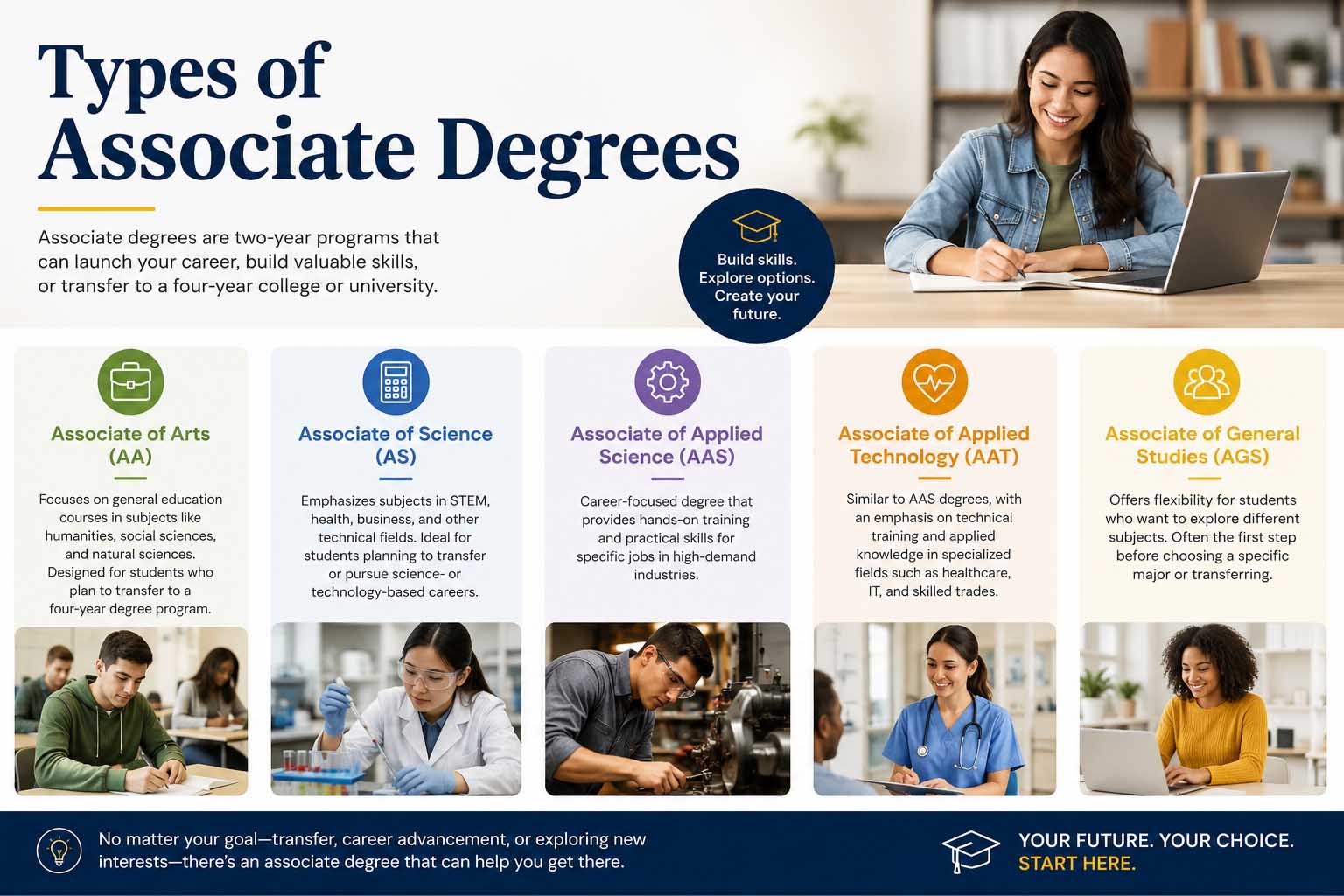
Types of Associate Degrees: A Complete Guide for Students
Many students begin their college journey by exploring the types of associate degrees available. An associate degree is one of the fastest ways to earn a college credential, build career skills, or prepare for a bachelor’s degree. Whether you’re planning to enter the workforce quickly or continue your education, understanding the available degree options helps you make a confident decision.
This guide explains the different types of associate degrees, what they focus on, who they’re designed for, and how each one can support your academic and career goals.
What Are Associate Degrees?
Students usually complete around 60 credit hours, although requirements vary by school and program.
Associate degrees combine general education courses with subject-specific classes, giving graduates practical knowledge and transferable academic skills.
Before choosing a program, it’s also helpful to understand the different types of colleges, since community colleges, technical colleges, and universities may offer different associate degree options.
Types of Associate Degrees Explained
There are several common types of associate degrees, each serving a different educational purpose.
The four most widely recognized are:
- Associate of Arts (AA)
- Associate of Science (AS)
- Associate of Applied Science (AAS)
- Associate of Applied Arts (AAA)
Some schools also offer specialized associate degrees based on regional education systems or industry needs.
Associate of Arts (AA)
The Associate of Arts focuses primarily on liberal arts, humanities, and social sciences.
Students typically study subjects such as:
- English
- History
- Psychology
- Sociology
- Communication
- Political science
The AA degree is designed mainly for students who plan to transfer into a bachelor’s degree program after graduation.
Many colleges accept a large portion of AA credits toward four-year degrees.
Associate of Science (AS)
The Associate of Science emphasizes mathematics, science, and technical coursework.
Popular study areas include:
- Biology
- Chemistry
- Physics
- Computer science
- Engineering
- Information technology
Students interested in STEM careers often begin with an AS before transferring to a university.
If you’re considering transferring later, learning the difference between college and university can help you understand how credits, campus experiences, and degree options may differ.
Associate of Applied Science (AAS)
The Associate of Applied Science prepares students for immediate employment.
Unlike the AA or AS, this degree focuses heavily on technical and career-specific skills.
Common AAS programs include:
- Nursing
- Cybersecurity
- Automotive technology
- Graphic design
- Welding
- Construction management
- Culinary arts
Although some AAS credits transfer, these programs are generally designed for students entering the workforce soon after graduation.
Associate of Applied Arts (AAA)
The Associate of Applied Arts combines creative education with practical career training.
Students may specialize in:
- Interior design
- Photography
- Digital media
- Advertising
- Animation
- Fashion design
These programs balance artistic development with workplace skills.
Different Types of Associate Degrees by Career Field
Students often choose programs based on future career interests rather than degree titles alone.
Some common fields include:
Business
Business associate degrees prepare students for careers in accounting, sales, marketing, customer service, and office management.
Many students searching for types of associate degrees in business find options such as:
- Business Administration
- Accounting
- Finance
- Human Resources
- Entrepreneurship
- Supply Chain Management
Graduates often continue into bachelor’s programs or begin entry-level business careers.
Healthcare
Healthcare remains one of the fastest-growing areas for associate degree graduates.
Popular programs include:
- Registered Nursing (RN)
- Dental Hygiene
- Respiratory Therapy
- Medical Laboratory Technology
- Radiologic Technology
Many healthcare careers require professional licensing after graduation.
Technology
Technology-focused associate degrees may include:
- Computer Programming
- Cybersecurity
- Network Administration
- Web Development
- Software Support
These programs combine classroom instruction with practical lab experience.
Skilled Trades
Trade-related associate degrees prepare students for hands-on careers in fields such as:
- Electrical Technology
- HVAC
- Industrial Maintenance
- Manufacturing
- Construction Technology
Many graduates begin working immediately after completing their programs.
What Types of Associate Degrees Are There?
Students frequently ask, what types of associate degrees are there because colleges offer many specialized programs.
While individual majors vary by institution, most associate degrees fall into one of these broad categories:
| Degree | Main Purpose | Best For |
|---|---|---|
| AA | University transfer | Liberal arts students |
| AS | STEM transfer | Science and technology majors |
| AAS | Career preparation | Workforce entry |
| AAA | Creative careers | Applied arts students |
Choosing the right degree depends more on your long-term goals than the degree title itself.
How Many Types of Associate Degrees Are There?
There isn’t one universal answer to how many types of associate degrees are there.
Most education systems recognize four primary categories, although some colleges offer additional specialized credentials or local degree titles.
Examples include:
- Associate of Fine Arts (AFA)
- Associate of Engineering (AE)
- Associate of Nursing (ADN)
- Associate of Occupational Studies (AOS)
The exact options depend on the country, institution, and academic system.
Benefits of Earning an Associate Degree
Associate degrees offer several advantages.
Faster Graduation
Most students complete an associate degree in approximately two years of full-time study.
This shorter timeline allows graduates to enter the workforce sooner than students pursuing four-year degrees.
Lower Tuition Costs
Community colleges generally charge lower tuition than universities.
Students can often reduce overall education expenses by completing general education courses before transferring.
Flexible Study Options
Many colleges provide:
- Evening classes
- Weekend programs
- Online learning
- Part-time enrollment
- Hybrid courses
These options help working adults and busy students continue their education.
Career Opportunities
Many employers value associate degrees because graduates have both academic knowledge and practical skills.
Healthcare, technology, manufacturing, and business industries regularly hire associate degree holders.
Can You Transfer to a Bachelor’s Degree?
Yes.
Many AA and AS degrees are specifically designed for transfer.
Students often complete their first two years at a community college before entering a university as juniors.
Some students even begin earning college credits earlier through What Is Dual Enrollment, allowing them to shorten the time needed to complete an associate degree.
Before enrolling, check whether your chosen college has transfer agreements with four-year institutions.
Financial Support for Associate Degree Students
Students have several ways to reduce education costs.
Common funding sources include:
- Scholarships
- Grants
- Student loans
- Employer tuition assistance
- Work-study programs
Many colleges also participate in What Is Work Study, which allows eligible students to earn money through part-time campus jobs while continuing their education.
Common Mistakes When Choosing an Associate Degree
Many students rush into selecting a program without enough research.
Some common mistakes include:
- Choosing a major based only on salary
- Ignoring transfer requirements
- Not researching career demand
- Overlooking internship opportunities
- Forgetting to compare accreditation
Taking time to compare programs can prevent costly changes later.
Career Pathways After Graduation
Graduates have several options.
Some immediately enter the workforce.
Others continue toward bachelor’s degrees in related fields.
After completing a bachelor’s degree, students may eventually pursue graduate education. Understanding What Is a Master’s Degree? can help you plan a long-term academic pathway if advanced study becomes one of your goals.
Career advancement often depends on experience, certifications, and continued education rather than degree level alone.
Tips for Choosing the Right Associate Degree
If you’re unsure where to begin, follow these steps:
- Identify your career interests.
- Decide whether you plan to transfer.
- Compare degree requirements.
- Research employment opportunities.
- Review tuition costs and financial aid.
- Speak with an academic advisor.
- Visit campus or attend virtual information sessions.
Making an informed decision now can save both time and money later.
Frequently Asked Questions
What are the main types of associate degrees?
The most common associate degrees are the Associate of Arts (AA), Associate of Science (AS), Associate of Applied Science (AAS), and Associate of Applied Arts (AAA).
What types of associate degrees are there for business?
Business students commonly choose programs in Business Administration, Accounting, Marketing, Finance, Human Resources, or Entrepreneurship.
How many types of associate degrees are there?
Most colleges recognize four primary associate degree categories, although some institutions offer additional specialized degrees such as Associate of Fine Arts or Associate of Engineering.
Can an associate degree lead to a bachelor’s degree?
Yes. Many AA and AS programs are specifically designed for transfer into bachelor’s degree programs at four-year colleges and universities.
Is an associate degree worth it?
For many students, yes. Associate degrees provide affordable education, career preparation, transfer opportunities, and faster entry into the workforce.
Choosing the Best Path for Your Education
Understanding the types of associate degrees makes it easier to choose a program that fits your academic plans and career goals. Whether you want to transfer to a university, gain technical skills, or start working as quickly as possible, there’s an associate degree designed for your needs. Take time to compare programs, research career outcomes, and speak with academic advisors before making your decision. A well-chosen associate degree can become the first step toward long-term educational and professional success.