
Types of Text Structures: A Complete Guide with Examples for Students
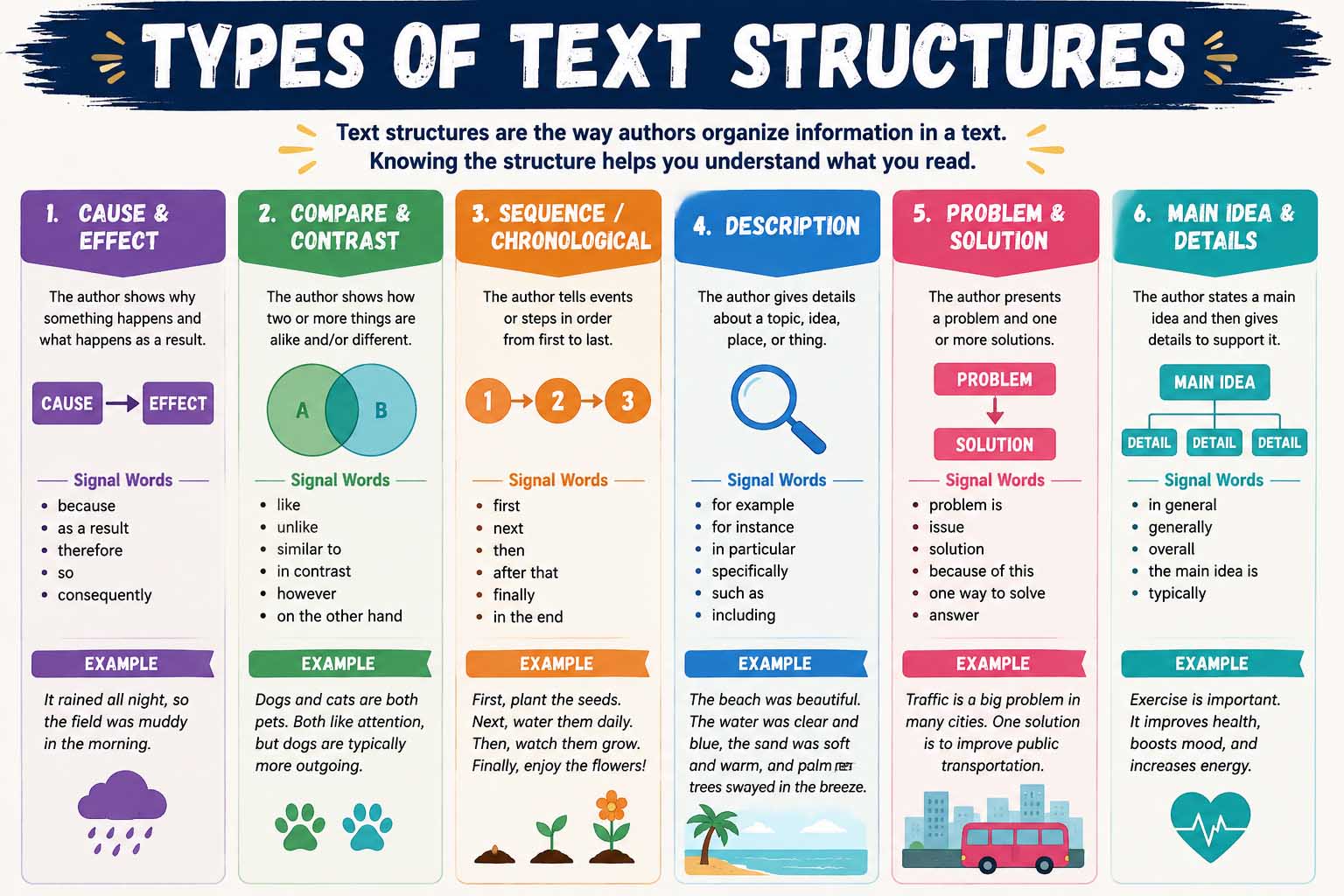
Types of Text Structures: A Complete Guide with Examples for Students
Have you ever finished reading a passage but struggled to understand how the author organized the information? Learning the types of text structures makes reading much easier because you begin to recognize patterns instead of treating every paragraph the same way. Once you know these organizational patterns, you’ll understand texts more quickly, answer comprehension questions with greater confidence, and become a stronger writer yourself.
Whether you’re in middle school, high school, college, or simply looking to improve your reading skills, understanding text structures is one of the most valuable literacy skills you can develop.
What Are Types of Text Structures?
Text structure refers to the way an author organizes ideas within a passage. Instead of presenting information randomly, writers arrange details in patterns that help readers follow the main message.
Each structure serves a different purpose. Some explain how events happen, while others compare ideas or describe causes and effects.
If you’re new to the topic, reviewing several Text Structure Examples can help you recognize these patterns more easily when reading nonfiction passages.
Why Text Structures Matter
Recognizing text structures helps students:
- Improve reading comprehension
- Identify key ideas faster
- Organize notes more effectively
- Write clearer essays
- Prepare for standardized tests
- Understand nonfiction texts
- Analyze informational writing
Rather than reading sentence by sentence, you begin looking for the overall pattern the author uses.
Different Types of Text Structures
Although schools sometimes teach five main structures, many educators include seven. If you’ve asked, what are the different types of text structures, this expanded list covers the most common organizational patterns.
| Text Structure | Purpose | Common Signal Words |
|---|---|---|
| Description | Explains characteristics | for example, such as, includes |
| Sequence | Shows order or steps | first, next, finally |
| Compare and Contrast | Shows similarities and differences | similarly, however, unlike |
| Cause and Effect | Explains reasons and results | because, therefore, as a result |
| Problem and Solution | Presents an issue and answer | problem, solution, resolve |
| Chronological Order | Organizes events by time | before, after, meanwhile |
| Question and Answer | Introduces a question then explains it | why, how, answer |
Let’s explore each one in more detail.
Types of Text Structures: Description
A descriptive text structure explains a topic by listing facts, characteristics, or features.
Example
Dogs are loyal animals. They can learn commands, assist people with disabilities, and provide companionship.
The passage doesn’t tell a story or compare ideas. Instead, it describes the subject.
Signal Words
Look for phrases such as:
- for example
- including
- consists of
- such as
- characteristics
- features
Sequence and Chronological Order
Both structures organize information in order.
Sequence usually explains steps in a process.
Chronological order focuses on events as they happen over time.
Example
- Mix the ingredients.
- Pour the batter into the pan.
- Bake for 30 minutes.
- Allow it to cool.
Each step follows the previous one.
Signal Words
- first
- next
- then
- finally
- afterward
- before
- later
Compare and Contrast
Authors use this structure when discussing similarities and differences between two or more subjects.
Example
Cats are generally more independent than dogs, while dogs often require more daily interaction. Both animals can become loving pets.
Signal Words
- similarly
- however
- unlike
- although
- both
- instead
- on the other hand
This structure frequently appears in science, history, and literature classes.
Cause and Effect
Cause-and-effect writing explains why something happens and what results from it.
Example
Heavy rainfall caused flooding, so several roads were temporarily closed.
Readers identify both the reason and the outcome.
Signal Words
- because
- since
- therefore
- consequently
- as a result
- due to
Problem and Solution
This structure presents an issue before offering one or more possible solutions.
Example
Plastic waste pollutes oceans. One solution is reducing single-use plastics while increasing recycling programs.
Many persuasive and informational articles use this format.
Signal Words
- problem
- challenge
- solution
- answer
- resolve
- improve
Question and Answer
Some educational materials organize information around questions students commonly ask.
Example
Why do leaves change color? Leaves lose chlorophyll during autumn, allowing other pigments to become visible.
This structure works well in textbooks, FAQs, and educational websites.
What Are the 7 Types of Text Structures?
Students often ask, what are the 7 types of text structures?
The seven commonly taught structures are:
- Description
- Sequence
- Chronological Order
- Compare and Contrast
- Cause and Effect
- Problem and Solution
- Question and Answer
Some classrooms combine sequence and chronological order into one category, resulting in five primary text structures instead of seven.
How to Identify Text Structures
Recognizing organization becomes easier with practice.
Follow these steps whenever you read.
Step 1: Read the Entire Passage
Avoid identifying the structure after only one sentence.
The full paragraph usually reveals the author’s organizational pattern.
Step 2: Look for Signal Words
Certain transition words provide strong clues.
For example:
- because → Cause and Effect
- first → Sequence
- however → Compare and Contrast
Signal words aren’t perfect, but they often point you in the right direction.
Step 3: Ask What the Author Is Trying to Do
Consider questions like:
- Is the author explaining?
- Comparing?
- Solving a problem?
- Describing events?
- Listing characteristics?
The purpose usually identifies the structure.
Step 4: Identify the Main Idea
Understanding What Is a Central Idea helps students distinguish between the author’s primary message and the organizational pattern used to present it.
The structure supports the central idea, but the two are not the same.
Text Structures and Writing Skills
Learning text structures doesn’t just improve reading.
It also strengthens writing.
Different types of writing often rely on different organizational patterns.
For example:
- Informational essays frequently use description.
- Process writing relies on sequence.
- Persuasive essays often follow a problem-and-solution structure.
- Scientific reports commonly explain cause and effect.
Strong writers choose the structure that best supports their purpose.
Classroom Activities for Learning Text Structures
Teachers often use interactive activities to reinforce these concepts.
Popular classroom exercises include:
- Matching passages to structures
- Highlighting signal words
- Organizing scrambled paragraphs
- Creating graphic organizers
- Writing examples using each structure
Practicing with short passages before reading longer texts builds confidence.
Common Mistakes Students Make
Many students confuse similar structures.
Watch for these common errors:
- Mixing sequence with chronological order
- Assuming every passage has only one structure
- Focusing only on signal words
- Ignoring the author’s overall purpose
- Confusing the main idea with organization
Reading the complete passage before deciding helps avoid these mistakes.
How Text Structures Support Reading Comprehension
Recognizing patterns allows readers to predict what comes next.
Instead of processing isolated facts, your brain organizes information more efficiently.
For example:
- Description encourages you to identify characteristics.
- Cause and effect prepares you to connect events.
- Compare and contrast encourages you to notice similarities and differences.
These patterns make complex texts much easier to understand.
When analyzing informational passages, reviewing Central Idea Examples alongside text structure practice can strengthen your ability to identify both the author’s message and how it is organized.
Text Structures and Evidence
Understanding organization also improves writing assignments.
When supporting your own arguments, selecting appropriate types of evidence in writing becomes easier because you understand how authors naturally organize facts, examples, statistics, and explanations.
Strong organization and strong evidence work together.
Study Tips for Mastering Text Structures
If you’re preparing for exams, these strategies can help.
- Learn the seven structures one at a time.
- Memorize common signal words.
- Practice with nonfiction articles.
- Create your own examples.
- Use graphic organizers.
- Highlight transitions while reading.
- Explain the structure aloud after finishing a passage.
Regular practice helps these patterns become automatic.
Frequently Asked Questions
What are text structures?
Text structures are the organizational patterns authors use to arrange information within a passage.
What are the 7 types of text structures?
The seven common structures are description, sequence, chronological order, compare and contrast, cause and effect, problem and solution, and question and answer.
Why are text structures important?
They improve reading comprehension, note-taking, writing, and critical thinking by helping readers understand how ideas connect.
Can one passage contain more than one text structure?
Yes. Longer passages often combine multiple structures, although one usually serves as the primary organizational pattern.
How can I identify text structures quickly?
Read the full passage, look for signal words, identify the author’s purpose, and determine how the ideas are organized.
Make Text Structures Part of Every Reading Session
Learning the types of text structures is one of the simplest ways to become a stronger reader and writer. Once you recognize how authors organize information, you’ll understand nonfiction texts more quickly, write more organized assignments, and approach classroom reading with greater confidence.
The next time you read an article, textbook chapter, or essay, pause for a moment and identify its structure before focusing on the details. With regular practice, recognizing these patterns will become second nature and make every reading task a little easier.