
Difference Between Metaphor and Simile: A Simple Guide for Students
Difference Between Metaphor and Simile: A Simple Guide for Students
Have you ever read a sentence like “Her smile was sunshine” or “Her smile was like sunshine” and wondered why they sound similar but aren’t exactly the same? Understanding the difference between metaphor and simile is one of the first steps toward mastering figurative language.
Both literary devices make writing more interesting by comparing two different things. Yet they do so in different ways. Once you understand how each one works, you’ll find it much easier to recognize them in books, poems, speeches, and even everyday conversations.
If you’re a student preparing for exams, a teacher explaining literary devices, or simply someone who enjoys learning English, this guide will help you understand the concepts through clear explanations and practical examples.
Difference Between Metaphor and Simile Explained
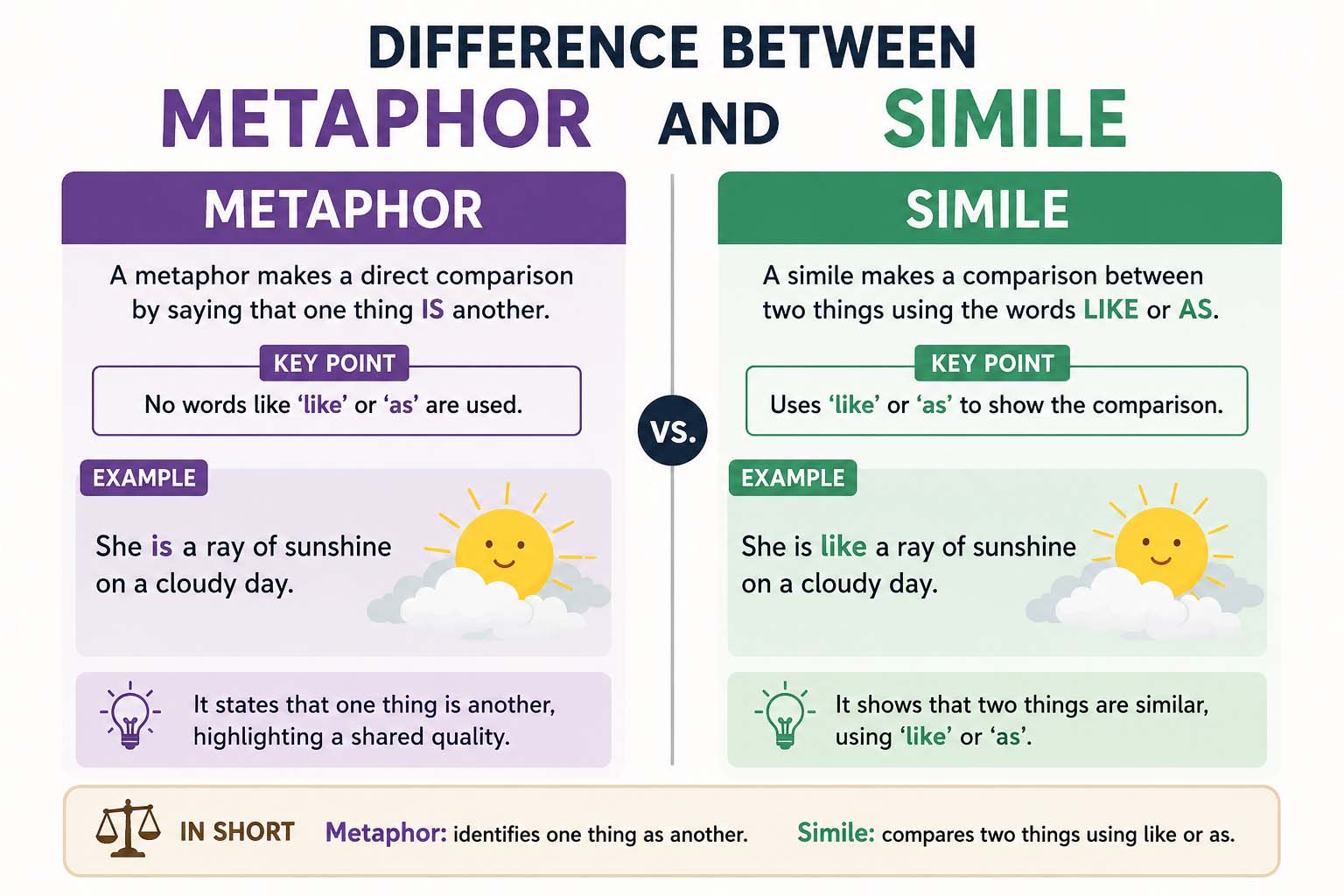
The easiest way to understand the difference between metaphor and simile is to remember one simple rule:
- A simile compares two things using the words “like” or “as.”
- A metaphor compares two things by saying one thing is another without using “like” or “as.”
Both belong to the broader topic of What Is Figurative Language, which includes many creative writing techniques that go beyond the literal meaning of words.
Although both create vivid images, they do it differently.
| Feature | Simile | Metaphor |
|---|---|---|
| Uses “like” or “as” | Yes | No |
| Makes a direct comparison | No | Yes |
| Creates imagery | Yes | Yes |
| Common in poetry | Yes | Yes |
| Easy for beginners to recognize | Usually | Sometimes |
This simple distinction answers one of the most common student questions: what is the difference between a simile and a metaphor?
What Is a Simile?
The comparison helps readers picture an idea more clearly.
Simile Examples
- She sings like a bird.
- The baby slept like a log.
- His hands were as cold as ice.
- The classroom was as quiet as a library.
- The runner was as fast as lightning.
Notice how each example includes like or as.
These comparison words signal that the sentence is using a simile rather than a metaphor.
What Is a Metaphor?
A metaphor also compares two unlike things, but it does not use like or as.
Instead, it states that one thing actually is another to create a stronger image.
Metaphor Examples
- Time is money.
- The classroom was a zoo.
- Her voice was music.
- My brother is a rock.
- Life is a journey.
No one believes these statements are literally true. Instead, the comparison helps readers understand the qualities of the subject.
If you’d like more practice identifying metaphors in everyday writing, the article Metaphor in a Sentence provides many useful examples.
Difference Between a Simile and a Metaphor (With Examples)
Many students understand the definitions but still confuse the two when reading.
Here’s a side-by-side comparison.
| Simile | Metaphor |
| He runs like the wind. | He is the wind. |
| Her eyes shine like stars. | Her eyes are stars. |
| She is as brave as a lion. | She is a lion in battle. |
| The blanket felt like silk. | The blanket was silk against my skin. |
Notice that both sentences express nearly the same idea.
The main difference is the wording.
A simile gently suggests a comparison, while a metaphor presents it more directly.
Why Writers Use Similes and Metaphors
Authors use these literary devices because plain descriptions are sometimes less memorable.
Instead of saying someone is very brave, a writer might compare that person to a lion.
Instead of saying water is calm, the writer might compare it to glass.
These comparisons help readers:
- Create vivid mental images
- Understand emotions more easily
- Remember ideas longer
- Enjoy stories and poems
- Connect with the writer’s message
As a result, both similes and metaphors make writing more engaging.
Step-by-Step: How to Tell Them Apart
If you’re unsure which device you’re reading, follow these simple steps.
Step 1: Look for “Like” or “As”
If the comparison uses like or as, it’s probably a simile.
Example:
“The clouds looked like cotton.”
Step 2: Check Whether One Thing Is Called Another
If the sentence says one thing is another, it’s usually a metaphor.
Example:
“The clouds were cotton floating across the sky.”
Step 3: Think About the Meaning
Ask yourself whether the writer is making a literal statement.
If not, the sentence is probably using figurative language.
Step 4: Identify the Comparison
Find the two things being compared.
For example:
- Her smile → sunshine
- The child → monkey
- Life → journey
Once you identify both parts of the comparison, deciding whether it’s a metaphor or simile becomes much easier.
Common Classroom Examples
Teachers often use familiar examples because they clearly show the difference between a simile and a metaphor.
Example 1
Simile: The snow was like a white blanket.
Metaphor: The snow was a white blanket covering the ground.
Example 2
Simile: He fought like a tiger.
Metaphor: He was a tiger on the battlefield.
Example 3
Simile: The cake was as soft as a cloud.
Metaphor: The cake was a cloud of sweetness.
These examples show that both comparisons express similar ideas but use different sentence structures.
Common Mistakes Students Make
Learning figurative language takes practice. Here are mistakes many beginners make.
Thinking Every Comparison Is a Simile
Not every comparison uses “like” or “as.”
If those words are missing, check whether the sentence is actually a metaphor.
Taking Metaphors Literally
A metaphor is not meant to be factual.
When someone says, “My teacher is a walking encyclopedia,” they mean the teacher is very knowledgeable—not actually a book.
Ignoring Context
Sometimes the same words can have literal meanings.
“The blanket is soft like cotton.”
This sentence compares two real objects, but it’s still a simile because of the word “like.”
Reading the entire sentence helps avoid confusion.
Practice Exercise
See if you can identify each sentence.
| Sentence | Simile or Metaphor? |
| The moon was a silver coin. | Metaphor |
| She floated like a feather. | Simile |
| His heart was stone. | Metaphor |
| The puppy was as playful as a child. | Simile |
| The city was a giant machine. | Metaphor |
Try creating your own examples after completing this exercise. Writing your own comparisons is one of the fastest ways to remember the difference.
How These Literary Devices Improve Writing
Students often ask why they need to learn metaphors and similes.
The answer is simple: they make writing stronger.
Instead of writing:
“The garden was beautiful.”
You could write:
“The garden was a rainbow of flowers.”
Or:
“The garden looked like a colorful painting.”
Both versions create clearer pictures for readers.
These techniques also improve:
- Creative writing
- Storytelling
- Poetry
- Speeches
- Personal essays
- Reading comprehension
When studying reading passages, you may also encounter figurative language while identifying themes. Skills learned in Central Idea Examples often work together with literary analysis because understanding comparisons helps reveal an author’s main message.
Simile vs. Metaphor: A Quick Study Guide
Before a quiz or exam, review this checklist.
Remember This
Similes use like or as
Metaphors do not
Both create imagery
Metaphors sound stronger because they make direct comparisons
Keeping these points in mind will help you answer most classroom questions correctly.
Why This Topic Appears in School Exams
Teachers include questions about metaphors and similes because these devices appear in many kinds of writing.
You’ll find them in:
- Poems
- Short stories
- Novels
- Speeches
- Song lyrics
- Historical writing
- Creative essays
Understanding figurative language also improves reading comprehension.
For example, if a passage says, “The classroom was a volcano,” recognizing it as a metaphor helps you understand that the classroom was noisy or chaotic rather than literally erupting.
Difference Between Simile and Metaphor: Frequently Asked Questions
Which is easier to identify?
Similes are usually easier because they include the words like or as.
Can a sentence contain both?
Yes. Skilled writers sometimes use both in the same paragraph to create stronger imagery.
Are metaphors stronger than similes?
Many readers feel metaphors create a stronger effect because they make direct comparisons. Even so, both are effective when used appropriately.
Why do authors use figurative language?
Figurative language helps readers visualize ideas, understand emotions, and remember important details.
Is every metaphor symbolic?
Not always. Some metaphors simply describe something more vividly without carrying a deeper symbolic meaning.
How can I remember the difference?
Think of this memory trick:
- Simile = Similar = Uses “like” or “as.”
- Metaphor = Makes one thing become another.
This simple rule works in most situations.
Build Confidence Through Practice
The difference between a metaphor and a simile becomes much easier once you practice spotting comparisons in everyday reading. Look for examples in novels, poems, newspapers, advertisements, and even conversations. Then try writing your own sentences using both devices.
You can also strengthen your understanding by identifying the main message of passages. Resources such as Central Idea Examples often include literary texts where figurative language supports the author’s overall purpose.
The more examples you read and write, the more natural these literary devices will become. Before long, you’ll be able to recognize them instantly and use them confidently in your own writing.