
Difference Between Charter and Public School: A Complete Guide for Students and Parents
Difference Between Charter and Public School: A Complete Guide for Students and Parents
Choosing the right school can feel overwhelming, especially when you’re comparing different education options. One of the most common questions parents ask is about the difference between charter and public school. While both provide free education funded by taxpayers, they operate in different ways and often offer different learning experiences.
Understanding these differences can help families make informed decisions based on a child’s learning style, academic goals, and personal interests. This guide explains how charter schools and public schools compare, what they have in common, and what factors you should consider before enrolling.
What Is the Difference Between Charter and Public School?
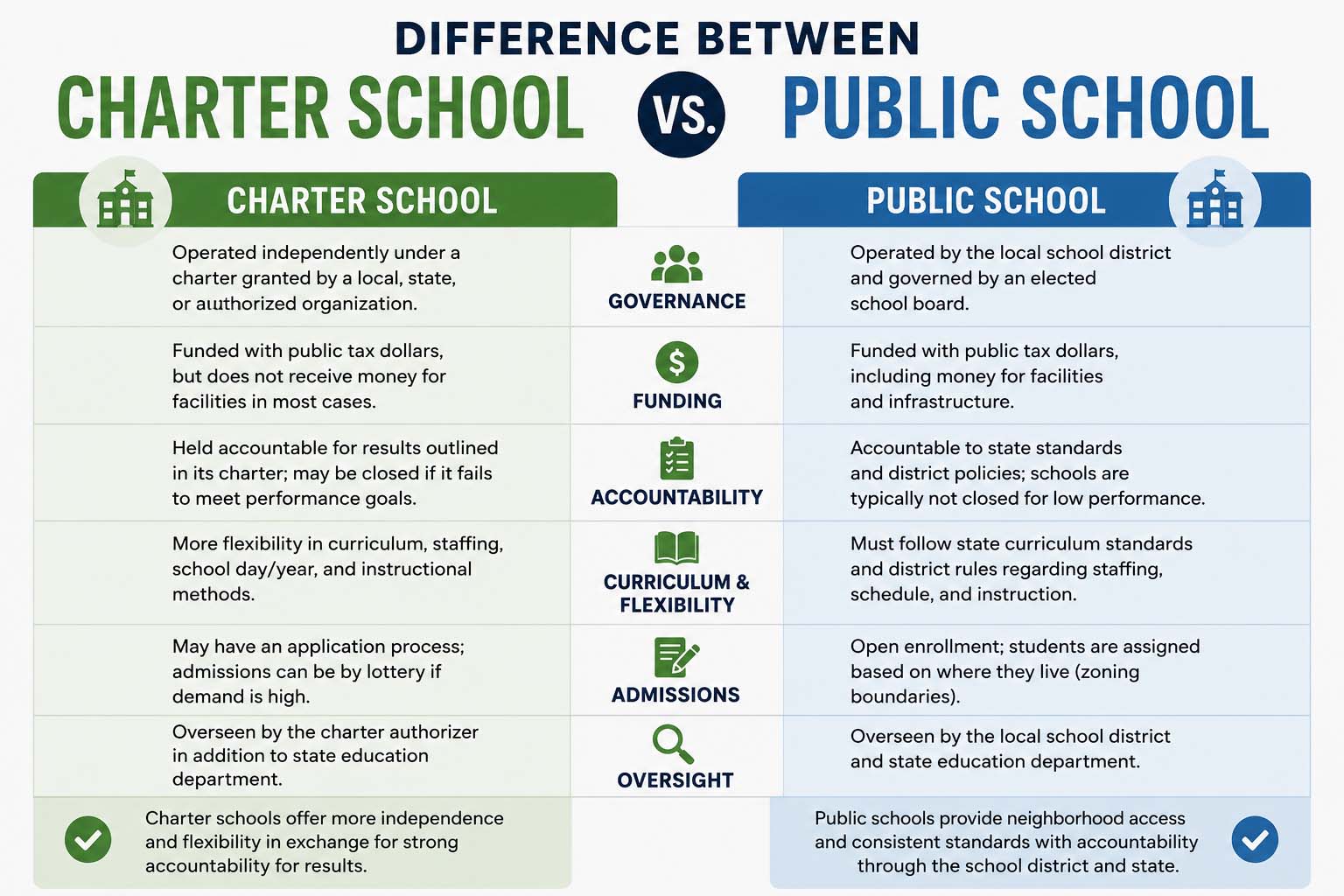
The simplest way to understand the difference between charter and public school is to look at how each school is managed.
A traditional public school is operated by a local school district and follows district policies, curriculum standards, and regulations established by state education authorities.
A charter school is also publicly funded, but it operates under a charter, which is a legal agreement that gives the school greater flexibility in exchange for meeting specific academic and operational goals.
Although both school types receive public funding, charter schools generally have more freedom to design teaching methods, specialized programs, and school policies.
What Is a Public School?
They are funded primarily through government resources, including state and local taxes, and they are managed by elected school boards or public education departments.
Most students attend the public school assigned to their residential area, although transfer options may be available depending on local policies.
Public schools typically offer:
- Standard state-approved curriculum
- Certified teachers
- Special education services
- Sports and extracurricular activities
- School transportation in many districts
- Free tuition
Their primary goal is to provide equal access to education for every student within the district.
What Is a Charter School?
A charter school is a publicly funded school that operates independently from many district-level regulations.
Each charter school follows a written agreement—called a charter—that outlines academic goals, financial accountability, and operational expectations.
Because they have greater flexibility, charter schools often develop specialized educational programs focused on areas such as:
- STEM education
- Arts and music
- College preparation
- Language immersion
- Technology
- Project-based learning
Some charter schools emphasize smaller class sizes or unique teaching approaches that differ from nearby public schools.
Difference Between Public and Charter School at a Glance
The difference between public and charter school becomes easier to understand when comparing their core features.
| Feature | Public School | Charter School |
|---|---|---|
| Funding | Public | Public |
| Tuition | Free | Free |
| Management | School district | Independent governing board |
| Curriculum | District and state standards | Greater flexibility while meeting state requirements |
| Admission | Usually based on attendance zone | Application or lottery if demand exceeds capacity |
| Accountability | Local school district | Charter agreement and state oversight |
| Specialized Programs | Varies by district | Often focuses on specific educational themes |
Although charter schools have more operational flexibility, they are still accountable for meeting state academic standards.
Funding and Governance
One of the biggest differences between these schools involves leadership and decision-making.
Traditional public schools receive funding from government sources and operate under local school districts. School boards make decisions regarding budgets, curriculum implementation, staffing, and district policies.
Charter schools also receive public funding, but they are usually managed by nonprofit organizations, educational groups, universities, or independent governing boards.
This independence allows charter schools to introduce new teaching methods more quickly while remaining responsible for meeting the performance goals outlined in their charter.
Admissions and Enrollment
Admissions represent another major difference between charter school and public education.
Public schools generally enroll students who live within designated attendance boundaries.
Charter schools usually accept applications from families interested in attending. If more students apply than there are available seats, many charter schools use a random lottery system to ensure fair admissions.
Neither school type typically charges tuition because both receive public funding.
Curriculum and Teaching Approaches
Public schools generally follow district-approved instructional materials and teaching frameworks aligned with state education standards.
Charter schools must also meet state academic expectations, but they often have greater flexibility in how they teach those standards.
For example, one charter school may emphasize hands-on science projects, while another focuses heavily on bilingual education or technology-based learning.
Students interested in specialized academic environments may also compare charter schools with What Is a Magnet School, since both can offer focused educational programs. However, magnet schools remain part of the public school system, while charter schools operate under separate charter agreements.
Teachers and Classroom Environment
Both charter schools and public schools employ qualified educators, although certification requirements can vary depending on state laws.
Public school teachers usually follow district hiring requirements and collective bargaining agreements where applicable.
Some charter schools have greater flexibility when hiring professionals with specialized industry experience alongside traditionally certified teachers.
Classroom environments also differ from one school to another.
Some charter schools intentionally maintain smaller class sizes to provide more personalized instruction, while many public schools serve larger student populations with broader program offerings.
Neither model automatically guarantees better teaching. Much depends on school leadership, teacher quality, available resources, and student engagement.
Student Programs and Opportunities
Students often choose schools based on opportunities beyond classroom instruction.
Public schools commonly provide:
- Athletic programs
- Music and performing arts
- Career and technical education
- Student organizations
- Advanced Placement (AP) courses
- School counseling services
Charter schools may offer many of the same opportunities, although their programs often reflect the school’s specialized mission.
For example, a STEM-focused charter school may invest more heavily in robotics labs, engineering projects, and computer science than traditional extracurricular activities.
Families should compare each school’s offerings rather than assuming one option always provides more opportunities.
Which School Is Better for Your Child?
There isn’t one answer that fits every family.
A child who thrives in a structured environment with extensive extracurricular activities may do very well in a traditional public school.
Another student may benefit from the specialized curriculum, innovative teaching methods, or smaller learning community found in a charter school.
Visiting schools, speaking with teachers, reviewing academic performance, and considering your child’s learning preferences can all help guide the decision.
Remember that the best school is the one that supports your child’s academic growth, personal development, and long-term goals—not simply the one with the most recognizable name.
Advantages and Disadvantages of Charter Schools
Like any educational option, charter schools have strengths and challenges. Understanding both sides helps families make informed decisions.
Advantages
Greater flexibility
Charter schools often have more freedom to introduce creative teaching methods, specialized programs, and innovative classroom activities.
Focused learning environments
Many charter schools center their curriculum around a particular subject, such as science, technology, arts, or language immersion. Students who enjoy these areas may find the learning experience more engaging.
Smaller school communities
Some charter schools serve fewer students than nearby public schools. Smaller campuses can make it easier for teachers and administrators to know students personally.
Unique educational approaches
Project-based learning, individualized instruction, and technology-rich classrooms are common features at many charter schools.
Disadvantages
Limited availability
Not every community has charter schools. Families may have fewer choices depending on where they live.
Enrollment limits
Popular charter schools often receive more applications than available seats. When this happens, admission usually depends on a lottery rather than guaranteed enrollment.
Program differences
Because every charter school operates under its own charter, educational quality and available programs can vary significantly from one school to another.
Advantages and Disadvantages of Public Schools
Traditional public schools also offer many benefits while facing their own challenges.
Advantages
Wide range of programs
Many public schools provide athletics, music, theater, clubs, career education, Advanced Placement courses, and student support services.
Stable funding
Public schools generally receive ongoing funding through local and state governments, allowing them to maintain long-term educational programs.
Guaranteed enrollment
Students living within the attendance area usually have the right to attend their assigned public school.
Comprehensive student services
Public schools often provide counselors, psychologists, special education programs, and transportation services that support a wide range of student needs.
Disadvantages
Less flexibility
District policies often determine curriculum, scheduling, and instructional approaches, leaving schools with fewer opportunities to experiment.
Larger class sizes
Some public schools serve large student populations, which may reduce opportunities for individualized instruction.
Difference Between a Charter and Public School: Choosing the Right Option
The difference between a charter and public school matters most when it matches a student’s individual needs.
Consider these questions before making a decision:
- Does your child learn better in smaller or larger classrooms?
- Are specialized academic programs important?
- How far is the school from home?
- What extracurricular activities are available?
- Does the school offer support services your child may need?
- What are the school’s academic results?
- How involved are parents in school activities?
There isn’t a universal “best” choice. The right school depends on your family’s priorities and your child’s learning style.
Step-by-Step Guide to Comparing Schools
If you’re deciding between a charter school and a public school, this simple process can help.
Step 1: Research Local Options
Visit school websites, review academic performance reports, and learn about available programs.
Step 2: Schedule School Visits
Walking through classrooms gives families a better understanding of school culture than brochures alone.
Observe how teachers interact with students and ask questions about daily routines.
Step 3: Review Academic Programs
Compare subjects, extracurricular activities, college preparation opportunities, and support services.
Some high schools also offer programs such as What Is Dual Enrollment, allowing eligible students to earn college credit before graduation. Checking whether a school provides these opportunities can be valuable for college-bound students.
Step 4: Talk With Current Families
Parents and students already attending the school can often provide practical insights about daily experiences.
Step 5: Consider Your Child’s Personality
Even an excellent school may not be the best fit for every learner.
Think about whether your child enjoys structured environments, independent learning, collaborative projects, or specialized subjects.
Common Myths About Charter and Public Schools
Several misconceptions make comparing schools more confusing than it needs to be.
Myth 1: Charter schools are private schools.
False.
Charter schools are publicly funded and do not charge tuition.
Myth 2: Public schools offer fewer opportunities.
Not necessarily.
Many public schools provide outstanding academic programs, athletics, arts, career education, and student organizations.
Myth 3: Charter schools always produce better academic results.
Academic performance varies by school.
Some charter schools perform exceptionally well, while others perform similarly to nearby public schools.
School leadership, teaching quality, family involvement, and student motivation often influence outcomes more than school type alone.
Myth 4: Public schools cannot specialize.
Many public schools provide specialized academies, career pathways, gifted education, and advanced academic programs.
Families may also compare them with What Is Boarding School options if they’re considering schools where students live on campus. Boarding schools serve a very different purpose and should be evaluated separately from both charter and traditional public schools.
Comparing Charter and Public Schools
The following summary highlights the major differences.
| Area | Charter School | Public School |
|---|---|---|
| Tuition | Free | Free |
| Funding | Public | Public |
| Management | Independent governing board | Local school district |
| Enrollment | Application or lottery | Attendance zone |
| Curriculum | Greater flexibility | District guidelines |
| Specialized Programs | Often available | Varies by district |
| Accountability | Charter agreement and state oversight | School district and state oversight |
Although their management structures differ, both school types aim to provide students with quality education.
Preparing for Success in Any School
Choosing a school is only one part of a student’s educational journey.
Students achieve better results when they:
- Attend classes regularly.
- Complete assignments on time.
- Ask questions when they need help.
- Participate in school activities.
- Build positive relationships with teachers.
- Develop strong study habits.
High school students should also begin thinking about future education and career goals. Questions such as What Should I Major In become much easier to answer when students understand their interests, strengths, and long-term plans before graduation.
Students planning to work while continuing their education may also benefit from learning about What Is Work Study, since these programs can provide valuable job experience while helping cover educational expenses.
Frequently Asked Questions
Are charter schools free?
Yes. Charter schools receive public funding, so students generally attend without paying tuition.
Can anyone apply to a charter school?
In most cases, yes. If more students apply than available seats, schools often hold a lottery to determine admission.
Do charter schools follow state standards?
Yes. Although charter schools have greater flexibility in teaching methods, they are still required to meet state academic requirements established in their charter agreements.
Are public schools better than charter schools?
Neither option is automatically better. The best choice depends on the student’s needs, learning preferences, available programs, and the quality of individual schools.
Can students transfer between charter and public schools?
Policies differ by state and school district, but transfers are often possible if enrollment requirements are met.
Key Takeaways
Understanding the difference between charter and public school helps families make decisions based on facts rather than assumptions. Both school types offer free public education, qualified teachers, and opportunities for academic success. The biggest differences involve governance, admissions, curriculum flexibility, and specialized programs.
Before choosing a school, take time to compare local options, visit campuses, speak with educators, and consider your child’s unique learning style. A school that matches your child’s interests, goals, and educational needs is far more valuable than simply choosing one type over another.