
Argumentative Essay Examples: A Complete Student Guide
Argumentative Essay Examples: A Complete Student Guide
Argumentative essays are among the most common assignments in schools, colleges, and universities. That is why many students look for argumentative essay examples: they show how to develop critical thinking skills, evaluate evidence, and present logical arguments on important topics.
In addition, good samples reveal how strong arguments are structured and how to write persuasive academic papers.
This guide explains argumentative essays, provides useful samples, and offers step-by-step instructions to help students improve their writing skills.
What Is an Argumentative Essay?
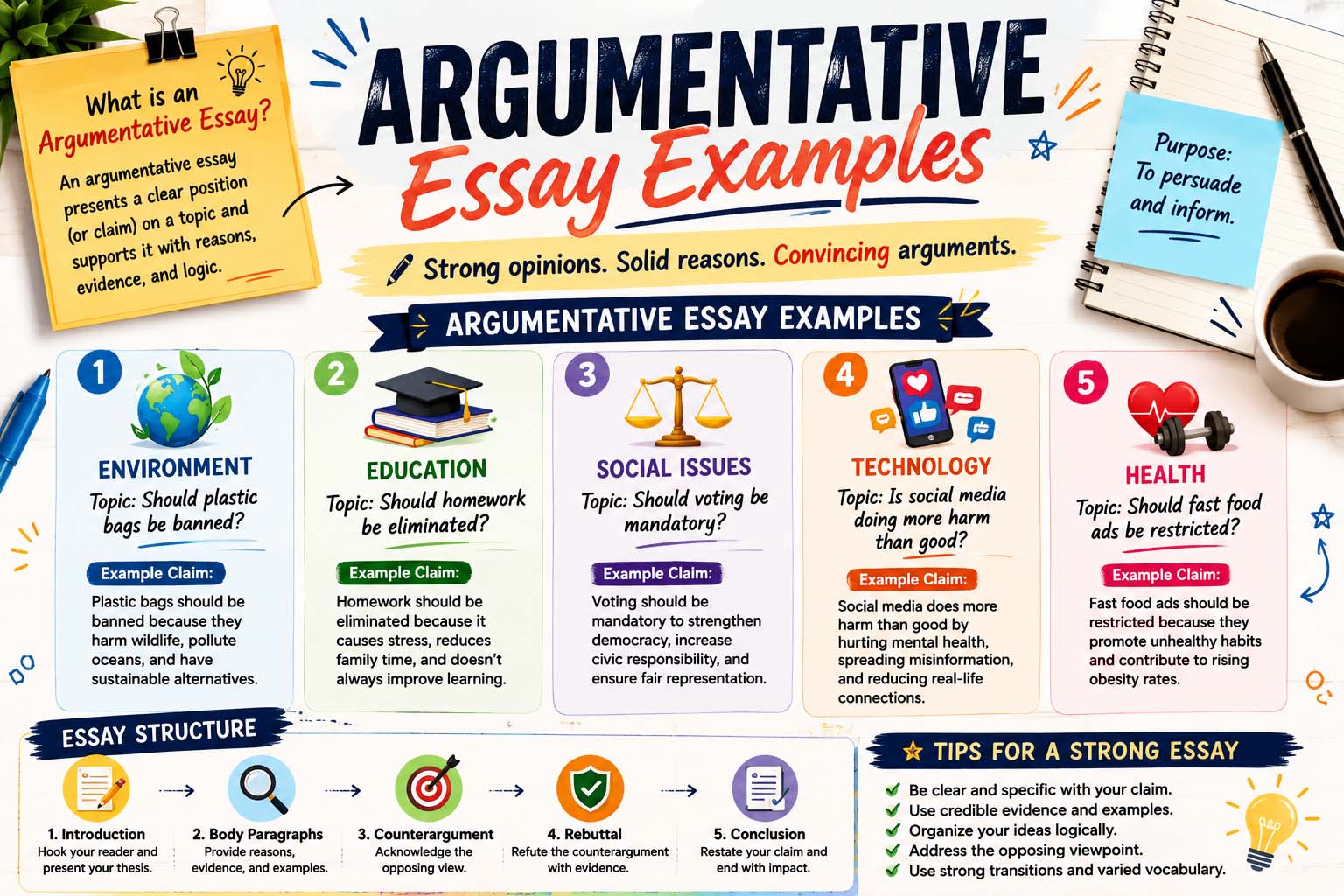
In simple terms, an argumentative essay is a type of academic writing that presents a claim or position on a topic and supports it with evidence, facts, and logical reasoning.
Unlike opinion essays, argumentative essays rely on research, evidence, logical arguments, counterarguments, and credible sources.
In the end, the goal is to persuade readers that the writer’s position is valid. The Purdue Online Writing Lab also gives a clear overview of how argumentative essays work.
Why Argumentative Essay Examples Matter
Argumentative essays help students develop critical thinking and improve research skills. Moreover, they strengthen communication abilities and teach evidence-based reasoning.
As a result, studying good samples helps students build persuasive writing techniques much faster.
Structure of an Argumentative Essay
Understanding different organizational patterns, such as those shown in Text Structure Examples, can help students arrange their arguments more clearly and create easier-to-follow essays.
In general, most argumentative essays follow a standard format.
| Section | Purpose |
|---|---|
| Introduction | Introduce topic and thesis |
| Body Paragraph 1 | First supporting argument |
| Body Paragraph 2 | Second supporting argument |
| Body Paragraph 3 | Third supporting argument |
| Counterargument | Address opposing view |
| Conclusion | Summarize and reinforce argument |
Because readers know what to expect, following this structure makes essays easier to read and understand.
How to Start an Argumentative Essay Examples
One of the most common student questions is how to start an argumentative essay examples.
First, a strong introduction should capture attention. Next, it should introduce the topic and give background information. Finally, it should present the thesis statement.
Example opening on school uniforms: “Every day, millions of students attend school wearing different styles of clothing. Some believe uniforms limit self-expression. However, others argue they improve discipline and reduce distractions. Therefore, school uniforms should be required because they promote equality, improve focus, and create a stronger sense of community.”
In this way, the introduction immediately introduces the topic and position.
Argumentative Essay Hook Examples
In simple terms, a hook is the first sentence designed to grab the reader’s attention.
Students often search for argumentative essay hook examples because strong openings create better first impressions.
Question hook: “Should schools require students to wear uniforms, or should personal expression come first?”
Statistic hook: “According to recent studies, students spend more than seven hours per day using digital devices.”
Surprising fact hook: “In fact, more than one-third of food produced globally is wasted each year.”
Quote hook: “As Nelson Mandela once said, ‘Education is the most powerful weapon which you can use to change the world.'”
Argumentative Essay Introduction Examples
Example 1, online learning: “Technology has transformed education in recent years. For example, online learning provides flexibility and accessibility that traditional classrooms often cannot match. Therefore, online education should remain a permanent option for students because it increases access, supports diverse learning styles, and promotes lifelong learning.”
Example 2, renewable energy: “Climate change continues to affect communities around the world. As governments search for sustainable solutions, renewable energy has become increasingly important. For this reason, countries should invest more in solar and wind power because these sources reduce pollution, create jobs, and protect future generations.”
Argumentative Essay Thesis Examples
Students searching for argumentative essay thesis examples often want to understand how to write clear and persuasive claims.
Technology: “Schools should integrate technology into classrooms because it improves student engagement, enhances learning opportunities, and prepares students for future careers.”
Education: “Homework should be reduced because excessive assignments contribute to student stress and limit opportunities for extracurricular development.”
Environment: “Single-use plastics should be banned because they contribute significantly to environmental pollution and harm wildlife ecosystems.”
In short, a strong thesis is specific, debatable, clear, and focused.
Argumentative Essay Examples of Topic Ideas
Students often struggle to choose topics. For this reason, here are some popular options.
Education: Should school uniforms be mandatory? Should homework be limited? Should college education be free?
Technology: Is artificial intelligence beneficial? Should social media have age restrictions? Is online learning better than traditional learning?
Environment: Should governments ban single-use plastics? Should renewable energy replace fossil fuels?
Health: Should sugary drinks be taxed? Should schools provide healthier lunches?
Overall, selecting a relevant topic makes writing easier.
Step-by-Step Guide to Writing an Argumentative Essay
First, choose a topic: select a subject that has multiple viewpoints.
Second, conduct research: gather information from academic journals, books, government websites, and reputable news sources. Then organize your notes so the most important facts are easy to find before you start drafting.
Third, create a thesis statement: clearly state your position. Before writing it, understand the main focus of your topic and review What Is a Central Idea to keep your argument clear and focused.
Next, develop supporting arguments: provide evidence for each main point.
After that, address counterarguments: acknowledge opposing perspectives and explain why your argument remains stronger.
Finally, write a conclusion: summarize key points and reinforce the thesis. To do this well, review Conclusion Paragraph Examples to learn how to leave a strong closing impression.
Common Mistakes Students Make
Above all, try to avoid these common errors.
Weak thesis statements: vague claims weaken the overall essay.
Lack of evidence: arguments should always rest on facts and research.
Ignoring counterarguments: addressing opposing views actually strengthens credibility.
Poor organization: a logical structure, on the other hand, improves readability.
Emotional arguments: academic essays should prioritize evidence over emotion instead.
Body Paragraph From Argumentative Essay Examples
Topic, school uniforms: “School uniforms can improve student focus by reducing distractions related to clothing choices. As a result, when students spend less time comparing fashion trends, they can concentrate more effectively on academics. Moreover, research has shown that schools with uniform policies often report improved classroom behavior and stronger learning environments.”
As you can see, this paragraph includes a topic sentence, supporting evidence, an explanation, and a connection to the thesis.
Benefits of Studying Argumentative Essay Examples
Reviewing samples helps students understand essay structure and improve organization. Furthermore, it teaches persuasive techniques and helps students develop stronger arguments.
Above all, samples build confidence in academic writing because they serve as practical learning tools.
FAQ
What is an argumentative essay?
In short, an argumentative essay presents a claim and supports it with evidence and logical reasoning.
Why are argumentative essay examples useful?
They help students understand structure, organization, and persuasive writing techniques because they show these skills in action.
What makes a strong thesis statement?
Generally, a strong thesis is specific, debatable, and clearly states the writer’s position.
How long should an argumentative essay be?
Length varies depending on assignment requirements. However, most academic essays range from several hundred to several thousand words.
What is a hook in an argumentative essay?
Simply put, a hook is an opening statement designed to capture the reader’s attention.
Should argumentative essays include opposing viewpoints?
Yes. Addressing counterarguments strengthens the overall argument and also demonstrates critical thinking.
Conclusion
Studying argumentative essay examples is one of the easiest ways to improve your writing. By looking closely at effective introductions, strong thesis statements, persuasive hooks, and well-organized arguments, students can develop more compelling essays and stronger critical thinking abilities.
So, whether you’re researching introductions, exploring thesis statements, learning how to start an essay, or reviewing hooks, mastering these parts will help you create persuasive and well-structured academic papers that stand out in any classroom.