
Why Is Literacy Important? How Reading Skills Shape Learning and Everyday Life
Why Is Literacy Important? How Reading Skills Shape Learning and Everyday Life
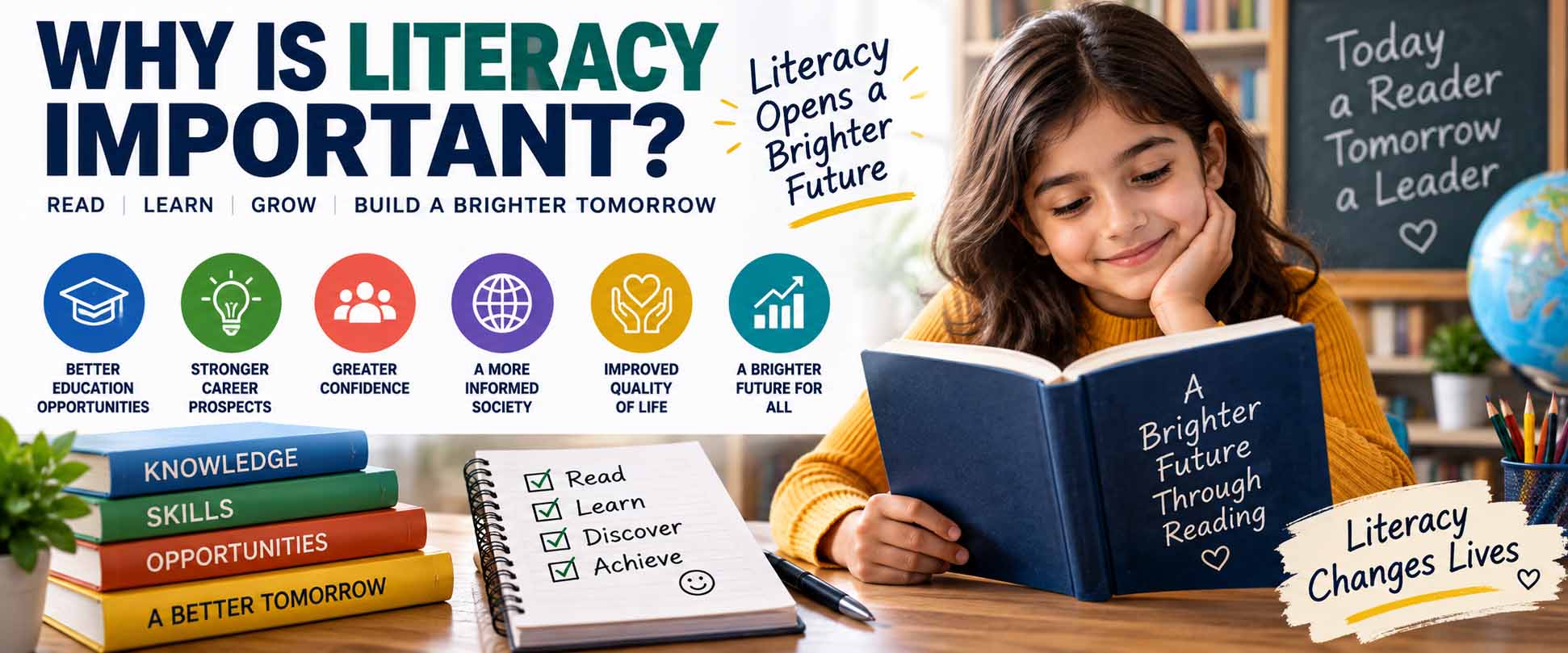
A child reads instructions for a science experiment, a teenager compares information online, and an adult fills out a job application. Literacy supports all of these everyday tasks. So, why is literacy important? At its core, helps people understand information, communicate ideas, learn independently, and make informed decisions. While reading and writing remain central, modern literacy also includes the ability to understand digital, financial, media, and health information.
What Does Literacy Really Mean?
Literacy is commonly associated with the ability to read and write. However, practical goes beyond recognizing words on a page.
A literate reader needs to understand what a text means, connect ideas, identify useful information, and communicate a response. Likewise, strong writing requires more than correct spelling. Students must organize thoughts, select appropriate words, and communicate clearly.
For example, a student may be able to pronounce every word in a textbook paragraph but still struggle to explain its main idea. In that case, decoding skills are present, yet comprehension still needs development.
As learners progress, they also encounter different types of reading, from close reading of academic texts to scanning instructions or reading for enjoyment. Each approach supports a different purpose.
Why Is Literacy Important for Students?
For students, why is literacy important becomes clear in almost every school subject. Reading and writing are not limited to language arts classes.
In mathematics, students must understand word problems and written instructions. Meanwhile, science requires them to interpret explanations, procedures, charts, and evidence. History involves reading sources and comparing viewpoints, while technology courses often require students to follow detailed written directions.
Therefore, acts as a foundation for learning across the curriculum.
A student with strong skills can usually access information more independently. Instead of relying on someone else to explain every instruction, the learner can read, interpret, question, and respond.
That independence becomes increasingly valuable as schoolwork becomes more complex.
Literacy Supports Reading Comprehension
Recognizing words is only one part of successful reading. Students must also understand relationships between ideas.
For instance, they may need to identify a main idea, compare two arguments, recognize cause and effect, or infer something the author does not directly state.
Teachers often use graphic organizers for reading comprehension because visual tools can help learners organize characters, events, causes, comparisons, and key ideas while reading.
As comprehension improves, students can spend less effort simply figuring out what a passage says and more effort thinking about what it means.
Literacy Builds Communication Skills
Literacy also strengthens communication.
Students use written communication when completing assignments, sending emails, preparing presentations, writing applications, or explaining their ideas. Meanwhile, reading exposes them to vocabulary, sentence patterns, arguments, and different ways of expressing ideas.
As a result, reading and writing can reinforce each other.
Consider two students who understand the same topic. One can organize the information into a clear explanation, while the other struggles to communicate what they know. Their subject knowledge may be similar, yet their ability to demonstrate that knowledge can differ because communication skills matter.
For that reason, literacy supports both learning and the ability to show what has been learned.
Why Literacy Matters From Early Childhood
Literacy development begins long before students start reading full books independently.
Young children build foundations by listening to stories, learning new words, recognizing sounds, noticing print, talking about pictures, and experimenting with letters.
Parents and teachers can make this process engaging rather than turning every activity into a formal lesson. For example, age-appropriate literacy activities for preschoolers can include shared reading, rhyming games, storytelling, letter play, and conversations about books.
These experiences help children become familiar with how language works.
However, children develop at different rates. Therefore, early activities should support learning without creating unnecessary pressure.
Regular exposure to meaningful language and books can provide a strong base for later reading instruction.
Why Is Media Literacy Important?
Students now encounter information through websites, videos, social platforms, advertisements, news stories, and online discussions. Consequently, simply being able to read the words is not enough.
So, why is media literacy important?
Media literacy helps people ask useful questions about information. Who created it? What is the purpose? What evidence supports the claim? Is something being presented as fact when it is actually opinion or advertising?
For example, two online posts may make opposite claims about the same issue. A media-literate reader does not automatically accept whichever post appears first. Instead, the reader considers the source, evidence, context, and possible bias.
These habits are especially useful for students doing research.
Rather than copying information from the first search result, students learn to evaluate whether a source is appropriate for an assignment.
Digital Literacy Is Part of Modern Learning
Reading increasingly happens on screens, so digital skills now overlap with traditional literacy.
Students may search online databases, submit assignments through learning platforms, participate in virtual classrooms, or create presentations. Therefore, understanding what is digital literacy can help learners recognize the skills needed to find, evaluate, create, and communicate information through digital tools.
Digital literacy does not simply mean knowing how to operate a phone or laptop.
A student might use technology confidently while still struggling to judge whether an online source is trustworthy. Likewise, someone may know how to search for information but not understand privacy settings, suspicious links, or how online content can be manipulated.
Because of this, schools increasingly treat critical evaluation as part of effective digital learning.
Computer Skills Strengthen Access to Information
Computer knowledge is closely connected with digital learning, although the two concepts are not identical.
Basic computer literacy can include using hardware, software, files, browsers, email, word-processing programs, and other common tools.
Students researching computer literacy meaning may notice that these practical abilities often support wider educational goals. For example, a learner who knows how to organize files, use search tools, and create documents can complete many academic tasks more efficiently.
However, technical ability alone does not guarantee good judgment.
Students still need skills to understand what they read, determine whether information makes sense, and communicate their findings clearly.
Why Is Financial Literacy Important?
Traditional reading literacy also supports another practical area: understanding money.
So, why is financial literacy important?
People regularly encounter bank statements, bills, contracts, loan terms, budgets, interest rates, paychecks, and financial advertisements. Understanding these materials can help them compare choices and recognize the consequences of financial decisions.
Financial literacy includes concepts such as budgeting, saving, borrowing, credit, interest, and financial risk.
For example, someone comparing two loans needs to read the terms carefully rather than looking only at the monthly payment. Similarly, a person using a credit card should understand that interest and fees can affect the total amount repaid.
This helps explain why financial literacy is important throughout adulthood. Money decisions often involve both numerical skills and careful reading.
Why Is Health Literacy Important?
Health information can also be difficult to understand.
People may need to read medicine labels, appointment instructions, health education materials, consent forms, or information about medical services.
Therefore, why is health literacy important has a practical answer: people need to understand health-related information well enough to communicate questions and make informed choices with appropriate professional guidance.
Health literacy does not mean diagnosing yourself through internet searches.
Instead, it includes being able to understand instructions, identify reliable sources, describe concerns clearly, and know when to ask a qualified professional for clarification.
For example, if written instructions are confusing, a health-literate person may recognize that they should ask a pharmacist, doctor, or another appropriate professional rather than guessing.
Literacy Supports Career and Workplace Skills
Literacy remains valuable after formal education ends.
Many jobs require employees to read instructions, write messages, understand workplace policies, complete forms, follow safety procedures, or interpret technical information.
Even jobs that involve significant hands-on work often require some form of reading and communication.
Meanwhile, more advanced roles may involve reports, presentations, research, documentation, or professional correspondence.
Strong literacy can also make it easier to learn new workplace skills. As tools and procedures change, employees often receive written instructions, training materials, or online courses.
Therefore, supports continued learning rather than only school achievement.
Literacy Encourages Independent Learning
One of literacy’s most powerful benefits is access to knowledge without always needing another person to teach it directly.
A strong reader can pick up a manual, article, textbook, guide, or credible online resource and begin learning.
For example, someone interested in photography can read about camera settings. Another learner can study a new software program through documentation. Meanwhile, a student can investigate a historical topic beyond what was covered in class.
This independence does not mean learners never need teachers.
Instead, literacy gives them another route to knowledge. Teachers can guide and challenge students, while students can continue exploring ideas on their own.
How Students Can Strengthen Literacy Skills
Literacy develops through regular, purposeful practice rather than one isolated exercise.
Students can start by reading material that is challenging enough to introduce new ideas without being so difficult that every sentence becomes frustrating.
Next, they can pause after a section and explain the main idea in their own words. If they cannot explain it, rereading may reveal something they missed.
Writing also helps. After reading a chapter or article, students can summarize the key points, write questions, or explain how the information connects with something they already know.
Vocabulary deserves attention as well. Instead of memorizing long lists, students can learn new words in context and practice using them in their own sentences.
Finally, discussing reading with another person can expose misunderstandings and new perspectives. Explaining an idea aloud often reveals whether you truly understand it.
Common Misunderstandings About Literacy
One common misunderstanding is that simply means being able to read words aloud.
Fluent pronunciation helps, but comprehension is essential. A reader needs to understand the message and use the information appropriately.
Another misconception is that literacy development ends after elementary school.
In reality, reading becomes more specialized as students progress. A high school science article, historical document, college textbook, employment contract, and news report all demand somewhat different reading strategies.
Likewise, is not only an academic skill.
People use it while comparing products, following directions, communicating at work, managing money, evaluating online information, and navigating everyday responsibilities.
Frequently Asked Questions
Why is literacy important in everyday life?
Literacy helps people understand written information, communicate clearly, follow instructions, evaluate choices, and continue learning. Therefore, it supports tasks ranging from reading a school assignment to understanding workplace documents.
How does literacy affect academic success?
Strong literacy gives students better access to material across subjects. They can understand instructions, interpret textbooks, explain ideas, and complete written work more independently.
Is literacy only about reading and writing?
Reading and writing form the foundation, but modern literacy is broader. It can also involve digital information, media, finances, health information, and other specialized areas.
Can literacy improve critical thinking?
Yes, especially when students actively evaluate what they read. Comparing evidence, identifying arguments, recognizing assumptions, and questioning sources can strengthen critical thinking.
How can parents encourage literacy at home?
Parents can read with children, discuss stories, encourage questions, provide access to age-appropriate books, and make reading part of everyday life. Meanwhile, older children can benefit from conversations about news, online sources, and topics that interest them.
Make Literacy Part of Everyday Learning
Understanding why is literacy important becomes easier when we look beyond textbooks. Literacy helps students learn in class, yet it also helps people communicate, evaluate information, use technology, understand money, navigate health information, and keep learning throughout life.
The best way to strengthen is to use it regularly. Read for different purposes, ask questions about what you read, write to organize your ideas, and check whether information comes from a reliable source. Over time, these small habits build skills that support learning far beyond the classroom.