
Graphic Organizers for Reading Comprehension: Types, Examples, and Classroom Uses
Graphic Organizers for Reading Comprehension: Types, Examples, and Classroom Uses
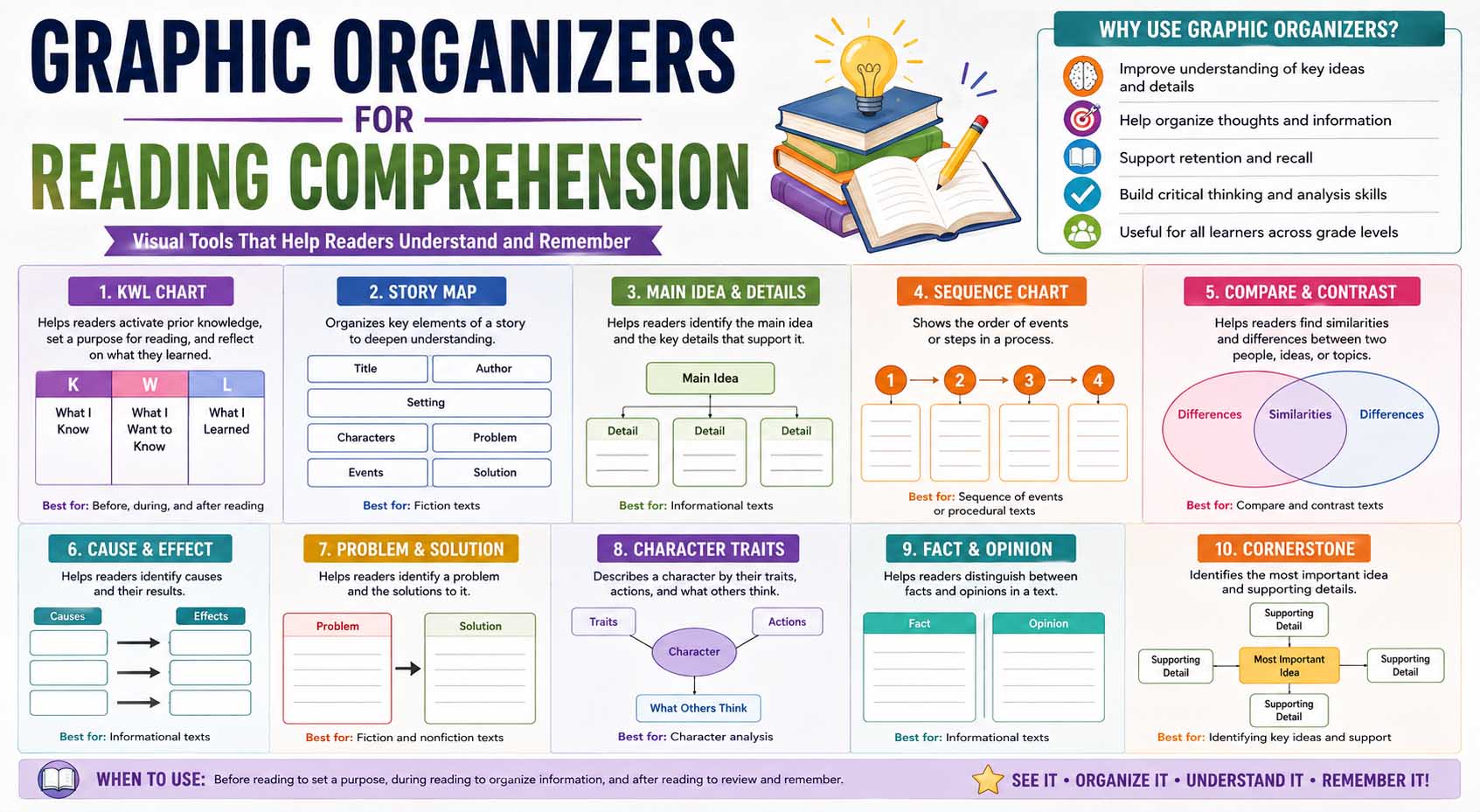
Graphic organizers for reading comprehension help students turn complex reading into clear visual information. Instead of trying to remember every detail in a passage, learners can sort ideas into boxes, charts, timelines, webs, or diagrams. As a result, they can more easily identify main ideas, compare information, follow sequences, understand text structure, and remember what they read.
Teachers often use graphic organizers before, during, or after reading. However, they are not only classroom worksheets. Students can also use them independently for homework, test preparation, book reports, and study sessions.
The best organizer depends on what the student needs to understand. Therefore, a story map works well for fiction, while a cause-and-effect chart makes more sense for informational text.
What Are Graphic Organizers for Reading Comprehension?
A graphic organizer is a visual framework that helps readers arrange information in a meaningful way.
For example, instead of writing several paragraphs of notes, a student might place the main idea in a central box and connect supporting details around it. Likewise, a timeline can help organize events in chronological order.
These tools are useful because reading comprehension requires more than recognizing words. Readers need to identify relationships between ideas, separate key information from minor details, make connections, and sometimes infer meaning.
A graphic organizer gives students a visible structure for doing that work.
For younger readers, organizers can make abstract reading skills easier to understand. Meanwhile, older students can use more detailed versions to analyze complex texts.
Why Reading Comprehension Graphic Organizers Help Students
Graphic organizers reduce the amount of information students need to hold in working memory at one time.
Instead of remembering several details mentally, students can place them into a visual pattern. Consequently, the relationships between ideas become easier to see.
For example, a student who is learning What Is a Central Idea can use a main idea organizer with one large box for the central idea and several smaller boxes for supporting evidence.
This approach encourages students to ask, “Which details really support the main point?”
Graphic organizers can also help students monitor their own understanding. If they cannot complete part of the organizer, they may realize they need to reread that section.
For more background on classroom comprehension strategies, Reading Rockets explains how graphic organizers can support reading comprehension by helping students organize ideas and relationships visually.
Types of Graphic Organizers for Reading Comprehension
There are many types of graphic organizers for reading comprehension, but a few formats cover most classroom needs.
Main Idea Graphic Organizer for Reading
This organizer usually places the main idea at the top or center, with supporting details underneath or around it.
It works well for nonfiction passages, articles, textbook sections, and short reading assignments.
For example:
Main idea: Bees are important to ecosystems.
Supporting details:
- They pollinate plants.
- Many crops depend on pollination.
- Their activity supports food chains.
This format helps students distinguish the most important idea from examples or evidence.
Story Map for Reading Comprehension
A story map works best with fiction.
Typical sections include:
- characters
- setting
- problem
- major events
- solution
- theme
Students can complete the map as they read or after finishing the story.
For beginners, a simple version with only character, setting, problem, and solution is often enough.
Sequence Graphic Organizer for Reading
A sequence chart shows events or steps in order.
It may look like:
First → Next → Then → Finally
This organizer is useful for stories, historical events, science processes, biographies, and procedural texts.
Meanwhile, older students can use timelines when exact dates matter.
Cause-and-Effect Reading Comprehension Organizer
Cause-and-effect charts help students understand why something happened and what resulted from it.
For instance:
Cause: Heavy rain continued for several days.
Effect: The river overflowed its banks.
This format is particularly useful in science, history, and informational reading.
Students who are learning types of text structures can use cause-and-effect organizers to recognize how authors arrange nonfiction information.
Compare-and-Contrast Graphic Organizers for Reading
A Venn diagram is one of the best-known reading organizers.
Two overlapping circles allow students to record differences on the outside and similarities in the overlapping center.
Students might compare:
- two characters
- two historical events
- two animals
- two arguments
- two versions of the same story
However, a comparison table can work better when students need to compare several specific features.
For example:
| Feature | Character A | Character B |
|---|---|---|
| Main goal | Win the competition | Help a friend |
| Personality | Competitive | Cooperative |
| Major challenge | Fear of failure | Lack of confidence |
Comparing visual formats like these with Text Structure Examples can help students recognize when an author uses comparison as the main organization pattern.
Problem-and-Solution Graphic Organizer for Comprehension
A problem-and-solution chart asks students to identify:
- the main problem
- possible or attempted solutions
- the final result
This structure works especially well for stories, biographies, history passages, and informational texts about social or scientific problems.
For example, a passage about water shortages might include:
Problem: A town has limited clean water.
Solution: Officials introduce water recycling and conservation programs.
Result: Water use decreases.
This organizer encourages students to focus on relationships rather than copying sentences from the text.
Character Analysis Graphic Organizer for Reading
Character organizers help students examine how a fictional character changes throughout a story.
Useful sections may include:
- appearance
- personality traits
- motivations
- actions
- conflicts
- relationships
- evidence from the text
- changes over time
For stronger readers, ask students to include direct evidence or page references.
As a result, the activity moves beyond simple description and encourages evidence-based analysis.
KWL Chart for Reading Comprehension
A KWL chart is often used before and after reading nonfiction.
The letters stand for:
- K: What I Know
- W: What I Want to Know
- L: What I Learned
Before reading, students activate background knowledge. Next, they create questions. Finally, they record new learning.
Because the chart begins before reading, it can increase curiosity and give students a reason to pay attention to specific information.
However, it works best when students already know at least something about the topic.
Text Feature Organizer for Reading Comprehension
Informational texts often include headings, captions, diagrams, maps, charts, bold words, and sidebars.
Students can use a text feature organizer to record each feature and explain how it supports understanding.
For example:
| Text Feature | What It Shows | How It Helps |
|---|---|---|
| Heading | Topic of section | Previews information |
| Diagram | Parts of a volcano | Makes structure visible |
| Caption | Explains an image | Adds useful context |
Learning about types of text features can make this organizer especially useful in science and social studies reading.
How to Use Graphic Organizers for Reading Comprehension
The effectiveness of an organizer depends on how it is introduced.
Simply handing students a blank worksheet may not improve comprehension. Instead, teachers should first model how to use it.
Step 1: Identify the Reading Comprehension Goal
First, ask what students should understand from the passage.
Are they finding the central idea? Comparing characters? Following a sequence? Identifying cause and effect?
The learning goal should determine the organizer.
Step 2: Model the Graphic Organizer
Next, complete part of the organizer together.
For example, read one paragraph aloud and think through which detail belongs in the main idea box.
This modeling helps students understand the thinking process rather than simply seeing the finished answer.
Step 3: Practice the Reading Strategy
Next, allow students to complete another section with guidance.
Then, gradually reduce support as they become more confident.
Step 4: Explain the Organizer Choices
After completing the organizer, ask students why they placed information where they did.
This step matters because the organizer is a tool for thinking, not just a worksheet to finish.
Free Graphic Organizers for Reading Comprehension
Teachers and parents can create effective organizers without buying expensive materials.
Simple paper templates often work perfectly.
For example, you can make:
- a central idea web
- a Venn diagram
- a sequence timeline
- a character chart
- a cause-and-effect table
- a KWL chart
Many educators also search for free graphic organizers for reading comprehension that they can print or edit digitally.
When choosing a free template, focus on clarity rather than decoration. A simple organizer with enough writing space is often more useful than a highly decorated page.
You can also let older students draw their own organizers. As a result, they may think more actively about how the information fits together.
Graphic Organizers for Reading Comprehension PDF Resources
A graphic organizers for reading comprehension PDF can be useful when teachers want reusable printable materials.
PDF organizers work especially well for:
- homework packets
- independent reading
- substitute teacher plans
- intervention groups
- reading centers
- test preparation
However, the same organizer should not be used for every text.
For example, a story map may frustrate students if the assigned reading is an informational article with no characters or plot.
Therefore, keep several organizer types available and match each one to the reading goal.
Digital versions can also work well when students complete assignments on tablets or computers.
Matching Graphic Organizers to Reading Levels
Graphic organizers should become more complex as students develop stronger reading skills.
For early elementary readers, use simple labels, large boxes, and visual cues.
For example, a beginner story organizer might include:
- Who?
- Where?
- What happened?
Meanwhile, middle-grade students can add conflict, theme, evidence, and character development.
High school students may use organizers for argument analysis, multiple-source comparison, evidence evaluation, and complex text structures.
Teachers can use reading levels by grade as one reference point when deciding how much language and detail an organizer should contain.
Still, individual ability matters more than grade alone.
Adapting Reading Graphic Organizers for Different Learners
One major advantage of graphic organizers is flexibility.
Students who struggle with writing can use short phrases instead of full sentences.
Meanwhile, visual learners may benefit from colors, arrows, or symbols.
English language learners can use pictures or vocabulary support.
Students who need more challenge can add text evidence, quotations, or written explanations.
Therefore, one organizer can often serve several ability levels with small changes.
For example, younger students might identify a character trait, while advanced students must also provide evidence and explain how the trait affects the plot.
Common Mistakes With Graphic Organizers for Reading
One mistake is giving students too many boxes to fill.
When an organizer becomes crowded or complicated, students may focus more on completing the worksheet than understanding the reading.
Another mistake is choosing the organizer before choosing the learning goal.
Teachers should first ask what comprehension skill students need to practice.
Likewise, students should not copy entire sentences unless the activity specifically requires quotation evidence.
Short notes usually work better because they force readers to identify key information.
Finally, avoid treating every student response as identical. A well-supported interpretation may differ from the teacher’s example and still be reasonable.
Reading Comprehension Example: Choosing the Right Organizer
Imagine students are reading an article about how hurricanes form.
A story map would not fit well because the passage does not have characters or a plot.
Instead, a sequence chart could show:
Warm ocean water → Moist air rises → Clouds form → Storm strengthens
Meanwhile, a cause-and-effect organizer could help students connect warm water and atmospheric conditions to storm development.
Therefore, the best organizer depends on what students need to understand from the passage.
This selection process is one of the most important parts of using graphic organizers for reading comprehension effectively.
Frequently Asked Questions About Reading Graphic Organizers
What Is the Best Graphic Organizer for Reading Comprehension?
There is no single best option. A main idea web works well for central ideas, while story maps help with fiction and sequence charts help with chronological information.
Can Graphic Organizers Improve Reading Comprehension?
Yes. They can make relationships between ideas more visible and reduce the amount of information students must organize mentally. However, teachers should still provide instruction and reading support when needed.
Are Reading Graphic Organizers Only for Elementary Students?
No. Middle school, high school, and college students can use more advanced organizers for arguments, research, source comparison, and complex texts.
Should Students Complete Organizers While Reading?
Sometimes. Completing a chart during reading can help students track ideas. However, other organizers work better after reading because students need to understand the whole text first.
Can Students Make Their Own Graphic Organizers?
Yes. In fact, designing an organizer can encourage deeper thinking because the student must decide how the information relates.
How Many Reading Organizers Should Students Use?
Usually, one well-chosen organizer is better than several unnecessary worksheets. Therefore, choose the format that directly supports the reading skill being taught.
Using Graphic Organizers to Strengthen Reading Comprehension
The most useful graphic organizers for reading comprehension are not necessarily the most colorful or detailed. Instead, they are the ones that help students see how information fits together.
Start with the reading goal, then choose a visual structure that matches it.
For instance, use a story map for plot, a Venn diagram for comparison, a sequence chart for order, or a main idea web for key details.
Over time, students can begin choosing their own organizers. At that point, the tool becomes more than a classroom worksheet—it becomes a practical reading strategy they can use whenever a text feels difficult to organize or understand.