
Types of Reading: Methods, Skills and Practical Examples
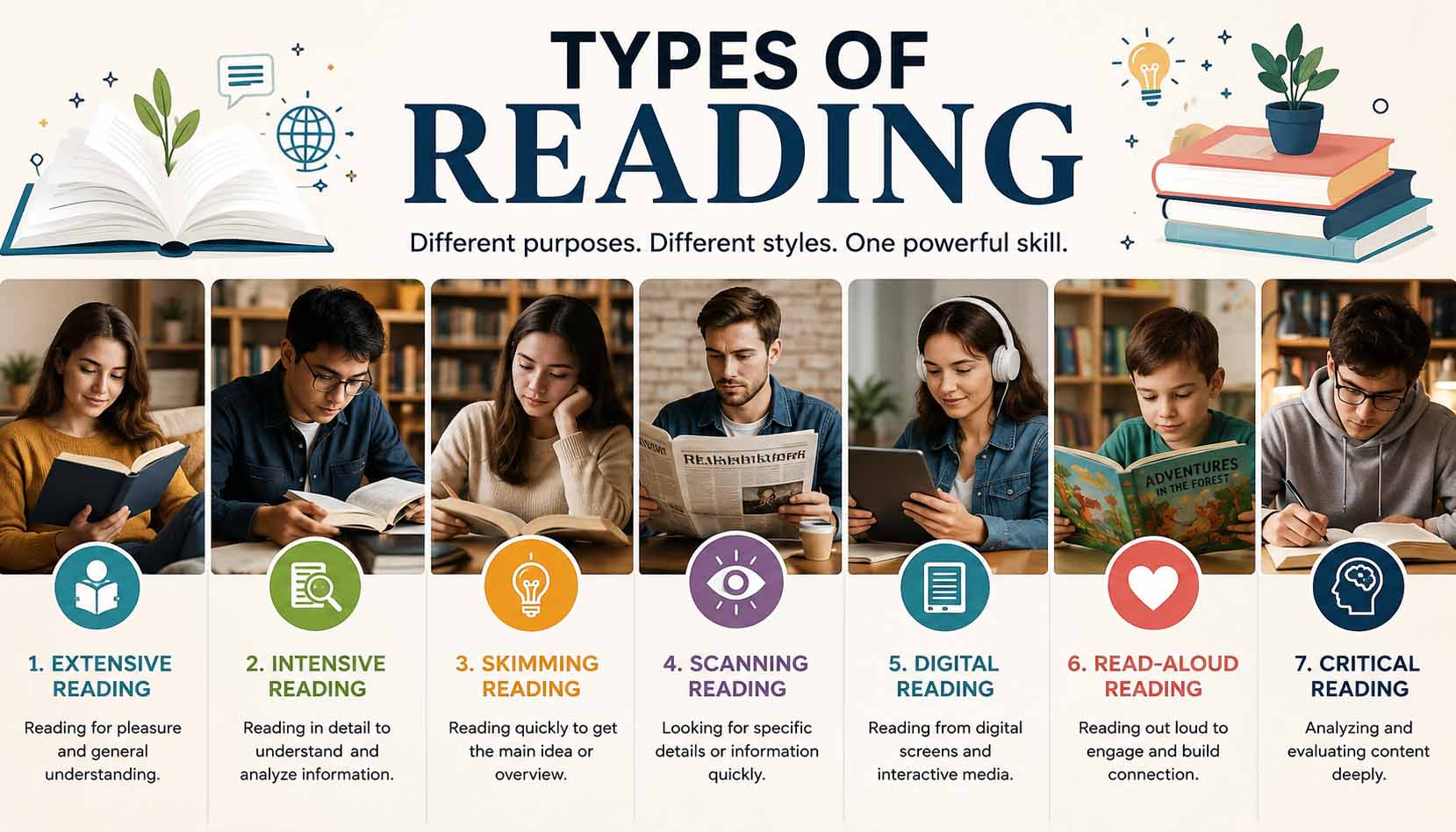
Types of Reading: Methods, Skills and Practical Examples
Reading a textbook chapter is not the same as checking a train schedule, enjoying a novel, or searching an article for one fact. . Understanding the main types of reading can help students read more efficiently, improve comprehension, and choose better strategies for different learning situations.
The four commonly taught reading approaches are intensive reading, extensive reading, skimming, and scanning. However, reading also involves skills such as critical analysis, close reading, active reading, and comprehension. Rather than treating one method as the best, strong readers learn when to switch between them.
This guide explains how the different approaches work, when to use them, and how students can strengthen their reading habits.
What Are the Main Types of Reading?
Reading methods are strategies people use to process written information according to a particular purpose.
For example, you probably would not examine every sentence of a restaurant menu with the same attention you give an important textbook chapter. Likewise, you would not normally read an entire dictionary from beginning to end to find one definition.
Four widely recognized approaches are:
| Reading Type | Main Purpose | Common Example |
|---|---|---|
| Intensive reading | Understand details carefully | Studying a textbook chapter |
| Extensive reading | Read longer material for general understanding | Reading a novel |
| Skimming | Understand the main idea quickly | Previewing an article |
| Scanning | Locate specific information | Finding a date or name |
These methods often overlap. For instance, a student may skim a chapter first and then switch to intensive reading for difficult sections.
Learning to recognize What Is a Central Idea can also make reading more efficient because identifying the author’s main point helps readers separate essential information from supporting details.
Intensive Reading for Detailed Understanding
Intensive reading means studying a relatively short section of text carefully to understand its details.
Students commonly use this approach for textbooks, academic articles, instructions, difficult passages, and exam materials.
Instead of moving quickly, you slow down and pay attention to vocabulary, arguments, evidence, sentence relationships, and important details.
Suppose your biology textbook contains two pages explaining cellular respiration. Rather than simply reading those pages once, you might underline key terms, examine a diagram, reread difficult sentences, and summarize each section.
That is intensive reading.
When Intensive Reading Works Best
Use intensive reading when accuracy matters more than speed.
For example, it works well when:
- Preparing for an examination
- Learning unfamiliar concepts
- Reading complicated instructions
- Analyzing a literary passage
- Studying research
- Reviewing important definitions
However, intensive reading requires concentration. Therefore, trying to use it for every page of every book can become tiring and inefficient.
A better strategy is to identify the material that deserves close attention and spend more time there.
Extensive Reading for Fluency and General Understanding
Extensive reading involves reading larger amounts of material, usually with less attention to every individual word or sentence.
The goal is often overall understanding, enjoyment, exposure to language, or general knowledge.
A student might read a novel, biography, magazine, or accessible nonfiction book without stopping every few sentences to take notes.
Because the material usually flows more naturally, extensive reading can help students become more comfortable with longer texts.
It can also expose readers to vocabulary in context. Instead of memorizing every unfamiliar word, readers often infer meaning from the surrounding sentences and continue reading.
Choosing Material for Extensive Reading
Ideally, the text should be interesting and reasonably comfortable to read.
If you need to look up several words in every paragraph, the material may be too difficult for relaxed extensive reading.
On the other hand, slightly challenging material can still be useful. The key is being able to understand the general meaning without constantly interrupting the reading process.
Skimming: Reading Quickly for the Main Idea
Skimming means moving quickly through a text to understand its overall topic, organization, and major ideas.
You do not try to process every word.
Instead, you look for clues such as:
- Titles
- Headings
- Subheadings
- Opening paragraphs
- Topic sentences
- Bold terms
- Summaries
- Visual elements
For example, before studying a 25-page chapter, you might spend several minutes reading its headings and examining diagrams. As a result, you gain a basic mental map before beginning detailed study.
Understanding Text Structure Examples can strengthen this strategy because recognizing patterns such as cause and effect, compare and contrast, sequence, and problem and solution makes a text easier to preview.
Skimming Is Not Careless Reading
Students sometimes assume that fast reading means poor reading. However, speed is useful when it matches your purpose.
If you simply need to decide whether an article contains relevant information, reading every sentence would waste time.
Skimming allows you to make that decision first. Afterward, you can return to the relevant sections and read them carefully.
Scanning: Finding Specific Information Fast
Scanning is different from skimming.
When you skim, you want the overall meaning. When you scan, you already know what information you are looking for.
Imagine checking a concert schedule for a specific starting time. Your eyes move across the page until you locate the relevant number. You do not need to read everything around it.
Students use scanning when looking for:
- Names
- Dates
- Definitions
- Statistics
- Keywords
- Page numbers
- Specific facts
Scanning becomes easier when a document has clear organization.
For example, headings, captions, labels, indexes, charts, and bold terms act as navigation tools. Learning about types of text features can therefore help students recognize the visual and organizational clues that make information easier to locate.
Different Types of Reading Beyond the Four Basics
The four approaches provide a useful foundation, yet academic reading often requires more specialized strategies.
Close Reading
Close reading involves carefully examining a short text or passage.
Readers may pay attention to word choice, sentence structure, imagery, evidence, tone, patterns, and implied meaning.
It is especially common in literature and language classes.
For example, instead of simply understanding what happens in a poem, a student might examine why the writer chose a particular metaphor and how that choice affects meaning.
Critical Reading
Instead, readers evaluate the information.
They may ask:
Who wrote this?
What evidence supports the claim?
Does the reasoning make sense?
Is relevant information missing?
Could the author have a particular perspective or bias?
Critical reading is especially valuable when working with persuasive writing, research, news, online information, and academic sources.
Active Reading
Active reading means interacting mentally or physically with a text rather than passively moving from one sentence to another.
Students might:
- Ask questions
- Highlight selectively
- Write margin notes
- Predict what comes next
- Summarize sections
- Connect ideas
- Create diagrams
- Test themselves afterward
As a result, reading becomes an active learning process.
How Text Organization Changes the Way You Read
Strong readers do not only recognize words; they notice how information is organized.
Writers structure information differently depending on their purpose. A history chapter may present events chronologically, while a science article might explain causes and effects.
Learning the types of text structures can help readers anticipate where information is likely to appear and understand how ideas relate to each other.
For instance, when you recognize a compare-and-contrast structure, you can actively look for similarities and differences.
Meanwhile, a problem-and-solution structure tells you to identify both the issue and the proposed response.
This awareness makes reading more purposeful because you begin seeing the framework behind the information.
Finding Main Ideas and Supporting Details
Reading comprehension depends heavily on distinguishing central ideas from supporting information.
A central idea expresses the main point the author wants readers to understand. Supporting details then explain, demonstrate, prove, or expand that idea.
Consider a paragraph describing several ways regular practice improves musical performance. Individual examples may discuss timing, technique, and confidence. However, the broader central idea could be that consistent practice strengthens musical ability.
Reviewing Central Idea Examples can help students practice separating the main message from individual facts, especially in longer informational passages.
A useful habit is to stop after each major section and ask:
“What is the one thing I should remember from this?”
If you can answer that question in your own words, you probably understand the section.
Types of Reading Disabilities and Reading Difficulties
Reading difficulties should not be confused with reading strategies.
A reading disability is a learning difficulty that can affect skills involved in reading. Dyslexia is one well-known example, although reading challenges can have different causes and patterns.
Students may experience difficulties with areas such as:
- Word recognition
- Decoding
- Reading fluency
- Vocabulary
- Phonological processing
- Reading comprehension
People searching for what are the 4 types of reading difficulties may encounter different classification systems because educators and specialists do not always group reading problems into exactly four categories.
For that reason, persistent difficulties should be evaluated individually rather than diagnosed from an online checklist.
Teachers, reading specialists, school psychologists, speech-language professionals, or other qualified specialists may be involved depending on the student’s needs and local educational system.
Support can then focus on the specific skills that need development.
What About Types of Reading Glasses?
The phrase types of reading glasses refers to vision aids rather than reading methods.
Reading glasses are commonly associated with presbyopia, an age-related change that makes focusing on nearby objects harder. Depending on a person’s vision needs, options may include ready-made readers, prescription reading glasses, bifocals, progressive lenses, or other prescription solutions.
Students researching reading strategies should therefore recognize that this is a separate meaning of the word “reading.”
Anyone experiencing new or persistent vision problems should consider an eye examination rather than assuming that standard over-the-counter readers are the right solution.
How to Choose the Right Reading Method
Instead of asking which reading method is best, ask what you need from the text.
Before reading, identify your purpose.
If you need one fact, scan.
If you need a quick overview, skim.
For complex academic work, you may combine several approaches.
For example, you could skim a textbook chapter for five minutes, scan it for vocabulary terms listed by your teacher, intensively read the most important sections, and later review the chapter through active recall.
That combination is usually more efficient than reading every page at exactly the same speed.
Common Reading Habits That Can Slow Learning
One common mistake is treating all text as equally important.
A textbook may contain definitions, examples, explanations, side notes, charts, and review material.
Another mistake is highlighting too much. When nearly an entire page is highlighted, nothing stands out.
Instead, highlight selectively after identifying the main idea.
Students also sometimes continue reading even when they realize they have stopped understanding the material. In that situation, rereading a short section, slowing down, checking unfamiliar vocabulary, or summarizing the passage can work better.
Finally, avoid judging reading ability by speed alone. Fast reading has value in some situations, while careful reading is necessary in others.
FAQs About Types of Reading
What Are the Four Main Types of Reading?
The four commonly taught approaches are intensive reading, extensive reading, skimming, and scanning. Each serves a different purpose, so skilled readers switch between them as needed.
What Is the Difference Between Skimming and Scanning?
Skimming helps you understand the general idea of a text quickly. In contrast, scanning helps you locate a specific piece of information such as a name, number, date, or keyword.
Which Type of Reading Is Best for Studying?
Intensive and active reading are especially useful when students need detailed understanding. However, skimming before intensive reading can provide a helpful overview.
Can You Use More Than One Reading Method?
Yes. In fact, experienced readers frequently combine methods. You might skim an article first, scan for a specific topic, and then carefully read the most relevant section.
How Can Students Improve Reading Comprehension?
Set a clear purpose before reading, identify main ideas, connect new information with prior knowledge, summarize sections in your own words, ask questions, and review difficult material when necessary.
Build a Flexible Reading Strategy
Strong reading is not about moving through every text as quickly as possible. Instead, it is about choosing the right level of attention for the task.
Start by practicing the four basic types of reading: intensive reading, extensive reading, skimming, and scanning. Then, strengthen those methods with active and critical reading when assignments require deeper thinking.
Before opening your next textbook chapter or article, decide what you actually need to learn. Once your purpose is clear, choose the reading method that matches it. Over time, switching between strategies becomes more natural, and reading can become both more efficient and more meaningful.