
Literacy Activities for Preschoolers: Fun Ways to Build Early Reading Skills
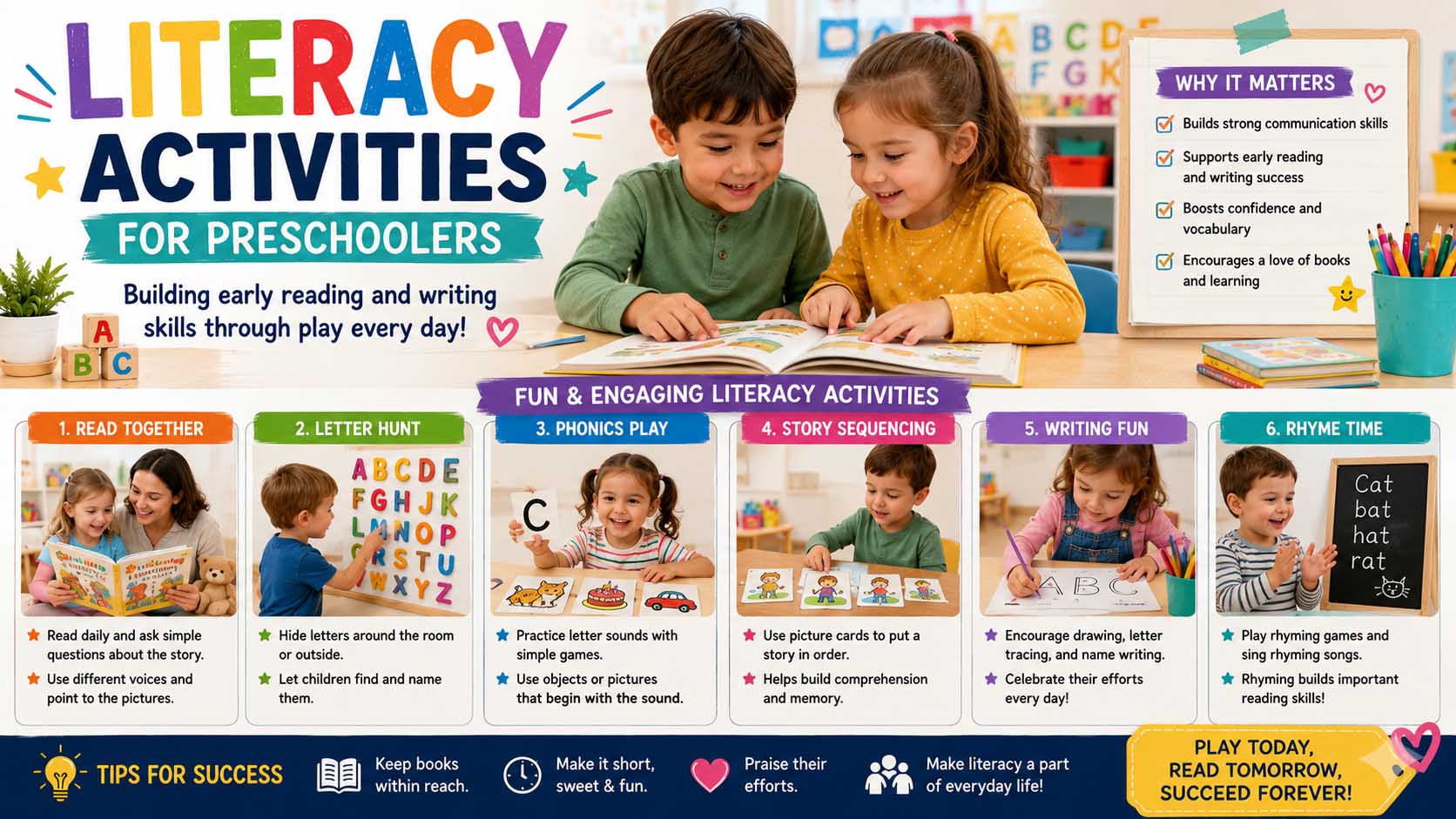
Literacy Activities for Preschoolers: Fun Ways to Build Early Reading Skills
Preschool children do not need worksheets and long lessons to begin developing strong reading skills. In fact, some of the best literacy activities for preschoolers feel more like games than lessons. Singing rhymes, looking through picture books, matching letters, telling stories, and playing with sounds can all help children build the foundations they will eventually use for reading and writing.
At this age, the goal is not to make every child read independently. Instead, preschool literacy focuses on helping children notice sounds, recognize letters, understand spoken language, enjoy books, build vocabulary, and discover that printed words carry meaning. Therefore, short, playful activities usually work better than formal instruction.
Parents and teachers can also include literacy throughout the day. For example, children can identify letters on signs, tell a story about a drawing, find objects beginning with a certain sound, or help make a shopping list. As a result, early literacy becomes a natural part of everyday life.
What Do Preschool Literacy Activities Teach?
Early literacy covers several connected abilities that develop before and during the beginning stages of reading.
For example, children learn that books contain stories, words have meaning, sentences are made of words, and spoken words contain smaller sounds. Meanwhile, they begin recognizing letters and connecting some letters with their sounds.
One major part of early literacy is phonological awareness. Parents who wonder what is phonological awareness can think of it as a child’s ability to notice and work with sounds in spoken language. For instance, recognizing rhyming words, clapping syllables, and identifying the first sound in “sun” all involve phonological awareness.
At the same time, preschoolers build vocabulary and oral language by listening, talking, asking questions, and telling stories. Therefore, a balanced literacy routine should include sounds, letters, books, conversations, drawing, and early writing rather than focusing on only one skill.
10 Fun Literacy Activities for Preschoolers
The best activities are usually simple enough to repeat regularly. Although teachers can use them in the classroom, parents can easily adapt most of these ideas for home.
1. Go on an Alphabet Hunt
Choose one letter and ask children to find it around the classroom or home. For example, they might spot the letter B on a cereal box, book cover, poster, or toy package.
Afterward, ask children to say the letter’s name and, when appropriate, its common sound.
You can also place letter cards around a room and let children collect them. Because children move while learning, this version works especially well for energetic preschoolers.
2. Play a Beginning-Sound Game
Place several familiar objects on a table, such as a ball, cup, spoon, toy car, and sock. Then, say a sound and ask the child to choose the object that begins with it.
The child can then select the ball.
Activities like this provide a gentle introduction to phonics for reading because children begin connecting spoken sounds with the letters that commonly represent them.
However, keep the activity playful. If a child struggles, simply model the answer and try another example.
3. Make Rhyming Pairs
Rhyming games help children listen carefully to word endings. Start with familiar pairs such as cat-hat, sun-fun, or log-dog.
Then, place picture cards on a table and ask children to find matching rhymes.
You can also make silly rhymes together. For example, ask, “What rhymes with bear?” Even invented words can be useful because the goal is listening to sound patterns rather than testing vocabulary.
4. Clap the Syllables
Choose familiar words and clap once for each syllable.
For example:
cat = 1 clap
apple = 2 claps
banana = 3 claps
Next, try children’s names, classroom objects, animals, or foods. Because children already know these words, they can focus on hearing their parts.
Meanwhile, movement makes the activity more engaging. Children can clap, tap, stomp, or jump once for every syllable they hear.
5. Create a Story From Pictures
Choose three or four picture cards and place them in a row. Then, ask the child to invent a story connecting the pictures.
For example, pictures of a dog, puddle, umbrella, and house might inspire a story about a dog getting wet in the rain before running home.
At first, adults can help with prompts such as, “What happened first?” and “What happened next?”
Over time, children begin creating longer sequences independently. As a result, the activity develops vocabulary, imagination, sequencing, listening, and narrative skills without requiring children to read printed text.
Language and Literacy Activities for Preschoolers
Literacy development begins with language. Therefore, conversations can be just as valuable as letter games.
One easy activity is “describe the mystery object.” Put a familiar item inside a bag and provide clues without naming it. For instance, you might say, “It is round, you can throw it, and you can kick it.” Then, children guess the object.
Similarly, children can take turns describing objects themselves. Consequently, they practice choosing useful words and organizing their thoughts.
Songs and nursery rhymes also make effective language and literacy activities for preschoolers because repetition helps children remember new words and notice patterns in spoken language.
Meanwhile, reading aloud gives children access to vocabulary they may not hear during ordinary conversations. Pause occasionally to explain unfamiliar words, predict what might happen next, or discuss a character’s actions.
However, avoid stopping after every sentence to ask a question. Children should still have time to enjoy the story.
6. Match Uppercase and Lowercase Letters
Create two sets of cards: one with uppercase letters and another with lowercase letters. Then, ask children to match pairs such as A-a, M-m, and T-t.
Start with only a few familiar letters. Later, add more as the child becomes confident.
You can also use magnetic letters, foam letters, bottle-cap letters, or homemade cards.
These hands-on activities can complement phonics for kindergarten preparation because children become increasingly comfortable recognizing letters before encountering more structured reading instruction.
Still, preschoolers do not need to master every letter immediately. Frequent short practice usually works better than long memorization sessions.
7. Build Names With Letter Cards
A child’s own name is often one of the most meaningful words to introduce.
First, write the child’s name clearly on a card. Next, provide separate letter cards and ask the child to arrange them in the same order.
Once that becomes easy, remove the model and see whether the child can build the name independently.
Later, use classmates’ names, family members’ names, or simple familiar words.
Because the words have personal meaning, children often remain interested longer than they would with random vocabulary lists.
8. Read Interactive Picture Books
Picture-book reading becomes more powerful when children participate.
Before opening the book, look at the cover and ask what they think the story might be about. While reading, occasionally pause and invite them to predict what comes next.
Afterward, ask the child to retell one or two parts using the pictures as prompts.
Parents sometimes become concerned about when do kids start reading, especially when comparing one child with another. However, early reading development varies considerably. Preschool is generally a time to strengthen the underlying skills and positive reading habits that support later independent reading.
Therefore, shared reading should feel encouraging rather than like a test.
9. Try Letter-Sound Sorting
Create several categories using letters that children already recognize. Then, provide pictures of familiar objects.
For example, use B, M, and S as category labels. Children might place a ball under B, a moon under M, and a sock under S.
Initially, emphasize the first sound of each word. Then, help children connect that sound with the correct printed letter.
This activity works well because it combines visual recognition, listening, vocabulary, and categorization.
If a child makes a mistake, say the word slowly and emphasize its first sound. Consequently, the correction becomes another learning opportunity rather than a failure.
10. Encourage Early Writing Through Drawing
Preschool writing does not have to look like adult handwriting.
Children may begin with scribbles, shapes, pretend writing, letter-like forms, and individual letters. Therefore, give them plenty of opportunities to experiment with pencils, crayons, markers, and chalk.
For example, ask children to draw a picture and tell you about it. Then, write their spoken sentence underneath the picture.
Over time, encourage them to add a letter, their name, or a simple label themselves.
This process teaches an essential idea: spoken language can be represented in print.
Small Group Literacy Activities for Preschoolers
Small groups allow teachers to give children more individual attention while keeping activities social.
For example, four children can work together on a letter-sorting activity. Meanwhile, another small group might sequence picture cards or listen for rhyming words.
Teachers can also adjust difficulty more easily. One group may practice recognizing letters, while another may match letters to beginning sounds.
Games involving high-frequency words may become useful later. Still, understanding phonics vs sight words can help adults avoid relying too heavily on memorized words before children develop a foundation in sounds and letters.
Useful small-group activities include shared picture-book reading, alphabet bingo, sound sorting, story sequencing, name building, rhyming games, and collaborative storytelling.
Generally, 10 to 15 minutes is enough for many preschool groups. Since young children have limited attention spans, ending while they are still interested can make them more eager to participate next time.
Printable Literacy Activities for Preschoolers
Printable resources can be useful when they provide meaningful practice. For instance, children might match pictures to beginning letters, trace their names, connect rhyming pictures, sequence a simple story, or identify a target letter among several choices.
However, worksheets should not replace conversation, play, books, and hands-on activities.
When choosing printable literacy activities for preschoolers, look for pages with clear instructions, large images, limited visual clutter, and age-appropriate tasks.
Likewise, avoid expecting preschoolers to complete many pages at once. One short printable activity followed by a hands-on game can create a better learning experience.
Teachers can also reuse printables by placing them inside dry-erase sleeves. As a result, children can practice tracing or matching multiple times without using a new sheet.
A Simple Weekly Preschool Literacy Routine
A literacy routine does not need to be complicated. Instead, rotate activities so children practice several skills across the week.
| Day | Main Activity | Skill Practiced |
|---|---|---|
| Monday | Alphabet hunt | Letter recognition |
| Tuesday | Rhyming game | Sound awareness |
| Wednesday | Interactive picture book | Vocabulary and comprehension |
| Thursday | Letter-sound sorting | Early phonics |
| Friday | Draw and tell a story | Oral language and early writing |
Of course, reading aloud can happen every day. Likewise, songs, conversations, and environmental print can appear naturally throughout the routine.
This approach also keeps language literacy activities for preschoolers varied. Consequently, children practice several connected skills without repeating the same type of lesson each day.
Common Mistakes to Avoid
One common mistake is pushing children toward independent reading before they have developed the skills that support it. Instead, focus on listening, speaking, sounds, letters, books, and positive experiences with print.
Another mistake is turning every literacy activity into a quiz. Constantly asking, “What letter is this?” can become tiring. Therefore, mix questions with modeling, storytelling, games, and exploration.
Likewise, avoid comparing children. Some preschoolers recognize many letters early, while others develop those abilities later.
Finally, do not rely entirely on screens. Educational apps can provide useful practice, yet children also need conversations, physical books, drawing, movement, pretend play, and hands-on materials.
FAQs About Preschool Literacy Activities
How long should a preschool literacy activity last?
Many activities work well in about 5 to 15 minutes. However, follow the child’s interest. If children remain engaged, an activity can continue longer. If they lose interest quickly, switch to something more active.
Should preschoolers learn sight words?
Some preschoolers naturally recognize common words, especially their own names. Still, early literacy should include strong attention to spoken sounds, letters, vocabulary, and books rather than focusing mainly on memorizing word lists.
What literacy activities can parents do at home?
Parents can read picture books, sing rhymes, play letter hunts, clap syllables, tell stories from pictures, practice names, and identify beginning sounds. Everyday conversations also build valuable language skills.
Do preschool literacy activities need worksheets?
No. In fact, many effective preschool literacy activities require no worksheets at all. Books, toys, magnetic letters, songs, drawings, household objects, and conversations can provide plenty of meaningful practice.
How often should preschoolers practice literacy?
Short literacy experiences can happen every day. However, they do not need to resemble formal lessons. Reading at bedtime, talking during meals, spotting letters outside, and singing in the car all provide opportunities to practice.
Keep Early Literacy Playful and Meaningful
The most useful literacy activities for preschoolers help children become curious about sounds, letters, words, books, and stories. Therefore, choose activities that encourage participation instead of demanding perfect answers.
Read together often, talk about interesting things, play sound games, experiment with letters, and give children opportunities to draw and tell stories. Then, adjust activities as their abilities grow.
Above all, keep early literacy connected to enjoyable experiences. When children associate books, language, and learning with curiosity and success, they build a strong foundation for the reading and writing skills they will develop throughout school.