
Steps to Becoming a Doctor: Complete Education and Career Guide
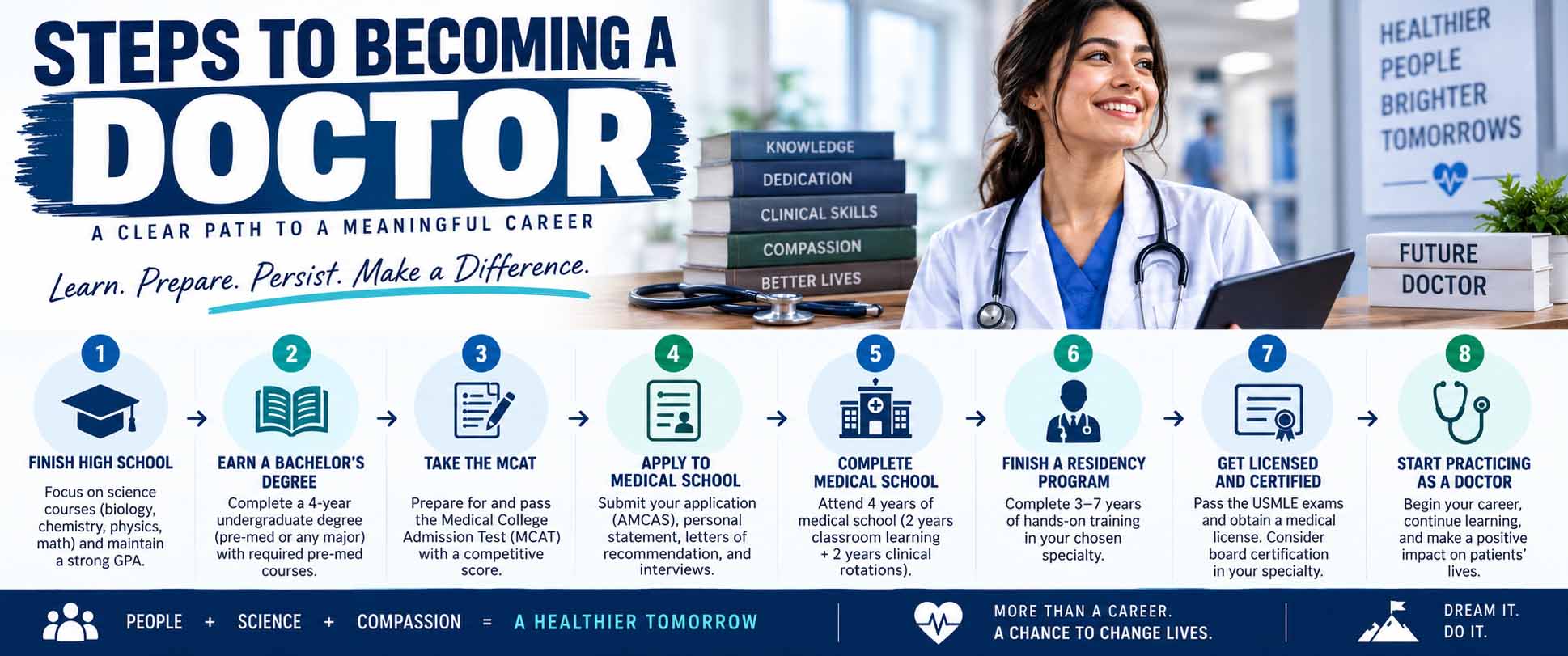
Steps to Becoming a Doctor: Complete Education and Career Guide
Becoming a physician takes years of education, clinical training, exams, and supervised practice. However, understanding the steps to becoming a doctor makes the journey much easier to plan. In the United States, students generally complete a bachelor’s degree, attend medical school, enter a residency program, meet licensing requirements, and then begin independent medical practice. Some doctors also complete fellowship training when they want to specialize further.
The path is demanding, but you do not have to plan everything at once. Instead, focus on the next educational milestone while building the academic and practical skills needed for the stage that follows.
What Are the Steps to Becoming a Doctor?
The typical path to becoming a physician in the U.S. looks like this:
| Stage | Typical Length | Main Goal |
|---|---|---|
| Bachelor’s degree | About 4 years | Complete undergraduate education and medical school prerequisites |
| Medical school | About 4 years | Study medicine and develop clinical skills |
| Residency | About 3–7 years | Train in a medical specialty under supervision |
| Fellowship | Varies | Optional advanced subspecialty training |
| Licensure | Requirements vary | Meet state requirements to practice medicine |
Altogether, becoming a doctor usually requires at least 11 years of education and training after high school when combining four years of college, four years of medical school, and a residency of at least three years. However, the total can be longer depending on the specialty, individual path, and additional training.
Students should view this timeline as a general guide rather than a guarantee. For instance, gap years, combined programs, research, or longer residency programs can change the total.
Step 1: Complete High School and Build a Strong Foundation
The journey begins well before medical school. During high school, students can prepare by developing strong skills in science, mathematics, reading, writing, and communication.
Courses such as biology, chemistry, physics, and mathematics can provide useful preparation. Still, students should not neglect English and other subjects because doctors need strong communication and critical-thinking abilities.
At this stage, you can also explore healthcare careers through volunteering, job shadowing, health-related clubs, or community activities when appropriate opportunities are available.
You do not need to have your entire career planned as a teenager. In fact, students asking What Should I Major In may benefit from exploring several academic interests before choosing a college program.
Step 2: Earn a Bachelor’s Degree
After high school, the next major step is completing undergraduate education.
Many future doctors choose majors such as biology, chemistry, biochemistry, or neuroscience. However, medical schools generally do not require every applicant to major in the same subject.
Instead, applicants need to meet the prerequisite coursework and admission requirements of the medical schools they plan to apply to. Those requirements can vary, so students should research individual schools rather than relying on a single universal course list.
A science major can make completing prerequisites convenient, but another major may also work if you complete the necessary courses.
For example, students comparing undergraduate degree options may want to understand the difference between ba and bs, since either degree can potentially be part of a premedical path depending on the program and completed coursework.
Build More Than a Strong GPA
Grades matter because medical school is academically challenging. However, a competitive application usually involves more than classroom performance.
During college, students may participate in activities such as clinical volunteering, physician shadowing, research, community service, campus organizations, or paid healthcare work.
Still, avoid treating extracurricular activities as boxes to check. Instead, choose meaningful experiences that help you understand healthcare, service, teamwork, and the responsibilities physicians carry.
Step 3: Prepare for and Take the MCAT
For many students pursuing medical school in the United States, the Medical College Admission Test, or MCAT, is another major milestone.
The exam assesses knowledge and reasoning across areas relevant to medical education. Therefore, students usually prepare after completing much of the foundational coursework needed for the test.
A good preparation plan should begin with your current strengths and weaknesses. First, review the exam structure and content areas. Next, create a realistic study schedule. Then, combine content review with practice questions and full-length practice exams.
Instead of studying intensely for a few days and then stopping, aim for consistent preparation.
Your MCAT score is one part of a medical school application. Medical schools may also review academic history, experiences, essays, recommendations, and other application components.
Step 4: Apply to Medical School
Applying to medical school requires organization because students often need to manage several requirements at once.
Applications can involve academic records, MCAT scores, personal statements, activity descriptions, recommendation letters, secondary applications, and interviews.
Start preparing well before deadlines. For example, request recommendation letters early and keep a record of your meaningful academic, clinical, service, and leadership experiences.
Your personal statement should explain your motivation for pursuing medicine through specific experiences rather than relying on generic claims.
Likewise, during interviews, applicants should be ready to discuss why they want to become physicians, what they learned from their experiences, and how they approach ethical or interpersonal situations.
Step 5: Complete Medical School
Medical school typically lasts four years in the United States, although program structures can differ.
During the earlier portion of medical school, students build knowledge in areas such as anatomy, physiology, pathology, pharmacology, and other medical sciences. Programs may integrate clinical experiences into these years as well.
Later, students spend substantial time in clinical rotations. During these experiences, they work with healthcare teams and encounter fields such as internal medicine, surgery, pediatrics, psychiatry, family medicine, and obstetrics and gynecology.
Clinical rotations can help students identify which specialties fit their interests, abilities, and preferred working environment.
At this point, it also becomes easier to understand the broader types of doctorate degrees because a professional medical doctorate follows a very different training path from many research-focused or academic doctoral programs.
Step 6: Choose a Medical Specialty
During medical school, students eventually need to consider what type of medicine they want to practice.
Possible specialties include family medicine, internal medicine, pediatrics, emergency medicine, surgery, psychiatry, anesthesiology, radiology, and many others.
Do not choose based only on salary or prestige. Instead, consider the type of patients you enjoy working with, preferred work environment, procedures, training length, lifestyle expectations, and the kind of medical problems that interest you.
Clinical rotations are especially useful here because firsthand experience can change your expectations about a specialty.
Talking with residents and practicing physicians can also provide a more realistic picture of daily work.
Step 7: Enter a Residency Program
Graduating from medical school does not mean training is finished.
New physicians generally continue into residency, where they receive intensive supervised training in their chosen specialty.
Residency length depends on the specialty. Some programs take around three years, while others require substantially longer training.
Residents care for real patients while working under experienced physicians. As their knowledge and skills grow, they gradually take on greater responsibility.
This stage can involve long hours and significant pressure. Therefore, time management, communication, teamwork, and healthy study habits become especially valuable.
When exploring healthcare careers, students may also encounter physician assistants and nurse practitioners. Understanding the difference between pa and np can help clarify how those careers differ from the physician training route and from each other.
Step 8: Meet Medical Licensing Requirements
Physicians must meet licensing requirements before practicing independently.
In the U.S., specific requirements vary by state and by the physician’s educational pathway. They generally involve graduating from an appropriate medical program, completing required postgraduate training, passing required licensing examinations, and submitting documentation to the relevant state medical board.
Because regulations can change, students and physicians should check current requirements directly with official licensing bodies rather than relying on an old checklist.
Licensure and board certification are also different concepts. A medical license provides legal authorization to practice medicine within the applicable jurisdiction, while specialty board certification is a separate professional credential with its own requirements.
Step 9: Consider Fellowship or Subspecialty Training
Not every physician needs a fellowship.
However, doctors who want advanced training in a narrower subspecialty may pursue one after residency. The exact pathway and duration depend on the specialty.
For example, a physician may complete a broader residency and later train in a more focused area within that field.
This extra training increases the total steps to becoming a medical doctor, so students should account for it when estimating how long their preferred career pathway could take.
Although students sometimes ask What Is a Master’s Degree? while researching graduate education, a master’s degree is not the standard qualification that makes someone a physician in the United States. Medical education follows its own professional degree and postgraduate training pathway.
Steps to Becoming a Doctor Timeline
A high school student looking ahead might picture the steps to becoming a doctor timeline like this:
Years 1–4 after high school: Complete a bachelor’s degree and required premedical coursework.
Around the undergraduate years: Prepare for the MCAT, gain relevant experiences, and apply to medical schools according to your planned application cycle.
Next 4 years: Complete medical school.
Next 3–7+ years: Complete residency training, depending on specialty.
After residency: Begin practice after meeting applicable licensing requirements or continue into fellowship when specialized training is desired.
As a result, many physicians spend well over a decade preparing after high school.
However, the length should not discourage students who genuinely want the career. Breaking the process into individual stages makes the pathway much more manageable.
How to Prepare for the Long Medical Education Path
Strong students do not simply memorize large amounts of information. Instead, they develop study systems that help them understand, retain, and apply knowledge.
Use active recall rather than repeatedly rereading notes. For example, close your textbook and try to explain a biological process from memory.
Spaced review can also help. Rather than studying a topic once, revisit it at increasing intervals.
Meanwhile, practice questions can reveal gaps that passive reading may hide. After answering a question incorrectly, identify why you missed it and review the underlying concept.
Also, protect time for sleep, exercise, relationships, and interests outside school when possible. Medical training is long, so sustainable habits are more useful than constantly pushing yourself toward exhaustion.
Common Mistakes Future Doctors Should Avoid
One mistake is assuming you must major in biology. Although biology is common, the better choice is a major that fits your interests and allows you to complete the necessary medical school prerequisites.
Another mistake is waiting too long to research admission requirements. Because schools can differ, early planning can prevent missing coursework or other expectations.
Students also sometimes focus exclusively on grades. Academic performance matters, yet healthcare requires communication, professionalism, empathy, teamwork, and sound judgment as well.
Finally, do not compare your timeline too closely with someone else’s. Some students take gap years, change majors, conduct research, work before medical school, or follow nontraditional paths.
A slower route is still a route.
Steps to Becoming a Doctor in the US: FAQs
What are the steps to becoming a doctor after high school?
The typical path includes earning a bachelor’s degree, completing required premedical coursework, taking the MCAT when required for your target schools, applying to and completing medical school, finishing residency, and meeting state licensing requirements.
How long does it take to become a doctor?
A common minimum is around 11 years after high school: approximately four years of undergraduate education, four years of medical school, and at least three years of residency. Some specialties and fellowships require more time.
What degree do you need before medical school?
Most U.S. medical schools expect applicants to complete a bachelor’s degree or meet specific undergraduate education requirements. However, exact admissions policies vary by institution, so check each medical school’s current requirements.
Do you have to major in biology to become a doctor?
No. Students can choose different undergraduate majors as long as they meet the admission and prerequisite requirements for the medical schools they plan to attend.
Is medical school the final step?
No. Medical school graduates generally complete residency training before independent practice. Physicians must also satisfy applicable licensing requirements, while some choose further fellowship training.
What is the hardest step to becoming a doctor?
There is no single hardest stage for everyone. Some students find medical school admission particularly challenging, while others struggle more with demanding coursework, licensing exams, clinical training, or residency. Good planning and consistent study habits can make each stage more manageable.
Your Next Step Toward Medicine
The steps to becoming a doctor may look overwhelming when you see the entire pathway at once. Yet you only need to tackle one stage at a time.
If you are still in high school, build strong academic habits and explore healthcare careers.steps to becoming a doctor If you are entering college, choose a major that suits you while planning required premedical coursework. Later, focus on medical school admission, clinical education, residency, and licensure as each stage arrives.
Most importantly, use official medical school, testing, residency, and state licensing sources when making major decisions because requirements can change. With realistic expectations, consistent preparation, and genuine interest in patient care, you can turn a long medical education pathway into a series of achievable milestones.