
How Long Does It Take to Become a Doctor? Complete Education Timeline
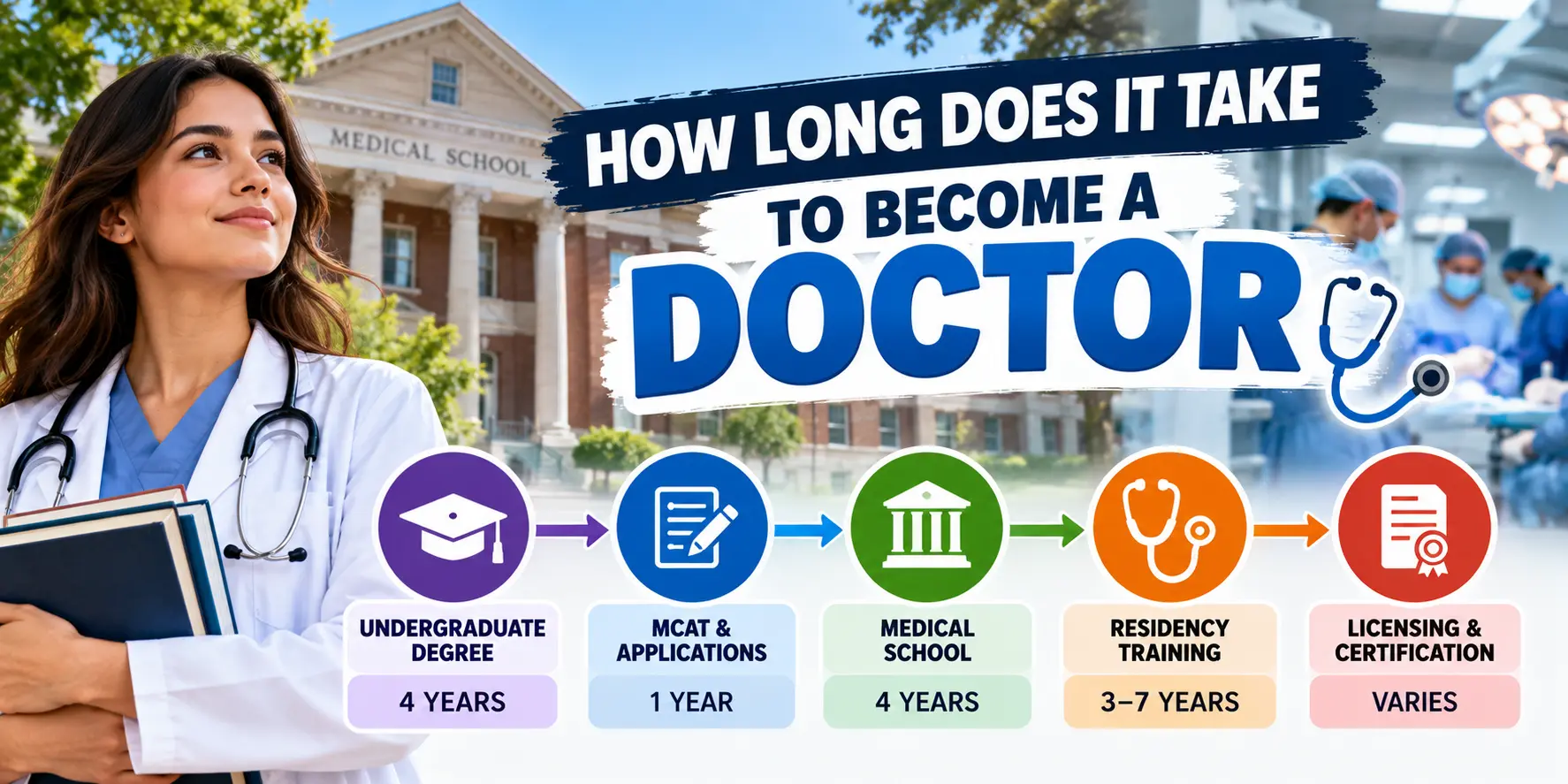
How Long Does It Take to Become a Doctor? Complete Education Timeline
If you’re thinking about a career in medicine, one of your first questions is probably: how long does it take to become a doctor? In the United States, becoming a fully trained physician generally takes 11–16 years or more after high school, depending on your specialty and whether you complete additional fellowship training.
Although that sounds like a long journey, each stage builds the knowledge and practical skills needed to care for patients.
First, students complete undergraduate education. Next, they attend medical school. After graduation, they enter residency training, where they gain supervised experience treating patients.
Some physicians also complete fellowships to specialize further.
However, the timeline varies by career goals, academic progress, and training requirements.
This guide explains every stage, compares medical specialties, and shares practical advice for students planning a future in medicine.
How Long Does It Take to Become a Doctor in the United States?
For most students, the traditional pathway includes three main stages: college, medical school, and residency.
Here’s a quick breakdown.
| Education Stage | Typical Duration | Main Purpose |
|---|---|---|
| Undergraduate degree | 4 years | Complete college education and medical school prerequisites |
| Medical school | 4 years | Learn medical science and develop clinical skills |
| Residency | 3–7 years | Receive supervised specialty training |
| Optional fellowship | 1–3+ years | Develop advanced subspecialty expertise |
| Total | 11–16+ years | Complete training for independent medical practice |
For example, someone pursuing family medicine may finish the standard pathway in approximately 11 years after high school.
Meanwhile, a student pursuing a surgical specialty may spend considerably longer in training.
Therefore, your intended specialty plays a major role in determining the total timeline.
Step 1: Complete an Undergraduate Degree
Typical duration: 4 years
The first stage usually involves earning a bachelor’s degree from an accredited college or university.
However, medical schools generally don’t require students to major in biology or another specific science.
Instead, applicants must complete the prerequisite courses required by their chosen medical schools.
These commonly include biology, chemistry, physics, mathematics, and English or writing courses.
Choosing the Right College Major
Many future physicians major in biology, chemistry, biochemistry, or neuroscience.
However, students can also pursue humanities, psychology, or other subjects while completing the necessary science coursework.
If you’re wondering What Should I Major In, consider your academic strengths, interests, and the prerequisites of medical schools you may apply to.
For example, a psychology major interested in psychiatry can still pursue medical school after completing the required science courses.
Does a BA or BS Matter?
Medical schools generally evaluate academic preparation rather than requiring one particular bachelor’s degree designation.
Therefore, understanding the difference between ba and bs can help you compare college programs without assuming that one degree automatically offers better admission prospects.
Strong grades, appropriate coursework, meaningful experiences, and a competitive application matter more than the degree abbreviation alone.
Step 2: Apply to Medical School
Application process: Often 1 year, overlapping with college
Many students apply to medical school during their final undergraduate year.
However, others take one or more gap years to gain experience or strengthen their applications.
Most U.S. medical schools consider several factors, including:
- Undergraduate academic performance
- Medical College Admission Test (MCAT) scores, where required
- Clinical exposure and volunteering
- Letters of recommendation
- Personal statements and interviews
- Research, service, and leadership experiences
Because admission is competitive, students should begin planning well before graduation.
The Association of American Medical Colleges’ guide to applying to medical school provides official information about preparing applications and understanding the admissions process.
For a broader overview of the steps to becoming a doctor, it helps to understand how academic preparation, applications, and clinical training connect.
Step 3: Attend Medical School
Typical duration: 4 years
After acceptance, students begin medical school.
In the United States, students generally pursue either a Doctor of Medicine (MD) or Doctor of Osteopathic Medicine (DO) degree.
Both pathways can lead to physician licensure and medical practice.
First Two Years: Medical Foundations
During the early portion of medical school, students study subjects such as:
- Human anatomy and physiology
- Pharmacology
- Pathology
- Microbiology
- Medical ethics
- Clinical reasoning
However, many modern programs introduce patient interactions and clinical skills earlier than traditional curricula did.
As a result, students may begin practicing communication and examination techniques from their first year.
Final Two Years: Clinical Rotations
Later, students spend substantial time working in supervised clinical settings.
Common rotations include internal medicine, surgery, pediatrics, psychiatry, obstetrics and gynecology, and family medicine.
During these experiences, students learn how physicians evaluate symptoms, develop treatment plans, and communicate with patients.
They also prepare for licensing examinations and residency applications.
Step 4: Complete Residency Training
Typical duration: 3–7 years
Residency begins after medical school graduation.
At this stage, graduates work as physicians in structured, supervised training programs.
Although residents have earned medical degrees, they must complete the required training and meet licensing requirements before practicing independently in their chosen roles.
Residency length depends mainly on specialty.
| Medical Specialty | Typical Residency Length |
|---|---|
| Family medicine | 3 years |
| Internal medicine | 3 years |
| Pediatrics | 3 years |
| Emergency medicine | 3–4 years |
| Psychiatry | 4 years |
| Anesthesiology | 4 years |
| General surgery | 5 years |
| Orthopedic surgery | 5 years |
| Neurological surgery | 7 years |
These are common U.S. training lengths. Individual programs and pathways may differ.
Consequently, students interested in longer surgical specialties should plan for additional years of education.
How Long Does It Take to Become a Doctor in Different Specialties?
Although every physician completes substantial training, some career paths take longer than others.
How Long Does It Take to Become a Family Doctor?
Students asking how long does it take to become a family doctor can generally expect approximately 11 years after high school.
The usual pathway includes four years of college, four years of medical school, and three years of family medicine residency.
Family physicians provide primary care to patients across different age groups.
Therefore, their training covers a broad range of medical conditions and preventive care.
How Long Does It Take to Become a Pediatric Doctor?
For students wondering how long does it take to become a pediatric doctor, the typical U.S. pathway also takes approximately 11 years.
After college and medical school, pediatricians generally complete a three-year pediatrics residency.
However, those pursuing pediatric subspecialties may need additional fellowship training.
How Long Does It Take to Become a Surgeon?
Surgeons typically spend more time in postgraduate training.
For example, general surgery residency commonly lasts five years.
Therefore, the standard pathway takes approximately 13 years after high school.
Some surgical specialties require longer residencies or additional fellowships.
When Do You Officially Become a Medical Doctor?
Students typically earn an MD or DO degree after approximately eight years of college and medical school.
However, earning the degree doesn’t mean they have completed the training needed for independent specialty practice.
Residency usually adds at least three more years.
Therefore, the distinction between earning a medical degree and completing postgraduate training matters when comparing timelines.
Step 5: Consider Fellowship Training
Typical duration: 1–3+ additional years
Some physicians pursue fellowship training after residency.
For example, an internal medicine physician may complete additional training in cardiology, gastroenterology, or another subspecialty.
Likewise, pediatricians may specialize in areas such as pediatric cardiology or neonatology.
However, fellowships aren’t necessary for every physician.
Students comparing medical education with other advanced academic pathways may find it helpful to explore the types of doctorate degrees, since professional medical degrees and research doctorates serve different purposes.
How Much Does It Cost to Become a Doctor?
Medical education can involve substantial expenses.
Students often pay for undergraduate tuition, medical school tuition, housing, textbooks, examinations, and application fees.
However, total costs vary widely by institution, residency status, financial aid, and personal circumstances.
Public universities may offer lower tuition to eligible in-state students, while private institutions often use different pricing structures.
For families asking Why Is College So Expensive, understanding tuition, living expenses, and financial aid can make long-term education planning easier.
Fortunately, scholarships, grants, institutional assistance, and certain service-based programs may help eligible students manage costs.
Students should compare each school’s published cost of attendance rather than focusing only on tuition.
Can You Become a Doctor Faster?
Some students complete their education through accelerated or combined programs.
For example, certain BS/MD pathways combine undergraduate and medical education into a structured program that may shorten the usual timeline.
However, admission is often highly competitive, and accelerated programs aren’t available everywhere.
Likewise, some medical schools offer three-year MD programs for selected students pursuing specific career pathways.
Even so, residency training remains necessary for most physicians seeking independent specialty practice.
Therefore, faster education doesn’t automatically eliminate postgraduate training requirements.
How Long Does It Take to Become a Naturopathic Doctor?
Students sometimes ask how long does it take to become a naturopathic doctor when comparing healthcare careers.
In jurisdictions that recognize licensed naturopathic doctors, the educational pathway commonly includes undergraduate preparation followed by a four-year naturopathic medical program.
However, naturopathic education differs from MD and DO physician training.
Licensing, permitted services, and professional regulation also vary considerably by location.
Therefore, students should verify program accreditation and local licensing rules before choosing this career.
Practical Tips for Students Planning a Medical Career
Although becoming a physician requires years of preparation, students can make the journey more manageable through early planning.
Build Strong Science Foundations
First, focus on understanding biology, chemistry, and mathematics.
Rather than memorizing every fact, practice explaining concepts and applying them to new problems.
Explore Healthcare Before Committing
Next, seek appropriate volunteering, shadowing, or healthcare-related experiences.
These opportunities can help you understand patient care and determine whether medicine matches your interests.
Develop Consistent Study Habits
Medical education involves large amounts of information.
Therefore, practice active recall, spaced repetition, and regular self-testing.
For example, reviewing material throughout the week is generally more manageable than relying entirely on last-minute studying.
Protect Your Well-Being
Finally, maintain realistic expectations about workload and personal responsibilities.
Medicine can be rewarding, but the training process also requires sustained effort.
Building supportive relationships and healthy routines can help you manage academic demands.
Frequently Asked Questions
Can You Become a Doctor in Eight Years?
You can typically earn an MD or DO degree after approximately eight years of undergraduate and medical education.
However, residency training usually adds another three to seven years before completion of specialty training.
What Is the Shortest Path to Becoming a Doctor?
In the traditional U.S. pathway, family medicine, internal medicine, and pediatrics are among the specialties with three-year residencies.
Therefore, these pathways commonly take around 11 years after high school.
Accelerated programs may shorten the educational portion for eligible students.
Is Medical School Harder Than College?
Medical school generally involves more intensive medical coursework, clinical responsibilities, and professional examinations.
However, individual experiences vary depending on preparation, learning habits, and support.
Do Doctors Get Paid During Residency?
Yes. Residents generally receive salaries while completing supervised postgraduate medical training.
However, compensation varies by institution, training year, and location.
Is Becoming a Doctor Worth the Time?
That depends on your interests, career goals, financial circumstances, and willingness to complete lengthy training.
Students who enjoy science, problem-solving, and patient care may find medicine a meaningful career.
Planning Your Journey Into Medicine
Becoming a physician is a long-term commitment, but understanding the timeline can make the process feel more manageable.
For most U.S. students, the traditional route requires four years of college, four years of medical school, and at least three years of residency.
Specialty training and optional fellowships may extend that timeline.
If you’re still in school, start by exploring medical careers, strengthening your science knowledge, and researching college prerequisites.
Then, build a realistic academic and financial plan that fits your goals.
The best first step isn’t rushing through the process. It’s choosing a pathway that prepares you to become a knowledgeable, capable, and responsible physician.