
Public Health Careers: Real Jobs, Degree Levels and How to Get Started
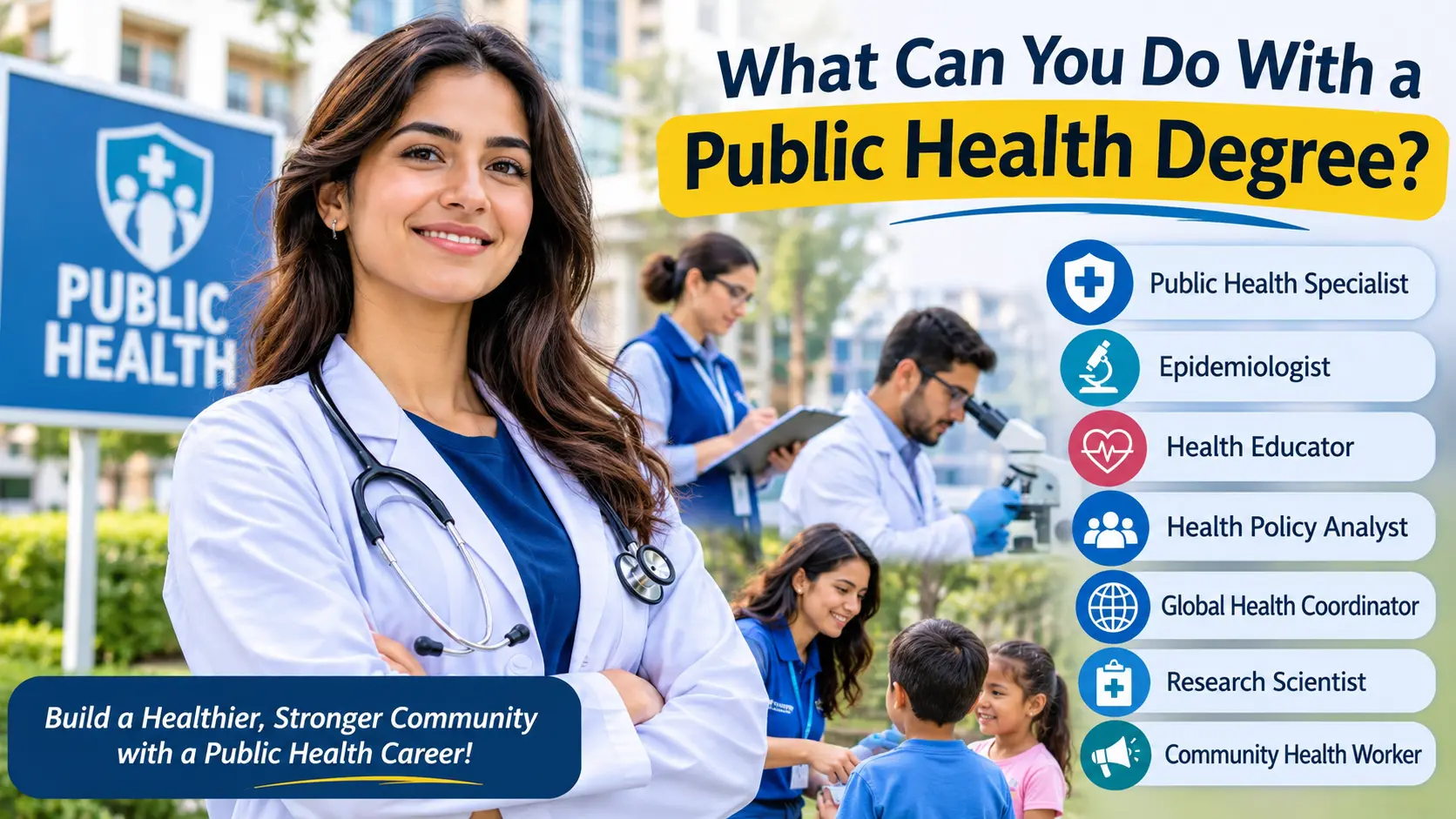
Public Health Careers: Real Jobs, Degree Levels and How to Get Started
Picture a college sophomore staring at a course catalog and wondering, “Will this major actually lead to a job?” If public health is on your list, you are probably asking the same thing: what can you do with a public health degree? Honestly, the answer is “a lot more than most people think.” In fact, public health graduates work in hospitals, government offices, schools, nonprofits and even tech companies.
In this guide, you will see real job options, what each degree level unlocks and how to make your degree work harder for you.
What Can You Do With a Public Health Degree? The Short Answer
Basically, a public health degree prepares you to protect and improve the health of whole communities. So instead of treating one patient at a time, you help prevent problems for thousands of people at once.
For example, you might teach teens about vaping risks, track a flu outbreak or help a city plan safer bike lanes. Likewise, you could analyze health data, write policy or run a community clinic program.
As a quick overview, here are the main career areas:
- Health education and community outreach
- Environmental and workplace safety
- Data, research and disease tracking
- Health policy and program management
What Public Health Actually Means
Simply put, public health is the science of keeping people healthy before they get sick. Therefore, it covers clean water, vaccines, nutrition, mental health, safe workplaces and much more.
At the undergraduate level, colleges usually offer either a Bachelor of Arts or a Bachelor of Science in public health. Generally, the BA leans toward social sciences and policy, while the BS adds more biology, chemistry and statistics. If you are torn between the two, understanding the difference between ba and bs can help you pick the track that fits your goals.
Jobs You Can Get With a Public Health Bachelor Degree
Good news first: you do not always need grad school to start working. Actually, if you are wondering what can you do with a public health bachelor degree, these entry-level paths are a great place to begin.
1. Health Education Specialist
In this role, you teach people how to live healthier lives. For instance, you might run workshops on diabetes prevention or create social media campaigns about sleep. Also, many health educators earn the Certified Health Education Specialist (CHES) credential to stand out.
2. Community Health Worker
Next, community health workers act as a bridge between families and health services. Typically, they help people find clinics, sign up for insurance or manage long-term conditions. Because the work is so personal, strong people skills matter as much as your degree.
3. Environmental Health Specialist
Meanwhile, environmental health specialists check things like restaurant safety, water quality and air pollution. As a result, they help stop illnesses before they spread. Usually, a BS with extra science classes works best for this path.
4. Occupational Health and Safety Specialist
Similarly, these specialists protect workers. For example, they inspect factories, construction sites and offices for hazards, then recommend fixes.
5. Public Health Program Coordinator
Finally, program coordinators keep health projects running. In other words, they plan events, manage budgets, track results and report to funders. So if you love organizing, this could be your fit.
Careers That Open Up With an Advanced Public Health Degree
On the other hand, some roles need more education. Most often, students choose a Master of Public Health (MPH), but a Master of Science in epidemiology or biostatistics is also common. Before applying, it helps to compare the types of masters degrees so you pick the one that matches the job you want.
Epidemiologist
Basically, epidemiologists are disease detectives. They study patterns of illness and injury, then help leaders respond. According to the U.S. Bureau of Labor Statistics, epidemiologists typically need at least a master’s degree, and their median annual wage was $87,220 in May 2025.
Health Policy Analyst and Biostatistician
Next up, health policy analysts study laws and programs to see what works. Meanwhile, biostatisticians use math and coding to make sense of health data. Both roles often start with a master’s. However, if you want to lead major research or teach at a university, learning about the types of doctorate degrees, such as the PhD and DrPH, is a smart next step.
Public Health Degree Jobs at a Glance
To make comparing easier, here is a quick-reference table.
| Job | Typical Starting Degree | Main Focus |
|---|---|---|
| Health Education Specialist | Bachelor’s | Teaching healthy habits |
| Community Health Worker | Varies (often less than a bachelor’s) | Connecting families to care |
| Environmental Health Specialist | Bachelor’s (science-heavy) | Food, water and air safety |
| Occupational Safety Specialist | Bachelor’s | Workplace hazards |
| Program Coordinator | Bachelor’s | Running health projects |
| Health Data Analyst | Bachelor’s or Master’s | Turning data into insights |
| Epidemiologist | Master’s | Tracking disease patterns |
| Health Policy Analyst | Master’s | Studying laws and programs |
| Biostatistician | Master’s or PhD | Advanced health statistics |
As the table shows, there are paths for every level, so you can start working early and keep growing.
Is a Public Health Degree Right for You?
Of course, a list of jobs only helps if the field fits you. So ask yourself a few honest questions:
- Do I care about helping large groups of people?
- Am I curious about why some communities get sick more often?
- Do I enjoy science, data or teaching?
- Would I like a career with many possible directions?
If you said yes to most of these, public health could be a strong match. Still, if you feel unsure, reading a guide like What Should I Major In can help you compare it with other options before you commit.
How to Get the Most From Your Public Health Degree
Above all, your degree is only part of the story. In fact, employers also look for real experience and practical skills.
Build Hands-On Experience Early
First, look for volunteer roles at local clinics, food banks or health departments. Then, aim for at least one internship before graduation. If you have never applied for one, learning how to get an internship step by step can make the process feel much less scary.
Learn Skills Employers Want
Next, focus on skills that travel well across jobs. For example, Excel, basic statistics, survey design and clear writing all come up again and again. Also, a second language can be a huge plus in community-facing roles.
Common Mistakes to Avoid
Unfortunately, many students wait until senior year to explore careers. Instead, start talking to professionals in your first or second year. Similarly, avoid picking classes only because they seem easy. After all, the right electives can point you toward a clear specialty.
Student Questions, Answered
Is a public health degree worth it?
For most students who enjoy health and helping others, yes. Because the field is so broad, you can move between education, data, policy and safety work over time.
Can you go to medical school with a public health degree?
Yes, you can. However, you will still need to complete the required pre-med science courses. In fact, many future doctors like public health because it teaches them how health problems start in communities.
What jobs can you do with a public health degree if you dislike math?
Good question. Luckily, roles like health education, community outreach and program coordination rely more on people skills than heavy math.
Your Next Steps
To sum up, a public health degree opens doors to meaningful, flexible careers. So this week, pick two jobs from the table that excite you. Then, look up one local organization that hires for each and read their job posts.
After that, note the skills they ask for and choose one to start building now. Little by little, those small moves turn a degree into a career you are proud of.