
When Do Kids Start Reading? A Parent-Friendly Guide to Reading Milestones
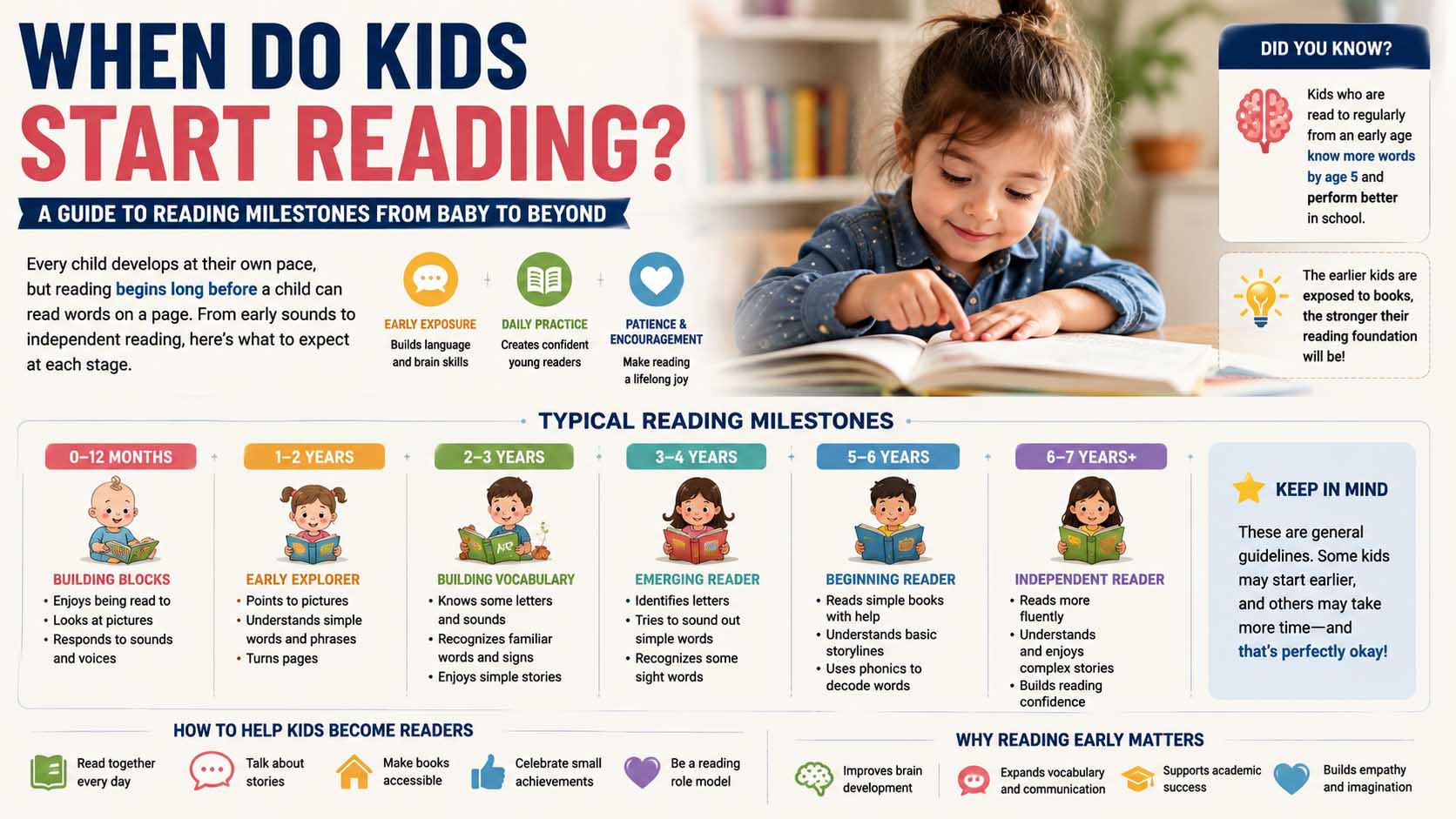
When Do Kids Start Reading? A Parent-Friendly Guide to Reading Milestones
Watching a child recognize a word for the first time can make parents wonder when do kids start reading independently. There is no single age when every child suddenly becomes a reader. Instead, reading develops gradually as children learn spoken language, notice print, recognize letters, connect letters with sounds, blend those sounds into words, and eventually understand sentences and stories. Many children begin reading simple words around ages 4 to 6, while stronger independent reading commonly develops during the early elementary years.
When Do Kids Start Reading on Their Own?
Most children build the foundations for reading long before they can independently read a book.
During the preschool years, children often recognize familiar signs, logos, letters, or their own names. Then, as they learn how letters represent sounds, they can begin decoding simple printed words.
By kindergarten and first grade, many children are learning to read short words and simple sentences. However, development varies considerably, so age alone should not determine whether a child’s reading development is on track.
Some children read recognizable words before kindergarten. Meanwhile, others need more time and structured instruction before reading becomes comfortable.
What matters most is steady development of the underlying skills.
When Do Most Kids Start Reading? A General Timeline
Although every child develops differently, broad milestones can help parents understand what reading development often looks like.
| Approximate Age | Common Literacy Development |
|---|---|
| 1–2 years | Enjoys being read to, points at pictures, learns new spoken words |
| 2–3 years | Recognizes favorite books, may finish familiar phrases |
| 3–4 years | Notices letters, recognizes some symbols and possibly their own name |
| 4–5 years | Learns more letter sounds and may begin reading simple words |
| 5–6 years | Starts decoding short words and reading beginner sentences |
| 6–7 years | Reads increasingly independently and builds fluency |
| 7–9 years | Reads longer texts and focuses more heavily on meaning |
| 9+ years | Uses reading increasingly as a tool for learning |
These ages are broad guides rather than deadlines.
For example, a 5-year-old who cannot independently read a story may still have strong language skills and be making appropriate progress. Likewise, a younger child who reads early does not necessarily remain academically ahead in every area.
The National Institute of Child Health and Human Development’s information on learning to read also emphasizes several skills involved in reading development, including phonemic awareness, phonics, fluency, vocabulary, and comprehension.
How Kids Start Reading and Developing Decoding Skills
Reading involves several skills working together. Therefore, simply memorizing lots of printed words is not the whole process.
Children first develop spoken-language skills and awareness of the sounds within words.
Next, they learn that written letters and letter combinations represent those sounds.
Afterward, they learn to blend sounds together to read words.
For example, a child might learn the sounds represented by m, a, and p. Then, the child blends those sounds to read map.
This connection between written symbols and speech sounds is central to phonics for reading, particularly during the beginning stages of literacy instruction.
As decoding becomes more automatic, children can direct more attention toward understanding what they read.
When Do Kids Start Reading Words?
Parents asking when do kids start reading words may actually be noticing several different skills.
A preschooler might recognize “STOP” on a familiar road sign. However, recognizing a memorized visual pattern is not necessarily the same as independently decoding an unfamiliar word.
True word reading becomes more apparent when a child can apply letter-sound knowledge to words they have not simply memorized.
For example, if a child learns to decode cat, then successfully reads hat, mat, and sat, the child is beginning to use a transferable reading strategy.
This process often becomes more noticeable around kindergarten and first grade.
Still, children should not face pressure to read before they have developed the necessary foundation.
Early Reading Skills Kids Need Before Reading Independently
Before children can effectively connect letters to sounds, they need awareness of the sounds within spoken language.
So, what is phonological awareness in practical terms? It is a broad ability to notice and work with the sound structure of spoken language, including words, syllables, rhymes, and individual speech sounds.
For example, a child may recognize that cat and hat rhyme. Later, the child may identify individual sounds within words.
These activities can happen without printed letters.
Once children can hear and manipulate sounds, teachers can connect those sounds to written letters through explicit phonics instruction.
As a result, oral language activities, rhyming games, songs, and sound play can support later reading development.
When Do Kids Usually Start Reading in Kindergarten?
Kindergarten is often a major transition from early literacy experiences toward more systematic reading instruction.
Children may learn letter names, letter sounds, sound blending, simple spelling patterns, and high-frequency words. Meanwhile, teachers often read stories aloud to develop vocabulary and comprehension.
Structured phonics for kindergarten can help children understand how the alphabetic system works rather than requiring them to guess unfamiliar words from pictures or context.
However, kindergarten reading expectations vary by school, curriculum, and country.
Therefore, parents should consider the child’s actual classroom expectations instead of comparing progress with random examples online.
By the end of kindergarten, many children can read some simple decodable text. Still, reading fluency continues developing well beyond this stage.
Phonics and Word Recognition
Beginning readers encounter both decodable words and frequently occurring words.
Therefore, parents sometimes wonder about phonics vs sight words and which method children should use.
These approaches do not need to compete.
Systematic phonics teaches children how written letters represent speech sounds, allowing them to decode unfamiliar words. Meanwhile, with practice, frequently encountered words can become recognizable quickly and automatically.
Some high-frequency words contain spelling patterns that children have not learned yet. Teachers can still draw attention to the regular and irregular parts of those words rather than treating every word as an arbitrary picture to memorize.
Over time, successful decoding helps many words become instantly recognizable.
Signs a Child Is Ready to Start Reading
Early literacy skills often appear during everyday activities rather than formal lessons.
A child may:
- Ask what written words say
- Recognize their own name
- Notice letters on signs
- Identify some letter sounds
- Enjoy rhymes and word games
- Pretend to read familiar books
- Retell a favorite story
- Track print while an adult reads
- Blend simple sounds together
- Attempt to write letters or words
No child needs to demonstrate every skill at a specific birthday.
Instead, look for gradual growth and curiosity about language and print.
How Parents Can Support Early Reading
Children benefit from reading experiences that are both enjoyable and instructional.
Read Aloud Regularly
Reading aloud exposes children to vocabulary and sentence structures that may be more advanced than their independent reading level.
While reading, occasionally discuss what is happening. For example, ask what a character might do next or why something happened.
However, avoid turning every page into a quiz. The story should still feel enjoyable.
Practice Sounds in Everyday Life
Simple sound games can build early literacy skills.
For example, ask a child to think of words that rhyme with cat. You can also practice breaking simple words into their individual sounds to build early phonological awareness.
Keep these activities brief and playful.
Choose Appropriately Challenging Books
A beginning reader needs text that allows practice with skills they have actually learned.
If every sentence contains unfamiliar patterns, reading may become frustrating.
On the other hand, books that are far too easy provide limited opportunities to build new skills.
Therefore, teachers and parents can gradually increase difficulty as the child’s decoding and comprehension improve.
Keep Books Easy to Reach
Children are more likely to explore books when they can access them independently.
A small basket or shelf with picture books, decodable books, nonfiction, comics, and favorite stories can encourage casual reading.
Variety matters as children grow because different types of reading build different experiences, from enjoying stories to learning facts and following instructions.
When Do Kids Start Reading Chapter Books?
Another common milestone involves reading chapter books without adult help.
Many children begin exploring early chapter books around ages 6 to 8, although there is a wide range.
Early chapter books usually contain short chapters, relatively large print, straightforward vocabulary, and occasional illustrations. Therefore, they provide a bridge between beginner readers and longer novels.
However, a child does not need to abandon picture books after beginning chapter books.
In fact, sophisticated picture books can contain challenging vocabulary, complex ideas, and rich storytelling. Therefore, children can benefit from both formats.
Also, listening to a parent or teacher read a chapter book aloud allows a child to enjoy stories above their current independent decoding level.
Reading Fluency Develops With Practice
Once children can decode words, they need practice becoming fluent.
Fluency involves reading accurately, at an appropriate pace, and with meaningful expression. However, speed alone should never be the goal.
A child who rushes through a paragraph but cannot explain it is not demonstrating strong reading comprehension.
Repeated reading of suitable texts can help build automatic word recognition. Meanwhile, listening to skilled adults read aloud gives children a model of phrasing and expression.
As decoding becomes easier, children have more mental capacity available for understanding ideas.
Reading Comprehension and Vocabulary Development
Reading words correctly is only part of successful reading.
Children also need to understand vocabulary, connect ideas, make reasonable inferences, remember information, and recognize how a text is organized.
Parents can support these abilities naturally.
After reading, you might ask:
- “What was your favorite part?”
- “What did you learn?”
- “Can you tell me what happened in your own words?”
These questions encourage conversation rather than testing.
Common Early Reading Mistakes Parents Can Avoid
Comparing one child with another is one of the easiest ways to create unnecessary worry.
Children develop at different rates. Therefore, compare a child’s progress over time rather than constantly comparing the child with siblings or classmates.
Another mistake is correcting every tiny error immediately. Sometimes, allowing a child a moment to work through a word encourages independence.
However, children should not be encouraged to simply guess unknown words from a picture. Instead, guide them toward the letter-sound information they have learned.
Also, avoid making reading a punishment. Requiring extra reading because a child behaved badly can accidentally make books feel negative.
When Reading Development Needs Extra Support
Occasional difficulty is normal during learning. However, persistent problems deserve attention rather than a “wait and see forever” approach.
Talk with the child’s teacher if the child consistently struggles to learn letter-sound relationships, blend sounds, recognize words, read accurately, or understand age-appropriate text.
Teachers can explain how the child is performing compared with instructional expectations and what support the school already provides.
Depending on the situation, the school may recommend targeted instruction, screening, or a more detailed evaluation.
Early support can be especially valuable because reading skills build on one another.
Reading is a learned skill, and some learners simply need more explicit instruction, more practice, or specialized support.
Frequently Asked Questions About When Kids Start Reading
Can a 3-Year-Old Learn to Read?
Some 3-year-olds recognize letters or familiar words, while a smaller number begin decoding simple words. However, independent reading is not a standard expectation for every 3-year-old. At this age, talking, playing with sounds, sharing books, and developing vocabulary are highly valuable.
Should a 4-Year-Old Be Reading?
A 4-year-old may begin reading simple words, but many children at this age are still developing foundational skills. Therefore, focus on letters, sounds, oral language, books, and enjoyment rather than demanding fluent reading.
Should a 5-Year-Old Be Able to Read?
Many 5-year-olds are beginning to decode simple words and sentences. However, development varies, and schooling experience also matters. A teacher can provide better context about an individual child’s progress.
At What Age Do Children Read Fluently?
Fluency generally develops progressively through the early elementary years rather than appearing at one specific age. Accurate decoding comes first, while speed, expression, vocabulary, and comprehension continue improving with practice.
Is Early Reading a Sign of High Intelligence?
Early reading can reflect advanced literacy development, strong interest, instruction, or other factors, but reading age alone does not measure overall intelligence. Children can show strengths in many different areas.
Helping Children Become Confident Readers
So, when do kids start reading? Many begin decoding simple words between ages 4 and 6, while independent and increasingly fluent reading develops through the early elementary years. However, there is a normal range, and one birthday should never become a rigid deadline.
Parents can help most by reading aloud, talking with children, playing with language sounds, providing systematic reading practice, and keeping books enjoyable and accessible. Meanwhile, if progress seems persistently difficult, talking with the child’s teacher can identify where support is needed.
Reading develops step by step. When children receive clear instruction, suitable practice, interesting books, and patient encouragement, those individual skills can gradually come together into confident, meaningful reading.