
Reading Log Printable: A Simple Way to Build Better Reading Habits
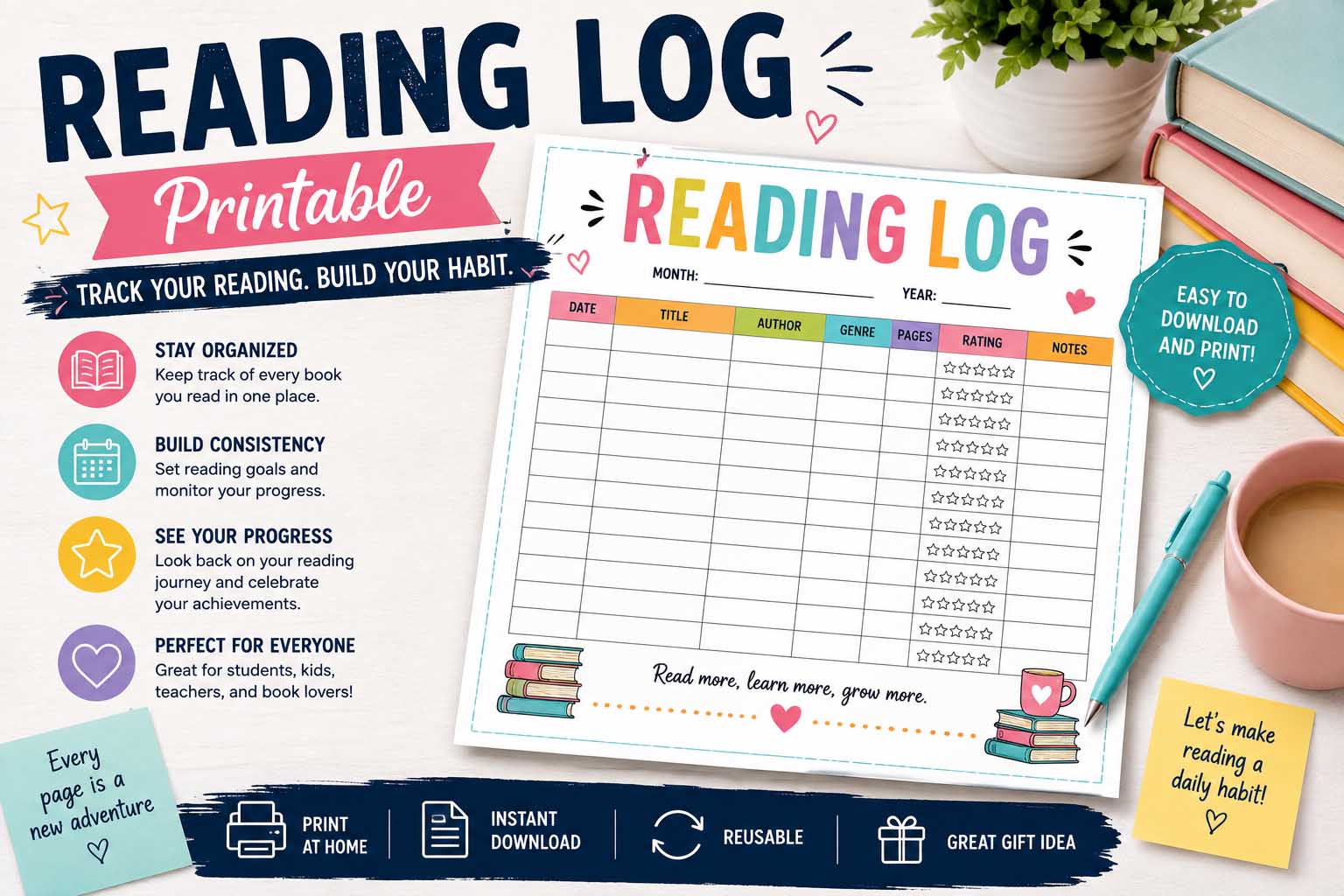
Reading Log Printable: A Simple Way to Build Better Reading Habits
Keeping track of reading does not have to feel like another homework assignment. A well-designed reading log printable gives students a simple place to record what they read, how long they spent reading, and what they learned from each session. Meanwhile, parents and teachers can use the same log to encourage consistency without turning reading into a complicated tracking exercise.
Reading logs can work for elementary students, middle school learners, homeschool families, classrooms, and independent readers. However, the format should match the student’s age and purpose. A young child may only need spaces for the book title and minutes read, while an older student can benefit from short summaries and reflections.
The best logs are simple enough to use regularly. Therefore, instead of tracking every possible detail, focus on information that actually supports the learner’s reading goals.
What Is a Reading Log?
A reading log is a record of a student’s reading activity over a set period. For example, students might record each book they read during a month or write down their daily reading time.
Teachers often use logs to encourage independent reading. Likewise, parents can use them at home to establish a regular routine. Older students may also use logs to remember key ideas from books or prepare for classroom discussions.
The exact information varies. Still, most reading logs include some combination of:
- Date
- Book title
- Author
- Pages read
- Minutes spent reading
- Short summary
- Student reaction
- Parent or teacher initials
Because students practice different types of reading depending on their purpose, a flexible log can also include space to identify whether they read fiction, nonfiction, poetry, informational text, or another format.
What Should a Reading Log Printable Include?
A useful reading log printable should provide enough structure to help the learner without creating unnecessary work.
For younger students, a simple layout usually works best. They might enter the date, title, and number of minutes they read. Meanwhile, older learners can record page ranges, new vocabulary, main ideas, or a brief response.
Here is a practical example:
| Date | Book Title | Pages | Minutes | Short Note |
|---|---|---|---|---|
| Sept. 3 | Example Book | 1–12 | 20 | Met the main character |
| Sept. 4 | Example Book | 13–27 | 25 | Learned about the main problem |
| Sept. 5 | Example Book | 28–40 | 20 | Predicted what may happen next |
The final column does not need to contain a full paragraph. In fact, one meaningful sentence can often show more understanding than a long response written simply to complete an assignment.
How to Use a Reading Log Printable Effectively
Printing a worksheet is easy. However, turning it into a helpful learning habit takes a little planning.
Choose a Realistic Reading Goal
First, decide what the student is trying to accomplish. A beginning reader may aim to read for 10 or 15 minutes each day. In contrast, an older learner might track chapters or pages rather than time.
Goals should feel achievable. Otherwise, students may start viewing the log as a record of failure rather than progress.
Fill In the Log Soon After Reading
Next, record the reading session while the details are still fresh. Waiting several days makes it easy to forget page numbers, reading time, or important events from the book.
Fortunately, this process should only take a minute or two for a basic log. Therefore, students can make it part of their normal routine: read, mark the stopping point, and complete one row.
Add a Meaningful Response When Appropriate
A summary can make the log more educational, particularly for older students. However, students do not need to retell every detail.
Instead, they might write what changed in the story, identify an important fact, explain a character’s decision, or record a question they still have.
This approach shifts attention from simply completing pages toward understanding what was read.
Free Printable Reading Log With Summary: When Is It Useful?
A free printable reading log with summary can be particularly helpful when comprehension matters as much as reading frequency.
For instance, a teacher might ask students to summarize each chapter in two sentences. Meanwhile, homeschool learners can use the summary area to practice identifying the central idea.
A good summary section should remain short. Otherwise, students may spend more time writing about reading than actually reading.
One practical format uses three prompts:
What happened or what did I learn?
Write one or two sentences about the most important information.
What stood out to me?
Record an interesting detail, idea, character, or event.
What do I think will happen next?
For suitable books, make a prediction based on evidence from the text.
These prompts encourage active thinking while keeping the worksheet manageable.
Reading Logs for Beginning Readers
Young learners need a different approach because they are still developing decoding, fluency, and word-recognition skills.
Therefore, kindergarten and early elementary logs should be visually simple. Large writing spaces, check boxes, smiley-face ratings, and short prompts usually work better than detailed tables.
Children who are learning phonics for reading may also benefit from recording unfamiliar words they successfully sounded out. That gives parents or teachers a useful picture of developing decoding skills without making the log feel like a test.
Using Logs During Early Phonics Instruction
For children working on phonics for kindergarten, adults can record most of the information while the child focuses on reading. For example, the adult might write the title and date while the child colors a star after completing the book.
As skills improve, the student can gradually take responsibility for filling in more of the worksheet.
This progression matters because handwriting and spelling demands should not overshadow the actual reading practice.
Printable Reading Log for Elementary Students
By elementary school, students can usually take more ownership of their reading records.
A printable reading log for this age group might include the book title, author, date, starting page, ending page, minutes read, and a one-sentence reaction.
However, avoid treating page totals as the only measure of progress. Some books contain dense text, while others use larger print or more illustrations. As a result, two students may make equally meaningful progress even when their page counts look very different.
Likewise, reading ability develops through several skills. Understanding phonics vs sight words, for instance, can help adults recognize why a child may read some familiar words instantly while needing to decode unfamiliar ones.
Reading Logs for Middle and High School Students
Older students generally need less monitoring and more reflection.
Instead of requiring a parent signature every evening, teachers might ask learners to maintain a weekly record. They can then add notes about themes, arguments, unfamiliar vocabulary, quotations, or questions for discussion.
At this level, reading logs can also support studying. A learner who records key ideas while reading has useful notes available before an assessment.
In that sense, a log can become part of a broader academic organization system. Students learning How to Make a Study Guide can use their reading notes as source material instead of trying to reconstruct an entire book or chapter shortly before a test.
How Teachers Can Keep Reading Logs Useful
Reading logs sometimes receive criticism because students may rush through them or treat them as paperwork. However, the problem often comes from how the activity is designed rather than from the idea of tracking reading itself.
Teachers can keep logs useful by limiting repetitive requirements. For example, instead of asking the same summary question every night, rotate prompts.
One day students might identify a new word. On another day, they could explain a character’s motivation. Later, they might write one question about the text.
Choice also helps. Allowing students to select from several response prompts can make the activity feel more personal.
Most of all, teachers should use the information students record. If nobody discusses the logs or responds to them, learners may quickly decide that completing them has little purpose.
Teachers and parents who want broader evidence-based guidance on supporting children’s literacy can also explore Reading Rockets’ reading resources, which cover reading instruction, comprehension, fluency, and literacy development.
How Parents Can Support a Daily Reading Routine
Parents can use a free printable reading log without making every reading session feel like an assignment.
Start by choosing a predictable reading period. For example, reading after dinner or before bedtime can become easier to remember than trying to find a different time every day.
Next, keep books within reach. Children are more likely to read independently when suitable books are easy to access.
Parents can also talk briefly about the book afterward. Instead of testing the child with many questions, ask something conversational such as, “What was your favorite part?” or “What surprised you?”
Then, let the child update the log. This small routine creates a visible record of progress.
Common Reading Log Mistakes to Avoid
The biggest mistake is making the log more demanding than the reading itself. If a child reads for 15 minutes but needs another 20 minutes to complete the worksheet, motivation can disappear quickly.
Another problem is rewarding only quantity. Reading more pages does not automatically mean better comprehension.
Parents and teachers should also avoid turning the log into a competition between children. Reading speed varies, while book difficulty and reading goals vary as well.
Finally, do not expect one format to suit every age. A picture-based chart can motivate a first grader, yet the same design may feel childish to a middle school student.
Reading Log Printable Free Options: Choosing the Right Format
When looking for a reading log printable free resource, choose the format according to the learner rather than selecting the worksheet with the most fields.
For early readers, look for large spaces, simple instructions, and visual elements. For elementary students, consider pages and minutes alongside a short reaction. Meanwhile, middle and high school students may benefit from vocabulary, summaries, themes, and reflection prompts.
Weekly logs work well when daily paperwork feels excessive. Monthly logs, on the other hand, provide a useful overview for students who already read independently.
You can also use separate sheets for different goals. For instance, one sheet might track daily reading, while another records completed books and ratings.
FAQs About Reading Logs
How Many Minutes Should a Student Read Each Day?
There is no single amount that fits every student. Age, reading ability, school expectations, and individual needs all matter. Therefore, follow the teacher’s requirements when applicable and choose a realistic routine at home.
Should Parents Sign a Reading Log?
A signature can help when schools use logs to confirm home reading. However, older independent readers may not need daily verification unless their teacher requests it.
Does a Reading Log Need a Summary?
No. Younger students can benefit from a simple record of books and reading time. Meanwhile, short summaries can become more useful as comprehension and academic reading demands increase.
Can Students Use the Same Reading Log for Nonfiction?
Yes. However, instead of describing characters or predicting story events, students can record the main idea, new facts, vocabulary, or questions about the topic.
Should Students Count Audiobooks?
That depends on the goal of the activity. Audiobooks can support engagement with stories and information, while independent print reading practices other skills. Therefore, teachers should clearly state what formats count toward a particular assignment.
Turn the Log Into a Reading Habit
A reading log printable works best when it stays simple, useful, and appropriate for the student’s age. Rather than focusing only on minutes or page counts, use the record to notice consistency, comprehension, interests, and gradual progress.
For younger readers, keep the process short and encouraging. Meanwhile, older students can use summaries and reflection notes to strengthen comprehension and prepare for classroom work.
Most importantly, the worksheet should support reading rather than compete with it. When students can complete their log quickly and see their progress over time, it becomes a practical learning tool instead of another piece of paperwork.