
Reading Levels by Grade: What Students Should Be Able to Read
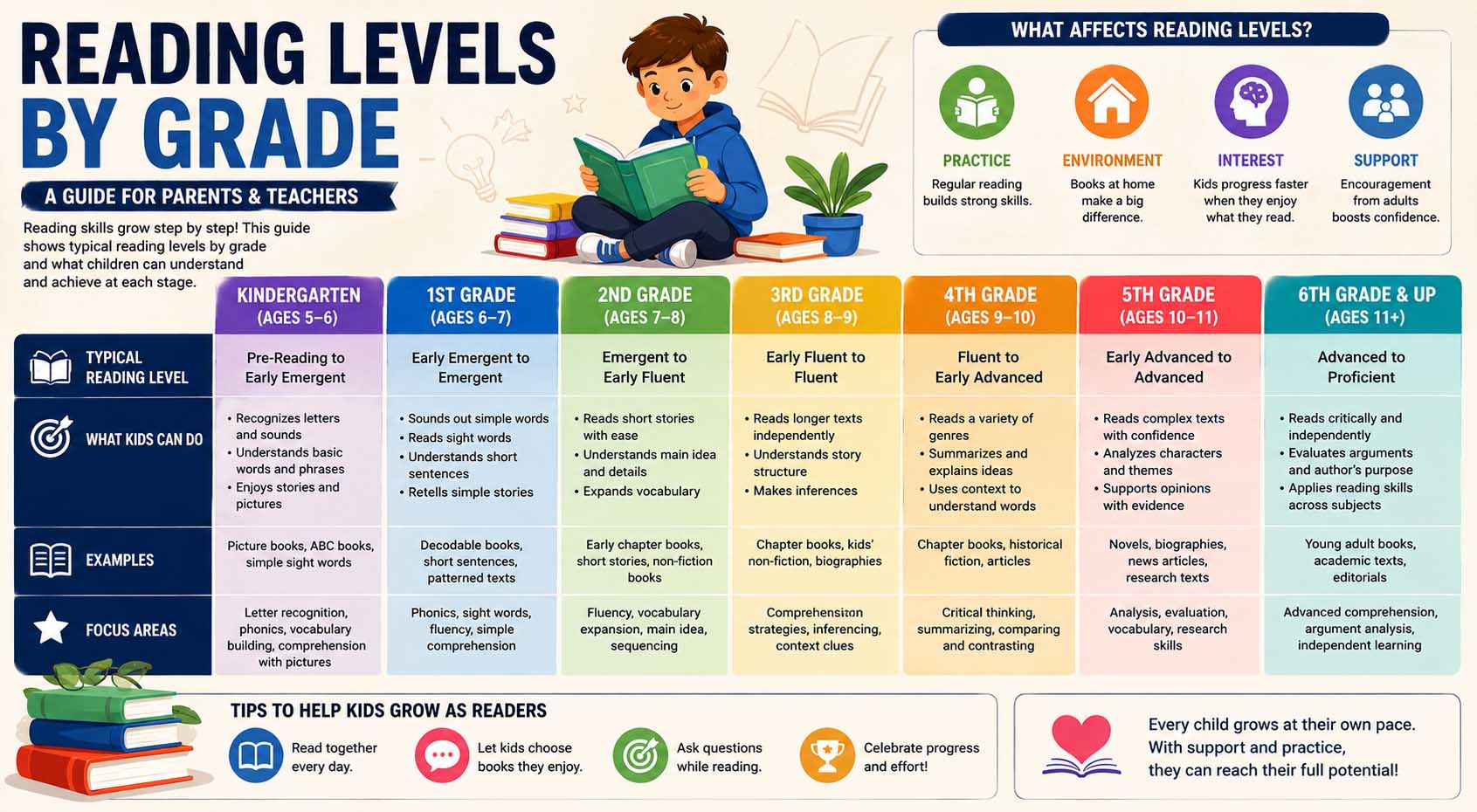
Reading Levels by Grade: What Students Should Be Able to Read
Children do not suddenly become strong readers at a particular age. Instead, reading develops gradually as students build decoding, vocabulary, fluency, and comprehension skills. Understanding reading levels by grade gives parents and teachers a practical way to see how those abilities commonly progress from kindergarten through high school. However, grade-level expectations are guidelines rather than strict rules, since children develop at different rates and schools may use different assessment systems.
A reading level can help adults choose books that provide enough challenge without making reading unnecessarily frustrating. At the same time, a level should never become a label that limits what a student is allowed to read.
What Do Reading Levels Mean?
A reading level is an estimate of how difficult a text may be for a reader. Depending on the system, the calculation may consider vocabulary, sentence complexity, word frequency, text structure, and other features.
Schools also assess the reader, not just the book. For example, teachers may listen to oral reading, check decoding accuracy, measure fluency, and ask comprehension questions.
As a result, two students in the same grade can have different reading levels while both continue making healthy academic progress.
Parents sometimes ask when do kids start reading, but there is no single age that applies to every child. Many children begin recognizing letters and familiar words during preschool, while more systematic decoding commonly develops during kindergarten and first grade.
Reading Levels by Grade: Quick Reference Guide
Because schools use different systems, no single chart applies everywhere. Still, the following overview describes common reading development from kindergarten through grade 12.
| Grade | Typical Reading Focus | Common Skills |
|---|---|---|
| Kindergarten | Emergent reading | Letter sounds, simple words, basic sentences |
| Grade 1 | Early independent reading | Decoding, sight words, simple comprehension |
| Grade 2 | Growing fluency | Longer sentences, vocabulary, story sequence |
| Grade 3 | Reading to learn | Main ideas, details, informational texts |
| Grade 4 | Deeper comprehension | Inference, context clues, text evidence |
| Grade 5 | Complex text structures | Theme, comparison, summarizing |
| Grade 6 | Middle-grade texts | Analysis, evidence, academic vocabulary |
| Grades 7–8 | Advanced comprehension | Author’s purpose, arguments, multiple sources |
| Grades 9–10 | High school literacy | Complex fiction and nonfiction analysis |
| Grades 11–12 | College/career readiness | Independent analysis, synthesis, research |
These expectations should be treated as broad benchmarks. Therefore, a teacher’s assessment provides more useful information about an individual student than a general grade chart alone.
Kindergarten Reading Level
Kindergarten is usually about establishing the foundations of literacy rather than expecting every student to read independently from the beginning.
Children commonly learn uppercase and lowercase letters, letter-sound relationships, rhyming, print direction, and how spoken words connect with written words.
Systematic phonics for kindergarten can help students understand that letters and groups of letters represent sounds. Once children begin connecting those sounds, they can start decoding simple words rather than relying entirely on memorization.
By the end of kindergarten, many students can read simple decodable sentences and recognize a growing number of familiar words. Still, development varies considerably, so progress in foundational skills often matters more than reaching a particular book level.
Reading Levels by Grade 1 and Grade 2
First and second grade often bring some of the most noticeable changes in reading ability.
First Grade
In first grade, students typically strengthen phonemic awareness and phonics while learning to decode increasingly complex words. At first, reading may sound slow because children are working through individual sounds.
However, repeated practice gradually improves automatic word recognition.
Effective phonics for reading gives students strategies for decoding unfamiliar words. Instead of guessing from a picture or memorizing every word separately, children learn patterns that they can apply to new vocabulary.
Comprehension develops alongside decoding. Therefore, teachers may ask students to identify characters, retell events, predict what happens next, or explain the main idea of a short passage.
Second Grade
By second grade, many students become noticeably more fluent. Consequently, they can devote more mental energy to understanding the meaning of a passage rather than decoding every word.
Texts may contain longer sentences, richer vocabulary, multiple paragraphs, and more detailed storylines.
At this stage, students also encounter different types of reading, including stories, informational passages, poetry, instructions, and simple reference materials. Exposure to varied texts helps children learn that reading strategies can change depending on the purpose and format.
Reading Levels for Grades 3 Through 5
Upper elementary school often marks a shift from primarily learning how to read toward using reading as a tool for learning.
Third Grade
Third graders commonly work with chapter books and more substantial informational texts. Meanwhile, comprehension questions become more complex.
Students may identify a central message, explain cause and effect, compare characters, determine word meanings from context, and locate evidence that supports an answer.
Fluency still matters. However, understanding increasingly becomes the central goal.
Fourth Grade
By fourth grade, students often encounter more complex vocabulary and text structures across science, social studies, mathematics, and language arts.
They may need to distinguish facts from opinions, interpret figurative language, make inferences, summarize passages, and explain how details support a main idea.
Because academic reading becomes more demanding, a student who can pronounce every word may still need help with comprehension.
Fifth Grade
Fifth-grade readers are usually expected to handle longer texts with greater independence.
For instance, students may compare information from multiple sources or examine how an author organizes an argument. Likewise, fiction may include more complicated themes, character motivations, and points of view.
At this age, reading should extend beyond answering worksheet questions. Discussions, book choices, research projects, and independent reading can all strengthen comprehension.
Middle School Reading: Grades 6–8
Middle school texts introduce greater complexity in both language and ideas.
Students encounter novels, biographies, historical documents, scientific explanations, argumentative writing, and increasingly technical vocabulary. Therefore, strong reading requires more than fast word recognition.
Sixth graders may focus on finding textual evidence and understanding how authors develop ideas. By seventh and eighth grade, students commonly analyze arguments, compare sources, evaluate claims, and interpret language in context.
The familiar debate around phonics vs sight words is usually less central at this stage because most students have moved beyond beginning reading instruction. Still, older struggling readers may need targeted instruction in decoding or word structure rather than simply being told to read more.
Teachers can identify the underlying difficulty through appropriate assessment and then provide support that matches the student’s needs.
Reading Levels by Grade in High School
High school reading becomes increasingly specialized.
A student might read Shakespeare in English class, analyze primary sources in history, interpret a scientific article in biology, and follow technical instructions in a career course. Consequently, being a strong reader means adapting strategies to different subjects.
Grades 9–10
Students typically work on analyzing themes, evaluating arguments, interpreting figurative language, and using evidence to support conclusions.
They also encounter more demanding nonfiction. Therefore, academic vocabulary becomes increasingly valuable.
Grades 11–12
By the final years of high school, students are generally expected to read complex material independently.
They may synthesize information from several sources, identify bias, assess evidence, interpret sophisticated arguments, and conduct research.
Still, difficulty depends heavily on the material. A strong reader may easily understand a novel yet struggle with an unfamiliar technical document. Therefore, reading ability cannot always be reduced to one number.
How Schools Measure Grade-Level Reading
When schools evaluate reading levels by grade, they may use several assessment methods because each reveals different information.
A teacher might ask a student to read aloud while recording errors and self-corrections. Next, the teacher may ask questions to determine whether the student understood the passage.
Computer-based assessments are also common. These programs may adjust question difficulty based on previous responses and then estimate a student’s reading range.
Schools may use systems such as Lexile measures, guided reading levels, Developmental Reading Assessment approaches, or other district-selected tools.
However, scores from different systems should not be treated as directly interchangeable unless a validated conversion method exists.
The National Center on Improving Literacy’s guidance on screening also explains how educators use screening and assessment information to identify students who may need additional reading support.
Why Reading Level and Grade Level Aren’t Exactly the Same
A grade tells you where a student is in school. A reading level estimates some aspect of reading performance.
Those are related concepts, yet they are not identical.
For example, a fourth grader may comfortably read some fifth-grade books while finding a fourth-grade science passage difficult because it contains unfamiliar vocabulary. Likewise, another student may decode advanced words accurately but miss important details about the story.
Interest also changes performance. A child fascinated by dinosaurs may persist through challenging dinosaur books because prior knowledge helps make the vocabulary meaningful.
Therefore, adults should look at comprehension, fluency, motivation, and decoding together rather than judging reading ability from a single score.
How to Help a Child Improve Their Reading Level
Improvement usually comes from regular, appropriately challenging practice rather than pushing students immediately into much harder books.
First, choose material that the child can read with reasonable accuracy. If every sentence contains several unknown words, comprehension can disappear because too much attention goes toward decoding.
Next, encourage active reading. Before starting a book, discuss the title and topic. During reading, ask occasional questions about predictions or confusing sections. Afterward, invite the child to explain what happened in their own words.
Vocabulary matters as well. Instead of requiring children to memorize long word lists, discuss unfamiliar words when they naturally appear in books, conversations, and school subjects.
Most of all, provide variety. Comics, nonfiction, magazines, biographies, novels, instructions, and age-appropriate digital texts can all contribute to literacy development.
Common Mistakes Parents and Students Can Avoid
One mistake is treating grade-level reading as a competition. Reading significantly above grade level does not automatically mean a student understands every advanced text.
Likewise, reading below a benchmark does not tell you why a student is struggling. The challenge could involve decoding, vocabulary, fluency, comprehension, attention, limited background knowledge, or another factor.
Another mistake is selecting books solely by level. Children also need opportunities to read material they genuinely enjoy.
Finally, avoid comparing siblings or classmates too closely. Students can reach similar literacy goals through different developmental paths.
Frequently Asked Questions About Reading Levels by Grade
What Reading Level Should My Child Be At?
The appropriate level depends on the child’s grade, school expectations, assessment system, and individual development. Therefore, ask the teacher which benchmark the school uses and how your child’s decoding, fluency, vocabulary, and comprehension compare with current instructional goals.
Should Children Only Read Books at Their Level?
No. Students can read easier books for enjoyment and fluency while also working with more challenging texts when appropriate. Adults can also read harder books aloud so children can enjoy sophisticated ideas before they can decode those books independently.
What If My Child Reads Below Grade Level?
Start by finding out which specific reading skills need support. A teacher or reading specialist can assess whether the main difficulty involves decoding, fluency, vocabulary, or comprehension. Then, targeted instruction is usually more useful than simply assigning harder books.
Can Reading Every Day Improve Reading Skills?
Regular reading provides valuable practice, especially when the material matches the student’s abilities and interests. However, children with specific skill gaps may also need explicit instruction rather than independent practice alone.
Are Online Reading-Level Tests Accurate?
They can provide useful information, but a single online score should not be treated as a complete evaluation. Teacher observations, oral reading, comprehension tasks, and formal assessments can provide a fuller picture.
Helping Readers Progress Without Pressure
Reading levels by grade are most useful when they guide instruction rather than define a child’s ability. They can help teachers choose appropriate materials, help parents recognize developing skills, and help students set realistic goals.
At the same time, progress deserves attention beyond the number on an assessment. A student who reads more smoothly, understands unfamiliar vocabulary, explains a passage clearly, or willingly chooses a book is building meaningful literacy skills.
Therefore, focus on steady practice, appropriate instruction, varied reading material, and genuine enjoyment. When a child consistently struggles despite support, talking with the classroom teacher or a qualified reading specialist can help identify the next practical step.