
What Is Phonological Awareness? A Beginner’s Guide to Building Strong Reading Skills
What Is Phonological Awareness? A Beginner’s Guide to Building Strong Reading Skills
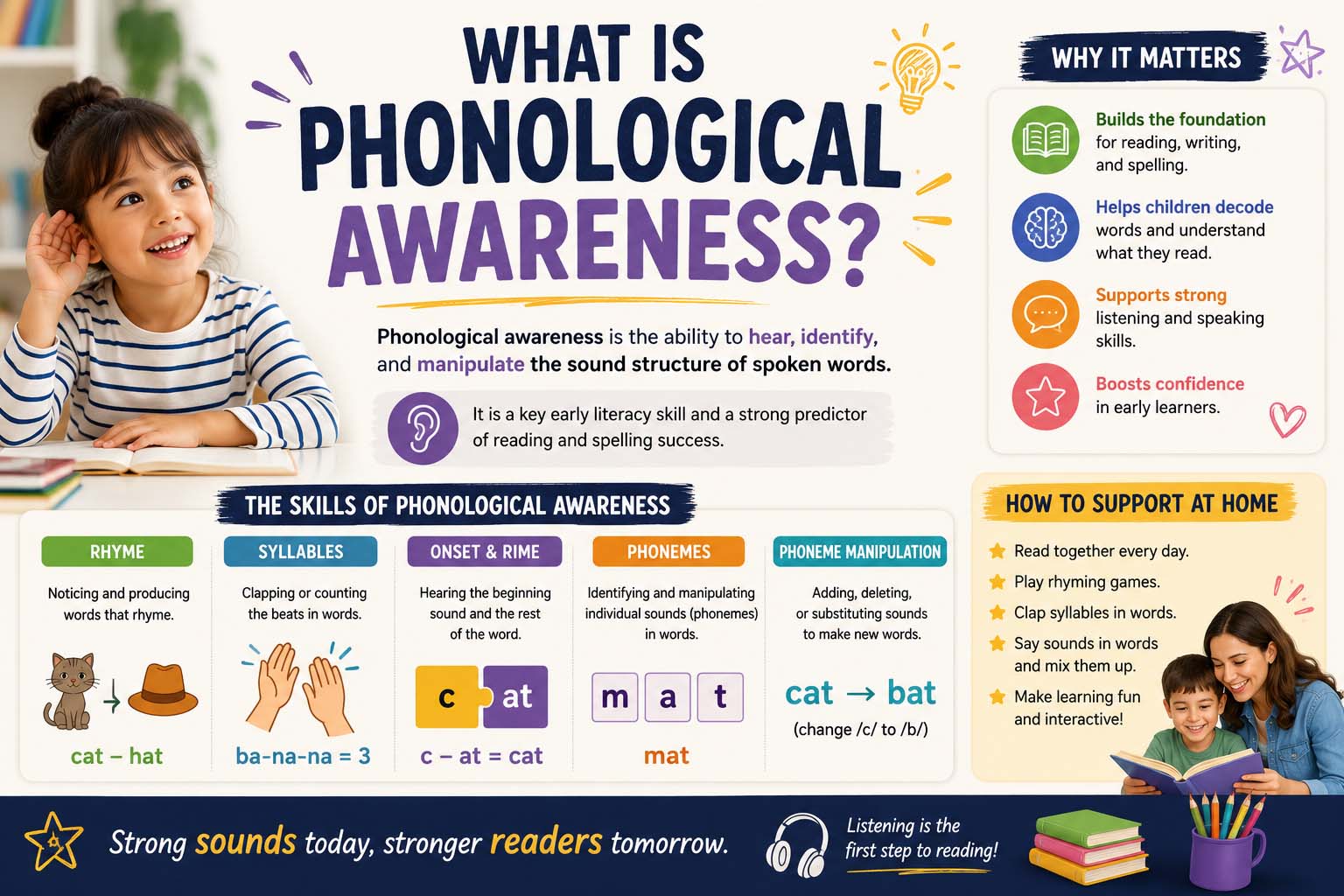
Learning to read starts long before a child opens a book. One of the most valuable early literacy skills is what is phonological awareness—the ability to hear, recognize, and work with the sounds of spoken language. Before children connect letters to sounds, they first learn to notice rhymes, clap syllables, and identify similar sounds in words.
Whether you’re a student, parent, teacher, or tutor, understanding can help you support stronger reading and writing skills from the very beginning.
What Is Phonological Awareness?
Phonological awareness is the ability to recognize and manipulate the sound structures in spoken language without looking at written words. It focuses entirely on listening and speaking rather than reading printed text.
Children develop this skill by learning to:
- Recognize rhyming words
- Count syllables
- Identify beginning and ending sounds
- Blend sounds into words
- Break words into smaller sound parts
In simple terms, if a child can hear that cat and hat rhyme or clap the three syllables in elephant, they are using phonological awareness.
Some people ask, what is a phonological awareness. The correct phrase is simply phonological awareness, which refers to this broad set of listening and sound-based language skills.
Why Is Phonological Awareness So Important?
Reading may seem like recognizing letters on a page, yet successful readers first learn to hear the sounds inside spoken words.
When children develop strong they often find it easier to:
- Learn letter sounds
- Decode unfamiliar words
- Spell accurately
- Read more fluently
- Improve vocabulary
- Build reading confidence
Research consistently shows that is one of the strongest early predictors of future reading success.
Because language learning relies heavily on listening, these sound skills also support students who later study additional languages. As learners compare sound systems, they often notice why pronunciation differs across languages, much like they discover when exploring What’s the Hardest Language to Learn.
What Is Phonological Awareness in Reading?
Many parents ask, what is phonological awareness in reading because the term often appears in literacy programs.
In reading instruction, prepares children to connect spoken sounds with written letters. It acts as a bridge between oral language and reading.
For example:
| Spoken Activity | Reading Skill It Supports |
|---|---|
| Identifying rhymes | Recognizing word families |
| Clapping syllables | Breaking longer words into parts |
| Blending sounds | Decoding new words |
| Segmenting sounds | Spelling words correctly |
| Matching beginning sounds | Learning letter-sound relationships |
Notice that none of these activities require children to read printed text. Instead, they strengthen the listening skills that make reading easier later.
Levels of Phonological Awareness
Phonological awareness develops gradually rather than all at once.
Word Awareness
Children first realize that sentences consist of separate words.
Example:
“I like apples.”
A child learns there are three individual words.
Syllable Awareness
Next, children hear the beats or chunks within words.
Examples:
- Sun = 1 syllable
- Tiger = 2 syllables
- Butterfly = 3 syllables
Teachers often ask students to clap each syllable.
Rhyme Awareness
Children begin recognizing words that sound alike at the end.
Examples:
- Cat – Hat
- Ball – Tall
- Tree – Bee
Nursery rhymes remain popular because they naturally build this skill.
Onset and Rime
Children separate the beginning sound from the rest of the word.
Example:
- c + at
- m + op
This helps prepare them for decoding.
Phonemic Awareness
The most advanced level involves hearing individual speech sounds, known as phonemes.
Example:
The word dog contains three sounds:
/d/ /o/ /g/
What Is the Difference Between Phonological Awareness and Phonemic Awareness?
Many educators hear questions like what is the difference between phonological awareness and phonemic awareness or what is the difference between phonemic awareness and phonological awareness.
The easiest way to understand it is that phonemic is one part of phonological awareness.
| Phonological Awareness | Phonemic Awareness |
|---|---|
| Covers all spoken sound skills | Focuses only on individual phonemes |
| Includes rhyming | Does not focus on rhyming alone |
| Includes syllables | Works with single sounds |
| Broader skill | Smaller skill within phonological awareness |
Think of phonological as an umbrella. Under that umbrella sits phonemic awareness, along with rhyming, syllables, and other sound activities.
Examples of Phonological Awareness Activities
Students learn best through playful listening activities.
Here are several simple examples.
Rhyming Games
Ask children to identify which words rhyme.
Example:
- Cake
- Snake
- Fish
Correct answer: Cake and Snake.
Clap the Syllables
Students clap once for every syllable.
Examples:
- Dog → 1 clap
- Apple → 2 claps
- Computer → 3 claps
Sound Matching
Ask:
“Which word starts with the same sound as sun?”
Choices:
- Sock
- Moon
- Apple
Answer: Sock.
Blend the Sounds
Say each sound separately.
Example:
/c/ /a/ /t/
Students respond:
“Cat.”
Segment the Sounds
Say a word.
Example:
Fish
Students separate it into:
/f/ /i/ /sh/
These activities strengthen listening before formal reading instruction begins.
A Step-by-Step Way to Build Phonological Awareness
Children usually develop these skills in a predictable order.
- Listen to songs and nursery rhymes.
- Identify rhyming words.
- Count words in sentences.
- Clap syllables.
- Match beginning sounds.
- Blend sounds into words.
- Break words into individual sounds.
- Connect sounds with letters during reading instruction.
Skipping steps may make reading more challenging, so steady practice often produces better results than rushing ahead.
Classroom Strategies That Work
Teachers use many engaging activities to strengthen phonological awareness.
Popular classroom ideas include:
- Morning rhyme challenges
- Picture sorting by beginning sounds
- Syllable clapping games
- Sound bingo
- Word chains
- Listening walks for environmental sounds
- Shared reading with repetitive patterns
- Interactive storytelling
These activities keep learning enjoyable while strengthening essential literacy foundations.
As students become stronger readers, they also begin exploring different types of writing, where these early sound skills support spelling, word recognition, and overall reading fluency.
How Parents Can Practice at Home
Families don’t need expensive materials to build phonological awareness.
Simple daily routines make a difference.
During Car Rides
Ask:
“What rhymes with tree?”
Children may answer:
- Bee
- Me
- Sea
While Cooking
Count syllables in food names.
Examples:
- Bread
- Banana
- Watermelon
At Bedtime
Read rhyming books aloud and pause before the final rhyming word.
Children enjoy predicting what comes next.
During Walks
Find objects that begin with the same sound.
Examples:
- Bird
- Bus
- Bike
These conversations naturally strengthen listening skills.
Common Mistakes About Phonological Awareness
Many people misunderstand what phonological awareness actually involves.
Here are a few common misconceptions.
Mistake 1: It Means Knowing Letters
Letter recognition belongs to alphabet knowledge, not phonological awareness.
Mistake 2: Reading Comes First
Children usually develop sound awareness before becoming fluent readers.
Mistake 3: It Is Only for Preschoolers
Older struggling readers may also benefit from targeted phonological awareness practice.
Mistake 4: Rhyming Is Enough
Rhyming is only one part of a much larger set of listening skills.
Signs a Child May Need Extra Practice
Some children benefit from extra support if they:
- Struggle to recognize rhymes
- Have difficulty clapping syllables
- Confuse beginning sounds
- Cannot blend simple sounds into words
- Frequently guess unfamiliar words while reading
Early support often prevents later reading difficulties.
Teachers may recommend small-group instruction or additional literacy practice when these signs appear consistently.
How Phonological Awareness Supports Future Learning
Strong phonological helps far beyond kindergarten.
Students often experience benefits in:
- Reading comprehension
- Vocabulary growth
- Accurate spelling
- Writing confidence
- Oral communication
- Learning additional languages
As literacy develops, students also begin recognizing literary techniques. For instance, understanding What Is Figurative Language becomes easier because confident readers can focus on meaning instead of decoding every word.
Later, learners may also study all types of figurative language, building on the strong reading foundation established through early sound awareness.
Frequently Asked Questions
Is phonological awareness only for young children?
No. While it develops during early childhood, older students with reading challenges can also improve through targeted practice.
Does phonological awareness involve reading books?
Not necessarily. Most activities involve listening and speaking rather than reading printed words.
How long does it take to develop phonological awareness?
Development varies from child to child. Consistent daily practice through songs, games, and conversations helps children improve steadily over time.
Why do schools teach phonological awareness before phonics?
Phonological teaches children to hear sounds first. Phonics then connects those sounds to written letters, making reading instruction more effective.
Key Takeaways for Learners
Phonological awareness is one of the strongest building blocks for reading success. By learning to hear rhymes, recognize syllables, blend sounds, and identify individual phonemes, children develop the listening skills they need before connecting sounds to printed words.
The best approach is to practice a little every day through songs, games, conversations, and read-aloud activities. These simple experiences help children become more confident readers, stronger writers, and lifelong learners.