
Phonics for Reading: A Practical Guide to Building Strong Reading Skills
Phonics for Reading: A Practical Guide to Building Strong Reading Skills
Learning to read can feel difficult when letters on a page seem like unrelated symbols. Phonics for reading makes that process easier by teaching learners how written letters and letter combinations connect to spoken sounds. As students understand these relationships, they can begin decoding unfamiliar words instead of depending only on memory or pictures.
For beginners, phonics provides a practical route from recognizing letters to reading sentences independently. At the same time, effective phonics instruction supports spelling, pronunciation, vocabulary development, and reading confidence. However, phonics works best as part of broader reading instruction that also includes language comprehension, vocabulary, fluency, and meaningful reading practice.
What Is Phonics for Reading?
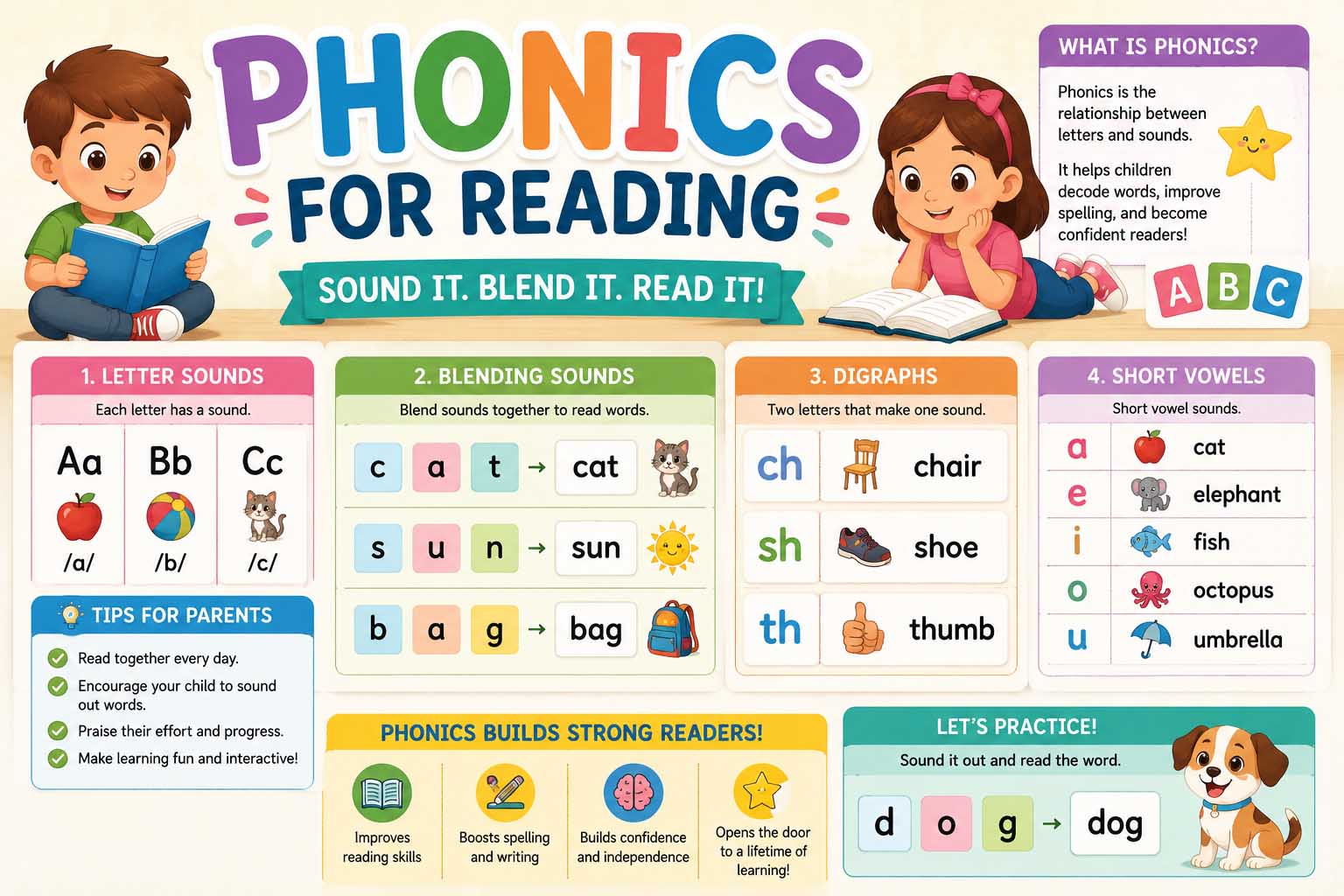
Phonics is an approach to reading instruction that teaches the relationships between written letters, called graphemes, and the sounds of spoken language, called phonemes.
For example, a learner may discover that the letter m commonly represents the /m/ sound. Next, the learner can combine that knowledge with other sound-letter relationships to decode a word such as map.
The process becomes more complex as students progress. They eventually learn that one sound can have different spellings and that groups of letters can work together.
For instance:
- sh appears in ship
- ch appears in chair
- ee appears in green
- oa appears in boat
- igh appears in night
Therefore, phonics is much more than memorizing the alphabet. Instead, learners gradually build a system for translating written words into spoken language.
A related concept is what is phonological awareness, which focuses on recognizing and working with the sounds of spoken language. Phonological awareness does not require printed letters, while phonics explicitly connects those sounds with written symbols.
Why Phonics Matters for Beginning Readers
Beginning readers encounter unfamiliar words constantly. If they rely only on memorization, they would need to remember thousands of individual word forms. Phonics gives them another option: they can analyze the letters and attempt to decode the word.
Suppose a child already knows the sounds represented by s, a, and t. The learner can blend those sounds together to read sat. Later, the same skill helps with words such as sit, mat, and cat.
As a result, each new sound-letter relationship can unlock many words.
Phonics also supports spelling. Once learners understand that spoken words contain individual sounds, they can listen to a word, identify its sounds, and connect those sounds with likely spellings.
Of course, English contains irregular words and complex spelling patterns. Therefore, phonics does not solve every reading challenge. Still, it gives learners a strong foundation for decoding a large number of words.
How Phonics for Reading Works Step by Step
Effective instruction usually moves from simple skills toward more complex patterns. Although programs differ, a beginner-friendly sequence often follows several basic stages.
Step 1: Learn Common Letter-Sound Relationships
First, learners connect individual letters with common sounds.
For example:
s → /s/
m → /m/
t → /t/
Teachers often introduce a carefully chosen group of letters rather than teaching every letter in alphabetical order. This approach allows children to start forming simple words sooner.
Learners need repeated opportunities to see a letter, say its sound, and recognize it in words.
Step 2: Blend Sounds Into Words
Next, students learn blending.
For the word map, a learner identifies:
/m/ + /a/ + /p/
Then, the learner blends those sounds smoothly to say map.
At first, children may pronounce each sound slowly. However, regular practice helps the process become faster and more automatic.
Step 3: Segment Spoken Words
Reading requires blending, while spelling often requires the reverse process: segmentation.
For example, a teacher might say dog. The learner then separates the word into:
/d/ /o/ /g/
After identifying the sounds, the student can choose letters that represent them.
Consequently, reading and spelling can reinforce each other instead of being taught as completely separate abilities.
Step 4: Learn Digraphs and Common Patterns
Once basic consonants and short vowels become familiar, learners can work with more complex spelling patterns.
Common examples include:
| Pattern | Example | What Learners Notice |
|---|---|---|
| sh | ship | Two letters represent one sound |
| ch | chin | A common consonant digraph |
| th | thin | Two letters work together |
| ee | feet | Common long-vowel spelling |
| oa | road | Common vowel team |
| ai | rain | Another vowel team |
Over time, learners also meet consonant blends, silent-e patterns, r-controlled vowels, and less predictable spellings.
Phonics Reading for Beginners: Keep Practice Manageable
For phonics reading for beginners, short and focused practice usually works better than overwhelming students with many new patterns at once.
Start with sounds the learner already understands. Then, introduce a small number of new correspondences and immediately use them in words.
For example, after practicing m, a, t, and s, students may decode mat, sat, and Sam. This gives the new knowledge an immediate purpose.
Decodable texts can also help. These books and passages are designed so that much of the text matches phonics patterns students have already learned. Therefore, learners get opportunities to apply decoding skills during real reading rather than completing isolated drills only.
As reading develops, students encounter different types of reading, from careful decoding of beginner texts to fluent reading for information and enjoyment. Phonics provides an early foundation, but later reading requires increasingly strong vocabulary and comprehension as well.
What Is a Phonics for Reading Program?
A phonics for reading program is usually a structured sequence of lessons that teaches sound-spelling relationships in a planned order.
Strong instruction is generally systematic rather than random. In other words, students do not simply study whichever spelling pattern happens to appear in a story that day.
Instead, lessons build on previously taught knowledge.
A basic sequence might progress from single consonants and short vowels to consonant digraphs, blends, long-vowel patterns, vowel teams, and more advanced word structures.
However, teachers still need to respond to individual learners. Some students understand a pattern after a few examples, while others need much more review.
That is one reason different types of teachers may adapt practice activities while still following the same instructional sequence. Classroom teachers, reading specialists, tutors, and special education teachers may use different supports depending on a student’s needs.
Understanding a Phonics for Reading Placement Test
A phonics for reading placement test can help educators determine where a learner should begin within a particular instructional sequence or program.
Rather than assuming that age or grade level tells the whole story, an assessment may check specific skills.
For example, it might examine whether a student can identify letter sounds, blend simple words, recognize vowel patterns, or decode increasingly complex words.
The goal should be instructional placement, not labeling a child as a “good” or “bad” reader.
If a student already reads simple consonant-vowel-consonant words accurately, repeating weeks of very basic work may provide little benefit. On the other hand, placing that learner in advanced lessons before foundational patterns are secure could create unnecessary frustration.
Because commercial programs use different assessments and scoring systems, educators should follow the instructions for the specific placement test they use.
Making Phonics Reading for Kids More Engaging
For phonics reading for kids, practice does not need to feel like a long worksheet session.
Simple games can provide valuable repetition.
For instance, write several words on cards and ask a child to sort them by spelling pattern. Words such as ship, shop, and fish can reinforce sh, while chair, chin, and much can reinforce ch.
Another activity involves changing one sound at a time:
cat → cot → hot → hop
This activity encourages children to pay attention to individual sounds and notice how changing one letter can change an entire word.
Word building with magnetic letters or letter tiles can also be useful. Because students physically move the letters, they can see how words change as sounds are added, removed, or replaced.
Still, games should reinforce teaching rather than replace it. Clear explanation and guided practice remain essential.
Moving From Decoding to Fluent Reading
Sounding out words is necessary for beginners, but it should gradually become more automatic.
Imagine having to stop and decode every word in a paragraph. By the time you reached the final sentence, remembering the meaning of the first sentence would be difficult.
Therefore, repeated accurate reading matters.
Students can reread short passages that contain familiar phonics patterns. With practice, many words become easier to recognize, and reading begins to sound smoother.
However, speed should not become the only goal. Fluent reading combines accuracy, appropriate pace, expression, and understanding.
Once decoding requires less mental effort, learners can devote more attention to meaning.
Phonics Is Only One Part of Reading
Strong phonics instruction is valuable, yet reading involves much more than pronouncing printed words.
Students also need vocabulary, background knowledge, oral language, fluency, and comprehension strategies.
For example, a learner might decode every word in a science paragraph correctly but still misunderstand its meaning because the vocabulary is unfamiliar.
Later, readers must also identify ideas that are not directly tied to decoding. Learning What Is a Central Idea helps students move from reading individual words toward understanding what an entire passage communicates.
Similarly, recognizing Text Structure Examples can help developing readers see how authors organize information through sequence, comparison, cause and effect, description, or problem and solution.
Thus, phonics opens the door to reading, while comprehension skills help students understand what they find on the other side.
Common Phonics Mistakes to Avoid
One common mistake is teaching too many patterns at once. Students need enough practice with one set of skills before they can confidently use them alongside newer material.
Another problem is allowing learners to guess words mainly from pictures or context when the word can be decoded. Pictures can support comprehension, but students should still learn to examine the letters carefully.
Likewise, endless isolated drills can become ineffective if students never apply the skills to connected text. After learning a pattern, students should encounter it in words, sentences, and suitable reading passages.
Parents and teachers should also avoid turning every error into a stressful event. Instead, give learners time to look at the word, identify familiar patterns, blend the sounds, and try again.
Finally, avoid expecting identical progress from every child. Learners develop at different rates, and some need much more explicit practice and review.
A Simple Phonics Practice Routine
A practical home or classroom session can remain fairly short.
Next, introduce or review one target pattern. Then, build and read several words containing that pattern.
Afterward, ask the learner to read a few sentences or a short decodable passage that uses the same skill.
Finally, finish with a quick spelling activity. For example, say three words and ask the learner to segment the sounds before writing them.
This routine connects sound recognition, decoding, reading, and spelling without requiring a long lesson.
Frequently Asked Questions About Phonics for Reading
At what age should children start learning phonics?
Children often begin early phonics instruction when they are ready to connect spoken sounds with printed letters, commonly during the early school years. However, readiness and educational systems vary, so instruction should match the learner rather than depend only on age.
Is phonics the same as phonological awareness?
No. Phonological awareness deals with the sound structure of spoken language, while phonics connects those sounds with written letters and spelling patterns.
Does phonics help with spelling?
Yes. Phonics can support spelling because learners practice identifying sounds in spoken words and representing those sounds with letters or letter combinations.
Can older students benefit from phonics?
Yes. Older struggling readers may still have gaps in decoding knowledge. In those cases, targeted phonics instruction can address specific weaknesses without treating the student like a very young beginner.
Should students memorize sight words too?
Students will eventually recognize many common words automatically. However, many frequently used words contain regular or partly regular sound-spelling relationships, so teachers can draw attention to the decodable portions instead of treating every common word as something that must be memorized as a whole.
How long should phonics practice last?
Quality and consistency matter more than making every session long. Short, focused lessons with frequent opportunities to apply skills can be easier for beginners to manage.
Helping Learners Turn Phonics Into Real Reading
The real purpose of phonics for reading is not to make children experts at naming isolated sounds. Instead, it should help them become increasingly independent readers.
Start with clear sound-letter relationships, practice blending and segmentation, and then move gradually into more complex patterns. At the same time, give learners plenty of opportunities to read meaningful text and talk about what it means.
As decoding becomes more automatic, shift more attention toward vocabulary, fluency, knowledge, and comprehension. That balance helps phonics become what it is meant to be: a practical foundation for confident, purposeful reading.