
Phonics vs Sight Words: What’s the Difference and Which Helps Children Read?
Phonics vs Sight Words: What’s the Difference and Which Helps Children Read?
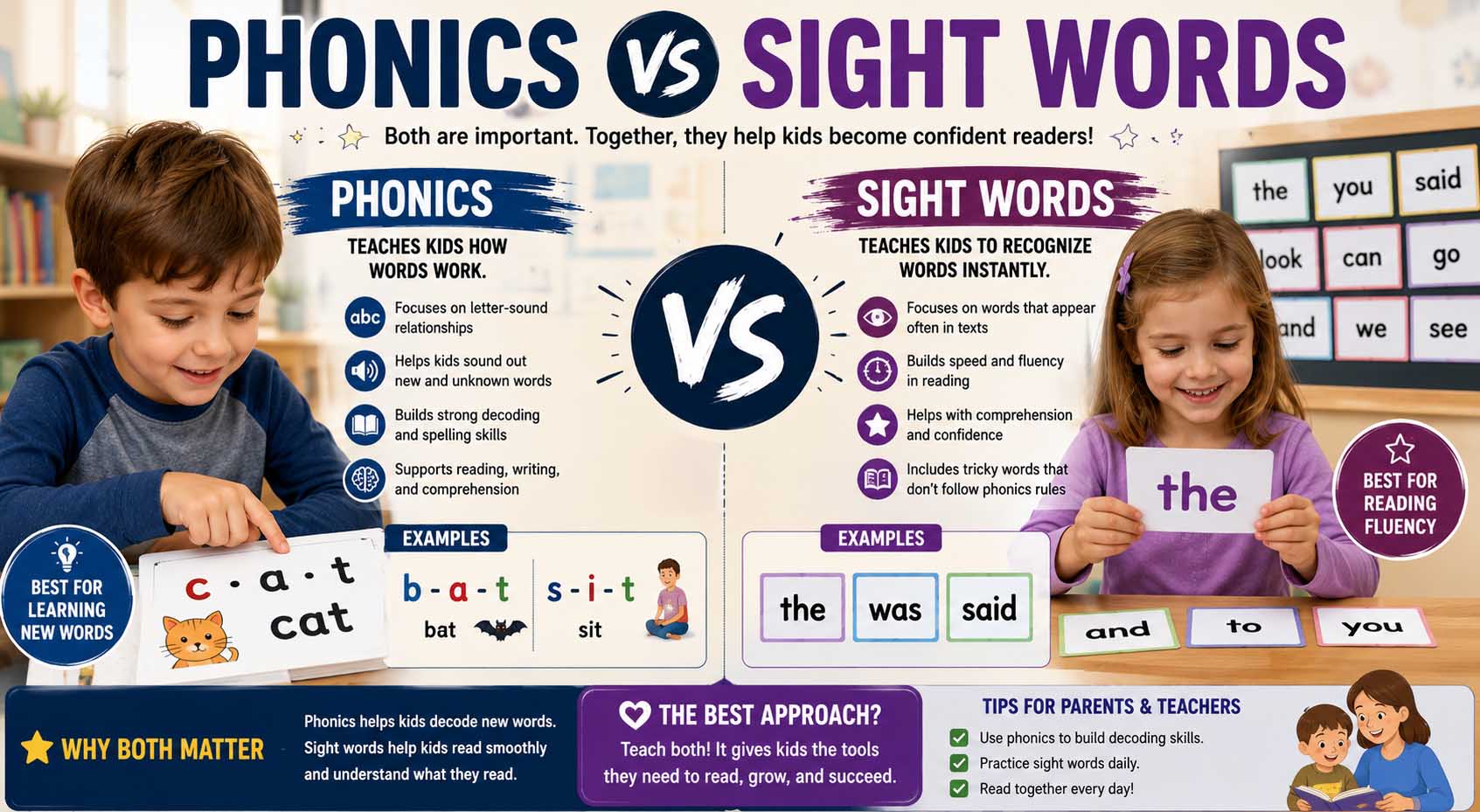
When a child starts learning to read, parents and teachers often hear two terms again and again: phonics and sight words. The phonics vs sight words question can make these approaches sound like competing methods, yet they serve different purposes. Phonics teaches children how written letters and letter combinations connect to sounds, while sight-word instruction helps them quickly recognize frequently encountered words, including words with spelling patterns they have not yet learned or parts that are unusual.
For most beginning readers, strong instruction does not require choosing one and abandoning the other. Instead, systematic phonics provides a foundation for decoding unfamiliar words, while carefully selected high-frequency words help children read connected text more smoothly.
Understanding how the two approaches work makes it much easier to support early reading without turning every new word into a memorization exercise.
Phonics vs Sight Words: The Basic Difference
The simplest difference is how children identify a written word.
With phonics, a learner uses knowledge of letters and sounds to decode it. For example, a beginner may look at map, connect m with /m/, a with /ă/, and p with /p/, then blend those sounds to read the word.
With sight-word recognition, the reader identifies a familiar written word quickly without consciously sounding through every letter each time.
However, this distinction needs some clarification. A word can eventually become instantly recognizable because a child has successfully connected its spelling, pronunciation, and meaning in memory. Therefore, automatic word recognition does not necessarily mean the child learned the word only by visually memorizing its shape.
This is one reason phonics for reading plays such a central role in early literacy: decoding helps children build the connections that eventually make many words automatic.
How Phonics Builds Decoding Skills
Phonics teaches the relationships between written letters or groups of letters and the sounds they represent.
For example:
- m commonly represents /m/
- sh can represent /sh/
- ch can represent /ch/
- ee can represent a long /ē/ sound
- ai can represent a long /ā/ sound
As children learn these patterns, they can apply them to words they have never seen before.
A child who knows the sounds in ship, for instance, does not need someone to teach that entire word as a picture. Instead, the learner can identify the letters, blend the sounds, and arrive at the spoken word.
Why Phonics Decoding Matters
English contains far too many words for children to memorize every word individually.
Therefore, phonics gives learners a reusable strategy. Once children understand a spelling pattern, they can apply it across many words.
For example, learning the -at pattern can support reading:
- cat
- hat
- mat
- sat
- flat
As learners gain experience, decoding becomes quicker and less effortful.
How Sight Words Support Early Reading
The term sight word is sometimes used in different ways.
Traditionally, teachers may use it for frequently occurring words that children are encouraged to recognize immediately. Examples often include words such as the, was, you, said, and are.
However, not every high-frequency word is completely irregular. In fact, many common words can be decoded once children know the relevant letter-sound relationships.
A more useful goal is therefore automatic word recognition rather than memorizing hundreds of words purely by visual appearance.
Some high-frequency words contain both regular and temporarily unexpected parts. A teacher can point out the decodable sounds while explicitly teaching the unusual spelling.
For example, children can learn which part follows a familiar sound-spelling relationship and which part needs special attention.
Sight Words vs Phonics: Do Children Need Both?
When comparing sight words vs phonics, the answer does not have to be either-or.
Children need a way to decode unfamiliar words. At the same time, fluent reading requires many familiar words to become automatic.
Systematic phonics instruction gives beginners a method for approaching new printed words. Meanwhile, targeted teaching of high-frequency words can help them handle common words that appear repeatedly in early books.
The balance changes as children develop.
A beginner may spend considerable effort blending three-sound words. Later, the same learner recognizes those words almost instantly because repeated successful reading has strengthened the connection between spelling and pronunciation.
Parents learning what is phonological awareness may also find the distinction useful. Phonological awareness involves noticing and working with sounds in spoken language, while phonics connects those spoken sounds with written letters.
Teaching Phonics vs Sight Words Step by Step
When considering teaching phonics vs sight words, start with the skills that allow children to unlock new words.
Young learners can begin by developing awareness of speech sounds and learning common letter-sound relationships. Then, they can practice blending those sounds into complete words.
For instance, a lesson might introduce s, a, t, p, and i. Once children know those relationships, they can begin decoding words such as sat, sit, pat, and tap.
High-frequency words can be introduced alongside this work, but teachers do not need to present every common word as something that children must memorize visually.
Step 1: Build Phonemic Awareness
Before or alongside printed-letter instruction, children benefit from activities involving spoken sounds.
They might identify rhyming words, blend separate sounds into words, or break simple spoken words into individual phonemes.
For example, a teacher can say /s/ /u/ /n/ and ask the learner to blend the sounds into sun.
Step 2: Learn Letter-Sound Relationships
Next, connect spoken sounds to printed letters.
Introduce relationships in a planned sequence so children can quickly use what they learn to build and read words.
Rather than teaching isolated facts for weeks, give learners regular opportunities to apply them.
Step 3: Practice Phonics Blending
Knowing individual sounds is not enough. Children need to combine them.
A learner might initially read fish slowly as /f/ /i/ /sh/. With practice, however, blending becomes smoother.
Step 4: Introduce High-Frequency Sight Words
Introduce useful common words when children need them in reading or writing.
If a word is decodable using patterns already taught, encourage the learner to decode it. If part of the spelling is unexpected, explicitly point out that part rather than asking the child to memorize the whole word as an arbitrary visual shape.
Phonics vs Sight Words Research and Evidence
People searching for phonics vs sight words research are often trying to determine which method has stronger evidence behind it.
Reading research supports explicit, systematic teaching of phonemic awareness and phonics as important parts of beginning reading instruction. The National Reading Panel’s findings on teaching children to read report that systematic phonics instruction significantly improves children’s word recognition and spelling and supports reading comprehension for many beginning readers.
However, fluent readers also recognize large numbers of words automatically.
These ideas are not contradictory. Through repeated successful decoding and exposure, written words can become securely stored in memory. Researchers often describe this learning process in terms of orthographic mapping.
In simple terms, children connect the sequence of letters in a word with its sounds and meaning. As those connections become established, recognition becomes fast.
Therefore, effective instruction aims to develop both accurate decoding and automatic recognition.
Why Visual Word Memorization Has Limits
A common mistake is encouraging children to identify words mainly by overall visual shape.
For example, a learner might be told to remember that one word “looks long” or has a particular outline.
That strategy is unreliable because many printed words have similar visual characteristics.
Likewise, asking a child to guess from the first letter and a picture can produce mistakes. A child seeing a picture of a horse might guess horse when the text actually says pony.
Instead, children should learn to pay attention to all the letters and connect them with the sounds in the word.
Pictures and context can support comprehension, but they should not replace accurate word reading.
Phonics for Kindergarten and Beginning Readers
Effective phonics for kindergarten does not need to feel like a long worksheet session.
Teachers can use magnetic letters, sound cards, whiteboards, short decodable texts, word-building games, and oral sound activities.
For example, children can build sat with magnetic letters. Then, the teacher can change s to m and ask what the new word says.
This small activity teaches children that changing one letter changes the spoken word.
Lessons can remain short and focused. However, frequent practice matters because young learners need repeated opportunities to connect print with speech.
Building Fluency With Phonics and Sight Words
Accurate decoding comes first, but readers also need fluency.
When children must slowly sound out every familiar word, comprehension becomes difficult because so much attention goes toward identifying words.
Repeated reading can help. Choose short texts that match the letter-sound patterns children have already learned, then allow them to reread the material.
However, speed should never become the only goal. Accurate reading and understanding the text matter more than racing through a passage.
As skills grow, children encounter different types of reading, from careful decoding of unfamiliar text to fluent reading for meaning. Their strategies naturally become more flexible as their knowledge expands.
Sight Words vs Phonics in Parent Discussions
Parents sometimes search sight words vs phonics Reddit because they want real experiences from families and teachers.
Community discussions can offer useful classroom ideas, book suggestions, games, and descriptions of what worked for individual children. However, personal experiences cannot establish which instructional method works best across learners.
One child may appear to memorize printed words very quickly, while another may struggle with the same activity.
Therefore, use community advice for practical ideas while relying on well-supported literacy principles when deciding how children should be taught to read.
Common Phonics and Sight Word Teaching Mistakes
One mistake is treating phonics as endless sounding-out with no meaningful reading. Children need opportunities to apply their skills to actual sentences and stories.
Another mistake is giving beginners huge stacks of flashcards and expecting them to memorize every word visually.
Likewise, moving too quickly can create gaps. A child who has not mastered basic blending may struggle when lessons introduce complex vowel patterns.
However, staying on easy material for too long can also slow progress. Once learners consistently demonstrate a skill, introduce the next appropriate pattern while continuing brief review.
Finally, avoid encouraging guessing. If a child struggles, guide attention toward the letters and sounds instead of immediately saying, “Look at the picture.”
Practicing Phonics and Sight Words at Home
Parents do not need specialized teaching equipment to reinforce early reading.
Magnetic letters are useful because children can physically build and change words. Likewise, a small whiteboard makes quick sound and spelling activities easy.
During shared reading, adults can read more difficult sections while allowing children to decode words that match what they have learned.
Keep practice manageable. Ten focused minutes can be more productive than a long session that leaves a child frustrated.
Also, continue reading enjoyable books aloud. Children can develop vocabulary, background knowledge, comprehension, and enthusiasm for stories even when those books are too difficult for them to decode independently.
Phonics vs Sight Words FAQs
Should Children Learn Phonics or Sight Words First?
Early sound awareness and systematic phonics provide a strong foundation for word reading. However, children can also learn a limited number of useful high-frequency words alongside phonics instruction.
Should Sight Words Be Memorized?
The goal is fast, automatic recognition, but that does not mean every word should be memorized purely as a visual image. Connecting spelling with sounds helps words become stored more securely.
Can Phonics Teach Every English Word?
English spelling includes complex and irregular patterns, so not every word is immediately decodable for a beginner. Still, many apparently irregular words contain regular elements that teachers can point out.
Why Does My Child Keep Guessing Words?
Some children develop guessing habits when they rely heavily on pictures, context, or the first letter. Encourage them to look across the whole written word and use the sound-spelling relationships they know.
How Long Does It Take for Words to Become Automatic?
There is no fixed number of repetitions for every child or word. Familiarity, decoding skill, practice, vocabulary, and individual learning differences can all influence how quickly recognition develops.
Are Flashcards Bad for Teaching Reading?
Not necessarily. Flashcards can provide quick practice when used thoughtfully. However, they should not replace systematic instruction in how letters represent sounds or become the main method for learning every new word.
Choosing a Balanced Early Reading Approach
The phonics vs sight words debate becomes much simpler when the goal is clear: children need to read unfamiliar words accurately and eventually recognize familiar words quickly.
Phonics provides the tools for decoding. Meanwhile, repeated successful encounters with written words help recognition become automatic, and carefully taught high-frequency words support children as they begin reading real text.
Rather than asking children to memorize an ever-growing collection of word shapes, teach them how written English works. Then, give them plenty of appropriate practice through word building, decodable reading, conversation, and enjoyable books.
When decoding, automatic recognition, vocabulary, and comprehension develop together, children have a stronger foundation for becoming confident, independent readers.