
Phonics for Kindergarten: A Practical Guide to Early Reading Skills
Phonics for Kindergarten: A Practical Guide to Early Reading Skills
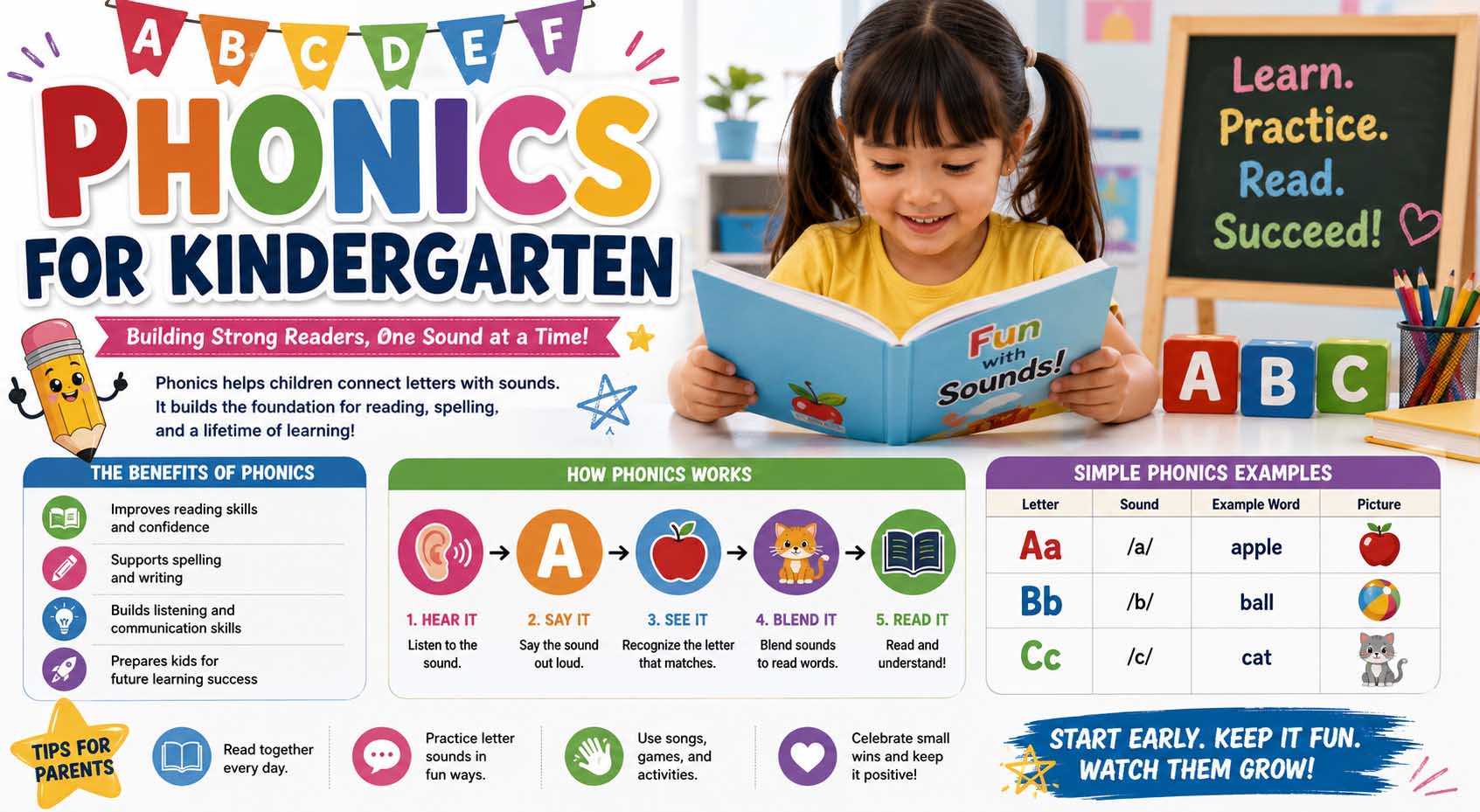
A child looks at the word “cat,” says the sounds /k/ /ă/ /t/, and then blends them together: “cat.” That small moment shows phonics for kindergarten in action. Phonics teaches children how written letters and letter combinations connect with spoken sounds, giving beginning readers a practical way to decode unfamiliar words instead of relying only on pictures or memorization.
Kindergarten is an especially valuable time for this instruction because children are building the foundations they will use throughout their reading development. With clear teaching, plenty of guided practice, and enjoyable activities, phonics can help young learners become more accurate and confident readers.
What Is Phonics for Kindergarten?
Phonics is a method of reading instruction that teaches relationships between letters, or graphemes, and the sounds they represent, or phonemes.
For example, children learn that the letter m commonly represents the /m/ sound. Later, they learn that combinations of letters can represent sounds too. The letters sh, for instance, commonly represent /sh/.
However, phonics involves more than memorizing individual letter sounds. Children gradually learn to use those relationships to read and spell words.
A typical progression might move from:
- Recognizing letters
- Connecting letters with sounds
- Blending sounds into words
- Segmenting words into individual sounds
- Reading simple decodable words
- Learning common digraphs and other spelling patterns
- Reading increasingly complex words and sentences
These skills form a key part of phonics for reading because children can apply the patterns they learn to words they have not seen before.
Phonics and Phonological Awareness Are Different
Phonics and phonological awareness work closely together, but they are not identical.
In contrast, phonological awareness focuses on the sounds of spoken language and does not require printed letters.
That is a phonological awareness task. Likewise, asking a child to identify the first sound in “sun” can be done without showing the written word.
If parents or teachers are wondering what is phonological awareness, it can be thought of as the broader ability to notice and work with sound structures in spoken language. Phonemic awareness, which focuses specifically on individual phonemes, sits within that broader skill set.
Strong early literacy teaching brings these abilities together. Children hear and manipulate sounds, then learn how letters represent those sounds in print.
Why Phonics Matters in Kindergarten
Beginning readers cannot memorize every word they will encounter. Instead, they need strategies for working out unfamiliar printed words.
Phonics gives them one of those strategies.
Suppose a child knows the sounds represented by m, a, and p. When the child encounters “map,” they can sound out each part and blend the sounds together.
As children become more experienced, this process gets faster. Eventually, many familiar words can be recognized automatically.
Phonics also supports spelling. If a teacher says “sit,” for example, a child can segment the spoken word into /s/ /ĭ/ /t/ and connect those sounds with letters.
Therefore, reading and spelling practice can reinforce each other.
Core Phonics Skills Kindergarten Children Learn
Children do not need to master every English spelling pattern during kindergarten. Instead, instruction generally starts with useful foundational relationships and builds systematically.
Letter-Sound Relationships
Children learn that printed letters represent sounds.
For example:
s → /s/
m → /m/
t → /t/
Teachers typically introduce letter-sound relationships in an intentional sequence rather than simply expecting children to memorize the alphabet from A to Z before reading words.
Blending Sounds
Blending means combining individual sounds to produce a word.
For example:
/m/ /ă/ /p/ → map
At first, children may need a teacher to model the process slowly. Then, with practice, they begin blending independently.
Segmenting Words
Segmenting works in the opposite direction.
A child hears “dog” and separates it into:
/d/ /ŏ/ /g/
This skill supports spelling because the child can identify the sounds that need to be represented in writing.
Reading Simple CVC Words
CVC means consonant-vowel-consonant. Words such as cat, sit, map, hot, and sun follow this simple structure.
Once children know the necessary letter-sound relationships, CVC words provide useful early blending practice.
Phonics Games for Kindergarten
Young children need repetition, but repetition does not have to feel repetitive.
Good phonics games for kindergarten give children many opportunities to hear, identify, blend, and manipulate sounds while keeping the activity short and engaging.
Sound Hunt
Choose one target sound, such as /b/. Then ask children to find objects or pictures whose names begin with that sound.
They might find a book, bag, block, or ball.
This activity works especially well when children already understand the target letter-sound relationship.
Build the Word
Give children letter tiles and say a simple word such as “map.”
First, ask them to stretch the word slowly. Next, have them identify each sound. Then, let them select the letters and arrange them in order.
This combines phonemic awareness, phonics, and spelling practice.
Change One Sound
Start with a word such as cat. Then ask children to change the first letter to make hat.
Later, try:
hat → hot → hop → mop
Word chains help children notice how changing one sound and letter can create a different word.
Useful Phonics Activities for Kindergarten
Effective phonics activities for kindergarten do not need expensive classroom materials.
Letter cards, magnetic letters, mini whiteboards, simple books, and everyday objects can provide plenty of practice.
For example, teachers can display several pictures and ask children to sort them according to their beginning sounds. Meanwhile, parents can practice the same skill at home using familiar objects.
Another useful activity involves matching words with pictures. Once a child can decode “sun,” for instance, they can match the written word with a picture of the sun.
Teachers can also use sound boxes. Draw three boxes for a three-phoneme word, then have the child move a counter into each box while saying each sound.
These short activities make abstract sound patterns more concrete.
How to Use Phonics Worksheets for Kindergarten
Phonics worksheets for kindergarten can support learning when they reinforce skills that children have already been taught.
For example, a worksheet might ask children to match pictures with beginning letters, complete simple CVC words, identify a target sound, or read short decodable words.
However, worksheets should not replace direct teaching, speaking, listening, reading, and hands-on practice.
Young children learn through interaction. Therefore, a worksheet becomes more valuable when an adult discusses the sounds and words with the child rather than simply assigning a page independently.
Keep worksheet sessions short as well. Ten focused minutes can be more productive than a long session that leaves a child tired or frustrated.
A Simple Step-by-Step Kindergarten Phonics Lesson
A phonics lesson does not need to be complicated. In fact, a predictable routine can help children focus on the new learning.
Step 1: Review Known Sounds
Begin by quickly reviewing several letter-sound relationships children already know.
Keep the pace lively and provide immediate correction when needed.
Step 2: Introduce the New Pattern
Show the new letter or spelling pattern and clearly say its sound.
Then, have children repeat it and identify the sound in several spoken words.
Step 3: Practice Blending
Use words containing only letter-sound relationships the children have learned whenever possible.
For example, if they know the necessary sounds, model:
s-a-t → sat
Then let children try similar words.
Step 4: Practice Segmenting and Spelling
Say a word aloud and ask children to identify each sound.
Next, children can use letter tiles or write the letters themselves.
Step 5: Read Connected Text
Finally, give children a short decodable sentence or book that includes the patterns they have practiced.
This step matters because phonics should lead into actual reading rather than remain an isolated exercise.
Choosing Phonics Programs for Kindergarten
Parents and teachers can choose from many phonics programs for kindergarten, but colorful materials alone do not make a program effective.
Look for instruction that follows a clear, systematic sequence. Children should learn foundational patterns before being expected to decode words containing more advanced ones.
A useful program should also provide explicit teaching rather than expecting children to discover spelling patterns on their own.
Ideally, it includes practice with:
- Phonemic awareness
- Letter-sound relationships
- Blending
- Segmenting
- Word reading
- Spelling
- Decodable text
- Regular review
The pace should also respond to learners. Some children need extra repetition, while others become ready for new patterns sooner.
Connecting Phonics With Real Reading
Phonics instruction has a clear purpose: helping children read and write.
Therefore, children should have opportunities to apply newly learned patterns in appropriate texts.
Decodable books can be useful at this stage because they contain many words that match phonics patterns children have already learned. As a result, beginning readers can practice decoding instead of relying mainly on guessing.
However, children’s literacy experiences should not consist only of books they can decode independently. Adults should also read rich stories, nonfiction, poems, and other texts aloud.
Those experiences develop vocabulary, background knowledge, oral language, comprehension, and enjoyment of books.
Over time, learners encounter different types of reading, from carefully decoding beginner texts to reading stories and informational material for meaning. Strong literacy instruction supports both accurate word reading and comprehension.
Common Phonics Teaching Mistakes
One mistake is teaching too many new sounds at once. Children need enough practice to remember and apply what they learn.
Another mistake is asking children to guess words primarily from pictures or the first letter. Pictures can support comprehension, but children also need to attend to the letters throughout a word when decoding.
Likewise, memorizing large lists of words cannot replace learning how the writing system works.
It is also easy to move too quickly. If a child cannot blend simple words consistently, introducing much harder spelling patterns may create unnecessary frustration.
At the same time, avoid endless drilling of isolated letter sounds. Once children know enough sounds, give them opportunities to use those skills in words and connected text.
Supporting Phonics at Home
Parents do not need to recreate an entire classroom lesson.
Instead, use short, relaxed practice sessions. For example, spend a few minutes building simple words with magnetic letters, identifying sounds while preparing dinner, or reading a short decodable book together.
When a child struggles with a word, encourage them to look closely at the letters and blend the sounds they have learned.
Also, continue reading aloud every day when possible. Children can understand stories and vocabulary that are much more advanced than the text they can currently decode themselves.
Most of all, keep practice positive. Learning to read takes time, and children progress at different rates.
Frequently Asked Questions
When should kindergarten children start phonics?
Phonics instruction can begin when children are ready to connect spoken sounds with printed letters. Kindergarten programs commonly teach these skills systematically throughout the school year, often alongside phonemic awareness.
How long should a phonics lesson be?
There is no single perfect length. However, young children generally benefit from focused, engaging instruction rather than overly long practice sessions. Schools may use a structured daily block, while home practice can often be much shorter.
Are phonics worksheets enough to teach reading?
No. Worksheets can reinforce specific skills, but children also need explicit instruction, oral sound activities, blending practice, spelling, and opportunities to read connected text.
Should children memorize sight words?
Children do need to recognize many common words quickly. However, teachers can often connect even high-frequency words to known and less predictable spelling patterns rather than treating every word as a visual shape to memorize.
What if a child struggles with phonics?
First, slow down and identify the specific skill causing difficulty. For example, a child may know letter sounds but struggle to blend them. If difficulties persist despite clear instruction and extra practice, parents can discuss the child’s progress with the teacher or an appropriate reading specialist.
Helping Kindergarten Readers Make Steady Progress
Good phonics for kindergarten instruction is systematic, clear, active, and connected to real reading. Children first learn how sounds and letters relate, then practice blending and segmenting, and gradually apply those skills to words, sentences, and books.
Games, letter tiles, short activities, decodable texts, and carefully chosen worksheets can all support that process. However, consistency matters more than having a huge collection of materials.
Give young readers plenty of opportunities to practice skills they have already learned while continuing to read interesting books aloud to them. With patient instruction and regular practice, children can build the word-reading foundation they need for increasingly independent and meaningful reading.