
What Is Decoding in Reading? A Beginner-Friendly Guide
What Is Decoding in Reading? A Beginner-Friendly Guide
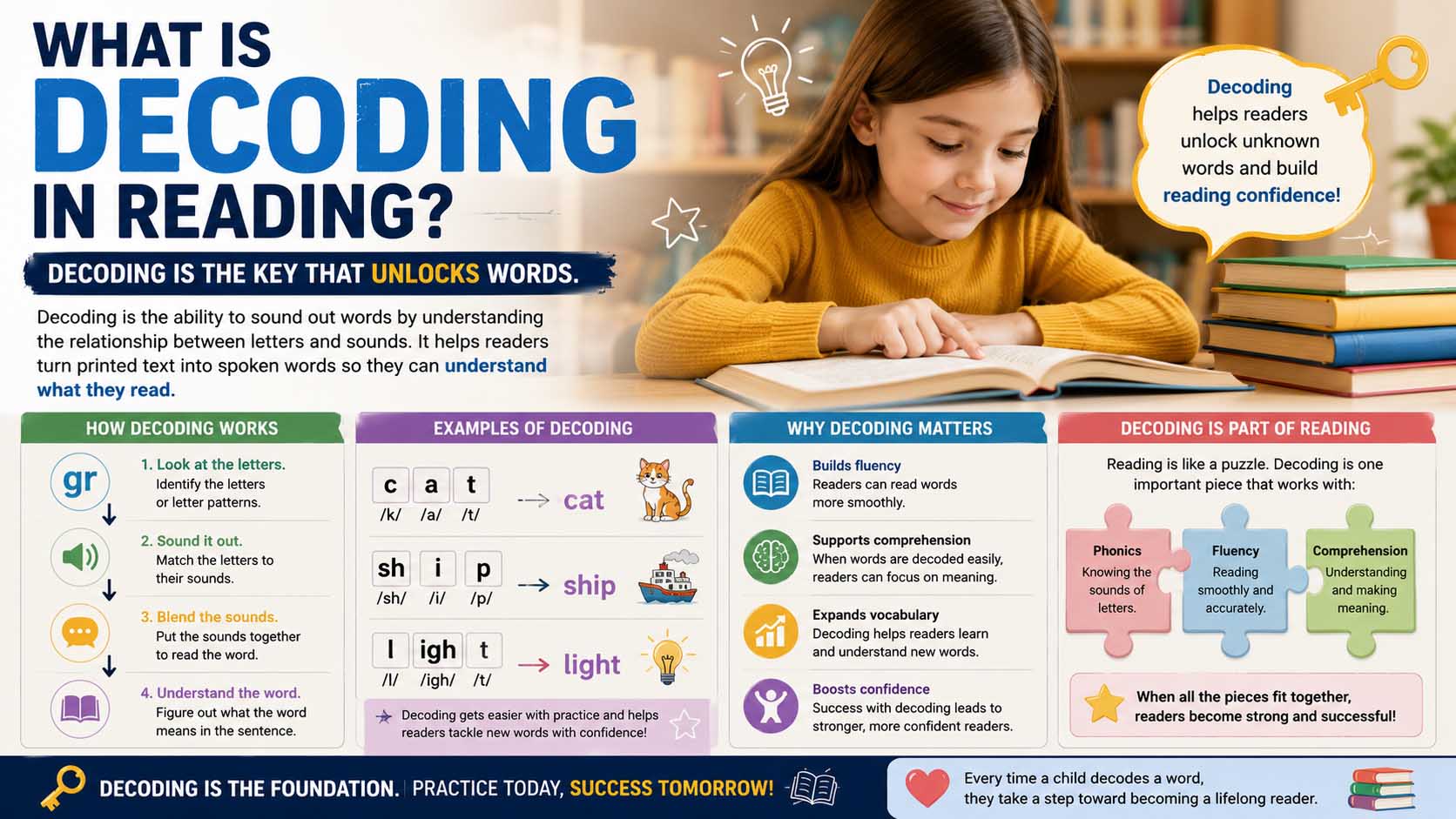
Imagine a child looking at the unfamiliar word “sunset.” They recognize the letters, connect them with sounds, separate the word into manageable parts, and then blend those sounds until they can say “sunset.” That process helps explain what is decoding in reading: using knowledge of letters, spelling patterns, and speech sounds to turn written words into spoken words that a reader can recognize and understand.
Decoding is one of the foundational skills involved in learning to read. Although experienced readers often recognize familiar words almost instantly, beginners need repeated opportunities to connect written patterns with spoken language.
As decoding becomes faster and more accurate, readers can spend less effort figuring out individual words and more attention understanding what a sentence or story means.
What Is Decoding in Reading and How Does It Work?
Decoding is the process of translating written letters and letter combinations into the sounds they represent and using those sounds to identify words.
Consider the word “map.”
A beginning reader can identify the sounds represented by m, a, and p. Next, the reader blends /m/ /a/ /p/ together and recognizes the spoken word “map.”
However, English reading quickly becomes more complex than sounding out individual letters. Readers also learn common letter combinations, syllable patterns, and spelling conventions.
For example, the letters sh commonly work together to represent one sound. Likewise, a reader encountering “ship” benefits from recognizing sh as a unit instead of trying to pronounce s and h separately.
This is one reason systematic phonics for reading plays such a useful role in early instruction. Phonics explicitly teaches relationships between written letters or letter patterns and the sounds they represent.
Why Decoding Skills Matter for Reading
A reader cannot fully understand a written passage if too many of its words remain inaccessible.
Suppose a student reads this sentence:
“The rabbit disappeared behind the garden fence.”
If the student spends considerable effort trying to identify “rabbit,” “disappeared,” and “garden,” they have fewer mental resources available for understanding what happened.
As word reading becomes more accurate and automatic, comprehension becomes easier to support.
However, decoding and comprehension are not the same skill. A child might correctly pronounce every word in a sentence without understanding its meaning.
Therefore, effective reading instruction develops word recognition alongside vocabulary, language comprehension, background knowledge, fluency, and comprehension strategies.
Skills Readers Use to Decode Words
Decoding may look like one simple action, yet several underlying skills work together.
Phonological and Phonemic Awareness
Before children can effectively connect print with speech sounds, they benefit from understanding that spoken language contains smaller sound units.
Phonological awareness is a broad ability to notice and work with the sound structure of spoken language. It can include recognizing rhymes, syllables, and individual speech sounds.
Phonemic awareness is more specific. It involves identifying and manipulating phonemes, the smallest meaningful sound units in spoken words.
For parents or teachers asking what is phonological awareness, understanding this sound-based foundation helps explain why some learners need oral sound practice alongside printed-word instruction.
Letter-Sound Knowledge for Decoding
Readers need to learn how letters and common letter combinations represent sounds.
For instance, a student learns that m commonly represents /m/. Later, the student learns patterns such as ch, sh, th, and vowel teams.
However, English spelling is not perfectly regular. Therefore, students gradually learn both common patterns and less predictable words.
Blending Sounds Into Words
Knowing individual sounds is not enough. Readers must combine them smoothly.
For example:
c – a – t → cat
A learner may initially pronounce each sound separately. Then, through practice, the learner becomes quicker at blending the sounds into the complete word.
Recognizing Larger Word Parts
As students progress, they do not need to decode every long word one letter at a time.
Instead, they learn to recognize syllables, prefixes, suffixes, roots, and familiar spelling patterns.
For example, a student reading “unhelpful” may recognize un-, help, and -ful as meaningful parts. Consequently, longer words become easier to manage.
Decoding in Reading: A Simple Example
Consider the unfamiliar word sunfish.
A learner might approach it like this:
- Look carefully at all the letters.
- Identify recognizable patterns.
- Divide the word into manageable parts: sun + fish.
- Connect letters and patterns with their sounds.
- Blend the sounds within each part.
- Combine the parts to say “sunfish.”
This final step matters because reading involves meaning as well as pronunciation.
Still, readers should not be encouraged to guess words from context instead of attending to the print. Context can help confirm meaning, while the letters and spelling patterns provide the primary information needed to identify the written word accurately.
What Is Decoding and Encoding in Reading?
Decoding and encoding are closely connected literacy skills, but they work in opposite directions.
Decoding means looking at written language and turning it into recognizable spoken words.
Encoding means hearing or thinking of a spoken word and representing its sounds with written letters and spelling patterns.
For example, when a child sees dog and reads it aloud, they are decoding. Meanwhile, when the child hears “dog,” identifies its sounds, and writes d-o-g, they are encoding.
| Skill | Starting point | Goal | Simple example |
|---|---|---|---|
| Decoding | Written word | Read the word | sees “shop” → says “shop” |
| Encoding | Spoken word | Spell/write the word | hears “shop” → writes “shop” |
Therefore, when someone asks what is encoding and decoding in reading, the simplest explanation is that decoding moves from print toward speech, while encoding moves from speech toward print.
Difference Between Encoding and Decoding in Reading
The main difference is the direction in which the learner applies their knowledge.
During decoding, the student sees letters and works toward pronunciation and word recognition. During encoding, the student starts with sounds in a spoken word and chooses letters or spelling patterns to represent them.
For example, imagine the word chat.
While decoding, a reader notices that ch represents a sound and blends it with the remaining sounds to read “chat.”
During encoding, the student hears “chat,” separates the sounds, and decides which letters represent them.
So, what is the difference between decoding and encoding in reading in practical classroom terms? Decoding mainly supports word reading, while encoding is central to spelling and writing. Because both rely on knowledge of sound-symbol relationships, teaching them together can reinforce learning.
Decoding vs. Memorizing Sight Words
Children often learn some frequently occurring words quickly, which can create confusion about the relationship between decoding and sight-word reading.
A “sight word” is best understood as a word a reader recognizes automatically without needing to consciously sound it out each time. Many words can become sight words after readers repeatedly connect their spellings, pronunciations, and meanings.
Some high-frequency words contain less predictable spelling elements and may need extra attention.
Therefore, phonics vs sight words should not be treated as a choice between two competing approaches. Phonics knowledge helps children decode words, while repeated accurate encounters help words become increasingly automatic.
That automatic recognition supports smoother reading.
How Decoding Develops as Children Learn to Read
Early readers often need time to sound out simple words. However, with instruction and practice, the process becomes increasingly efficient.
Children usually develop language and early literacy abilities before they read independently. They may learn about print, rhyming, sounds, letters, and books long before fluent word reading appears.
Parents wondering when do kids start reading should remember that development varies considerably. Rather than expecting every child to read independently at exactly the same age, watch for steady growth and respond to difficulties with appropriate instruction and support.
As students advance, their decoding work also changes. Instead of focusing mainly on simple consonant-vowel-consonant words, they encounter vowel patterns, multisyllabic words, prefixes, suffixes, and increasingly complex spelling structures.
Signs of Difficulty With Word Decoding
Decoding difficulties can appear in several ways.
A student may read very slowly because they need to work through nearly every word. Alternatively, they may frequently substitute one word for another that looks somewhat similar.
Other signs can include difficulty blending sounds, inconsistent recognition of common spelling patterns, trouble reading unfamiliar words, and avoiding reading aloud.
Some learners also rely heavily on pictures or sentence context to guess words rather than carefully processing the letters.
However, one difficult reading session does not establish a reading disorder. Students learn at different rates, and the difficulty of the material matters.
Comparing a student’s current skills with appropriate reading levels by grade can provide general context, but grade-level charts should not replace individual assessment or teacher observation.
Strategies That Help Build Decoding Skills
Effective practice should be structured enough to teach useful patterns while giving learners plenty of opportunities to apply them in real reading.
Teach Letter-Sound Relationships Explicitly
Beginners benefit from clear instruction showing how letters and common spelling patterns represent speech sounds.
Rather than expecting students to discover every pattern independently, teachers can introduce patterns systematically and provide guided practice.
For a broader explanation of evidence-based early reading instruction, Reading Rockets explains phonics instruction and how children learn to connect letters with sounds.
Practice Blending for Better Word Reading
Students need opportunities to move from isolated sounds to complete words.
For example, a teacher might present:
s – i – t
Then, the learner blends the sounds until they recognize “sit.”
As students improve, practice can move toward more complex words.
Use Decodable Text at the Right Stage
Decodable texts contain many words that match sound-spelling patterns students have already learned.
As a result, beginners can practice applying their knowledge rather than relying mainly on guessing.
However, students should also hear and engage with richer texts that build vocabulary, knowledge, and comprehension, even when those texts are beyond what they can independently decode.
Practice Reading and Spelling Together
Because encoding and decoding rely on related knowledge, spelling can strengthen reading practice.
For instance, after students learn a spelling pattern, they can read several words containing it and then practice writing words with the same pattern.
This gives them experience moving in both directions between sounds and print.
Give Useful Feedback During Decoding Practice
When a learner misreads a word, simply providing the answer every time may miss a teaching opportunity.
Instead, a teacher might direct attention to the letters, ask the student to identify a known pattern, and guide them through blending.
The goal is not to make students struggle unnecessarily. Rather, feedback should help them apply a strategy they can use again.
Common Decoding Mistakes
One mistake is encouraging children to guess an unknown word mainly from a picture. Pictures can support comprehension, yet they do not replace careful attention to written letters.
Another mistake is moving to difficult text before a learner has enough foundational knowledge. If nearly every sentence contains several words the student cannot read, practice can become frustrating and inefficient.
At the same time, endless isolated phonics drills without meaningful reading can limit opportunities to build fluency and comprehension.
A balanced instructional routine therefore gives students explicit foundational instruction, purposeful practice, vocabulary development, and plenty of meaningful language and reading experiences.
From Decoding to Fluent Reading
Accurate decoding is a foundation, but the larger goal is fluent, meaningful reading.
At first, identifying a word may require conscious effort. After repeated successful encounters, however, many familiar words become easier to recognize automatically.
That increased automaticity can free attention for phrasing, vocabulary, ideas, characters, arguments, and other aspects of comprehension.
Still, learners continue decoding unfamiliar words throughout their education. Even skilled adult readers use knowledge of spelling patterns, word parts, and language when encountering unfamiliar technical or academic vocabulary.
So, understanding what is decoding in reading is not only about teaching children to sound out three-letter words. It is about developing a flexible word-reading system that supports increasingly complex reading.
Frequently Asked Questions About Decoding in Reading
What Is a Simple Definition of Decoding in Reading?
Decoding is using knowledge of letters, spelling patterns, and sounds to identify written words. For example, a beginning reader may connect the letters in “fish” with their sounds and blend those sounds to recognize the word.
Is Decoding the Same as Phonics?
No. Phonics is instruction about relationships between written letters or letter patterns and speech sounds. Decoding is the act of applying that knowledge to read words.
Is Decoding the Same as Reading Comprehension?
No. Decoding helps readers identify written words, while comprehension involves understanding their meaning within sentences, paragraphs, and complete texts. Strong reading depends on both word recognition and language comprehension.
What Is the Difference Between Decoding and Encoding in Reading?
Decoding generally moves from print to spoken word recognition, while encoding moves from spoken language toward written spelling. For example, reading “lamp” is decoding, while hearing “lamp” and spelling it is encoding.
How Can Parents Practice Decoding at Home?
Parents can read with children, practice sound-letter relationships that match what children are learning, and encourage them to blend sounds in manageable words. Meanwhile, reading interesting books aloud can continue building vocabulary, knowledge, and enjoyment of stories.
Does Decoding Become Automatic With Practice?
Many frequently encountered words can become rapidly and automatically recognized after successful learning and repeated exposure. However, readers may still need deliberate decoding strategies when they encounter unfamiliar words, names, or specialized vocabulary.