
Hard Vocabulary Words: Challenging Words With Meanings and Examples
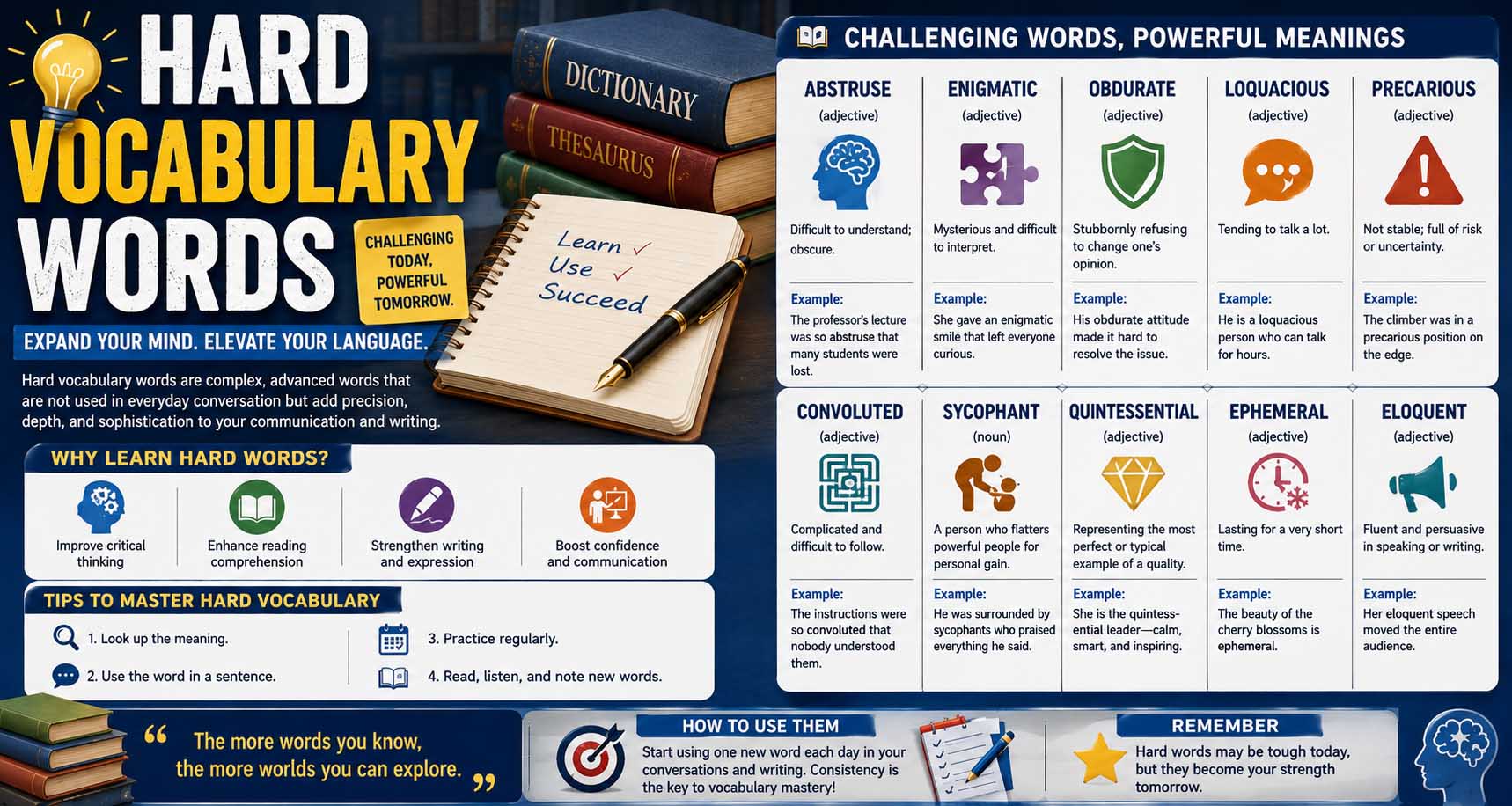
Hard Vocabulary Words: Challenging Words With Meanings and Examples
Have you ever reached a word in a book and had no idea how to pronounce it, let alone explain what it means? Learning hard vocabulary words can feel challenging at first, but difficult words become much easier when you connect them with simple definitions, examples, and familiar situations. Instead of memorizing a huge list, students can build a stronger vocabulary gradually and learn how to recognize unfamiliar words while reading.
A larger vocabulary can make reading easier, improve writing, and help students express ideas more precisely. In addition, it can make textbooks, essays, tests, and classroom discussions less intimidating.
Below, you’ll find challenging words with plain-English meanings, example sentences, and practical strategies for remembering them.
What Makes Hard Vocabulary Words Difficult?
A word can feel difficult for several reasons.
Sometimes the meaning is unfamiliar. In other cases, the spelling does not seem to match the pronunciation. Also, long words can contain roots, prefixes, or suffixes that students have not learned yet.
Context matters as well. For example, ambiguous becomes easier once you see it used in a sentence:
“The teacher’s instructions were unclear, so several students understood them in different ways.”
As a result, the surrounding information suggests that ambiguous means unclear or open to more than one interpretation.
Strong readers often use several strategies at once. For instance, they examine context, recognize word parts, reread the sentence, and check a dictionary when necessary.
That process connects naturally with what is decoding in reading, because decoding skills help readers turn written symbols and letter patterns into recognizable spoken words before they focus on deeper meaning.
Hard Vocabulary Words With Meaning and Examples
If you’re looking for hard vocabulary words with meaning, start with words that appear in academic writing, literature, news, and everyday communication.
To make the list easier to study, the examples below are divided into two smaller groups.
Challenging Words for Everyday and Academic Use
| Word | Simple Meaning | Example |
|---|---|---|
| Ambiguous | Having more than one possible meaning | His answer was ambiguous. |
| Benevolent | Kind and generous | The benevolent neighbor helped the family. |
| Candid | Honest and direct | She gave a candid response. |
| Diligent | Careful and hardworking | He was diligent about studying. |
| Eloquent | Clear and persuasive in speaking or writing | Her speech was eloquent. |
| Frivolous | Not serious or useful | They avoided frivolous arguments. |
| Gregarious | Sociable and friendly | Mia is naturally gregarious. |
| Hypothetical | Based on an imagined situation | The teacher asked a hypothetical question. |
| Impeccable | Without noticeable faults | His manners were impeccable. |
| Judicious | Showing good judgment | She made a judicious decision. |
| Meticulous | Extremely careful about details | He kept meticulous notes. |
| Novice | A beginner | I am still a novice at chess. |
| Obsolete | No longer commonly used | That technology became obsolete. |
| Pragmatic | Practical and realistic | We need a pragmatic solution. |
| Resilient | Able to recover from difficulty | The team remained resilient after losing. |
These words appear in many kinds of reading. Therefore, learning them can help students understand both classroom material and everyday communication.
More Difficult Words With Simple Meanings
| Word | Simple Meaning | Example |
|---|---|---|
| Scrutinize | Examine very carefully | Scrutinize the instructions before starting. |
| Tenacious | Persistent and determined | The tenacious student kept practicing. |
| Unprecedented | Never known or done before | The event attracted unprecedented attention. |
| Venerate | Respect deeply | Many people venerate the historic leader. |
| Wary | Cautious | She was wary of the unfamiliar website. |
| Alleviate | Make something less severe | The shade helped alleviate the heat. |
| Conundrum | A difficult problem | The puzzle presented a real conundrum. |
| Disparity | A noticeable difference | Researchers studied the disparity in results. |
| Exacerbate | Make a problem worse | Delaying repairs could exacerbate the damage. |
| Ineffable | Too great to describe easily in words | He felt ineffable joy. |
| Magnanimous | Generous and forgiving | The winner was magnanimous toward her opponent. |
| Ostentatious | Designed to attract attention or impress | The room had ostentatious decorations. |
| Perplexed | Confused | The difficult question left him perplexed. |
| Reclusive | Avoiding other people | The writer lived a reclusive life. |
| Ubiquitous | Present almost everywhere | Smartphones have become ubiquitous. |
Instead of memorizing every word today, choose five and use each one in your own sentence. As a result, you begin connecting each definition with actual language rather than treating the words as an isolated list.
More Hard Vocabulary Words for Students
Once the first group feels comfortable, students can expand their vocabulary with words that frequently appear in more advanced reading.
For example, try these:
- Abstain — choose not to do or have something
- Acquiesce — accept something without strongly protesting
- Amiable — friendly and pleasant
- Anomaly — something that differs from what is expected
- Arbitrary — based on preference rather than a clear reason
- Belligerent — hostile or aggressive
- Coherent — logical and easy to understand
- Conspicuous — easy to notice
- Deference — respectful submission to someone’s judgment
- Detrimental — harmful
- Empirical — based on observation or evidence
- Fallacious — based on incorrect reasoning
- Impartial — fair and not favoring one side
- Incessant — continuing without stopping
- Lucid — clear and easy to understand
- Mitigate — reduce the seriousness of something
- Plausible — appearing reasonable or believable
- Precarious — uncertain or dangerously unstable
- Superfluous — unnecessary because there is already enough
These words become much easier when students meet them repeatedly during different types of reading, including academic reading, informational texts, fiction, and close reading.
Therefore, students should not expect one encounter with a word to create lasting knowledge. Instead, repeated exposure helps strengthen recognition and understanding.
Advanced Hard Vocabulary Words and Examples
Students asking what are some hard vocabulary words may be ready for less common terms that appear in advanced literature, exams, or college-level texts.
For instance, the following examples introduce more challenging vocabulary with straightforward explanations.
Circumlocution
Meaning: Using more words than necessary instead of expressing an idea clearly and directly.
Example: His circumlocution made a simple explanation unnecessarily long.
Ephemeral
Meaning: Lasting for a very short period of time; brief or temporary.
Example: The beauty of the spring flowers was ephemeral.
Fastidious
Meaning: Very careful about details and difficult to satisfy.
Example: The fastidious editor noticed every punctuation error.
Idiosyncratic
Meaning: Having unusual characteristics specific to a person or thing.
Example: The artist was known for her idiosyncratic style.
Juxtaposition
Meaning: Placing things close together so their differences or similarities become noticeable.
Example: The photograph used the juxtaposition of an old building and a modern skyscraper.
More Challenging Words for Advanced Learners
The next group can stretch vocabulary further. However, learners should focus on how each word works in context rather than memorizing definitions word for word.
Obfuscate
Meaning: Make something unclear or difficult to understand.
Example: Technical jargon can obfuscate an otherwise simple explanation.
Perspicacious
Meaning: Quick to understand, notice, or recognize things, often showing sharp awareness or intelligence.
Example: Her perspicacious observations revealed a problem everyone else had missed.
Recalcitrant
Meaning: Unwilling to obey rules or authority.
Example: The recalcitrant character refused to follow the king’s orders.
Sycophant
Meaning: Someone who excessively praises an influential person for personal advantage.
Example: The leader surrounded himself with sycophants who rarely challenged his decisions.
Vicissitude
Meaning: An unexpected or difficult change in circumstances.
Example: The novel follows the family’s fortunes through many vicissitudes.
Because these terms are less common, learners may need several encounters before they can recognize and use them comfortably. For example, reading the same word in a novel, article, and classroom discussion can gradually make its meaning more familiar.
How Context Helps You Understand Hard Vocabulary
When an unfamiliar word appears in a passage, do not immediately stop reading.
First, read the entire sentence. Then, read the sentence before and after it.
Suppose you see:
“Unlike his cheerful sister, Marcus remained morose throughout the celebration.”
Even if morose is unfamiliar, “unlike his cheerful sister” provides a clue. Therefore, you can reasonably predict that the word describes sadness or gloominess.
The ability to identify the What Is a Central Idea of a paragraph can help too. Once you understand what a passage is mainly discussing, you have a smaller range of possible meanings for an unfamiliar word.
After making a prediction, check a reliable dictionary. In this way, you can practice inferring meaning while still verifying accuracy.
For more classroom-focused guidance, Reading Rockets explains practical approaches to vocabulary instruction, including ways students can build word knowledge through reading and instruction.
Learn Hard Vocabulary Through Word Families
Memorizing isolated words is less efficient than recognizing related forms.
For example, consider:
Analyze → analysis → analytical → analyst
Once you understand the core idea, several related words become easier.
Next, consider another example:
Specify → specific → specifically → specification
Grammar also influences how a word works. Therefore, reviewing Examples of Adverbs can help students recognize endings such as -ly and understand why specific and specifically serve different grammatical roles.
Prefixes and suffixes provide clues as well.
For instance, pre- often suggests “before,” while re- commonly indicates “again.” Meanwhile, suffixes such as -less, -ful, -tion, and -ment can help readers identify meaning or grammatical function.
As a result, learning common word parts can make unfamiliar vocabulary less intimidating.
Using Figurative Language to Build Vocabulary
Not every difficult word should be interpreted literally.
Writers frequently use words figuratively to create images, comparisons, or emotional effects. Therefore, knowing What Is Figurative Language can prevent confusion when a familiar word seems to have an unusual meaning.
For example, consider this sentence:
“The classroom erupted after the announcement.”
The classroom did not literally explode. Instead, erupted describes a sudden burst of noise or excitement.
Similarly, writers may describe someone’s argument as hollow, a person’s voice as warm, or a problem as thorny. As a result, recognizing figurative meaning helps readers expand their understanding beyond basic dictionary definitions.
A Simple Method for Learning Hard Vocabulary Words
A long vocabulary list becomes manageable when you study in small groups.
First, start with five new words.
For each word:
- Read it aloud.
- Write a simple definition.
- Find or create an example sentence.
- Think of a synonym or antonym.
- Connect it with an image or personal situation.
- Use it in your own sentence.
- Review it the following day.
Then, test yourself without looking at the definition.
For example, instead of memorizing “meticulous = very careful,” imagine someone checking every tiny detail of a school project three times.
As a result, that mental image gives the word something to attach to. Consequently, recalling its meaning may become easier than relying on definition memorization alone.
Hard Vocabulary Words for Writing
A stronger vocabulary can improve writing, but difficult words should make ideas clearer rather than simply make writing sound impressive.
For example, useful writing words include:
- Concise — brief but complete
- Compelling — strongly convincing or interesting
- Corroborate — provide evidence supporting a claim
- Delineate — describe something precisely
- Disseminate — spread information widely
- Infer — reach a conclusion from evidence
- Nuance — a subtle difference
- Rebut — argue against a claim
- Substantiate — support with evidence
- Synthesize — combine information into a connected whole
Consider this sentence:
“The second source corroborates the researcher’s claim.”
In comparison, you could write:
“The second source says the same thing.”
The first version is more precise. However, replacing every simple word with a complicated one usually makes writing harder to read. Therefore, good vocabulary is about precision, not showing off.
Common Mistakes When Learning Hard Vocabulary Words
One mistake is memorizing dictionary definitions without learning how the words behave in sentences.
Another is studying 50 new words at once. As a result, you may recognize them briefly yet forget most of them several days later.
Instead, use spaced review. First, study a small set today. Next, revisit it tomorrow. Then, test yourself again later in the week.
Pronunciation should not be ignored either. In fact, hearing the word and saying it aloud can make it easier to recognize during conversations, lectures, and presentations.
Finally, do not use a difficult word simply because it sounds sophisticated. Instead, check its exact meaning, tone, and grammatical role first.
How Teachers Can Teach Difficult Vocabulary
Teachers can make challenging vocabulary more memorable by connecting words with actual reading rather than presenting disconnected lists.
Before reading a difficult passage, introduce a few essential terms. During reading, ask students to predict unfamiliar meanings from context. Afterward, let them confirm their predictions and use the words in new situations.
Vocabulary maps can also work well. For example, place the target word in the center and surround it with its definition, synonyms, antonyms, word parts, an illustration, and an example sentence.
Games can help too. For instance, students can play vocabulary charades, match definitions with words, create word cards, or compete to write the most accurate original sentence.
Therefore, repeated encounters usually provide more useful practice than one long study session.
Hard Vocabulary Words FAQs
How Many Vocabulary Words Should I Learn Each Day?
There is no perfect number. However, five to ten words can be a manageable starting point for many learners because it leaves enough time to practice each one properly.
What Is the Easiest Way to Memorize Difficult Words?
Combine several methods. First, read the word in context and define it simply. Then, say it aloud and create your own sentence. Finally, review it over several days.
Does Reading Improve Vocabulary?
Yes. Regular reading exposes you to unfamiliar words in meaningful contexts. However, actively checking and reviewing useful new words can make vocabulary growth more effective.
Should Students Memorize Dictionary Definitions?
Short definitions can help, but understanding and usage matter more than repeating exact dictionary wording. Instead, students should be able to explain a word naturally and use it correctly.
What Are Good Difficult Vocabulary Words for High School Students?
For example, ambiguous, corroborate, empirical, exacerbate, hypothetical, meticulous, pragmatic, resilient, scrutinize, and substantiate are useful words because they appear across academic subjects.
How Can I Tell Whether I Really Know a Word?
First, try explaining it without looking at a definition. Then, use it correctly in an original sentence. Finally, check whether you can recognize the word when it appears in a different context.
If you can recognize, explain, and use it, your understanding is much stronger than simple memorization.
Build a Strong Vocabulary One Word at a Time
Learning hard vocabulary words is easier when you stop treating vocabulary as one giant memorization task. Instead, choose a few useful words, understand them in context, connect them with familiar ideas, and use them repeatedly.
Reading regularly also gives difficult words a purpose. For example, when ambiguous, meticulous, or resilient appears again, you will recognize it instead of starting from zero.
Finally, keep a small vocabulary notebook or digital list and review it several times each week. Over time, words that once looked intimidating will become normal parts of your reading, writing, and everyday communication.