
What Is a Good PSAT Score? A Complete Guide for Students
What Is a Good PSAT Score? A Complete Guide for Students
Many students preparing for college admissions ask the same question: what is a good PSAT score? The answer depends on your grade level, academic goals, and the colleges you hope to attend in the future.
The PSAT, or Preliminary SAT, is designed to help students practice for the SAT while measuring college readiness. It also serves as the qualifying test for the National Merit Scholarship Program for many juniors.
What Is the PSAT?
The PSAT is a standardized test administered by the College Board and is closely related to the SAT.
The exam measures skills in:
- Reading
- Writing and Language
- Mathematics
Students often take the PSAT during high school to prepare for future SAT testing and evaluate their academic progress.
The PSAT provides valuable feedback and helps students understand where they stand compared to other test takers nationwide.
What Is a Good PSAT Score?
A common question among students is what is a good score on the PSAT.
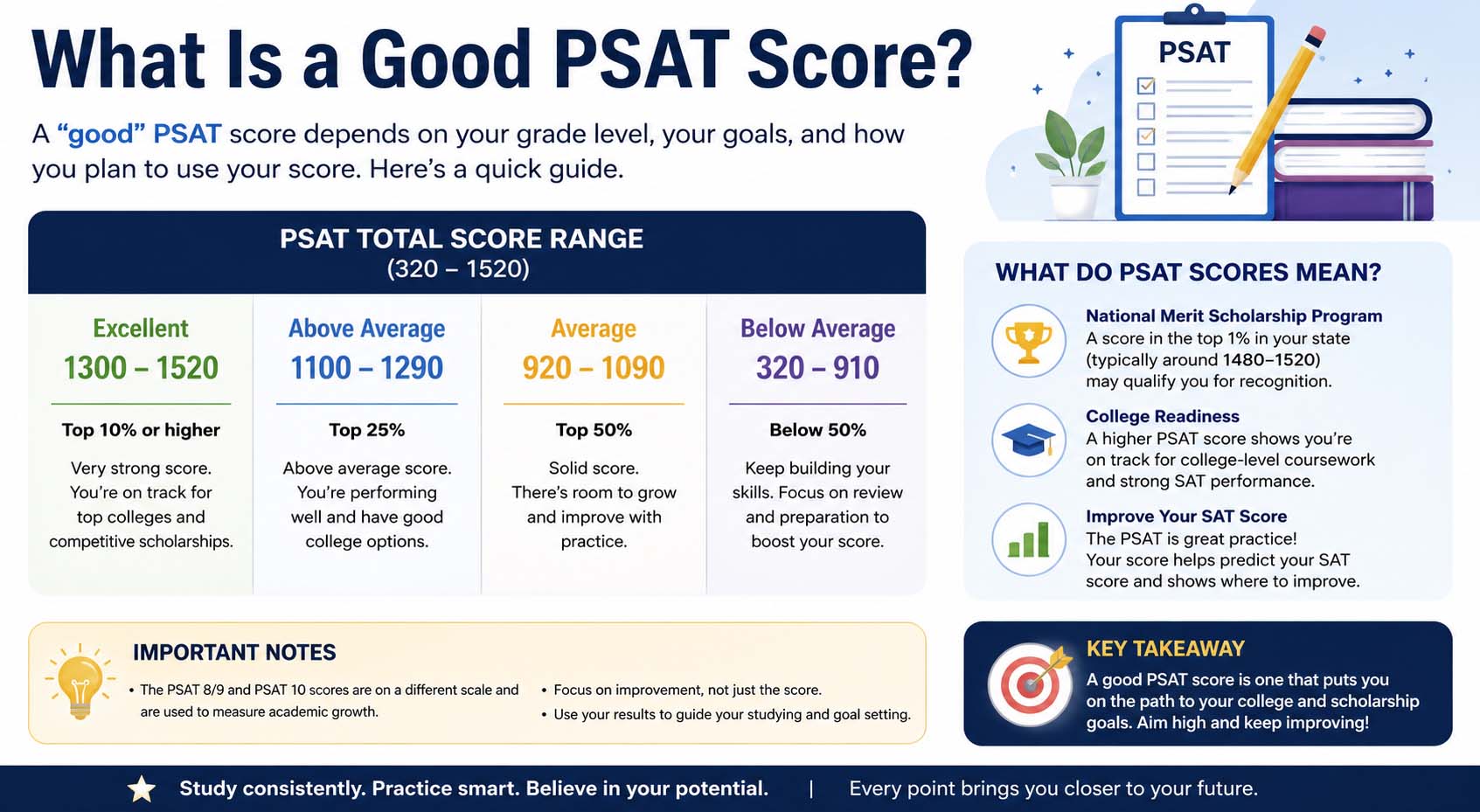
The PSAT score range is typically from 320 to 1520.
| Score Range | Performance Level |
|---|---|
| 320–900 | Below Average |
| 900–1100 | Average |
| 1100–1200 | Above Average |
| 1200–1350 | Strong Score |
| 1350–1520 | Excellent Score |
A score above 1200 is generally considered strong for most students.
However, the definition of a good score varies depending on your grade level and future goals. Students should also understand What Is a Good GPA, since colleges often evaluate standardized test performance alongside academic achievement.
Understanding PSAT Score Components
Your total PSAT score combines two sections:
Reading and Writing
This section evaluates:
- Reading comprehension
- Grammar skills
- Vocabulary in context
- Analytical reasoning
Mathematics
The math section measures:
- Algebra
- Problem solving
- Data analysis
- Advanced mathematical concepts
Both sections contribute equally to your overall score.
Reviewing section scores helps students identify which academic areas need additional practice.
What Is a Good PSAT Score for a Freshman?
Many younger students ask what is a good PSAT score for a freshman.
Since freshmen are just beginning high school, expectations are different from those of upperclassmen.
Generally:
- 800–950 = Average
- 950–1050 = Good
- 1050–1150 = Very Good
- 1150+ = Excellent
Freshmen should focus less on competitive scores and more on understanding the testing format and building foundational skills.
A score around 1000 as a freshman often indicates strong potential for future improvement.
What Is a Good PSAT Score for a Sophomore?
Another frequently searched question is what is a good PSAT score for a sophomore.
By sophomore year, students have completed more coursework and have a stronger academic foundation.
Typical score benchmarks include:
- 950–1050 = Average
- 1050–1150 = Good
- 1150–1250 = Strong
- 1250+ = Excellent
Sophomore scores can provide an early indication of college readiness and potential National Merit competitiveness during junior year.
Students scoring above 1150 often position themselves well for future SAT success.
What Is a Good PSAT Score for a Junior?
Many students wonder what is a good PSAT score for a junior because junior-year PSAT results can impact National Merit Scholarship eligibility.
General benchmarks include:
- 1000–1100 = Average
- 1100–1200 = Good
- 1200–1300 = Strong
- 1300–1400 = Excellent
- 1400+ = Exceptional
A score above 1300 is often considered highly competitive.
However, National Merit qualification depends on Selection Index scores and varies by state each year.
Juniors aiming for scholarships should focus on achieving the highest score possible rather than targeting a specific national average.
Why PSAT Scores Matter
Although colleges generally do not use PSAT scores directly in admissions decisions, the exam offers several benefits.
SAT Preparation
The PSAT closely resembles the SAT, making it excellent practice.
Scholarship Opportunities
High junior-year scores may qualify students for National Merit recognition.
Academic Planning
Students can identify strengths and weaknesses before taking the SAT.
College Readiness Assessment
The exam provides insight into whether students are prepared for college-level academic work. Understanding admission processes, including What Is Rolling Admission, can also help students prepare for future college applications.
These advantages make the PSAT an important educational tool.
PSAT Score Examples
Understanding real-world examples can make score interpretation easier.
Example 1
Student Score: 980
This score is solid for a freshman and indicates room for growth before junior year.
Example 2
Student Score: 1180
This is generally considered a strong sophomore score and suggests good college readiness.
Example 3
Student Score: 1350
This is an excellent junior score and may place the student in a competitive position for scholarship consideration.
Every student’s academic journey is different, so comparisons should be used only as general guidance.
How to Improve Your PSAT Score
Students often want to know how to raise their scores before future testing.
Step 1: Analyze Your Results
Review score reports carefully.
Identify:
- Reading weaknesses
- Grammar challenges
- Math problem areas
Step 2: Create a Study Schedule
Even 20–30 minutes per day can produce significant improvement.
Step 3: Practice with Official Materials
Use College Board resources and official practice questions.
These materials closely match actual test content.
Step 4: Strengthen Reading Skills
Reading academic articles, nonfiction books, and educational materials can improve comprehension.
Step 5: Focus on Math Fundamentals
Review algebra, equations, percentages, and data interpretation concepts.
Strong math skills often produce substantial score increases.
Common Mistakes Students Make
Many students lose points due to avoidable errors.
Poor Time Management
Spending too much time on difficult questions can reduce overall performance.
Lack of Practice
Students unfamiliar with the test format often score below their true potential.
Ignoring Weak Areas
Focusing only on strengths limits improvement opportunities.
Test Anxiety
Nervousness can negatively affect concentration and decision-making.
Proper preparation helps reduce these challenges.
PSAT vs SAT: What’s the Difference?
Students frequently compare the PSAT and SAT.
| Feature | PSAT | SAT |
|---|---|---|
| Purpose | Practice and assessment | College admissions |
| Score Range | 320–1520 | 400–1600 |
| Scholarship Eligibility | Yes | No |
| Difficulty | Slightly easier | More advanced |
| College Use | Informational | Admissions factor |
The PSAT serves as an important stepping stone toward SAT success.
Beyond the PSAT: Preparing for College
Strong PSAT performance is only one part of college readiness.
Students should also focus on maintaining excellent grades, understanding What Is the Highest GPA used by their school, exploring financial aid opportunities like What Is Work Study, and planning ahead by asking What Will You Do to Maximize on Your Postsecondary Education Investment. Combining academic success with careful college planning can create more opportunities for scholarships and future career success.
Frequently Asked Questions
What is a good PSAT score?
For many students, a score above 1200 is considered strong, while scores above 1300 are often viewed as excellent.
What is a good score on the PSAT for college preparation?
A score between 1200 and 1300 generally indicates strong readiness for future SAT testing.
What is a good PSAT score for a freshman?
A score around 1000 or higher is typically considered good for a freshman.
What is a good PSAT score for a sophomore?
Many educators consider 1100–1200 a strong sophomore score.
What is a good PSAT score for a junior?
A score above 1200 is strong, while scores above 1300 may be highly competitive.
Do colleges see PSAT scores?
Most colleges do not use PSAT scores directly in admissions decisions.
Conclusion
Understanding what is a good PSAT score can help students set realistic academic goals and prepare effectively for future standardized tests. While score expectations differ by grade level, strong performance generally indicates readiness for college-level work and future SAT success. By combining consistent study habits with long-term academic planning, students can use the PSAT as an important stepping stone toward college admissions, scholarships, and future educational opportunities.