
Benefits of Recess: Why Break Time Matters for Students
Benefits of Recess: Why Break Time Matters for Students
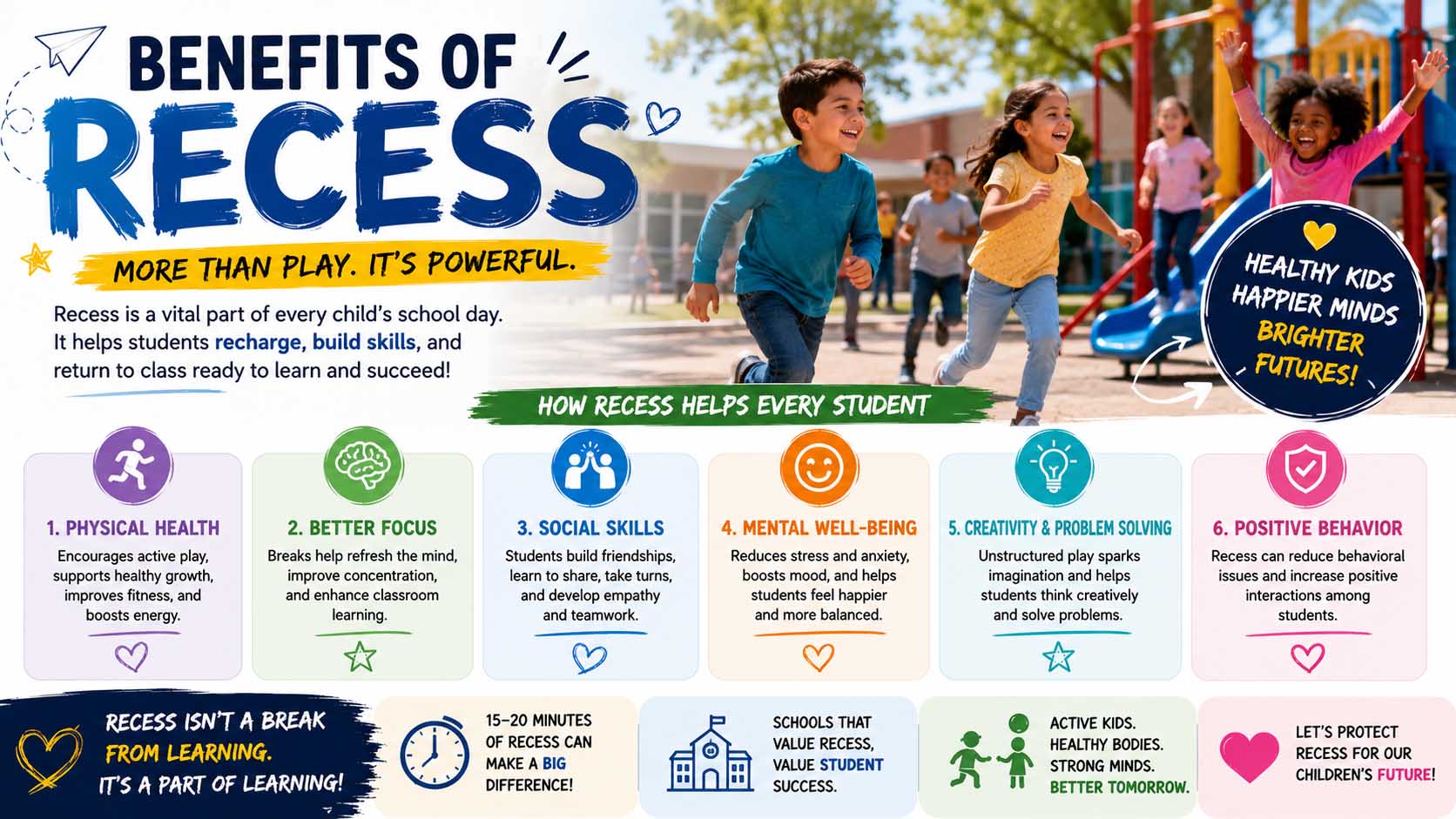
A school day asks children to listen, read, write, solve problems, follow directions, and manage their behavior for hours. That is why the benefits of recess go far beyond simply giving students time away from their desks. A well-planned break gives children opportunities to move, socialize, reset their attention, make choices, and return to class ready for the next part of the day.
Recess can look different depending on a student’s age and school. Younger children may use playground equipment, play tag, or invent games, while older students might walk, play sports, talk with friends, or simply take a mental break. In each case, the key idea is similar: students receive a temporary break from structured academic demands.
So, what are the benefits of recess, and why does it deserve a place in the school schedule? The answer involves physical health, classroom attention, social development, independence, and emotional well-being.
What Is Recess?
Recess is a scheduled period during the school day when students take a break from formal classroom instruction. Although schools organize it differently, recess often gives children more freedom to choose what they do than physical education classes do.
For example, a physical education lesson may teach a specific skill or require students to participate in planned activities. During recess, however, one student might play basketball while another talks with friends and another walks around the playground.
That element of choice matters. Students spend much of the school day following schedules and teacher instructions, whereas recess gives them a chance to decide how they use part of their time.
Recess also should not be viewed simply as “unused” academic time. Instead, it can complement classroom learning by giving students a change of pace between periods of concentration.
Benefits of Recess at a Glance
The value of recess becomes clearer when we look at the different parts of student development it can support.
| Area | How Recess May Help | Everyday Example |
|---|---|---|
| Physical activity | Encourages movement | Running, climbing, jumping |
| Attention | Provides a break from academic demands | Returning to class after outdoor play |
| Social skills | Creates peer interaction | Joining a group game |
| Independence | Allows student choices | Choosing an activity or play partner |
| Problem-solving | Creates real social situations | Agreeing on rules for a game |
| Emotional well-being | Provides enjoyable, less structured time | Talking or playing with friends |
| Creativity | Supports imaginative play | Inventing games and stories |
Not every student experiences recess in the same way. Still, when schools provide a safe and inclusive environment, break time can support several areas of development at once.
Physical Benefits of Recess
One of the easiest advantages to see is movement.
Children naturally vary in how active they are during recess. Still, playgrounds and open spaces give students opportunities to walk, run, climb, jump, throw, catch, and participate in games.
These activities can contribute to a child’s overall daily physical activity. They also provide practice with movement skills such as coordination, balance, speed, and spatial awareness.
Recess can be particularly valuable because students choose many of their own movements. A child who does not enjoy organized sports, for instance, might still enjoy walking with friends, playing on climbing equipment, or creating an informal game.
However, recess does not replace physical education. PE provides structured instruction and opportunities to learn movement skills, while recess provides less structured activity. Therefore, the two serve related but different purposes.
How Recess Can Support Classroom Attention
Students cannot maintain the same level of concentration indefinitely.
After sitting through lessons, assignments, and instructions, a short change in activity can give children a break from continuous academic demands. Consequently, returning to the classroom may feel like the beginning of a new learning period rather than an extension of the previous one.
This does not mean that recess automatically makes every child perfectly focused. Students have different needs, and classroom conditions matter as well.
Still, alternating concentrated academic work with appropriate breaks can create a more balanced school routine.
Teachers can also make the transition back to class smoother. For instance, a brief settling routine after recess can help students shift from energetic play to quieter learning.
Similarly, Morning Meeting Questions can help establish predictable classroom communication earlier in the day, while post-recess routines can provide another clear transition point.
Social Benefits of Recess
Recess gives students something classroom lessons cannot always provide: relatively unstructured interaction with peers.
During a game, children may need to decide who goes first, explain rules, negotiate disagreements, include another player, or respond when someone changes the activity.
Those situations can become practical opportunities to practice communication and cooperation.
For example, imagine four students creating a playground game. They must decide where the boundaries are, what counts as a point, and what happens when someone breaks a rule. A disagreement may occur, yet the students also have an opportunity to solve it.
Adults still need to intervene when bullying, unsafe behavior, or serious conflict occurs. However, children also benefit from age-appropriate opportunities to work through ordinary disagreements.
Schools that want to develop these skills more directly may pair recess experiences with Social Emotional Learning Activities that help students recognize emotions, communicate respectfully, and handle conflict.
Recess Gives Students a Chance to Make Choices
School schedules are necessarily structured. Teachers decide when lessons begin, which subject students study, what assignment comes next, and when activities end.
Recess provides a different experience.
Within reasonable school rules, students may decide whom to play with, what game to join, whether to move actively, or whether to spend time in a quieter activity.
These small decisions help children practice independence.
Choice can also make recess more inclusive when schools offer several options. Not every child wants competitive sports. Therefore, playgrounds can benefit from spaces for imaginative play, walking, conversation, drawing with chalk, playground equipment, and quieter activities alongside active games.
A successful recess period should not depend on being the fastest runner or best athlete.
Benefits of Outdoor Recess
Outdoor recess has several practical advantages.
First, outdoor spaces generally provide more room for movement than classrooms. As a result, children can run, play larger games, and move in ways that would be difficult indoors.
Second, going outside changes the student’s environment. Instead of looking at the same classroom walls, students experience open space, natural light, weather, and different sights and sounds.
Outdoor time also creates opportunities to notice nature. Depending on the school, children might observe trees, clouds, insects, seasonal changes, or birds without the experience needing to become a formal science lesson.
Of course, schools need appropriate policies for extreme heat, cold, storms, poor air quality, or unsafe playground conditions. On some days, indoor recess may be the safer option.
Still, when conditions allow, the benefits of outdoor recess make outdoor space worth using.
Recess and Emotional Well-Being
School can sometimes feel demanding, even when students enjoy learning.
Assignments, tests, social situations, classroom expectations, and long periods of concentration can create frustration or mental fatigue. Therefore, a break can provide temporary relief from those demands.
Some students release energy through movement. Meanwhile, others feel better after talking with friends or spending a few minutes in a less structured setting.
However, recess is not automatically relaxing for everyone.
A student who struggles to join games or experiences peer conflict may find the playground difficult. Therefore, teachers and supervisors should pay attention to students who repeatedly remain isolated or appear uncomfortable.
Schools can improve the experience by providing inclusive activities without forcing every child into organized play.
Benefits of Recess in Middle School
Recess is often associated with elementary school, yet older students still need breaks.
The benefits of recess in middle school may look somewhat different because adolescents are less likely to spend their break playing on traditional playground equipment.
Instead, middle-school students might benefit from walking, playing basketball, talking with friends, going outdoors, or participating in optional activities.
A break can also provide social time that doesn’t compete with classroom instruction. Without a designated break, students may try to meet their social needs during lessons.
Middle-school schedules vary widely, so schools may use advisory periods, activity breaks, outdoor lunch periods, or other formats rather than traditional recess. Still, the underlying principle remains useful: students benefit from having reasonable opportunities to move and reset during a long academic day.
How Teachers Can Make Recess More Inclusive
The experience students have during recess can depend partly on supervision and playground design.
Different types of teachers may approach playground supervision differently, yet effective recess support usually combines student freedom with clear safety expectations.
Teachers and playground staff can explain rules before problems happen. They can also make equipment accessible, watch for exclusion, and help children enter games when needed.
At the same time, adults do not need to organize every minute.
Too much adult direction can turn recess into another structured class. Instead, supervisors can stay available while allowing students enough freedom to create their own activities.
Schools can also consider quieter zones for children who become overwhelmed by noisy, highly active playgrounds.
Recess in Kindergarten and Early Elementary School
Young learners often alternate between direct instruction, hands-on activities, movement, and play throughout the day.
For kindergarten students, recess fits naturally into this pattern because long periods of sitting can be difficult for young children.
A child may spend part of the morning practicing phonics for kindergarten, for example, and then benefit from a change of activity before returning to another literacy or numeracy task.
The break does not replace teaching. Rather, it gives students a different kind of experience within the school day.
Young children can also practice social skills during play. Sharing equipment, taking turns, joining groups, and communicating ideas all require skills that continue developing throughout childhood.
Should Recess Be Taken Away for Poor Behavior?
Using recess as a routine punishment deserves careful consideration.
If a student needs opportunities for movement and a mental break, repeatedly removing the entire recess period may not address the reason behind the behavior. In some cases, a student who struggles with classroom regulation may particularly benefit from appropriate physical activity.
Schools still need consequences and behavior-management systems. However, educators can consider alternatives that preserve opportunities for movement whenever practical.
For example, a student might complete a restorative conversation, repair harm caused by inappropriate behavior, or receive another suitable consequence.
The goal should be to address the behavior rather than automatically treating recess as a reward that students must earn.
Common Misunderstandings About Recess
One common idea is that recess is simply free time with no educational value.
Yet learning does not occur only through worksheets and teacher-led lessons. Children also learn through social interaction, decision-making, movement, observation, and play.
Another misconception is that every student should be highly active throughout recess.
In reality, children use breaks differently. Some need vigorous movement, while others prefer conversation or quieter play. Therefore, schools can offer choices rather than expecting every child to participate in the same activity.
Finally, longer recess does not automatically mean better recess. Quality matters too. Safe spaces, appropriate supervision, accessible activities, and inclusive playground cultures all influence the experience.
Practical Ways Schools Can Improve Recess
Schools do not necessarily need expensive playground renovations to create a better break.
Simple equipment such as balls, jump ropes, cones, and chalk can support many activities. Meanwhile, clearly defined play areas can reduce conflict between running games and quieter activities.
Schools can also ask students what they enjoy doing. Their answers may reveal simple changes that adults have overlooked.
Likewise, teachers can observe patterns. If the same students repeatedly struggle to join games, staff can provide gentle support without taking control of the entire activity.
Most of all, schools should treat recess as part of the school day rather than as leftover time between “real” learning.
FAQs About the Benefits of Recess
What are the benefits of recess for students?
Recess can provide opportunities for physical activity, peer interaction, independent decision-making, creative play, and a break from structured academic demands. Its value depends partly on the quality and accessibility of the recess environment.
Does recess help students learn?
Recess does not replace instruction. However, it can complement learning by providing a break between periods of academic concentration and by giving students opportunities to practice social and problem-solving skills.
How does recess help physical development?
Active recess can involve running, jumping, climbing, throwing, catching, and other movements. As a result, students can practice coordination and movement skills while contributing to their daily physical activity.
Why is social interaction during recess useful?
Less structured peer interaction gives students opportunities to communicate, negotiate game rules, cooperate, handle ordinary disagreements, and develop friendships.
Do older students need recess?
Older students still need opportunities to move, socialize, and take breaks from concentrated academic work. However, schools may call these periods activity breaks, outdoor lunch, advisory breaks, or another name rather than recess.
Making Break Time Count
The benefits of recess come from much more than giving children a few minutes to burn energy. A thoughtful recess period can create space for movement, friendships, independence, creative play, problem-solving, and a temporary break from structured lessons.
For schools, the goal should not be to control every minute of that break. Instead, providing safe spaces, reasonable supervision, inclusive choices, and enough freedom for students to play can make recess a useful part of a balanced school day.
For parents and teachers, the simplest takeaway is that learning and breaks do not have to compete. When students have appropriate opportunities to move, interact, and reset, recess can work alongside classroom instruction as part of a healthy, supportive school experience.