
Types of Entrepreneurs: Classification, Examples, and Key Characteristics
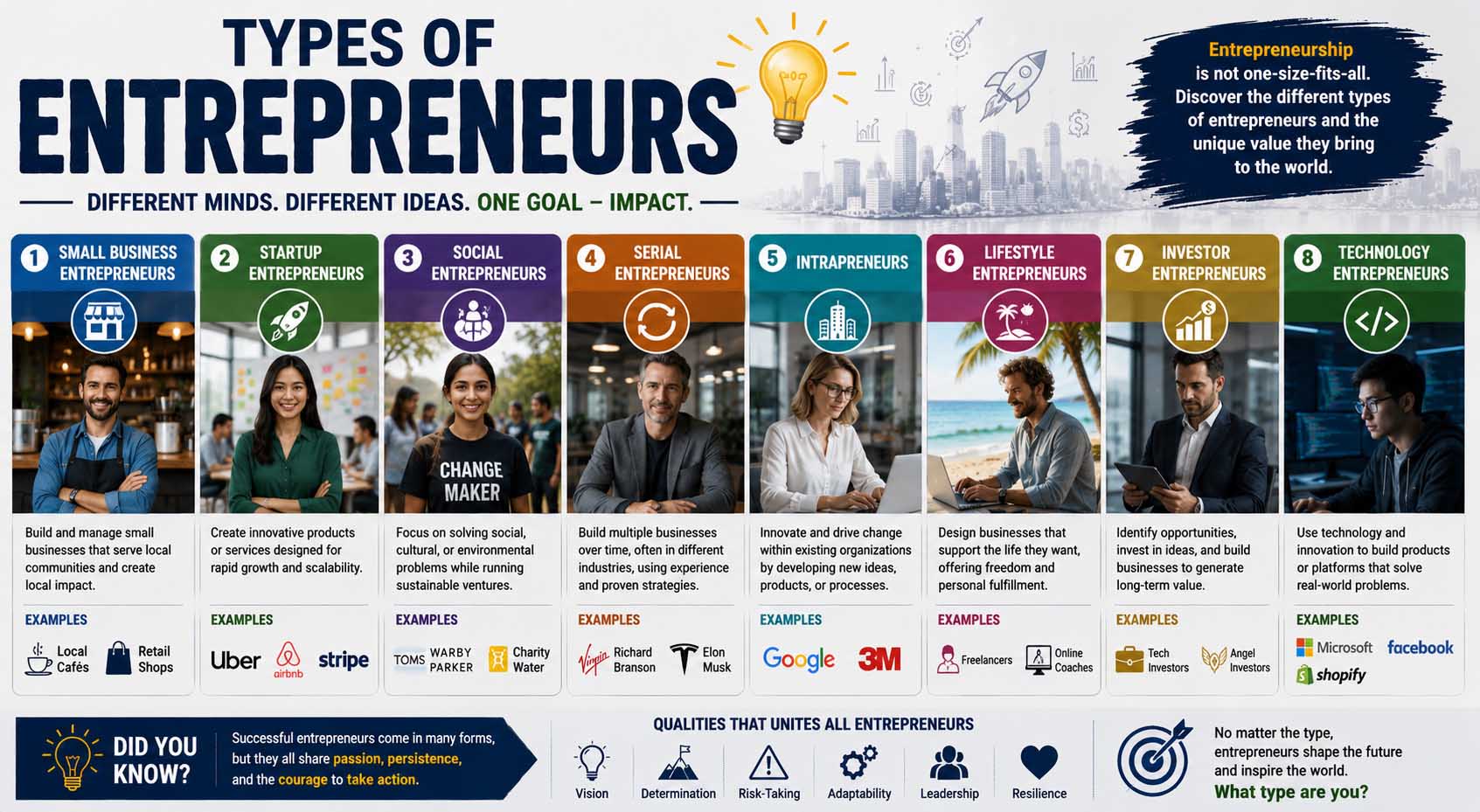
Types of Entrepreneurs: Classification, Examples, and Key Characteristics
Not every entrepreneur builds a business in the same way. Some create entirely new products, while others improve ideas that already work. Some want rapid growth, whereas others prefer a stable local business. Understanding the types of entrepreneurs helps students see how different goals, skills, resources, and attitudes can shape a business.
Entrepreneurship is also broader than simply starting a company. An entrepreneur identifies an opportunity, accepts a level of risk, organizes resources, and tries to create value. That value might come from selling a product, solving a social problem, improving an existing service, or introducing a new technology.
Because entrepreneurs behave differently, researchers and business educators use several classification systems. Therefore, learning these categories provides a useful foundation for business studies, economics, management, and career planning.
What Are the Main Types of Entrepreneurs?
The simplest way to understand entrepreneurs is to look at what motivates them and how they respond to opportunities.
For example, one entrepreneur may open a neighborhood bakery because they want independence and a reliable income. Meanwhile, another entrepreneur may develop software with the goal of reaching millions of customers. Both are entrepreneurs, although their strategies are very different.
Students may come across several versions of types of entrepreneurs classification in textbooks. Names and categories can vary because entrepreneurship can be classified according to innovation, business size, motivation, growth expectations, ownership, or behavior.
Still, several categories appear regularly in entrepreneurship education.
| Type | Main Focus | Simple Example |
|---|---|---|
| Innovative entrepreneur | Creating something new | Developing a new technology |
| Imitative entrepreneur | Adapting proven ideas | Bringing an established model to a new market |
| Small-business entrepreneur | Independence and steady income | Running a local bakery |
| Scalable startup entrepreneur | Rapid growth | Building a software startup |
| Social entrepreneur | Solving social problems | Creating affordable educational services |
| Corporate entrepreneur | Innovation inside a company | Developing a new product within a large firm |
These categories can overlap. For instance, a scalable startup founder can also be highly innovative.
4 Types of Entrepreneurs Based on Innovation
A traditional entrepreneurship classification focuses on how business owners respond to innovation and change. In this framework, the 4 types of entrepreneurs are innovative, imitative, Fabian, and drone entrepreneurs.
1. Innovative Entrepreneurs
Innovative entrepreneurs introduce new ideas, products, production methods, technologies, or business models.
Rather than simply copying what competitors already offer, they look for a different way to solve a problem. As a result, they can sometimes create entirely new markets or transform existing ones.
Imagine a student developing an app that uses a new approach to help people learn foreign-language vocabulary. If the concept introduces a genuinely different solution and later becomes a business, that student is acting as an innovative entrepreneur.
However, innovation brings uncertainty. Customers may not accept the new idea, development may cost more than expected, and competitors may respond quickly. Therefore, innovative entrepreneurs usually need creativity combined with research and practical business judgment.
Strong Commercial Awareness can also help an innovator understand customers, competitors, economic conditions, and market opportunities before committing major resources.
2. Imitative Entrepreneurs
Imitative entrepreneurs adopt an idea that has already succeeded and adapt it to a different situation.
The word “imitative” does not necessarily mean making an exact copy. Instead, these entrepreneurs often improve an existing concept or introduce it to a market where it is not yet widely available.
For example, suppose a meal-preparation subscription becomes popular in major cities. An entrepreneur might adapt the model for a smaller community while changing the menu, delivery system, and pricing for local customers.
Consequently, imitative entrepreneurship can involve less uncertainty than creating a completely unfamiliar product. Yet success still requires careful execution and knowledge of the target market.
3. Fabian Entrepreneurs
Fabian entrepreneurs tend to be cautious about change. They usually wait until there is strong evidence that adopting a new technology, method, or business practice is necessary.
Consider the owner of a long-established store who continues using traditional payment methods while competitors introduce new digital systems. The owner may eventually adopt the technology, but only after customers clearly expect it or competitors demonstrate its value.
This cautious approach can protect a business from spending money on short-lived trends. On the other hand, waiting too long can leave the company behind faster-moving competitors.
4. Drone Entrepreneurs
Drone entrepreneurs strongly resist changing established business methods, even when the market is moving in another direction.
For example, a company might continue producing an outdated product despite a clear decline in customer demand. Although maintaining familiar methods can feel safer, refusing to adapt can create serious competitive problems.
This category teaches students a useful business lesson: stability can have value, but businesses also need to recognize meaningful changes in customer behavior, technology, and competition.
Different Types of Entrepreneurs in Today’s Business World
The four-category model is useful academically, although modern entrepreneurship is often described using categories based on business goals and scale.
Therefore, students should also understand the following different types of entrepreneurs.
Small-Business Entrepreneurs
Small-business entrepreneurs create companies that generally serve a local or specialized market. Examples can include restaurant owners, independent retailers, photographers, electricians, consultants, and online shop owners.
Their goal is not always to create a global company. Instead, many want financial independence, control over their work, and sustainable income.
Before launching such a business, an entrepreneur might conduct a SWOT analysis to examine strengths, weaknesses, opportunities, and threats. Looking at a SWOT Analyse Beispiel can help students understand how this framework turns broad business ideas into more structured decisions.
Scalable Startup Entrepreneurs
Scalable startup entrepreneurs create businesses designed to grow quickly and potentially serve very large markets.
Technology startups provide common examples because software can sometimes reach large numbers of customers without requiring a physical location for every market.
However, rapid growth creates challenges. Founders may need outside investment, skilled employees, scalable systems, and a strong strategy.
For example, a founder might create an online learning platform for one university. After testing the concept, the company could expand to hundreds of institutions.
Social Entrepreneurs
Social entrepreneurs create organizations focused on addressing social or environmental challenges.
For instance, an entrepreneur might create an affordable tutoring platform for students in underserved communities. Another might develop a business that reduces food waste by connecting stores with organizations that can use surplus products
Social enterprises still need workable financial models. However, their goals normally extend beyond maximizing profit.
Types of Entrepreneurs With Examples Based on Their Goals
Another helpful way to study entrepreneurship is to examine what the founder wants to achieve.
Lifestyle entrepreneurs, for instance, often create businesses that support a preferred way of living. A photographer who builds a flexible freelance business because they value independence could fit this category.
Meanwhile, serial entrepreneurs repeatedly start businesses. They may build one company, sell it or hand over daily management, and then pursue another opportunity.
Corporate entrepreneurs, sometimes called intrapreneurs, work within existing organizations. Rather than starting independent companies, they develop new products, services, processes, or business opportunities for their employers.
This distinction also shows why entrepreneurship depends heavily on collaboration. A founder rarely possesses every skill required for finance, marketing, operations, product development, and customer service. Therefore, studying what are examples of effective team dynamics can help students understand how communication, trust, clear responsibilities, and shared goals support entrepreneurial projects.
What Skills Do Successful Entrepreneurs Need?
Different entrepreneurial paths require different strengths.Still, several skills are valuable across most categories, including communication, problem-solving, adaptability, teamwork, and time management.
Problem-solving comes first because businesses exist partly to meet needs or solve customer problems. Likewise, communication helps entrepreneurs explain ideas to customers, employees, investors, and suppliers.
Financial literacy also matters. Even a creative idea can struggle if the owner cannot understand costs, pricing, cash flow, and revenue.
Meanwhile, adaptability helps entrepreneurs respond when conditions change. A product may need adjustment, a marketing strategy may fail, or customers may request something unexpected.
Decision-making matters as well. Entrepreneurs frequently make choices with incomplete information, so they must evaluate evidence without expecting perfect certainty.
Finally, leadership becomes increasingly useful as a company grows. A founder who initially works alone may eventually need to recruit, train, motivate, and coordinate an entire team.
Education and Career Paths Into Entrepreneurship
There is no single educational path that someone must follow to become an entrepreneur.
Some people begin businesses after studying business administration, finance, engineering, design, computer science, or another specialized field. Others learn primarily through employment, apprenticeships, family businesses, or practical experience.
A business degree can provide structured knowledge about accounting, marketing, economics, management, and strategy. Later, some professionals consider graduate business education, so understanding the benefits of mba study can help them decide whether advanced management education fits their entrepreneurial goals.
However, formal qualifications alone do not create successful entrepreneurs. Practical experience remains valuable because entrepreneurship requires applying knowledge to uncertain real-world situations.
Students interested in entrepreneurship can start developing relevant skills long before launching a company. For example, they can organize a school project, sell a simple product, join a business competition, volunteer for leadership responsibilities, or study how local companies operate.
How Students Can Identify Their Entrepreneurial Style
Students do not need to choose one permanent category. Instead, classifications are learning tools that help explain behavior.
Start by asking what motivates you. Do you enjoy inventing new solutions, improving existing systems, organizing teams, or solving community problems?
Next, consider your attitude toward risk. Some people feel comfortable testing unproven ideas, while others prefer business models with established demand.
Then think about growth. Would you rather manage a small independent company, or does the idea of building a large organization appeal to you?
Your career experiences can change these preferences. As a result, career advancement strategies such as gaining industry experience, building professional networks, developing leadership skills, and learning new technical abilities may also prepare you for future entrepreneurship.
Common Misunderstandings About Entrepreneurs
One common misconception is that entrepreneurs must invent something completely new. In reality, many successful businesses improve existing products or deliver familiar services more effectively.
Another misconception is that every entrepreneur wants a huge company. Many small-business and lifestyle entrepreneurs deliberately choose manageable growth because it fits their personal and financial goals.
People also sometimes assume entrepreneurs work alone. Yet even solo founders depend on customers, suppliers, advisers, contractors, employees, and professional networks.
Finally, entrepreneurship is not simply about taking big risks. Skilled entrepreneurs often try to reduce uncertainty through research, testing, budgeting, customer feedback, and careful planning.
FAQs About Types of Entrepreneurs
What are the most common types of entrepreneurs?
Common categories include innovative, imitative, small-business, scalable startup, social, lifestyle, serial, and corporate entrepreneurs. However, classifications vary between textbooks and business frameworks.
What are the four traditional types of entrepreneurs?
A commonly taught classification identifies innovative, imitative, Fabian, and drone entrepreneurs. This model focuses mainly on how entrepreneurs respond to innovation and change.
Can one entrepreneur belong to several categories?
Yes. For example, someone can be both an innovative entrepreneur and a scalable startup entrepreneur. Similarly, a social entrepreneur may also run a small business.
What type of entrepreneur is best for beginners?
There is no universally best category. Instead, the right path depends on a person’s skills, goals, financial resources, experience, market opportunity, and tolerance for uncertainty.
Are small-business owners entrepreneurs?
Yes, many are. When someone identifies an opportunity, organizes resources, accepts business risk, and creates value through an independent venture, they generally fit the broad meaning of entrepreneurship.
A Simple Way to Remember the Types of Entrepreneurs
Rather than memorizing a long list, focus on the reason behind each category. Innovative entrepreneurs create new approaches, imitative entrepreneurs adapt proven ones, Fabian entrepreneurs change cautiously, and drone entrepreneurs strongly resist change.
Then broaden the framework by considering business goals. Small-business entrepreneurs often seek independence and sustainable income, scalable founders pursue growth, social entrepreneurs focus on impact, and corporate entrepreneurs innovate inside established organizations.
Once you understand those differences, the various types of entrepreneurs with examples become much easier to recognize in exams, case studies, and real businesses. More broadly, entrepreneurship is less about fitting perfectly into one label and more about recognizing opportunities, creating value, learning from evidence, and adapting when circumstances change.