
What Is Rolling Admission?
What Is Rolling Admission?
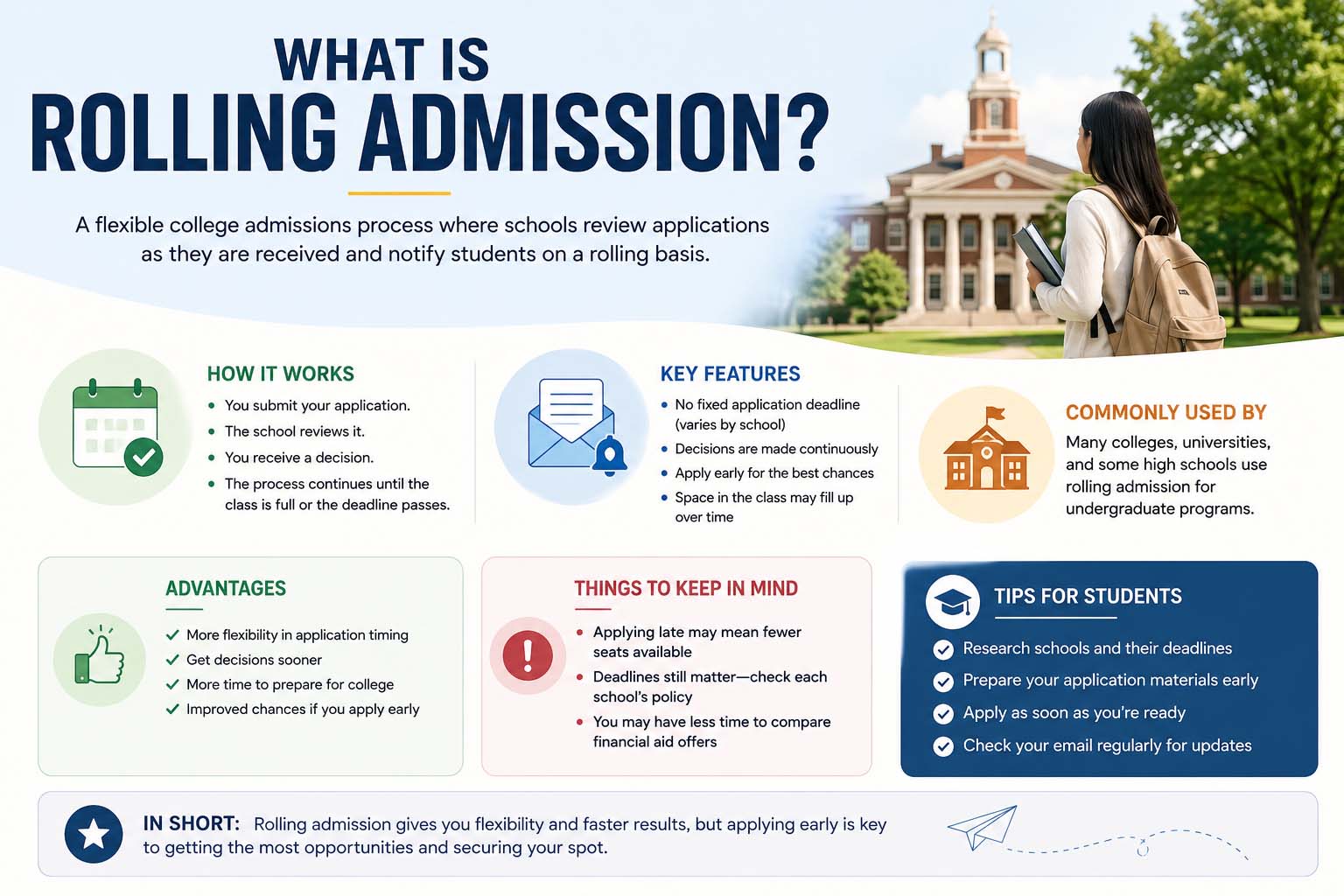
Understanding what is rolling admission can help you plan your college applications better. In simple terms, it is an application process where schools review applications as they arrive instead of waiting for one fixed deadline. As a result, you can usually apply during a long window and get a decision within a few weeks.
However, applying early still matters, because some schools have limited seats, financial aid, or housing as the cycle goes on. So, knowing how this system works can help you make smart choices, improve your chances, and reduce stress.
In this guide, you’ll learn how the process works, its pros and cons, and how it compares to other admission options.
What Is Rolling Admission?
It is a college admissions process where schools review applications one by one as they come in. Instead of judging every applicant at once after a deadline, these colleges look at each application throughout the cycle.
Once the school makes a decision, students hear back fairly quickly. Typically, the process continues until the school fills all open spots in the incoming class.
What Is a Rolling Admission?
Many students ask, what is a rolling admission, and how is it different from traditional admissions? Basically, this system lets colleges accept applications over a longer period, review them continuously, send decisions throughout the year, and fill seats gradually.
As a result, it gives flexibility to both schools and students. Rather than competing on a single decision date, schools consider applicants as their materials arrive.
Students comparing college options should also understand What Is Dual Enrollment, since it lets eligible students earn college credits while still in high school.
How Does Rolling Admission Work?
Strong academic records make up an important part of any application. Therefore, students should understand how schools judge grades, including What Is a Passing Grade and other academic requirements.
Step 1, submit your application: first, students send their application with materials such as transcripts, forms, personal essays, recommendation letters, and test scores if required.
Next, the school reviews it: admissions officers look at the application shortly after it arrives.
Then a decision arrives: the school accepts, denies, waitlists, or defers each student.
Finally, you decide on enrollment: accepted students choose whether to enroll before the college’s enrollment deadline.
Overall, this process often gives faster responses than traditional systems. For more tips, the College Board shares advice on applying to colleges with this kind of admission.
What Is Rolling Admission for College?
The phrase what is rolling admission for college refers to colleges and universities that use this flexible model. In fact, many schools choose it because it helps them manage applications efficiently, fill seats steadily, offer students more flexibility, and avoid processing backlogs.
Meanwhile, students benefit by getting decisions sooner and having more time to plan their money and studies.
Students planning their future education should also understand graduate options, such as the Types of Masters Degrees, to make informed decisions about long-term goals.
What Is Rolling Admission in College?
When discussing what is rolling admission in college, remember that schools still have application windows. In other words, schools do not accept applications forever.
For example, most colleges set an opening date, a priority deadline, and a final deadline. That’s why students who apply earlier often have an advantage, as more seats are still open.
Benefits for Students
This approach offers several advantages.
Earlier decisions: one of the biggest benefits is hearing back sooner. Instead of waiting months, students may get results within weeks.
Less stress: students can apply when they are ready rather than rushing to meet one deadline.
More flexibility: applicants can also build a broader application plan.
More planning time: earlier decisions give more time for financial aid, housing, scholarship applications, and course preparation. Because of this, the system is especially helpful for first-time college applicants.
Potential Drawbacks to Know
Although this system has many benefits, it is not perfect.
Limited space over time: as colleges accept students during the cycle, fewer seats remain later.
Early applicants may have an edge: similarly, students who apply early compete for more open seats.
Financial aid limits: in addition, some scholarships and aid programs have limited funds that schools give out early.
For these reasons, applying sooner is usually the best choice.
Why Applying Early Matters
Even with a flexible window, timing remains important. For instance, early applicants get more open class seats, better scholarship chances, faster decisions, and more housing options.
Therefore, students should not assume this system removes the need for early preparation.
A Simple Example
Imagine a university opens applications on September 1. Instead of waiting until January to review everything, the admissions team starts evaluating submissions right away.
Student A applies in September. As a result, this student gets a decision in October, faces more open spots, and receives early scholarship consideration.
Student B applies in March. By then, fewer seats remain, competition may be tougher, and less scholarship money is available.
Clearly, this example shows why early submission can help.
What Is Rolling Admission vs Early Action?
A common question is what is rolling admission vs early action. Although both can give earlier decisions, they work differently.
| Feature | Rolling Admission | Early Action |
|---|---|---|
| Application Review | Ongoing | Fixed Deadline |
| Decision Timing | Continuous | Specific Release Date |
| Application Window | Extended | Limited |
| Flexibility | High | Moderate |
In short, with the rolling option, schools review applications as they arrive. On the other hand, with early action, students apply by a set deadline and get decisions on a scheduled date.
Ultimately, understanding these differences helps students choose the best strategy.
Tips for Applying Successfully
Students can improve their chances by following a few simple tips.
Apply early: sending your application early increases your chances before seats start to fill.
Complete all materials: also, make sure you submit every document correctly.
Monitor deadlines: remember, these schools still have deadlines and seat limits.
Research scholarships: in addition, many scholarships run on separate timelines.
Stay organized: keep track of application status, required documents, financial aid forms, and housing deadlines. As a result, you’ll feel much less stress.
Common Myths to Avoid
“There are no deadlines”: actually, most colleges still set final deadlines.
“Applying late doesn’t matter”: in reality, open seats may shrink as the cycle continues.
“You will surely get in”: however, this system does not guarantee acceptance, since academic standards still apply.
“Decisions are instant”: although they are faster, decisions still need review time.
Who Should Consider Rolling Admission Colleges?
These colleges can be a great option for students who need flexibility, applicants still finalizing their college lists, and anyone who wants quicker decisions. In short, they offer a less rigid alternative to traditional admissions.
Before applying, students should also think about their interests and career goals by exploring What Should I Major In. After that, comparing the Difference Between BA and BS can help them choose the degree that best fits their future.
FAQ
What is rolling admission?
Simply put, it is a process where colleges review applications as they arrive and send decisions throughout the cycle.
What is rolling admission for college?
It is a flexible process many colleges use to review and accept applicants throughout the year until they fill all seats.
What is rolling admission vs early action?
The rolling option reviews applications continuously, while early action uses a fixed deadline and a set decision date.
Is it better to apply early?
Yes. In general, earlier applications have access to more seats, scholarships, and housing.
Conclusion
Understanding what is rolling admission can help you handle the college process with more confidence. Unlike traditional systems, it offers flexibility, earlier decisions, and longer application windows.
Still, applying early is the smart move, because seats, financial aid, and housing can run out as the cycle continues. In the end, good timing can improve your chances of getting into your preferred college.