
Types of Essay: A Student-Friendly Guide With Examples
Types of Essay: A Student-Friendly Guide With Examples
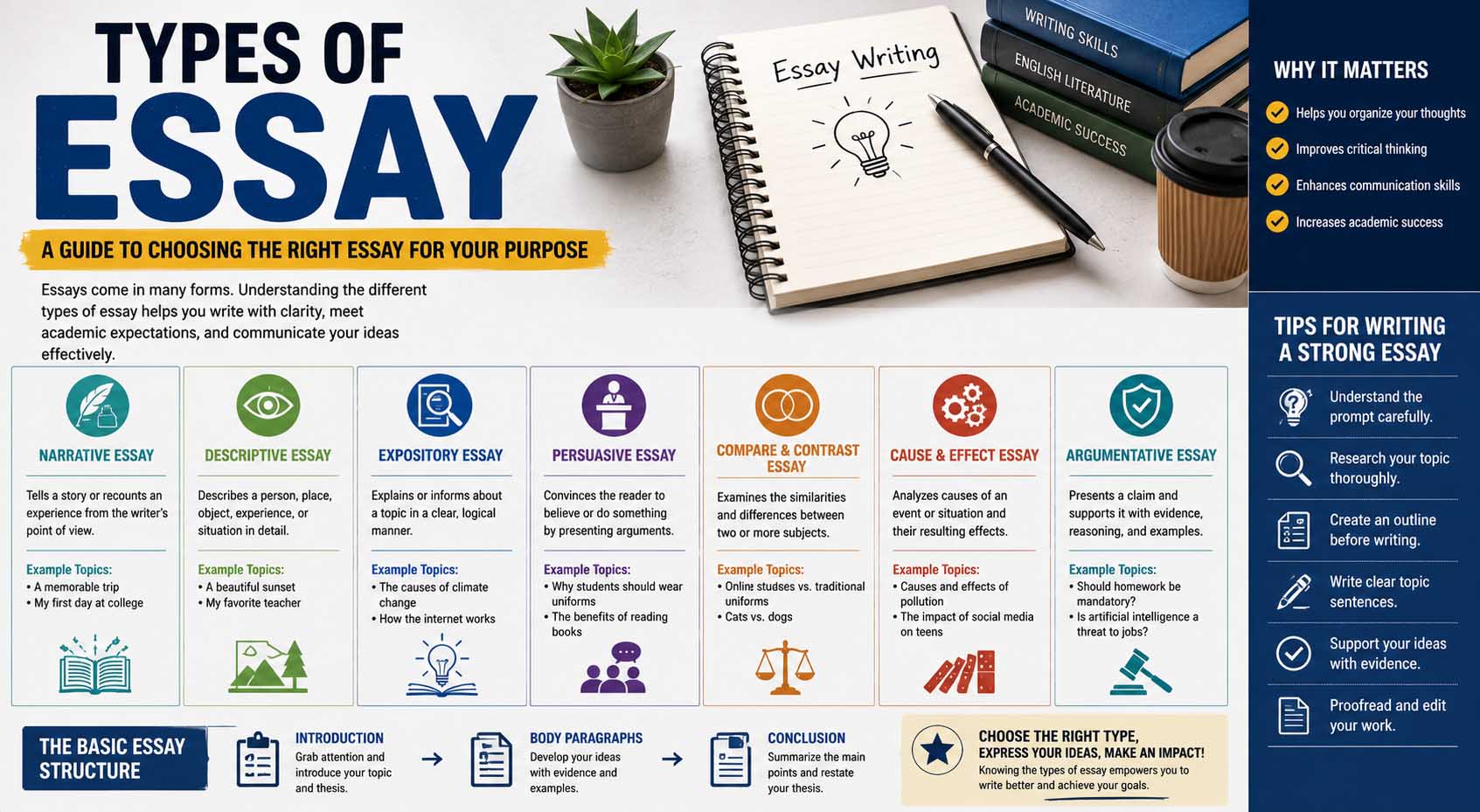
When a teacher assigns an essay, knowing what kind of writing is expected can make the task much easier. The main types of essay include narrative, descriptive, expository, argumentative, and compare-and-contrast essays. Although they share basic features such as an introduction, body paragraphs, and a clear focus, each type has a different purpose. Once you recognize that purpose, choosing evidence, organizing ideas, and developing your paragraphs becomes far more straightforward.
Students encounter essays throughout middle school, high school, college, and many professional courses. Therefore, learning how the major essay styles work is a practical academic skill rather than something useful for only one assignment.
What Is an Essay?
An essay is a focused piece of writing that develops an idea, explains a subject, tells a meaningful story, or supports a position. Depending on the assignment, an essay might be only a few paragraphs long or several pages.
Most academic essays contain an introduction, body, and closing section. However, the content within that structure changes according to the writer’s purpose.
For example, a personal narrative may use scenes and dialogue. In contrast, an argumentative paper usually depends on a clear claim, credible evidence, and logical reasoning.
Essays are also part of a much broader group of types of writing, which can include reports, stories, technical documents, letters, reviews, and other forms. Recognizing the purpose of each form helps students choose an appropriate writing strategy.
5 Types of Essay Students Commonly Write
Although teachers may use different labels, the 5 types of essay students frequently encounter are narrative, descriptive, expository, argumentative, and compare-and-contrast.
Here is a quick overview:
| Essay type | Main purpose | Simple example topic |
|---|---|---|
| Narrative | Tell a meaningful story | A challenge I overcame |
| Descriptive | Create a detailed picture | A place I will never forget |
| Expository | Explain or inform | How recycling works |
| Argumentative | Defend a position | Should schools require uniforms? |
| Compare and contrast | Examine similarities and differences | Online vs. classroom learning |
These categories can sometimes overlap. For instance, an argumentative essay may include explanatory sections, while a narrative essay may contain vivid description. Still, identifying the main purpose gives you a reliable starting point.
1. Narrative Essay
A narrative essay tells a story, usually about a real experience or event. However, it does more than list what happened in chronological order. Instead, a strong narrative develops a central point, lesson, or insight through the experience.
For example, a student might write about moving to a new school. Rather than describing every event from the first day, the student could focus on one moment that changed how they viewed friendship or confidence.
Narratives often include characters, setting, conflict, sensory details, and dialogue. Meanwhile, first-person language such as “I” and “my” is often acceptable when the assignment involves personal experience.
Students asking What Is a Narrative Essay should think of it as storytelling with a purpose: the events matter because they reveal something meaningful to the reader.
Example narrative topic
Prompt: Write about a time when you learned from a mistake.
A student could describe forgetting to prepare for an important presentation, struggling in front of the class, and then changing their preparation habits afterward.
The experience provides the story, while the lesson gives the essay its deeper purpose.
2. Descriptive Essay
A descriptive essay helps readers picture a person, place, object, experience, or moment. Therefore, specific details matter more than broad statements.
Instead of writing, “The beach was beautiful,” a student could describe the sound of waves, the temperature of the sand, the smell of saltwater, and the changing colors of the evening sky.
However, description should serve a purpose. Filling a paragraph with random adjectives usually makes the writing weaker rather than stronger.
Writers often use sensory details involving sight, sound, touch, smell, and sometimes taste. Likewise, figurative language can make descriptions more memorable when it fits naturally.
A descriptive essay may focus on topics such as a childhood home, an important object, a busy city street, or a memorable classroom.
3. Expository Essay
An expository essay explains a subject clearly and logically. Unlike a narrative, it generally does not center on the writer’s personal experience. Instead, the goal is to help readers understand a topic.
For example, an expository essay might explain how photosynthesis works, why sleep matters for learning, or how a bill becomes law.
A strong expository essay usually starts with a clear central idea. Then, each body paragraph develops one part of the explanation using facts, examples, definitions, or relevant details.
Because clarity matters, organization is especially useful. For instance, a process essay may follow chronological order, while an essay explaining causes may organize paragraphs from the most common cause to the least common.
Among the different types of essay writing, expository writing appears frequently in school because it shows whether students can understand information and explain it in their own words.
4. Argumentative Essay
An argumentative essay takes a position on a debatable issue and supports that position with evidence and reasoning.
For instance, a student might argue that high schools should begin later in the morning. Instead, the writer needs a clear claim and evidence that supports it.
Strong argumentative writing also considers opposing viewpoints. Therefore, students should recognize reasonable counterarguments and respond to them rather than pretending another perspective does not exist.
When students study Argumentative Essay Examples, they should pay attention to how writers connect claims, evidence, and reasoning instead of copying the wording or structure of a sample.
Evidence matters in argumentative writing
Evidence may come from research studies, statistics, expert sources, historical records, or other credible material. However, the best source depends on the claim being made.
Learning the different types of evidence in writing can help students decide whether a statistic, example, expert statement, or research finding offers the strongest support.
After presenting evidence, explain why it matters. Otherwise, readers have to make the connection themselves.
5. Compare-and-Contrast Essay
Students might compare two novels, historical events, educational methods, scientific theories, or career options. However, effective comparison requires subjects that share enough features to make the analysis meaningful.
For example, comparing online classes with traditional classroom learning gives a writer several useful points: flexibility, interaction, cost, learning environment, and access to resources.
Writers commonly organize these essays in two ways.
With the block method, you discuss the main points about the first subject and then the main points about the second.
With the point-by-point method, you compare both subjects according to one feature at a time.
The point-by-point approach often makes similarities and differences easier for readers to follow, especially in longer assignments.
Understanding Different Types of Essay Formats
The phrase types of essay formats can refer either to the essay’s organizational structure or to academic formatting styles.
Essay structure describes how ideas are arranged. For example, a narrative might follow chronological order, while an argumentative essay may organize body paragraphs around separate reasons supporting a claim.
Academic formatting, meanwhile, refers to requirements such as MLA, APA, or Chicago style. These systems can determine how sources, citations, headings, and reference pages appear.
Therefore, essay type and formatting style are not the same thing. You could write an argumentative essay using MLA format or an expository paper using APA style if your teacher requires it.
Always read the assignment instructions before starting because teachers may specify both the type of essay and the required formatting system.
Types of Essay Hooks for Strong Introductions
A hook is the opening line or idea designed to gain the reader’s attention. However, an effective hook should also connect naturally to the topic.
Common types of essay hooks include:
- A thought-provoking question
- A surprising fact or statistic
- A brief relevant story
- A vivid description
- A strong statement
- A meaningful quotation when appropriate
For example, an essay about sleep and academic performance might begin with a surprising research finding about how much sleep teenagers typically get.
Still, avoid dramatic hooks that have little connection to the actual essay. Readers should move smoothly from the opening into the topic and thesis.
Students who want more opening strategies can study types of hooks for essays and practice matching the hook style to the purpose and audience of an assignment.
How to Choose the Right Type of Essay
Often, the assignment prompt tells you exactly what kind of essay to write. However, sometimes you need to identify it from the task words.
First, look closely at the main verb in the prompt.
If it asks you to describe, detailed descriptive writing will probably matter. If it asks you to explain, an expository approach usually fits. Meanwhile, words such as argue, defend, or persuade often signal argumentative writing.
Next, identify your audience and purpose. Ask yourself what the reader should understand, believe, picture, or experience after reading the essay.
Then, decide what information you need. A personal narrative may rely primarily on your memory, while an argumentative essay usually requires outside research.
Finally, create a simple outline before drafting. Even five minutes of planning can prevent paragraphs from drifting away from the main idea.
A Simple Essay Writing Process
Regardless of essay type, a basic writing process can make assignments easier.
1. Read the prompt carefully. Identify the topic, required length, essay type, formatting rules, and deadline.
2. Brainstorm ideas. Write down possible examples, arguments, experiences, or facts before deciding what to include.
3. Develop your main idea. Decide what the essay will communicate rather than trying to cover everything about the topic.
4. Create an outline. Give each body paragraph one clear purpose.
5. Write the first draft. Focus on getting your ideas onto the page before worrying about every small wording choice.
6. Revise for meaning and organization. Check whether each paragraph supports the essay’s central purpose.
7. Edit and proofread. Finally, correct grammar, punctuation, spelling, citation, and formatting problems.
This process works across most academic essay assignments, although individual steps may change depending on the task.
Common Essay Writing Mistakes
One common mistake is starting to write before understanding the prompt. As a result, a well-written paper can still receive a poor grade if it answers the wrong question.
Another problem is mixing essay purposes without a clear reason. For example, a student may begin an argumentative essay with a strong position but spend most of the paper simply describing the topic.
Weak paragraph organization can also make good ideas difficult to follow. Therefore, each body paragraph should usually develop one main point and connect logically to the next.
Students also sometimes include evidence without explaining it. Instead, show readers how each example, fact, or source supports your central idea.
Finally, avoid treating the first draft as the finished paper. Revision gives you a chance to improve clarity, remove repetition, strengthen transitions, and correct weak reasoning.
Frequently Asked Questions About Types of Essay
What are the main types of essays?
Five common types are narrative, descriptive, expository, argumentative, and compare-and-contrast essays. However, teachers may also assign cause-and-effect, analytical, reflective, definition, or process essays.
What is the easiest essay type?
There is no easiest type for every student. For instance, students who enjoy storytelling may find narrative essays comfortable, while students who prefer facts and structured explanations may find expository writing easier.
What is the difference between expository and argumentative essays?
An expository essay primarily explains a subject. In contrast, an argumentative essay takes a position on a debatable issue and supports that position with evidence and reasoning.
Can an essay use more than one writing style?
Yes. For example, an argumentative essay may include descriptive or explanatory passages. However, the main purpose should remain clear throughout the paper.
How many paragraphs should an essay have?
There is no universal number. Although students often learn the five-paragraph model, longer assignments may need several body paragraphs. Therefore, use enough paragraphs to develop the topic properly while following your teacher’s requirements.
Build Your Essay Skills One Type at a Time
Learning the major types of essay makes writing assignments much less confusing because you can match your approach to the purpose of the task. Narrative essays tell meaningful stories, descriptive essays create vivid pictures, expository essays explain, argumentative essays defend positions, and compare-and-contrast essays examine relationships between subjects.
Instead of trying to master every style at once, practice identifying the purpose of each new assignment first. Then, plan your main idea, choose suitable details or evidence, and organize each paragraph around a clear job. With regular practice, choosing the right essay structure becomes a natural part of the writing process.