
Types of Hooks for Essays: A Complete Guide for Students
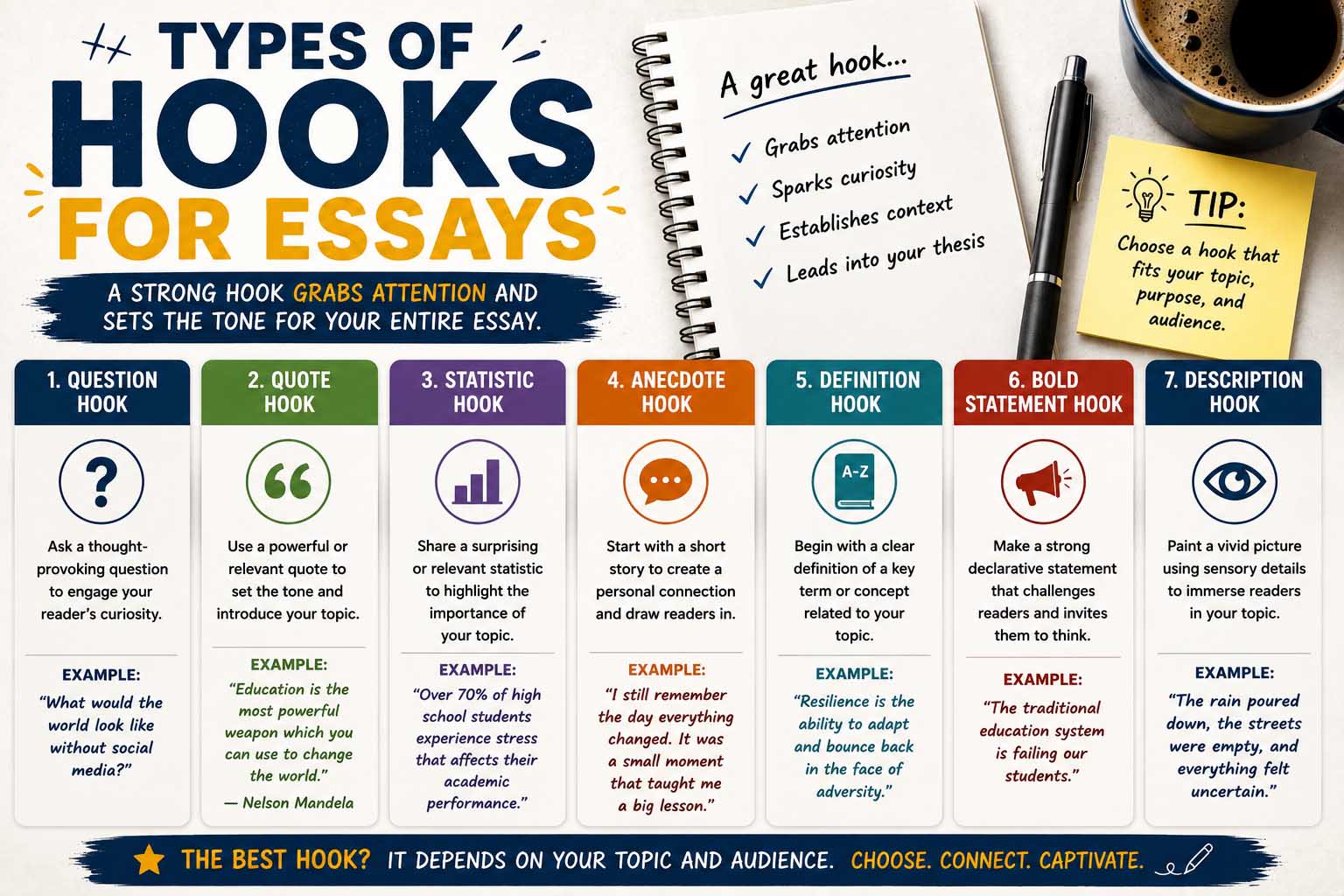
Types of Hooks for Essays: A Complete Guide for Students
Have you ever started writing an essay and wondered how to grab your reader’s attention right away? That’s exactly where types of hooks for essays come in. A strong hook is the opening sentence or two that encourages readers to keep going. Whether you’re writing for school, college, or a scholarship application, choosing the right hook can make your introduction much more engaging.
The good news is that you don’t need to be a professional writer to create an effective opening. Once you understand the different kinds of hooks and when to use them, writing introductions becomes much easier.
What Are Types of Hooks for Essays?
A hook is the opening part of an essay designed to capture the reader’s interest.
Instead of beginning with a plain statement, a hook gives readers a reason to continue. It creates curiosity, introduces the topic naturally, and sets the tone for the rest of the paper.
Different essays call for different opening styles. A personal story may work well for one assignment, while a surprising statistic fits another.
If you’re still learning the basics of essay writing, understanding types of writing can also help you recognize why introductions vary depending on the purpose of the assignment.
Why a Strong Hook Matters
Your introduction creates the reader’s first impression.
A good hook can:
- Capture attention immediately
- Introduce the topic naturally
- Encourage readers to continue
- Set the tone of the essay
- Lead smoothly into the thesis statement
A weak introduction, on the other hand, may make even a well-written essay feel less engaging.
Think of the hook as opening the door. If the entrance is interesting, readers are much more likely to stay.
Quick Comparison of Common Hook Types
| Hook Type | Best Used For | Example |
|---|---|---|
| Question | Persuasive and informative essays | What would happen if the internet disappeared tomorrow? |
| Surprising Fact | Research papers | The average person spends several years of their life looking at screens. |
| Statistic | Academic essays | Nearly 90% of students use digital tools for learning. |
| Quotation | Literature and history essays | “Education is the passport to the future.” |
| Anecdote | Narrative and personal essays | The first time I spoke in front of my class, my hands wouldn’t stop shaking. |
| Bold Statement | Opinion essays | Failure is often a better teacher than success. |
No single hook works for every assignment. The best choice depends on your audience and topic.
Different Types of Hooks for Essays
Let’s look at the most common hook styles students use.
Question Hook
A question immediately invites readers to think.
Example:
What would you do if technology disappeared for one week?
Questions work well because they encourage curiosity.
Try asking a question your essay will answer rather than one with an obvious response.
Surprising Fact Hook
People naturally pay attention to unexpected information.
Example:
More than half of the world’s population now uses social media every day.
A surprising fact should be accurate and related to your topic.
Whenever possible, verify statistics with reliable sources.
Statistic Hook
Statistics add credibility while introducing a topic.
Example:
Studies show that reading for just twenty minutes each day can significantly improve vocabulary over time.
This style works especially well for research papers and informative essays.
Quotation Hook
Beginning with a quotation can add authority to your writing.
Example:
“The beautiful thing about learning is that nobody can take it away from you.”
Choose quotations that genuinely connect to your topic instead of selecting famous quotes simply because they’re well known.
Anecdote Hook
An anecdote is a short personal story.
Example:
I still remember forgetting my homework on presentation day and realizing preparation matters more than confidence.
Stories help readers connect emotionally with the topic.
They work particularly well in personal and reflective essays.
Bold Statement Hook
Sometimes a confident statement creates immediate interest.
Example:
Every student can become a stronger writer with practice.
Readers naturally want to know whether the statement will be supported.
Description Hook
Descriptive openings paint a picture.
Example:
Rain tapped against the classroom windows while every student stared silently at the exam paper.
This approach works well when creating atmosphere.
Choosing the Right Hook for Different Essays
Not every hook fits every assignment.
Instead, match the hook to your essay’s purpose.
Narrative Essays
Narrative essays tell stories.
Personal anecdotes and descriptive openings often create the strongest introductions because they immediately place readers inside the experience.
If you’re unsure how personal storytelling differs from other academic writing, learning What Is a Narrative Essay can help you choose an introduction that matches the assignment.
Informative Essays
For that reason, types of hooks for informative essays often include:
- Statistics
- Interesting facts
- Thought-provoking questions
- Brief historical background
These hooks prepare readers to learn something new.
Persuasive Essays
Persuasive writing aims to convince readers.
Question hooks, bold statements, and surprising facts usually work well because they encourage readers to think about an issue before your argument begins.
Examples of Strong and Weak Hooks
Comparing examples makes it easier to recognize effective introductions.
| Weak Hook | Strong Hook |
|---|---|
| Pollution is a problem. | Every minute, the equivalent of a garbage truck full of plastic enters the ocean. |
| Reading is important. | One book can completely change the way a person sees the world. |
| Exercise helps people. | Just thirty minutes of daily exercise can improve both physical and mental health. |
Notice how the stronger versions create curiosity instead of simply stating the topic.
Types of Hooks for Argumentative Essays
When writing persuasive papers, your opening should encourage readers to consider your position.
Some of the most effective types of hooks for argumentative essays include:
A Challenging Question
Example:
Should schools replace traditional textbooks with digital learning materials?
This invites readers to form an opinion before they continue reading.
A Powerful Statistic
Example:
Millions of tons of food are wasted every year despite widespread hunger.
A reliable statistic helps establish credibility from the start.
A Bold Claim
Example:
Social media has changed education more than textbooks ever did.
A strong claim works best when the essay provides clear evidence to support it.
Students looking for inspiration before drafting persuasive papers often benefit from reviewing Argumentative Essay Examples to see how experienced writers connect their opening hook to a clear thesis.
Different Types of Hooks for Argumentative Essays
Although argumentative essays share the same goal of persuading readers, the best hook depends on the topic.
Here are a few effective approaches:
Comparison Hook
A comparison encourages readers to think about two ideas side by side.
Example:
Students spend years learning math and science, yet many graduate without basic financial literacy.
This type of opening naturally introduces an argument.
Scenario Hook
Paint a brief picture that relates to your topic.
Example:
Imagine arriving at school one day only to discover every class has moved completely online.
A scenario helps readers connect personally with the issue before the argument begins.
These different types of hooks for argumentative essays work well because they spark curiosity while leading naturally into a clear position.
How to Write an Effective Hook Step by Step
Writing a hook doesn’t have to be difficult.
Follow these simple steps.
Step 1: Know Your Topic
Before writing the introduction, make sure you understand your essay’s purpose.
Ask yourself:
- Am I informing?
- Am I persuading?
- Am I telling a story?
Your answer helps determine the best hook.
Step 2: Think About Your Audience
Consider who will read your essay.
Teachers, classmates, scholarship reviewers, and general readers may respond to different opening styles.
Choose a hook that matches their expectations.
Step 3: Select the Best Hook Type
Now decide which style fits your topic.
For example:
- Personal story → Narrative essay
- Statistic → Research paper
- Question → Persuasive essay
- Quotation → Literature essay
- Description → Creative writing
Don’t choose a hook simply because it sounds impressive. It should support the topic naturally.
Step 4: Connect the Hook to Your Thesis
One common mistake is writing a great opening that has nothing to do with the rest of the essay.
After your hook, include background information that smoothly leads into your thesis statement.
The introduction should feel like one connected conversation rather than separate pieces.
Practical Classroom Examples
Let’s see how different subjects use different hooks.
History
Hook:
Few events have changed the world as dramatically as the Industrial Revolution.
Science
Hook:
Every breath you take contains billions of invisible particles.
Literature
Hook:
What makes a fictional character unforgettable?
This question naturally introduces an analysis of a novel or short story.
When analyzing novels or poems, understanding What Is Figurative Language can also help you explain how authors capture readers’ attention through imagery and creative expression.
Environmental Studies
Hook:
Every year, millions of tons of plastic waste enter the oceans.
This fact prepares readers for an informative discussion.
Common Mistakes When Writing Essay Hooks
Even experienced writers occasionally struggle with introductions.
Here are mistakes to avoid.
Starting Too Broadly
Avoid opening with statements like:
Since the beginning of time…
These introductions sound vague and rarely add value.
Using Unrelated Quotes
A quotation should strengthen your topic.
Don’t include one simply because it’s famous.
Giving Away Every Main Point
The hook should create curiosity.
If the introduction explains every argument immediately, readers have little reason to continue.
Asking Questions With Obvious Answers
Instead of writing:
Do you like food?
Ask something that encourages genuine thinking.
For example:
Why do some healthy eating habits fail even when people have good intentions?
Forgetting the Transition
A hook should connect naturally to the thesis.
Readers shouldn’t feel like the opening sentence belongs to a different essay.
Tips for Choosing the Best Hook Every Time
Keep these guidelines in mind whenever you begin writing.
- Match the hook to the essay type.
- Keep the opening relevant.
- Use facts only if they’re accurate.
- Avoid overly dramatic claims.
- Write the hook after the essay if you’re stuck.
- Read your introduction aloud to check its flow.
Many students discover that writing the body first makes it easier to create a stronger introduction afterward.
Practice Activity
Try this simple exercise.
Choose one topic:
- Climate change
- Social media
- Healthy eating
- Artificial intelligence
- School uniforms
Now write three different hooks:
- A question
- A surprising fact
- A short anecdote
Compare each version and decide which one makes you want to keep reading.
Practicing multiple introductions helps you become a more flexible writer.
Frequently Asked Questions
What are the most common types of hooks for essays?
The most common hook types include questions, surprising facts, statistics, quotations, anecdotes, descriptive scenes, and bold statements.
Which hook is best for an argumentative essay?
Questions, strong statistics, and confident claims often work well because they encourage readers to think about the issue before reading the argument.
What are the best types of hooks for informative essays?
The most effective types of hooks for informative essays usually include interesting facts, statistics, historical context, or thoughtful questions that introduce the topic without expressing an opinion.
Can I use a quotation as a hook?
Yes. Just make sure the quotation directly relates to your topic and leads naturally into your thesis.
Should every essay have a hook?
Most academic essays benefit from a hook because it captures attention and creates a stronger first impression.
How long should a hook be?
Most hooks are one or two sentences. The goal is to gain the reader’s interest without delaying the main point of the introduction.
Build Better Introductions With Practice
Learning the types of hooks for essays is one of the easiest ways to improve your writing. Whether you’re working on a narrative, informative, or persuasive assignment, the right opening helps readers connect with your ideas from the very first sentence.
As you continue practicing, experiment with different hook styles instead of relying on the same one every time. Once your introduction captures attention, make sure the rest of your essay follows through with clear organization and supporting details. Finally, don’t overlook your ending—a strong introduction deserves an equally effective finish, so reviewing Conclusion Paragraph Examples can help you leave readers with a lasting impression.