
Types of Evidence in Writing: A Complete Guide for Students
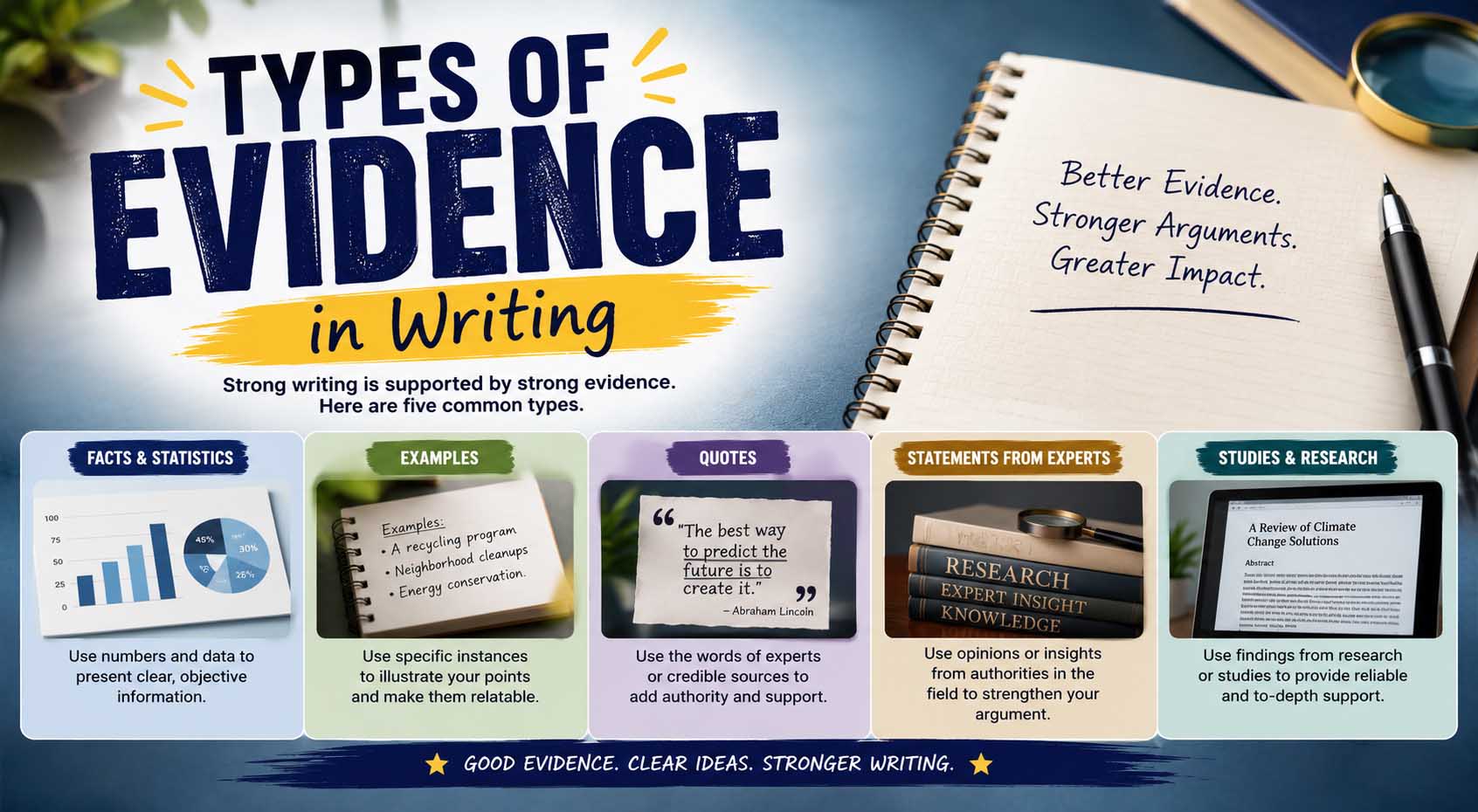
Types of Evidence in Writing: A Complete Guide for Students
Have you ever been told that your essay needs “more evidence”? Many students know they need evidence, but they aren’t always sure what counts as good support. Understanding the types of evidence in writing helps you build stronger arguments, explain ideas clearly, and convince your readers that your points are well supported.
Whether you’re writing a school essay, a research paper, or a persuasive assignment, choosing the right evidence makes your writing more credible and easier to understand. This guide explains the most common types of evidence, when to use each one, and how to include evidence effectively.
What Are Types of Evidence in Writing?
The types of evidence in writing are the different forms of information writers use to support claims, explain ideas, or prove a point.
Instead of making unsupported statements, good writers back up their ideas with reliable evidence. This helps readers trust the argument and understand the reasoning behind it.
Evidence may come from:
- Research studies
- Books
- News articles
- Expert opinions
- Statistics
- Historical events
- Personal observations (when appropriate)
- Real-world examples
The best evidence depends on your purpose, audience, and assignment.
Why Evidence Matters in Academic Writing
Evidence strengthens your writing in several ways.
It helps you:
- Support your claims
- Build credibility
- Explain complex ideas
- Answer questions clearly
- Persuade your audience
- Avoid unsupported opinions
For example, many Argumentative Essay Examples show how strong evidence can turn an opinion into a convincing argument.
Types of Evidence in Writing Explained
Understanding the types of evidence in writing makes it easier to choose the right support for each paragraph.
Facts
Facts are statements that can be proven true through evidence or verification.
Examples include:
- Historical dates
- Scientific findings
- Government records
- Definitions from trusted sources
Example:
Under standard atmospheric pressure, water freezes at 32°F (0°C).
Facts work well because they are objective rather than based on personal opinion.
Statistics
Statistics use numbers to support an argument.
Examples include:
- Survey results
- Census data
- Research findings
- Academic reports
Example:
A school survey found that 82% of students preferred digital textbooks for homework.
Always use statistics from reliable and current sources whenever possible.
Expert Opinions
Experts spend years studying specific subjects.
Quoting teachers, researchers, scientists, doctors, or industry professionals can strengthen your writing.
Example:
According to education researcher Dr. Smith, regular reading improves vocabulary development over time.
Expert opinions are especially useful when explaining complicated topics.
Examples and Case Studies
Examples help readers understand abstract ideas.
They may include:
- Historical events
- Classroom situations
- Business examples
- Scientific experiments
Example:
Instead of simply saying teamwork improves learning, describe a classroom project where students solved a difficult problem together.
Real examples often make arguments more memorable.
Anecdotal Evidence
Anecdotal evidence comes from personal experiences or individual stories.
Example:
A student may explain how practicing every day helped improve their writing skills over time.
While personal stories make writing engaging, they should not replace stronger research evidence in academic assignments.
Research Findings
Academic research combines evidence from carefully designed studies.
Research evidence often includes:
- Peer-reviewed journal articles
- University studies
- Government reports
- Educational research
Research usually provides stronger support than personal opinions.
Historical Evidence
Historical evidence uses past events to explain or support an argument.
Examples include:
- Historical speeches
- Government documents
- Major discoveries
- Important court decisions
History often provides valuable context for current issues.
Textual Evidence
Textual evidence comes directly from a written source.
Students commonly use textual evidence when analyzing:
- Novels
- Poems
- Articles
- Speeches
- Plays
If you’re analyzing literature, identifying What Is a Central Idea helps you choose quotations that directly support your interpretation instead of selecting random passages.
Types of Evidence in Writing Examples
Seeing evidence in action makes the concept easier to understand.
| Claim | Strong Evidence |
|---|---|
| Exercise improves health. | Research showing regular exercise reduces health risks. |
| Reading builds vocabulary. | Study results comparing frequent readers with non-readers. |
| Recycling helps the environment. | Government waste management statistics. |
| School uniforms affect behavior. | Survey data and educational research. |
Each example supports the claim with factual information rather than personal opinion.
Types of Evidence in Argumentative Writing
The types of evidence in argumentative writing should directly support your position while addressing opposing viewpoints.
Strong argumentative essays often combine several evidence types, including:
- Verified facts
- Reliable statistics
- Expert quotations
- Research findings
- Relevant examples
Rather than relying on only one source, combining different forms of evidence creates a more balanced and persuasive argument.
Types of Evidence in Persuasive Writing
The types of evidence in persuasive writing often overlap with argumentative writing, although persuasive pieces may appeal more to emotions while still relying on facts.
Effective persuasive writing frequently uses:
- Expert opinions
- Real-life examples
- Statistics
- Testimonials
- Historical evidence
Good persuasive writers avoid exaggeration and support emotional appeals with trustworthy information.
Choosing the Right Evidence for Different Types of Writing
Not every assignment requires the same kind of evidence.
For example, learning about different types of writing can help you recognize why a research essay requires stronger evidence than a personal reflection.
Here are some general guidelines:
| Writing Type | Best Evidence |
|---|---|
| Research paper | Studies, facts, statistics |
| Persuasive essay | Expert opinions, facts, research |
| Literary analysis | Quotations from the text |
| Historical essay | Historical documents and records |
| Informative article | Facts, examples, reliable sources |
How to Add Evidence Step by Step
Adding evidence becomes easier when you follow a simple process.
Step 1: Make a Clear Claim
Begin with a sentence that introduces your main point.
Example:
Daily reading improves academic performance.
Step 2: Find Reliable Evidence
Search for trustworthy information from:
- Academic journals
- Government websites
- Educational organizations
- Books
- Reputable news sources
Step 3: Introduce the Evidence
Don’t place a quotation or statistic into your paragraph without context.
Instead, prepare the reader.
Example:
A recent educational study found that…
Step 4: Explain Why It Matters
After presenting evidence, explain how it supports your claim.
This step is often where students lose marks because they assume the evidence speaks for itself.
Always connect the evidence back to your argument.
Common Mistakes Students Make
Many writing problems involve weak or poorly explained evidence.
Avoid these common mistakes.
Using Unreliable Sources
Random websites and unsupported social media posts are rarely appropriate for academic writing.
Choose trustworthy publications whenever possible.
Including Evidence Without Explanation
Never assume readers understand why your evidence matters.
Explain its significance clearly.
Using Too Much Evidence
More evidence does not always improve an essay.
Choose quality over quantity.
Well-explained evidence usually has more impact than several unrelated facts.
Depending Only on Personal Opinions
Opinions are valuable when appropriate, but academic writing generally requires outside support.
Personal beliefs become stronger when backed by research.
Tips for Finding Better Evidence
Good writers spend time evaluating sources before using them.
Ask yourself:
- Is the source reliable?
- Is the information current?
- Does it directly support my claim?
- Can I verify the facts?
- Does the evidence match my assignment?
Answering these questions helps improve both accuracy and credibility.
Building Strong Essay Paragraphs
Many students use a simple structure to organize evidence effectively.
Claim → Evidence → Explanation → Connection
For example:
- Make your point.
- Present supporting evidence.
- Explain what the evidence means.
- Connect it back to your thesis.
This pattern keeps paragraphs organized and easy to follow.
Before selecting supporting details, consider your introduction as well. Choosing effective types of hooks for essays can capture your reader’s attention, while strong evidence keeps them convinced throughout the paper.
Evidence in Narrative vs. Academic Writing
Evidence appears differently depending on the assignment.
For instance, What Is a Narrative Essay explains that personal stories rely on descriptive details and experiences instead of research-based evidence. By contrast, argumentative and informative essays usually require outside sources to support their claims.
Recognizing these differences helps you choose evidence that fits your writing purpose.
Frequently Asked Questions
What are the main types of evidence in writing?
The most common types include facts, statistics, expert opinions, examples, research findings, historical evidence, anecdotal evidence, and textual evidence.
What is the strongest type of evidence?
Research findings, verified facts, and expert opinions are generally considered the strongest forms of evidence because they come from reliable and credible sources.
Can I use personal experience as evidence?
Yes, but only when the assignment allows it. Personal experience works best alongside stronger supporting evidence rather than replacing it.
How much evidence should an essay include?
Each body paragraph should include enough evidence to support its main idea. Focus on using relevant, high-quality evidence instead of adding unnecessary details.
Why do teachers ask for evidence?
Evidence shows that your ideas are supported by facts, research, or reliable examples. It also demonstrates critical thinking and strengthens the overall quality of your writing.
Practice Using Evidence Every Time You Write
Learning the different types of evidence in writing is one of the most valuable skills you can develop as a student. Strong evidence makes your ideas clearer, strengthens your arguments, and helps readers trust your conclusions.
As you write future essays, focus on selecting reliable sources, explaining how each piece of evidence supports your claim, and matching your evidence to the purpose of the assignment. With regular practice, using evidence will become a natural part of your writing process, leading to stronger essays and greater academic confidence.