
Benefits of Trade School: Is Vocational Training Worth It?
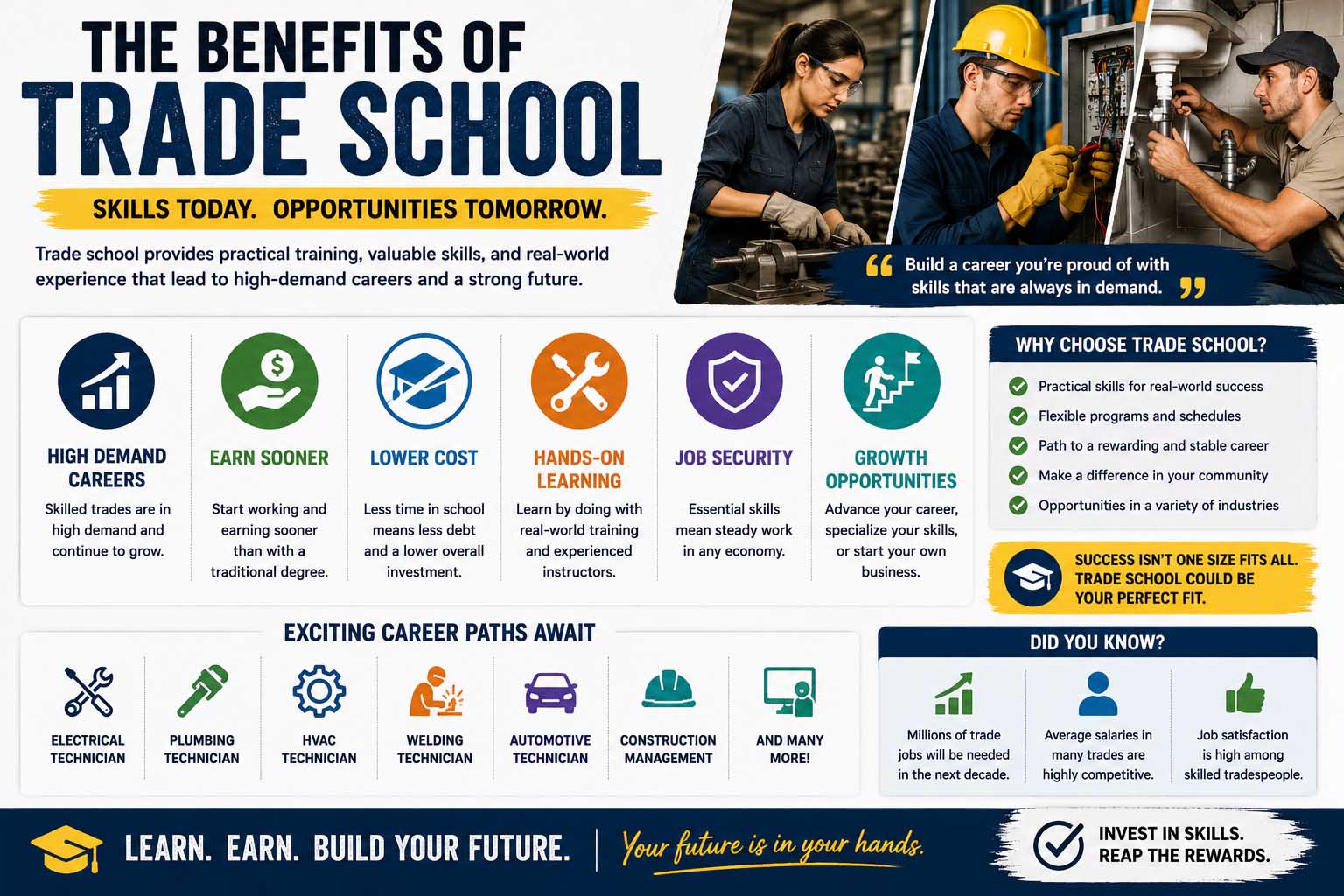
Benefits of Trade School: Is Vocational Training Worth It?
Choosing what to do after high school can feel complicated, especially when a four-year degree is not the right fit for every student. The benefits of trade school include focused career training, shorter programs, practical learning, and the possibility of entering the workforce sooner. For students who already have a career direction in mind, vocational education can offer a more direct route from the classroom to paid employment.
However, trade school is not automatically better than college. Instead, the best option depends on your career goal, learning style, finances, and the qualifications employers expect in your chosen field. Therefore, understanding how vocational programs work can help you make a decision based on your own future rather than simply following the most common path.
What Is Trade School?
A trade school, sometimes called a vocational or technical school, prepares students for a specific occupation. Rather than requiring a broad range of general education courses, these programs usually concentrate on the technical knowledge and practical skills needed for a particular career.
For example, programs may prepare students for work in welding, electrical technology, automotive service, HVAC, plumbing, cosmetology, culinary arts, dental assisting, medical assisting, or other skilled fields. However, available programs vary considerably by school and location.
Likewise, training formats differ. Some programs lead to certificates or diplomas, while others may connect with apprenticeships, licensing requirements, or industry credentials.
Therefore, students should research the types of trade schools available in their area and compare programs based on career outcomes rather than choosing a school simply because it is nearby.
Major Benefits of Trade School for Students
So, what are the benefits of trade school compared with other postsecondary choices? Although experiences vary by occupation and institution, several features make vocational education attractive to career-focused learners.
1. Training Is Focused on a Specific Career
One major advantage is specialization. Instead of spending several years exploring unrelated subjects, trade school students generally begin studying career-specific material early in their programs.
For instance, an automotive student may learn diagnostics, repair procedures, electrical systems, and shop safety. Meanwhile, an HVAC student may study heating systems, refrigeration, troubleshooting, and equipment installation.
As a result, students can see a clear connection between what they learn and what they may eventually do at work.
That focused approach can be especially helpful for learners who already know the occupation they want to pursue.
2. Many Programs Take Less Time Than a Bachelor’s Degree
Trade school programs are often shorter than traditional four-year bachelor’s programs. However, the exact length depends on the occupation, school, credential, licensing rules, and whether training is full time or part time.
Some certificate programs may take months, while other technical programs can take one or two years or longer. Certain careers also require apprenticeships or supervised experience after classroom training.
Even so, a shorter educational path may allow some students to start working earlier. Consequently, they may begin building professional experience and earning income while their peers are still completing longer academic programs.
Benefits of Going to Trade School for Hands-On Learners
Traditional classroom learning does not suit everyone. While some students enjoy lectures, academic reading, and theory-based assignments, others understand concepts more easily when they can practice them.
Trade schools commonly place significant emphasis on hands-on instruction. Therefore, students may spend time in workshops, labs, kitchens, clinics, salons, or simulated job environments.
For example, an electrical student may practice installing circuits in a controlled setting. Similarly, a welding student can develop techniques using actual equipment rather than learning only from diagrams.
This practical approach can make lessons feel more meaningful because students immediately apply what they have learned.
However, hands-on education does not mean academic skills disappear. Students may still need mathematics, technical reading, communication, problem-solving, and safety knowledge. Instead, those skills are often taught within a practical occupational context.
3. Trade School Can Offer a More Direct Career Path
Many college students begin their education without knowing exactly what occupation they want. As a result, they may change majors or spend time exploring different subjects.
Trade school usually works differently. Since students enroll in a particular occupational program, the connection between education and employment tends to be clearer from the beginning.
For instance, someone studying dental assisting knows the type of workplace the program is designed to prepare them for. Likewise, an aspiring electrician can investigate the education, apprenticeship, and licensing steps needed in their state or region.
That clarity can help students plan certifications, job searches, and early career goals more effectively.
Trade School Can Cost Less, but Compare the Full Price
Another commonly discussed benefit is cost. Because many vocational programs take less time than bachelor’s degrees, total tuition and related educational expenses can sometimes be lower.
However, students should never assume every trade program is inexpensive.
Tuition can differ significantly between public technical colleges, community colleges, nonprofit institutions, and private career schools. Meanwhile, students may also need to pay for tools, uniforms, equipment, certification examinations, books, transportation, or licensing fees.
Therefore, compare the total program cost, not merely the advertised tuition.
Concerns about Why Is College So Expensive can make shorter career programs attractive, yet price alone should not determine your decision. Instead, compare cost with program quality, completion rates, employment outcomes, accreditation when relevant, and the qualifications required for your target career.
Financial aid may also be available for eligible students and qualifying institutions. Still, availability varies, so students should verify aid options directly before enrolling.
Benefits of Trade School vs College
The benefits of trade school vs college become clearer when you compare the two pathways based on their purpose.
| Factor | Trade School | Four-Year College |
|---|---|---|
| Main focus | Specific occupation | Broader academic and professional education |
| Typical learning style | Practical and career-focused | Mix of theory, academics, labs, and practical work |
| Program length | Often shorter | Bachelor’s degree commonly designed around four years |
| Career flexibility | More specialized | Often broader |
| General education | Usually limited | Usually substantial |
| Entry into workforce | Can be faster | Often takes longer for bachelor’s students |
| Best suited for | Students targeting skilled occupations | Students pursuing careers requiring degrees or broad academic study |
Neither path wins every comparison.
For example, careers such as engineering, teaching, accounting, and many healthcare professions may require college degrees or specific professional education. Meanwhile, skilled trades may rely more heavily on vocational training, apprenticeships, certification, or licensing.
Students who are still exploring academic pathways may also benefit from understanding the difference between college and university before comparing those options with vocational education.
Therefore, start with the career you want and work backward to determine which education it requires.
4. Students Can Develop Job-Ready Skills
Trade education is designed around occupational competence. Consequently, students often practice tasks that resemble the work they may perform after graduation.
However, technical ability is only part of career readiness.
Employers also value reliability, communication, teamwork, time management, customer service, and problem-solving. Therefore, strong vocational programs often give students opportunities to develop professional habits alongside technical skills.
For instance, a student might need to diagnose a problem, explain the solution clearly, follow safety procedures, complete the work accurately, and document what was done.
Together, those abilities can make the transition from training to employment smoother.
5. Trade Careers Can Provide Opportunities for Growth
A common misconception is that vocational training leads to one job with little room for advancement. In reality, career progression varies widely across skilled occupations.
After gaining experience, a worker might become a supervisor, specialist, estimator, trainer, manager, or independent business owner. Meanwhile, some professionals earn advanced certifications or specialize in more technical areas of their field.
Therefore, students should think beyond their first job.
Once you enter the workforce, career advancement strategies such as earning relevant credentials, developing leadership skills, building professional relationships, and continuing your technical education can help you pursue higher-level opportunities.
Still, advancement is never automatic. Your occupation, local labor market, experience, performance, and qualifications all affect what opportunities become available.
6. Smaller Career Focus Can Make Planning Easier
Broad educational choices can sometimes overwhelm students. By contrast, a focused vocational program may simplify planning because coursework revolves around a defined career objective.
For example, instead of selecting dozens of electives, a student may follow a structured sequence of technical courses and practical training.
That structure can be useful for learners who prefer clear goals.
At the same time, students should not confuse a structured curriculum with an easy curriculum. Technical education can require precision, physical practice, safety awareness, problem-solving, and repeated skill development.
Therefore, success still depends on regular attendance, practice, and willingness to learn from mistakes.
What Are the Benefits of Attending a Trade School Before Entering the Workforce?
For many students, entering a technical occupation without preparation would be difficult or unsafe. Formal training can provide a supervised environment where learners practice before handling workplace responsibilities independently.
Instructors can demonstrate correct procedures, observe student performance, and correct mistakes. Consequently, learners can develop confidence while still receiving guidance.
Trade school can also expose students to equipment and workplace expectations they may encounter later. However, employers may still provide job-specific training after hiring.
Some programs also offer career services, employer connections, internships, or placement assistance. Yet these services differ between schools, so prospective students should ask exactly what support is available rather than assuming employment is guaranteed.
Possible Drawbacks to Consider
Although the benefits are appealing, trade school also has limitations.
First, vocational education is specialized. Therefore, changing careers later may require new training if your new field is very different.
Second, not every trade school offers the same quality. Some programs may have strong employer relationships and modern facilities, while others may provide weaker outcomes despite charging substantial tuition.
Third, physical demands can matter. Certain trades require lifting, standing, working outdoors, handling tools, or operating in challenging environments.
Finally, earning potential varies by occupation and location. Avoid assuming that every skilled trade automatically produces a high salary.
Instead, research actual employment data for the occupation and geographic area where you expect to work.
How to Decide Whether Trade School Is Worth It
Before enrolling, use a simple career-first process.
Step 1: Choose a possible occupation. Research what the job involves on a normal workday rather than focusing only on salary.
Step 2: Check entry requirements. Find out whether employers require a certificate, license, apprenticeship, associate degree, or another credential.
Step 3: Compare several programs. Look at tuition, program length, curriculum, facilities, graduation outcomes, accreditation when applicable, and employer connections.
Step 4: Calculate the full cost. Include tuition, fees, tools, transportation, exams, and other expenses.
Step 5: Research employment prospects. Check typical wages, job availability, working conditions, and advancement possibilities in your area.
Step 6: Compare alternatives. An apprenticeship, community college, employer-sponsored program, or traditional degree might offer another route into the same field.
Thinking about What Will You Do to Maximize on Your Postsecondary Education Investment can also help you judge whether the time, money, and credential are likely to support your career goal.
Common Mistakes When Choosing a Trade School
One mistake is enrolling because a program sounds profitable without researching the actual work. Instead, students should understand the daily responsibilities and working conditions first.
Another mistake is choosing the first school they find. Therefore, compare several programs and investigate their reputation, costs, facilities, credentials, and outcomes.
Likewise, avoid relying solely on advertisements that promise quick employment or unusually high earnings. Ask for evidence behind claims, and check whether the credential meets employer or licensing requirements where you intend to work.
Finally, do not assume vocational education eliminates the need for future learning. Technology, safety standards, tools, and industry practices change, so many skilled workers continue learning throughout their careers.
FAQs About the Benefits of Trade School
Is trade school better than college?
Trade school can be better for students pursuing occupations that require focused technical training. However, college may be more appropriate for careers requiring bachelor’s or advanced degrees. Therefore, the right choice depends mainly on your career objective.
How long does trade school take?
Program length varies by occupation and credential. Some programs take several months, while others can take one or two years or longer. Apprenticeship or licensing requirements may extend the complete training pathway.
Is trade school only for students who do not like academics?
No. Skilled careers often require mathematics, technical reading, communication, problem-solving, and detailed knowledge. However, trade programs tend to connect those academic skills directly with practical work.
Can you get financial aid for trade school?
Some eligible vocational programs and institutions participate in financial aid programs. However, eligibility varies. Therefore, students should confirm the school’s status and available aid before enrolling.
What are the biggest benefits of going to trade school?
For suitable careers, major advantages can include focused training, hands-on learning, shorter educational pathways, job-specific skill development, and potentially lower overall education costs.
Make the Decision Around Your Career Goal
The strongest benefits of trade school appear when a program matches both the student’s abilities and a realistic career plan. A shorter program has little value if its credential does not qualify you for the job you want. Conversely, a well-chosen vocational program can provide an efficient route into an occupation that genuinely suits you.
So, begin with the career rather than the school. Research the work, confirm the required qualifications, compare several training options, and calculate the complete cost. Once those pieces fit together, you can decide whether trade school offers the education, practical experience, and career direction you need.