
Central Idea Examples
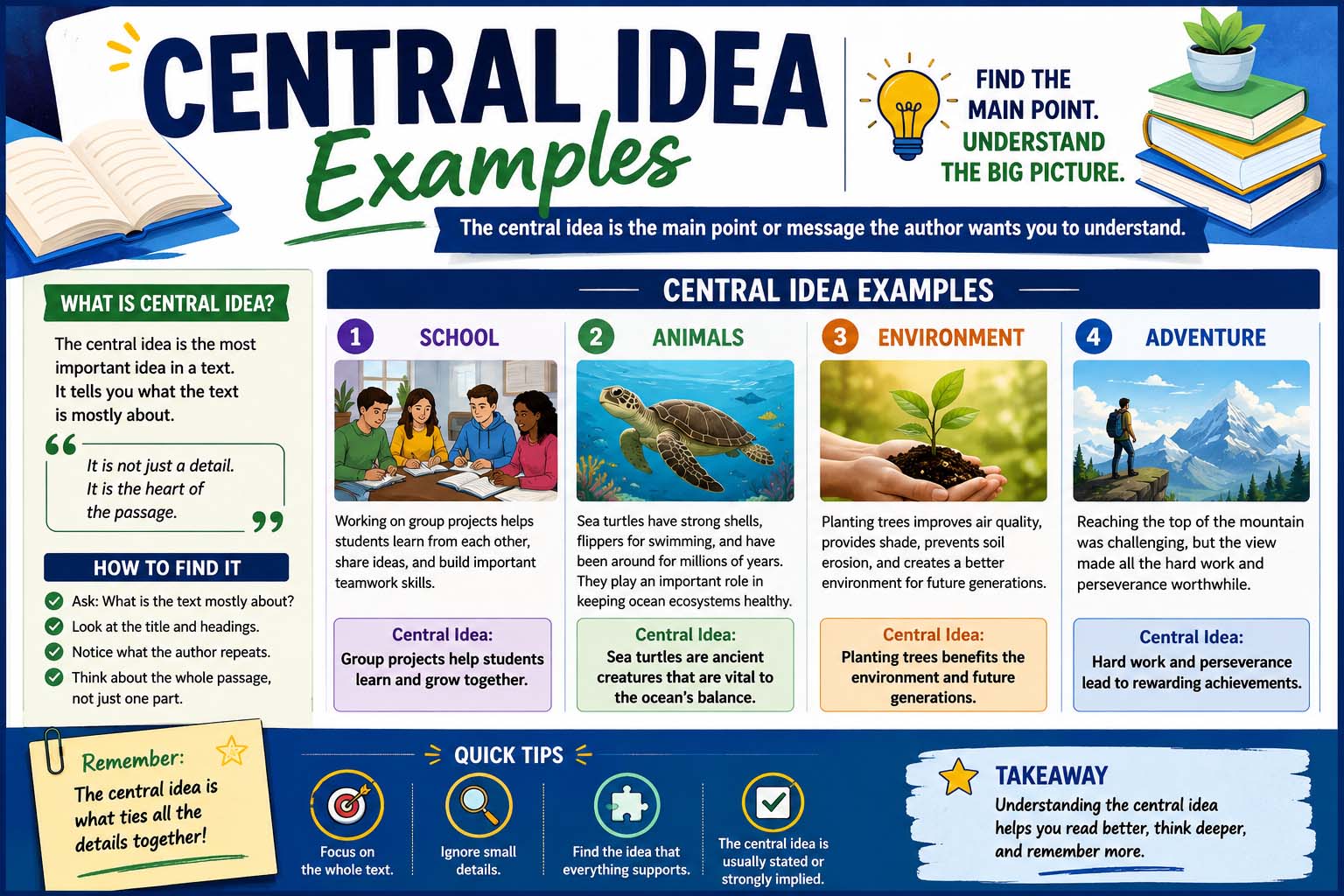
Central Idea Examples
Understanding central idea examples can make reading comprehension much easier. Have you ever finished reading a passage and wondered what the author was really trying to say? Identifying the central idea helps you answer that question.
The central idea is the main message or most important point an author communicates through a text. It connects the supporting details and gives readers a clear understanding of the passage.
For example, an article about recycling might discuss reducing waste, conserving resources, and protecting the environment. Together, these details support one central message about the benefits of recycling.
Learning to identify this message is an essential reading skill for students. In addition, it helps with classroom assignments, reading assessments, essay writing, and summarizing information.
This guide explains the meaning of central idea, provides practical examples, and shares simple strategies for finding the main message in different types of passages.
What Is a Central Idea? Definition and Examples
A central idea is the main point or overall message of a text. It explains what the author wants readers to understand about a particular subject.
Unlike a topic, which usually consists of one or two words, a central idea expresses a complete thought.
For example:
Topic: Recycling
Central Idea: Recycling helps reduce waste, conserve natural resources, and protect the environment.
In this example, recycling is the general subject. However, the central idea explains what the passage communicates about recycling.
For a more detailed explanation, students can explore What Is a Central Idea to understand how the main message connects with supporting information.
Central Idea Examples vs. Topic Examples
Many students confuse a topic with a central idea. However, the difference becomes clear when you compare examples.
| Topic | Central Idea |
|---|---|
| Dogs | Dogs make loyal companions because they provide friendship and protection. |
| Space | Space exploration has expanded our understanding of the universe. |
| School | Good study habits help students improve academic performance. |
| Exercise | Regular exercise supports physical and mental health. |
| Recycling | Recycling reduces waste and helps conserve valuable resources. |
A topic identifies what the text discusses. In contrast, the central idea explains the author’s main point about that topic.
Therefore, a strong central idea statement should communicate more than a general subject.
Why Central Idea Examples Help Reading Comprehension
Finding the central idea helps students understand what they read instead of simply remembering individual facts.
For example, a passage about ocean pollution might include information about plastic waste, marine animals, and water quality. However, the central idea connects those details into one meaningful message.
This skill helps students:
- Improve reading comprehension
- Understand nonfiction passages
- Analyze literature
- Write accurate summaries
- Prepare for reading assessments
- Identify supporting details
- Recognize an author’s main message
In addition, recognizing central ideas helps students organize information while studying.
As a result, they can focus on the most meaningful points rather than trying to memorize every sentence.
How to Find Central Ideas in Reading Passages
Finding the central idea becomes easier when you follow a consistent reading process.
Although every passage is different, these five steps work well for most informational texts.
Step 1: Identify the Topic in Central Idea Examples
First, ask yourself:
What is this passage mostly about?
For example, if a passage discusses different ways people save electricity, the topic is energy conservation.
However, identifying the topic is only the beginning.
Next, you need to determine what the author says about that subject.
Step 2: Look for Repeated Ideas
Authors often emphasize important information through repeated concepts.
Therefore, pay attention to:
- Repeated vocabulary
- Similar explanations
- Related facts
- Important examples
- Ideas that appear throughout the passage
For instance, a passage about exercise might repeatedly mention stronger muscles, improved heart health, and better energy levels.
Together, these details suggest that regular exercise benefits overall health.
Step 3: Read the Introduction and Conclusion
Introductions often introduce the main subject, while conclusions may reinforce the author’s message.
For example, an article might begin by explaining why clean water matters and end by encouraging water conservation.
Consequently, both sections can provide clues about the central idea.
However, not every passage states its main message directly.
Sometimes, readers must infer it from the supporting information.
Step 4: Separate Main Ideas From Small Details
Supporting details provide evidence, examples, or explanations.
However, they do not always represent the passage’s overall message.
For example:
Supporting Detail: Walking can strengthen the heart.
Central Idea: Regular physical activity provides several health benefits.
The supporting detail explains one benefit. Meanwhile, the central idea covers the broader message.
Step 5: Write One Complete Sentence
Finally, summarize the author’s main message in one clear sentence.
Ask yourself:
What does the author want readers to understand about this topic?
Then, check whether the important supporting details connect to your statement.
Understanding different Text Structure Examples can also help students recognize how authors organize information and emphasize important ideas.
Central Idea Examples for Reading Comprehension
The easiest way to understand this skill is to examine different passages and identify their main messages.
The following central idea examples demonstrate how supporting information connects to one complete statement.
Central Idea Examples: Bees and Pollination
Sample Passage:
Bees visit flowers to collect nectar and pollen. As they move between flowers, they transfer pollen that helps many plants reproduce. In addition, bees contribute to the production of fruits, vegetables, and other crops.
Topic: Bees
Central Idea: Bees play an important role in plant reproduction and food production.
Why It Works:
The passage describes several activities involving bees. However, all the details support their importance to plants and agriculture.
Central Idea Examples: Benefits of Reading
Sample Passage:
Reading regularly introduces people to new vocabulary and ideas. It also helps readers develop concentration and imagination. In addition, reading different types of books can strengthen language and comprehension skills.
Topic: Reading
Central Idea: Regular reading helps people develop language, concentration, and thinking skills.
Why It Works:
Each supporting detail describes a different benefit of reading. Therefore, the central idea combines those benefits into one message.
Central Idea Examples: Healthy Eating
Sample Passage:
A balanced diet includes different food groups that provide essential nutrients. Fruits and vegetables supply vitamins and minerals, while other foods provide protein, energy, and healthy fats. As a result, eating a variety of nutritious foods supports overall health.
Topic: Healthy eating
Central Idea: Eating a balanced variety of nutritious foods supports good health.
Why It Works:
The passage discusses several food groups. However, its main message concerns the importance of a balanced diet.
Example 4: Teamwork
Sample Passage:
Students working on group projects can divide responsibilities according to their strengths. They can also share ideas and help one another solve problems. Consequently, effective cooperation often makes challenging tasks easier to complete.
Topic: Teamwork
Central Idea: Working together helps groups complete tasks and solve problems more effectively.
Why It Works:
The passage explains several advantages of cooperation. Together, these details support the broader value of teamwork.
Example 5: Water Conservation
Sample Passage:
Freshwater is an important resource for homes, agriculture, and natural ecosystems. However, wasting water places unnecessary pressure on available supplies. Simple actions, such as fixing leaks and using water efficiently, can help conserve this resource.
Topic: Water conservation
Central Idea: Conserving water helps protect an essential natural resource.
Why It Works:
The passage provides reasons to save water and examples of conservation. Therefore, the central idea summarizes their shared message.
Central Idea Statement Examples
Teachers often ask students to write a complete statement that explains the author’s main message.
Unlike a single-word topic, a central idea statement communicates a meaningful point.
Here are several central idea examples written as complete statements:
- Practicing regularly helps athletes improve their skills and performance.
- Technology allows people to communicate more quickly across long distances.
- Plants need sunlight, water, and nutrients to grow.
- Kindness helps build stronger friendships and supportive communities.
- Learning from mistakes can improve problem-solving skills.
- Effective time management helps students complete assignments more efficiently.
- Protecting natural habitats supports wildlife conservation.
- Teamwork allows people to combine different strengths.
- Regular reading improves vocabulary and comprehension.
- Preparing for emergencies helps communities respond more effectively.
Each statement expresses a complete idea rather than simply naming a subject.
In addition, learning to develop clear central statements can strengthen academic writing.
For example, students reviewing Argumentative Essay Examples can practice distinguishing a writer’s main claim from the evidence supporting it.
However, remember that a central idea is not always an argument. Informational texts can communicate central ideas without trying to persuade readers.
Central Idea Sentence Examples by Subject
Different school subjects use central ideas in different ways.
Therefore, practicing with a variety of topics helps students recognize important messages across academic texts.
Science Central Idea Examples
Topic: Climate change
Central Idea: Climate change affects environmental conditions and ecosystems around the world.
History
Topic: Historical events
Central Idea: Studying historical events helps explain how societies develop and change over time.
Literature
Topic: Courage
Central Idea: A character’s courage helps them face difficult situations and overcome challenges.
Health
Topic: Physical activity
Central Idea: Regular physical activity supports physical health and emotional well-being.
Education
Topic: Goal setting
Central Idea: Setting realistic academic goals helps students stay organized and motivated.
Although these examples cover different subjects, they follow the same principle.
Each statement explains an important message about its topic.
Central Idea and Supporting Details Examples
Supporting details explain, illustrate, or provide evidence for a central idea.
For example, consider a passage about physical activity.
| Central Idea | Supporting Details |
|---|---|
| Regular exercise supports overall health. | Walking can strengthen the heart. |
| Physical activity can improve energy levels. | |
| Exercise may help reduce stress. | |
| Regular movement supports muscle strength. |
All the supporting details relate to the same overall message.
However, none of the individual details fully represents the entire passage.
How Supporting Details Connect to the Main Message
Imagine reading an article about protecting forests.
The author discusses animal habitats, air quality, and natural resources.
Although these subjects are different, they all support a larger message:
Central Idea: Protecting forests benefits wildlife, people, and the environment.
Therefore, identifying the relationship between details helps you recognize the author’s main point.
Central Idea Examples With Practice Questions
Practicing with central idea examples helps students apply reading strategies independently. The following short passages show how to identify the topic, recognize supporting details, and write an accurate central idea statement.
Practice Example 1: Trees
Passage:
Trees provide oxygen, improve air quality, reduce temperatures, and create habitats for wildlife. In addition, planting more trees can help communities become healthier and greener.
Topic: Trees
Supporting Details:
- Trees produce oxygen.
- They improve air quality.
- They help cool neighborhoods.
- They provide wildlife habitats.
Central Idea: Trees benefit both the environment and community health.
Explanation:
Although the passage describes several benefits, they all support the importance of trees.
Practice Example 2: Sleep
Passage:
Getting enough sleep helps students concentrate during lessons. Sleep also supports memory and gives the body time to recover. Therefore, maintaining healthy sleep habits can improve daily functioning.
Topic: Sleep
Central Idea: Healthy sleep habits support learning, memory, and overall well-being.
Explanation:
The passage discusses concentration, memory, and recovery. Together, these details explain why sleep matters.
Practice Example 3: Public Libraries
Passage:
Public libraries provide access to books, educational resources, and community programs. Many libraries also offer computers and study spaces. As a result, they help people learn and access useful information.
Topic: Public libraries
Central Idea: Public libraries support learning by providing educational resources and community services.
Explanation:
Each detail describes a service that helps people learn. Consequently, the central idea connects those services into one message.
Common Mistakes in Central Idea Identification
Finding the central idea becomes easier when students recognize common errors.
Mistake 1: Choosing a Supporting Detail
Too Narrow: Dogs enjoy playing fetch.
Better Central Idea: Dogs need regular physical activity to stay healthy.
The first statement describes one activity. In contrast, the second expresses a broader message that several details could support.
Mistake 2: Making the Statement Too Broad
Too Broad: Nature is important.
Better Central Idea: Protecting forests helps preserve wildlife and natural resources.
The improved statement identifies a specific message.
Therefore, it provides more useful information about what the author wants readers to understand.
Mistake 3: Including Personal Opinions
A central idea should reflect the author’s message rather than the reader’s personal beliefs.
For example, you might believe that dogs make better pets than cats.
However, if the passage discusses responsible pet care, your preference does not represent its central idea.
Mistake 4: Confusing the Topic With the Main Message
Topic: Pollution
Central Idea: Reducing pollution helps protect ecosystems and creates healthier communities.
The topic names the subject. Meanwhile, the central idea explains the author’s message about that subject.
Mistake 5: Writing a Statement Without Textual Support
Sometimes, students choose an answer that sounds reasonable but does not match the passage.
Therefore, always check whether the important details support your statement.
If they do not, revise your answer.
Classroom Strategies for Identifying Central Ideas
Teachers often encourage students to use simple reading strategies.
For example, the following techniques can help.
Highlight Repeated Ideas
Look for concepts that appear several times.
However, remember that authors may use different words to express the same idea.
Therefore, focus on meaning rather than repeated vocabulary alone.
Ask Questions While Reading
Consider these questions:
- What is the author explaining?
- Why did the author write this passage?
- Which ideas appear throughout the text?
- What do the supporting details have in common?
- What should readers remember?
These questions help direct your attention toward the main message.
Summarize Each Paragraph
After reading a paragraph, write a short summary.
Next, compare the summaries to identify a common idea.
As a result, longer passages become easier to understand.
How to Write a Central Idea Statement With Examples
Writing a central idea statement requires more than copying a sentence from the passage.
Instead, you should explain the author’s main message in your own words.
Follow these steps:
- Read the entire passage carefully.
- Identify the main topic.
- Highlight important supporting details.
- Look for connections between those details.
- Write one complete sentence.
- Compare your statement with the original text.
For example, imagine reading a passage about students who use planners, organize notes, and review lessons regularly.
The topic is study habits.
A suitable central idea might be:
Effective study habits help students stay organized and improve their learning.
In this example, the statement combines several related activities into one meaningful message.
Study Tips for Improving Reading Comprehension
Students can strengthen reading comprehension through regular practice.
For example, understanding How to Make a Study Guide can help you organize important concepts, reading notes, and review questions.
Other helpful strategies include:
- Read different types of texts regularly.
- Highlight meaningful information.
- Take notes while reading.
- Summarize important sections.
- Practice identifying supporting details.
- Compare answers with classmates.
- Ask teachers for feedback.
In addition, practice with science, history, literature, and informational passages.
Because different subjects organize information differently, varied reading experience can improve your ability to recognize central messages.
Use Reliable Reading Standards
Reading standards also emphasize identifying central ideas and explaining how details support them.
For example, the Common Core State Standards for English Language Arts include reading expectations related to determining central ideas and summarizing texts.
Therefore, practicing these skills can help students prepare for classroom reading tasks and assessments that follow similar learning goals.
Why Teachers Ask About Central Ideas
Teachers use central idea questions to evaluate several reading skills.
For example, students demonstrate that they can:
- Understand informational texts
- Recognize important patterns
- Separate major ideas from minor details
- Summarize information accurately
- Support answers with evidence
- Think critically about an author’s message
In addition, identifying the central idea helps students understand how authors organize and develop information.
As a result, this skill supports learning across multiple school subjects.
Central Idea Examples: Quick Identification Checklist
Before choosing your answer, review these questions:
- Did I identify the main topic?
- Did I recognize the most important details?
- Did I avoid focusing on one small fact?
- Does my statement explain the author’s message?
- Is my answer a complete sentence?
- Do the supporting details connect to my statement?
- Does my answer reflect the text rather than my personal opinion?
If you can answer yes to these questions, your statement likely captures the passage’s central message.
However, reread the text if any important details seem unrelated to your answer.
Frequently Asked Questions About Central Idea Examples
What Is a Central Idea?
A central idea is the main message or most important point an author communicates through a text.
In other words, it explains what readers should understand about the passage’s topic.
Are Central Idea and Main Idea the Same?
In many classrooms, teachers use these terms interchangeably.
However, some lessons distinguish between a main idea in a particular paragraph and a central idea that develops across an entire text.
Therefore, follow the terminology used in your assignment.
How Do I Identify the Central Idea?
First, identify the topic.
Next, look for repeated concepts and important supporting details.
Finally, write one sentence that explains the author’s overall message.
Can a Passage Contain Multiple Central Ideas?
Short passages often focus on one main central idea.
However, longer texts may develop several important ideas across different sections or chapters.
What Is the Difference Between a Topic and a Central Idea?
A topic identifies the subject of the text.
In contrast, the central idea explains what the author communicates about that subject.
For example:
Topic: Healthy eating
Central Idea: Eating nutritious foods supports overall health and well-being.
What Are Some Easy Central Idea Examples?
Here are three simple examples:
- Topic: Exercise — Central Idea: Regular exercise supports physical and mental health.
- Topic: Reading — Central Idea: Reading helps people develop language and thinking skills.
- Topic: Recycling — Central Idea: Recycling reduces waste and helps conserve resources.
Each statement expresses a complete message rather than a single subject.
Why Is the Central Idea Important?
Understanding the central idea helps readers improve comprehension, write accurate summaries, answer reading questions, and analyze informational and literary texts.
In addition, it helps students distinguish essential information from supporting details.
Final Study Advice for Finding Central Ideas
Learning to identify the central idea is an essential reading skill. Start by finding the topic, noticing repeated concepts, and examining how supporting details connect.
The central idea examples in this guide show how different passages communicate one main message through related information. Therefore, use these models when practicing with classroom assignments and reading exercises.
Although identifying central ideas may feel challenging at first, regular practice makes the process easier.
Finally, read a variety of texts, write short summaries, and check your answers against the supporting details. Over time, these habits can help you become a more confident reader and a stronger writer.