
Types of Chemical Reactions Worksheet Answers: A Complete Study Guide
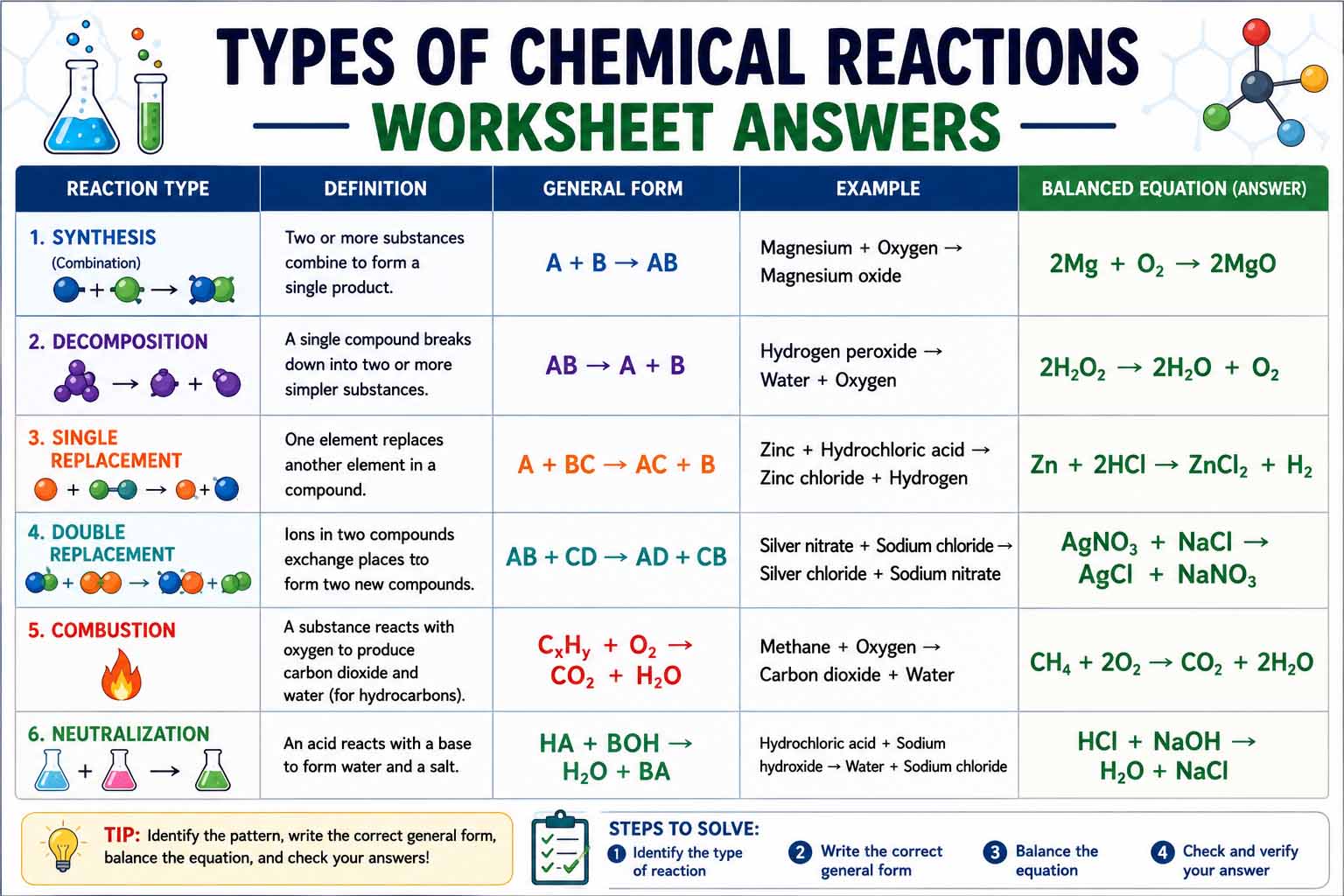
Types of Chemical Reactions Worksheet Answers: A Complete Study Guide
If you’ve been searching for types of chemical reactions worksheet answers, you’re probably preparing for a chemistry quiz, completing homework, or reviewing for an exam. While answer keys can be helpful, understanding why each reaction fits a certain category is much more valuable. Once you learn the patterns behind chemical reactions, identifying them becomes much easier.
This guide explains the six major reaction types, provides worked examples, highlights common mistakes, and shares study tips that help you solve worksheets with confidence.
What Are Chemical Reactions?
A chemical reaction occurs when substances called reactants undergo a chemical change to form new substances known as products, each with different chemical properties and compositions than the original materials.
During a reaction:
- Chemical bonds break.
- New bonds form.
- Atoms rearrange.
- Matter is conserved.
Because atoms cannot be created or destroyed during an ordinary chemical reaction, every chemical equation must be balanced.
Types of Chemical Reactions Worksheet Answers: The Six Main Reaction Types
Most classroom worksheets focus on six major categories of reactions.
| Reaction Type | General Pattern | Example |
|---|---|---|
| Synthesis | A + B → AB | 2H₂ + O₂ → 2H₂O |
| Decomposition | AB → A + B | 2H₂O₂ → 2H₂O + O₂ |
| Single Replacement | A + BC → AC + B | Zn + CuSO₄ → ZnSO₄ + Cu |
| Double Replacement | AB + CD → AD + CB | AgNO₃ + NaCl → AgCl + NaNO₃ |
| Combustion | Hydrocarbon + O₂ → CO₂ + H₂O | CH₄ + 2O₂ → CO₂ + 2H₂O |
| Acid-Base Neutralization | Acid + Base → Salt + Water | HCl + NaOH → NaCl + H₂O |
Learning these patterns makes worksheet questions much easier to recognize.
How to Identify Each Reaction Type
Rather than memorizing every equation, look for clues.
Synthesis Reactions
A synthesis reaction is a type of chemical reaction in which two or more reactants combine to form a single, more complex product.
Example:
2Mg + O₂ → 2MgO
Key clue:
Several reactants become a single compound.
Decomposition Reactions
A decomposition reaction is the opposite of a synthesis reaction, as it breaks a single compound down into two or more simpler substances.
Example:
CaCO₃ → CaO + CO₂
Key clue:
One compound breaks into multiple products.
Single Replacement Reactions
In a single replacement reaction, one element replaces another element within a compound, resulting in the formation of a new compound and a different free element.
Example:
Fe + CuSO₄ → FeSO₄ + Cu
Key clue:
A lone element appears on both sides of the equation.
Double Replacement Reactions
Two compounds exchange ions.
Example:
BaCl₂ + Na₂SO₄ → BaSO₄ + 2NaCl
Key clue:
In a double replacement reaction, the positive and negative ions switch partners, forming two new compounds.
Combustion Reactions
A combustion reaction occurs when oxygen reacts with a fuel, releasing energy in the form of heat and often light while producing new substances such as carbon dioxide and water in complete combustion.
Example:
C₃H₈ + 5O₂ → 3CO₂ + 4H₂O
Key clue:
Hydrocarbon plus oxygen usually produces carbon dioxide and water.
Acid-Base Neutralization
An acid reacts with a base.
Example:
H₂SO₄ + 2NaOH → Na₂SO₄ + 2H₂O
Key clue:
The products include water and a salt.
Step-by-Step Method for Solving Worksheets
When completing reaction worksheets, use a consistent process.
Step 1: Read the Entire Equation
Identify the reactants and products before making assumptions.
Step 2: Count the Number of Reactants
Ask yourself:
- Is there one reactant?
- Two compounds?
- An element plus a compound?
The structure of a chemical equation often reveals the type of reaction by showing how the reactants are rearranged to form the products.
Step 3: Compare with Reaction Patterns
Use the summary table above to match the equation to its general formula.
Step 4: Balance the Equation
After identifying the reaction, check whether the equation contains the same number of atoms on both sides.
Step 5: Double-Check Your Answer
Many worksheet mistakes happen because students identify the reaction correctly but overlook balancing errors.
Practice Examples
Let’s classify several reactions.
Example 1
2Na + Cl₂ → 2NaCl
Answer:
Synthesis reaction
Reason:
Two reactants combine to form one product.
Example 2
2KClO₃ → 2KCl + 3O₂
Answer:
Decomposition reaction
Reason:
One compound breaks apart.
Example 3
Zn + 2HCl → ZnCl₂ + H₂
Answer:
Single replacement reaction
Reason:
Zinc replaces hydrogen in the acid.
Example 4
AgNO₃ + NaCl → AgCl + NaNO₃
Answer:
Double replacement reaction
Reason:
The ions exchange partners.
Example 5
CH₄ + 2O₂ → CO₂ + 2H₂O
Answer:
Combustion reaction
Reason:
A hydrocarbon reacts with oxygen.
Common Mistakes Students Make
Many worksheet errors are easy to avoid by carefully reading the instructions, identifying the reaction pattern, and checking your answers before submitting your work.
Watch out for these mistakes:
- Confusing synthesis with single replacement
- Forgetting to balance equations
- Looking only at products instead of reactants
- Mixing up decomposition and combustion
- Ignoring reaction patterns
Instead of memorizing answers, focus on recognizing each reaction’s structure.
Tips for Studying Reaction Types
Consistent review works better than last-minute memorization.
One helpful strategy is creating flashcards with the reaction name on one side and the reaction pattern on the other.
Another effective method is to learn How to Make a Study Guide so you can organize equations, reaction patterns, and practice questions into one easy-to-review resource before your next chemistry test.
Types of Chemical Reactions Worksheet Answers PDF Resources
Many teachers provide downloadable practice materials.
You may come across searches for:
- types of chemical reactions worksheet answers pdf
- types of chemical reactions lab worksheet answers pdf
These resources are useful for extra practice, but they should be used to check your work after attempting each problem on your own. Understanding the reasoning behind each answer builds stronger long-term chemistry skills.
Understanding Laboratory Worksheets
Lab worksheets often require more than identifying reaction types.
Students may also need to:
- Record observations
- Balance equations
- Predict products
- Explain evidence of a reaction
- Draw particle diagrams
Because laboratory exercises involve critical thinking, instructors usually award points for both correct answers and explanations.
What About Types of Chemical Reactions Worksheet Answers SAC?
Some students search for types of chemical reactions worksheet answers SAC because certain schools or educational systems use specific chemistry worksheets or assessment materials with that title or abbreviation.
Once you understand the six main categories, you can solve most chemistry reaction classification exercises regardless of the worksheet format.
6 Types of Chemical Reactions Worksheet Answers
The phrase 6 types of chemical reactions worksheet answers usually refers to the same six reactions introduced earlier:
- Synthesis
- Decomposition
- Single replacement
- Double replacement
- Combustion
- Acid-base neutralization
Some textbooks combine or separate acid-base reactions differently, but these six remain the most commonly taught in high school chemistry.
Study Checklist Before Your Quiz
Use this quick review list before taking your chemistry test.
Know the six reaction categories.
Recognize each general reaction pattern.
Practice balancing equations.
Identify reactants and products first.
Solve several practice questions without using notes.
Review mistakes from previous worksheets.
Working through problems repeatedly builds confidence and improves accuracy.
How Teachers May Assess Chemical Reactions
Not every chemistry assessment looks the same.
Some teachers include matching questions, while others use diagrams, balancing exercises, or application-based problems.
Understanding different types of multiple choice questions can also help you prepare for chemistry exams because some questions ask you to identify reaction patterns, while others test your ability to eliminate incorrect answer choices.
Applying Math Skills in Chemistry
Chemistry often requires mathematical thinking.
For example, balancing equations, calculating molar ratios, and determining reactant quantities all involve numerical reasoning.
If you’re reviewing measurement concepts alongside chemistry, understanding What Is a Unit Rate can strengthen the problem-solving skills used in scientific calculations and stoichiometry.
Preparing for Chemistry Exams
Worksheet practice is excellent preparation, but exams often require deeper understanding.
Many chemistry teachers use cumulative tests that combine reaction identification with balancing equations, vocabulary, and laboratory concepts.
Looking at examples of Summative Assessment Examples can give you a better idea of how end-of-unit chemistry tests are typically organized and what kinds of questions you may encounter.
Frequently Asked Questions
What are the six types of chemical reactions?
The six common reaction types are synthesis, decomposition, single replacement, double replacement, combustion, and acid-base neutralization.
How do I identify reaction types quickly?
Start by counting the reactants and products, then compare the equation with the standard reaction patterns.
Why do I need to balance equations?
Balanced equations follow the law of conservation of mass, which states that atoms are neither created nor destroyed during a chemical reaction.
Are worksheet answers enough to study?
Answer keys help you check your work, but understanding why an answer is correct is much more effective for long-term learning.
What’s the best way to remember reaction types?
Practice regularly, use flashcards, solve sample equations, and review the general reaction patterns until you recognize them automatically.
Key Takeaways for Chemistry Success
Learning chemical reactions becomes much easier when you focus on patterns instead of memorizing individual equations. Practice identifying the six major reaction types, balance equations carefully, and review your mistakes after each worksheet. Over time, you’ll begin recognizing reaction categories almost instantly, making homework, quizzes, labs, and exams much less stressful.