
Types of Colleges: A Complete Guide for Students
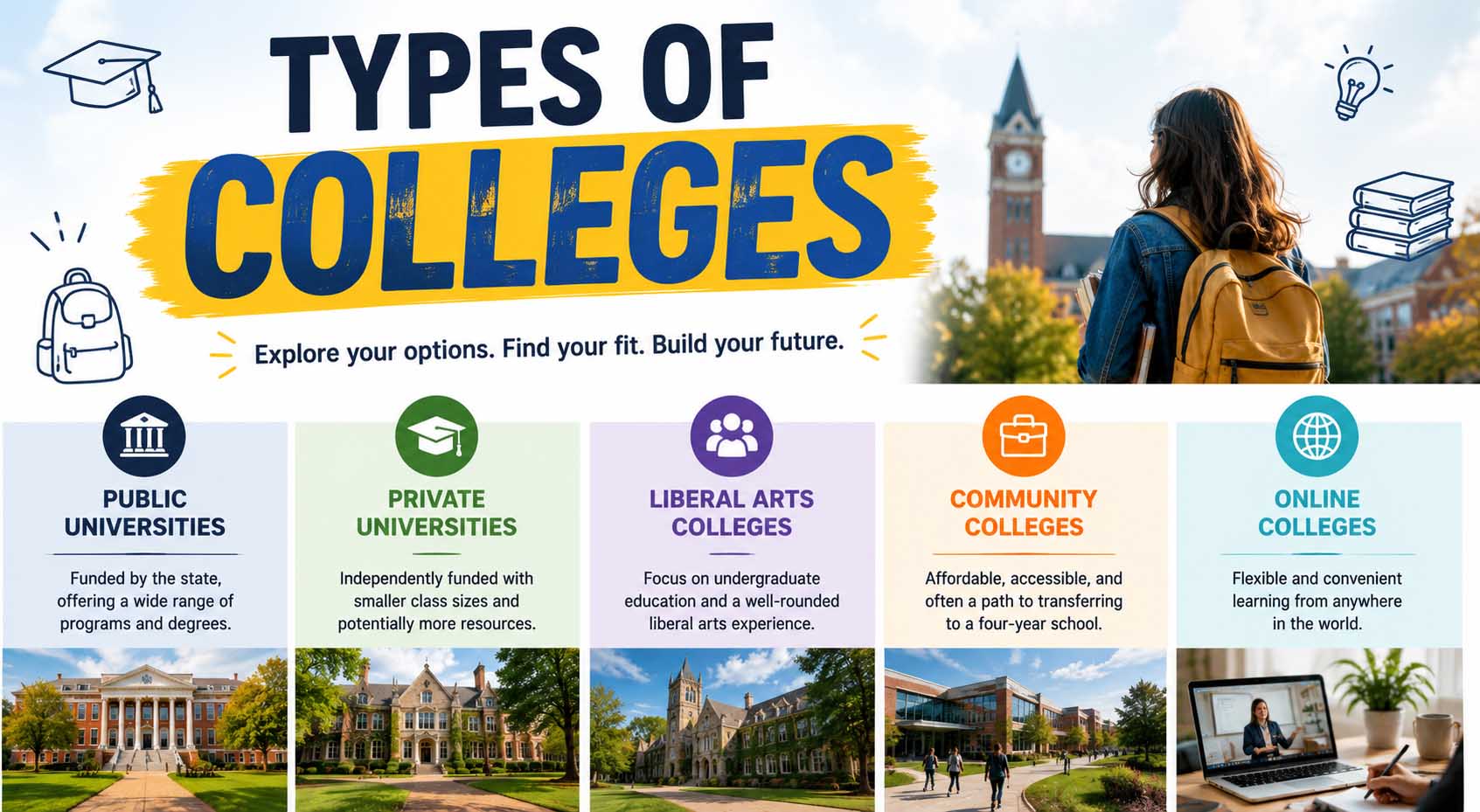
Types of Colleges: A Complete Guide for Students
Choosing a college is one of the biggest education decisions you’ll make, but many students don’t realize there are several types of colleges to choose from. Each type offers different programs, learning environments, costs, and career opportunities. Understanding these options can help you find a school that matches your goals, budget, and interests.
Whether you’re planning to earn a certificate, associate degree, bachelor’s degree, or beyond, knowing what types of colleges are there makes the college search much less overwhelming. This guide explains the most common college types, who they’re best suited for, and how to decide which one fits your future plans.
What Are Types of Colleges?
The phrase types of colleges refers to the different categories of higher education institutions. While every college focuses on education after high school, each one serves students in different ways.
Some colleges prepare students for specific careers, while others offer a broad academic education. Some are publicly funded and often have lower tuition for residents, while others are privately operated and may provide different campus experiences.
Learning about these differences before applying can save both time and money.
Types of Colleges Explained
If you’re wondering what are the 4 types of colleges, many education experts group them into four broad categories:
- Community colleges
- Public colleges and universities
- Private colleges and universities
- Technical or vocational colleges
Today, students also have options such as liberal arts colleges, online colleges, and specialized institutions, giving learners more choices than ever before.
Let’s look at each type in more detail.
Community Colleges
Community colleges are two-year institutions that primarily offer associate degrees, certificates, and workforce training.
Many students begin here because tuition is generally lower than at four-year schools. After earning an associate degree, students often transfer to a university to complete a bachelor’s degree.
If you’re still comparing schools, understanding the difference between college and university can make it easier to know which path best matches your educational goals.
Best for
- Affordable education
- Career training
- Students planning to transfer
- Adult learners
- Flexible schedules
Common Degrees
- Associate of Arts (AA)
- Associate of Science (AS)
- Associate of Applied Science (AAS)
- Career certificates
Public Colleges and Universities
Public colleges receive financial support from state governments. Because of this, residents usually pay lower tuition than out-of-state students.
These schools often have large campuses, extensive academic programs, research opportunities, and many student organizations.
Advantages
- Wide variety of majors
- Lower in-state tuition
- Large libraries and laboratories
- Athletics and campus activities
- Strong alumni networks
Students interested in a broad selection of academic programs often begin their search with public universities.
Private Colleges and Universities
Private colleges operate independently rather than receiving primary funding from state governments.
Although tuition is often higher, many private colleges provide generous scholarships and financial aid packages that reduce overall costs.
Class sizes also tend to be smaller, allowing students to build closer relationships with professors.
Best for
- Smaller classrooms
- Personalized instruction
- Specialized academic programs
- Close campus communities
Not every private college is expensive after financial aid, so it’s worth comparing actual costs instead of focusing only on published tuition.
Technical and Vocational Colleges
Technical colleges prepare students for specific careers by emphasizing hands-on learning instead of broad academic coursework.
Programs often take between several months and two years to complete.
Popular career areas include:
- Automotive technology
- Welding
- Information technology
- Culinary arts
- Medical assisting
- Electrical work
- HVAC
- Construction trades
Graduates typically enter the workforce soon after completing their programs.
Liberal Arts Colleges
Liberal arts colleges focus on developing communication, critical thinking, writing, and analytical skills across multiple subjects.
Students study humanities, science, mathematics, and social sciences while specializing in one major field.
These colleges encourage well-rounded learning rather than early career specialization.
Many employers value graduates because they develop strong problem-solving and communication skills.
Online Colleges
Online colleges have become increasingly popular because they allow students to complete coursework remotely.
Some schools operate entirely online, while traditional colleges also offer online degree programs.
Online learning works well for:
- Working adults
- Parents
- Military members
- Students living far from campus
- Learners who need flexible schedules
Success in online education requires good time management and self-discipline.
Specialized Colleges
Some institutions focus almost entirely on one area of study.
Examples include:
- Art colleges
- Music conservatories
- Military colleges
- Religious colleges
- Business schools
- Health sciences colleges
These schools provide highly focused training for students with clear career goals.
Comparing Different Types of Colleges
| College Type | Typical Length | Degrees Offered | Best For |
|---|---|---|---|
| Community College | 2 years | Associate, Certificate | Affordable education, transfers |
| Public University | 4+ years | Bachelor’s, Master’s, Doctorate | Wide academic choices |
| Private College | 4+ years | Bachelor’s and graduate degrees | Smaller classes |
| Technical College | Months to 2 years | Certificates, Associate | Career preparation |
| Liberal Arts College | 4 years | Bachelor’s | Broad education |
| Online College | Varies | Multiple degree levels | Flexible learning |
Types of Colleges Degrees
One reason students compare colleges is to understand the types of colleges degrees available.
Different institutions may offer different academic credentials.
Certificates
Usually completed within one year or less, certificates prepare students for entry-level careers or skill development.
Associate Degrees
Typically earned in two years, associate degrees can prepare students for employment or transfer into bachelor’s programs.
Bachelor’s Degrees
Most bachelor’s degrees require four years of full-time study and remain the standard requirement for many professional careers.
Graduate Degrees
Universities often offer:
- Master’s degrees
- Professional degrees
- Doctoral degrees
Not every college offers graduate programs, so students should review academic offerings carefully.
How to Choose Between Different Types of Colleges
Choosing the right school involves more than picking the closest campus.
Consider these factors before applying.
Your Career Goals
Start by asking yourself what kind of career you hope to pursue.
If you’re still uncertain, exploring What Should I Major In can help you connect your interests with possible degree programs before selecting a college.
Your Budget
Compare:
- Tuition
- Housing costs
- Books
- Transportation
- Scholarships
- Financial aid
Sometimes a private college costs less than a public university after scholarships are applied.
Learning Style
Ask yourself:
- Do you enjoy small classes?
- Would you prefer a large campus?
- Do you learn better online?
- Would hands-on training suit you better?
Matching your learning style with the college environment often improves academic success.
Campus Life
Think about:
- Student clubs
- Athletics
- Study abroad
- Internship opportunities
- Research programs
- Campus housing
These experiences shape college life beyond the classroom.
Common College Pathways
Many students follow one of these educational paths.
Path 1
High school → Community college → University → Bachelor’s degree
Path 2
High school → Public university → Bachelor’s degree
Path 3
High school → Technical college → Career
Path 4
High school → Private college → Graduate school
There is no single “best” pathway. The right choice depends on your goals, finances, and preferred learning experience.
Helpful Programs That Can Save Time and Money
Some students earn college credits before graduating from high school.
For example, What Is Dual Enrollment explains how eligible students can complete college courses while still in high school, helping them shorten the time needed to earn a degree.
During the application process, you’ll also encounter different admission timelines. Learning about What Is Rolling Admission can help you understand why some colleges review applications as they arrive rather than waiting until a single deadline.
Paying for College
Many students worry about college costs, but there are several ways to reduce expenses.
Look into:
- Scholarships
- Grants
- Federal student aid
- State financial aid
- Tuition payment plans
- Part-time employment
Some schools also offer campus jobs through programs like What Is Work Study, which allows eligible students to earn money while attending college.
Applying for financial aid early often increases your available options.
Common Mistakes When Choosing a College
Students sometimes focus on one factor while overlooking others.
Try to avoid these common mistakes:
- Choosing a school based only on rankings
- Ignoring graduation rates
- Not comparing financial aid offers
- Skipping campus visits or virtual tours
- Selecting a college because friends are attending
- Overlooking internship opportunities
- Applying without researching available majors
Taking time to compare schools carefully often leads to a better college experience.
Frequently Asked Questions
What are the 4 types of colleges?
The four most common categories are community colleges, public colleges and universities, private colleges and universities, and technical or vocational colleges.
What types of colleges are there besides universities?
Students can attend community colleges, liberal arts colleges, technical colleges, online colleges, military colleges, art schools, religious colleges, and many other specialized institutions.
Which type of college is the least expensive?
Community colleges generally have the lowest tuition, especially for local residents. Financial aid and scholarships can lower costs at other schools as well.
Can I transfer from one type of college to another?
Yes. Many students begin at a community college before transferring to a four-year university to complete a bachelor’s degree.
Do all colleges offer bachelor’s degrees?
No. Community colleges usually award associate degrees and certificates, while universities and many four-year colleges offer bachelor’s and graduate degrees.
Make Your College Choice with Confidence
Learning about the types of colleges helps you make informed decisions about your education instead of choosing a school based only on reputation or location. Every college type offers unique strengths, whether you’re looking for affordable tuition, specialized career training, flexible online learning, or a traditional campus experience.
As you compare schools, think about your career goals, preferred learning environment, budget, and long-term plans. A little research now can help you choose a college that supports your success for years to come.