
Difference Between College and University: A Complete Student Guide
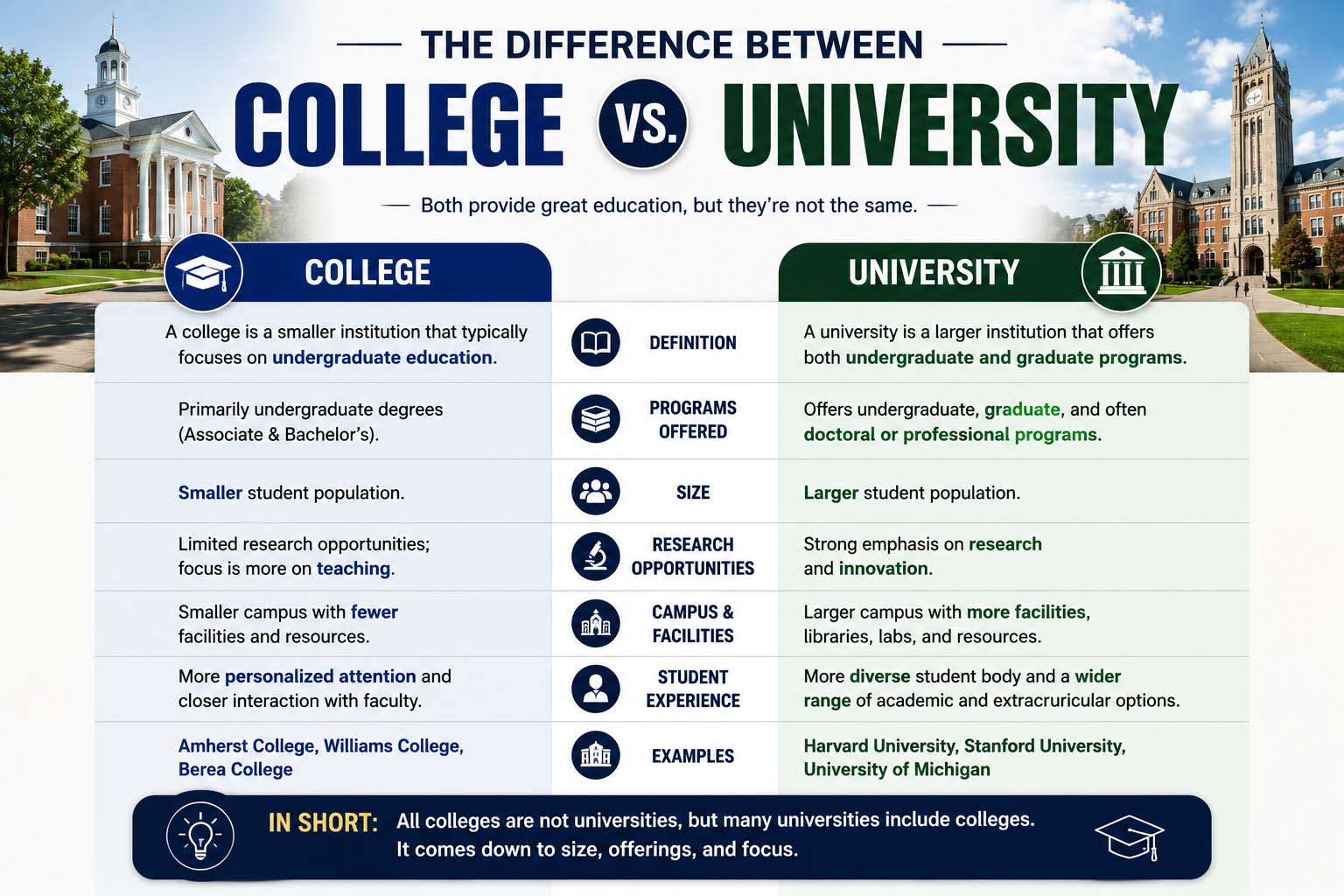
Difference Between College and University: A Complete Student Guide
If you’re planning to continue your education, you’ve probably wondered about the difference between college and university. Although many people use the terms interchangeably, they don’t always mean the same thing. Depending on the country, a college and a university can differ in size, academic programs, research opportunities, and the degrees they award.
Choosing the right institution is an important step because it can influence your learning experience, career opportunities, and campus life. Understanding these differences helps you make a more informed decision based on your personal goals rather than the name of the institution.
In this guide, you’ll learn what sets colleges and universities apart, how they compare, and which option may be the better fit for your educational journey.
What Is the Difference Between College and University?
The simplest answer to what is the difference between college and university is that universities are generally larger institutions offering undergraduate and graduate programs, while colleges often focus primarily on undergraduate education.
A college usually provides associate or bachelor’s degrees and may specialize in specific academic areas such as liberal arts, business, or technical education.
A university, on the other hand, typically includes multiple colleges or faculties under one institution. It offers bachelor’s, master’s, and doctoral degrees while supporting research and advanced academic programs.
Even though this is the most common distinction, the exact meaning varies by country. In some places, the words are used almost interchangeably.
College vs. University at a Glance
The table below highlights the most common differences.
| Feature | College | University |
|---|---|---|
| Typical size | Smaller | Larger |
| Degrees offered | Associate and bachelor’s | Bachelor’s, master’s, doctorate |
| Research opportunities | Limited | Extensive |
| Student population | Usually smaller | Often much larger |
| Academic departments | Fewer | Multiple colleges and faculties |
| Campus facilities | Basic to moderate | Extensive facilities and research centers |
| Graduate programs | Sometimes | Common |
While these are general differences, individual institutions may vary.
Understanding College
A college is usually designed to provide focused undergraduate education.
Many colleges emphasize:
- Smaller class sizes
- Close interaction with instructors
- Personalized learning
- Strong teaching focus
- Community-centered campus life
Students who prefer individual attention often appreciate the supportive environment found at many colleges.
Some colleges specialize in one field, while others offer programs across many subjects.
For students beginning their educational journey, exploring What Is Dual Enrollment can also be helpful. It explains how high school students may earn college credit before graduating, making the transition to higher education smoother.
Understanding a University
A university is generally a larger institution offering a wider variety of academic opportunities.
Universities commonly include:
- Undergraduate programs
- Graduate schools
- Professional schools
- Research laboratories
- Libraries
- Student organizations
- Athletic programs
Faculty members often balance teaching with research, allowing students to participate in research projects alongside their coursework.
Because universities usually serve larger student populations, they also provide more extracurricular activities and specialized academic resources.
Difference Between College and University in Academic Programs
One of the biggest parts of the difference between college and university is the range of academic programs.
Colleges
Many colleges focus primarily on undergraduate education.
Common degrees include:
- Associate degrees
- Bachelor’s degrees
- Certificate programs
Some colleges also offer a limited number of graduate programs.
Universities
Universities usually provide a complete academic pathway.
Students may earn:
- Bachelor’s degrees
- Master’s degrees
- Doctoral degrees
- Professional degrees
If you plan to continue your education after earning a bachelor’s degree, understanding What Is a Master’s Degree? can help you see how graduate education fits into a university setting.
Campus Size and Student Experience
Campus size can greatly affect your daily experience.
Colleges often have:
- Smaller campuses
- Fewer students
- Smaller classrooms
- More direct interaction with professors
Universities often offer:
- Large campuses
- Thousands of students
- More academic departments
- Greater diversity of clubs and organizations
- Extensive athletic facilities
Neither environment is automatically better. The right choice depends on your learning style and personal preferences.
Research Opportunities
Research is another major difference.
Many colleges focus primarily on teaching.
Universities usually invest heavily in research across science, engineering, medicine, business, education, and the humanities.
Students interested in research careers often find more opportunities at universities because faculty members actively conduct research and receive funding for large projects.
That said, some smaller colleges also offer excellent undergraduate research opportunities, especially for motivated students.
Degree Flexibility
Universities generally provide more flexibility when choosing majors, minors, and interdisciplinary programs.
For example, students may combine fields such as:
- Computer science and business
- Biology and chemistry
- Psychology and education
- Engineering and mathematics
Colleges may have fewer academic departments, although many still provide excellent degree options within their specialties.
When comparing undergraduate programs, you may also encounter choices like difference between ba and bs, which explains how Bachelor of Arts and Bachelor of Science degrees differ depending on your career goals.
College and University Around the World
The meaning of college and university changes depending on where you study.
United States
In the United States, colleges and universities both award bachelor’s degrees.
The main difference is that universities usually offer graduate education and conduct more research.
Canada
Canadian universities primarily grant academic degrees.
Many colleges focus on career training, technical education, diplomas, and applied learning.
United Kingdom
In the UK, the word “college” can refer to several different types of educational institutions.
Some colleges prepare students for university, while others are part of a larger university system.
Australia
Australian universities award higher education degrees, while colleges often provide vocational education, certificates, or specialized training programs.
Understanding the education system in your country is essential before applying, since the same terms may have different meanings depending on local regulations.
Difference Between University and College in Admissions
Another area where students notice the difference between university and college is the admissions process.
Many colleges have a straightforward application process and may place greater emphasis on academic readiness and personal fit. Some community colleges also have open admissions policies, allowing more students to begin higher education.
Universities often have more competitive admissions, especially for popular programs such as medicine, engineering, law, or computer science. They may consider factors such as:
- High school grades
- Standardized test scores (where required)
- Personal statements
- Letters of recommendation
- Extracurricular activities
Admission requirements vary widely, so it’s always worth checking each institution’s official criteria rather than assuming all colleges or universities follow the same process.
Career Opportunities After Graduation
One common question is whether employers prefer a college or university degree.
In most cases, employers care more about your knowledge, skills, work experience, and qualifications than the word “college” or “university” on your diploma.
For example, graduates from a well-respected college may compete successfully with graduates from large universities.
Your career success often depends on factors such as:
- Academic performance
- Internship experience
- Communication skills
- Professional certifications
- Networking
- Problem-solving ability
Choosing a school that supports your learning goals is usually more valuable than choosing one based solely on its size.
What’s the Difference Between College and University for Student Life?
If you’re wondering what’s the difference between college and university, student life is another area worth considering.
Colleges often provide:
- Smaller student communities
- Easier access to professors
- Close-knit campus culture
- Smaller class discussions
Universities usually offer:
- Hundreds of student clubs
- Research organizations
- Competitive athletics
- Large libraries
- International student communities
- More internship partnerships
Students who enjoy a busy campus with many activities may prefer a university, while those who value smaller classes and personal support may feel more comfortable at a college.
How to Choose Between a College and a University
The best choice depends on your personal goals rather than the institution’s title.
Ask yourself questions like:
- Do I prefer smaller or larger classes?
- Am I interested in research?
- Do I want to earn a graduate degree later?
- Which campus feels like the best fit?
- Does the school offer my preferred major?
- What is my budget?
Cost is another practical consideration. Tuition, housing, transportation, and living expenses can vary significantly between schools. Understanding Why Is College So Expensive can help you prepare for these costs and explore ways to reduce them through scholarships, grants, and financial aid.
Common Mistakes Students Make
Choosing a college or university is a major decision, but many students make similar mistakes during the process.
Assuming Universities Are Always Better
Larger doesn’t automatically mean better.
Many colleges provide excellent teaching, strong student support, and impressive career outcomes.
Ignoring Academic Programs
Some students choose a school because of its reputation instead of evaluating whether it offers the right major.
A smaller institution with an outstanding program may be a better choice than a larger university with fewer resources in your field of interest.
Focusing Only on Rankings
Rankings can provide useful information, but they shouldn’t be your only factor.
Campus environment, graduation rates, student support services, and internship opportunities often have a greater impact on your experience.
Overlooking Future Goals
Think beyond your first year.
If you’re planning graduate school or a specialized career, make sure your chosen institution provides the academic preparation you need.
If you’re still deciding on a field of study, reading What Should I Major In can help you connect your interests, strengths, and career goals before selecting a college or university.
Quick Checklist Before Applying
Use this checklist to compare your options.
| Question | College | University |
|---|---|---|
| Offers my preferred major | ✔ Check | ✔ Check |
| Fits my budget | ✔ | ✔ |
| Provides student support | ✔ | ✔ |
| Offers research opportunities | Sometimes | Often |
| Has graduate programs | Sometimes | Usually |
| Campus size suits me | Depends | Depends |
| Good internship opportunities | Varies | Varies |
Remember that no single institution is perfect for everyone.
Frequently Asked Questions
Is a university better than a college?
Not necessarily. Universities generally offer more academic programs and research opportunities, while colleges often provide smaller class sizes and more personalized instruction.
Can a college become a university?
Yes. In some countries, colleges become universities after expanding their academic programs, research activity, and degree offerings.
Do employers prefer university graduates?
Most employers focus on your skills, experience, and qualifications rather than whether your degree came from a college or a university.
Can I earn a bachelor’s degree at a college?
Yes. Many colleges award bachelor’s degrees, although some specialize in associate degrees or diploma programs.
Which is better for graduate school preparation?
Universities often provide more research opportunities and advanced academic resources, but many colleges also prepare students very well for graduate education.
Making the Right Choice for Your Future
Understanding the difference between college and university helps you choose an institution that matches your learning style, academic interests, and long-term goals. While universities often offer broader degree options, graduate programs, and research opportunities, colleges frequently provide smaller classes, closer relationships with instructors, and a more personalized educational experience.
The best decision isn’t about choosing the biggest campus or the most well-known name. Instead, focus on the quality of the program, available support services, career opportunities, affordability, and the environment where you’ll learn best. By comparing your options carefully and thinking about your future goals, you’ll be well prepared to choose the path that supports both your education and your career.