
Types of Masters Degrees: A Complete Guide to Choosing the Right Graduate Program
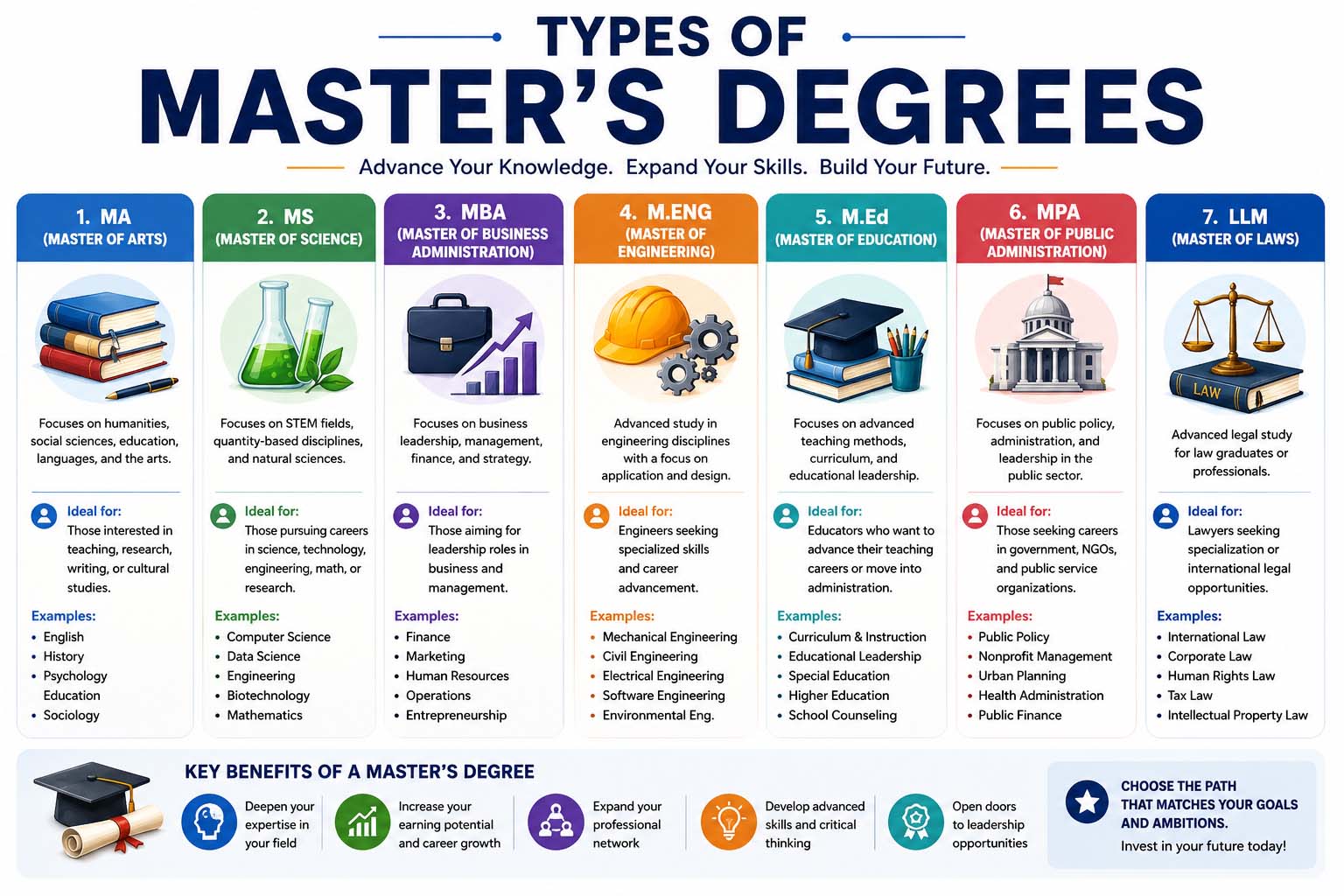
Types of Masters Degrees: A Complete Guide to Choosing the Right Graduate Program
If you’re planning to continue your education after earning a bachelor’s degree, understanding the types of masters degrees is one of the best places to start. Graduate programs are available in almost every academic field, from business and engineering to healthcare, education, and the arts. Choosing the right degree can help you develop specialized knowledge, qualify for advanced careers, or prepare for doctoral study.
Whether you’re a recent graduate or a working professional looking to advance your career, learning about the available master’s degrees will make your decision much easier.
What Is a Master’s Degree?
A master’s degree is a graduate-level academic qualification that students typically pursue after completing a bachelor’s degree. Most programs require one to three years of study, depending on the country, university, and subject area.
If you’re unfamiliar with graduate education, learning What Is a Master’s Degree? provides a helpful overview before comparing individual degree options.
Master’s programs usually combine coursework, research, practical projects, internships, or a final thesis. Some programs focus on professional skills, while others emphasize academic research.
Why Do Students Pursue a Master’s Degree?
People choose graduate education for many different reasons.
Some common goals include:
- Advancing their careers
- Qualifying for leadership positions
- Increasing earning potential
- Changing careers
- Developing specialized expertise
- Preparing for doctoral studies
- Meeting professional licensing requirements
For many industries, a master’s degree demonstrates advanced knowledge that employers value when hiring for senior or specialized roles.
What Types of Masters Degrees Are There?
One of the most common questions prospective students ask is, what types of masters degrees are there?
Although universities offer hundreds of specialized programs, most master’s degrees fall into a few broad categories based on the field of study and learning objectives.
Below are the most common options.
Master of Arts (MA)
A Master of Arts focuses primarily on humanities, social sciences, communication, and creative disciplines.
Popular MA subjects include:
- History
- English
- Political Science
- Sociology
- International Relations
- Communication
- Linguistics
Many MA programs encourage critical thinking, research, writing, and analytical skills.
Students interested in graduate school often compare undergraduate pathways first. Understanding the difference between ba and bs can make it easier to choose an academic foundation that aligns with future master’s programs.
Master of Science (MS)
The Master of Science emphasizes scientific, technical, and analytical subjects.
Common MS programs include:
- Computer Science
- Engineering
- Biology
- Chemistry
- Mathematics
- Data Science
- Cybersecurity
- Information Technology
MS programs often include laboratory work, research projects, data analysis, and technical coursework.
Graduates frequently pursue careers in research, technology, healthcare, manufacturing, and engineering.
Master of Business Administration (MBA)
The MBA is one of the world’s most recognized graduate business degrees.
Rather than specializing in a single technical discipline, MBA programs develop leadership, management, finance, operations, marketing, and strategic decision-making skills.
Typical MBA courses include:
- Accounting
- Finance
- Marketing
- Operations Management
- Business Analytics
- Leadership
- Organizational Behavior
Professionals considering management careers often explore the benefits of mba before deciding whether this degree aligns with their long-term goals.
Different Types of Masters Degrees by Academic Field
Universities offer graduate programs across nearly every discipline. While degree names differ, each program prepares students for specific careers or research areas.
Master of Education (MEd)
The Master of Education is designed for teachers, school administrators, instructional designers, and education professionals.
Students may specialize in:
- Curriculum development
- Educational leadership
- Special education
- Educational technology
- Literacy
- Higher education administration
An MEd can support career advancement in schools, colleges, nonprofit organizations, and educational consulting.
Master of Fine Arts (MFA)
The MFA is a professional graduate degree for creative disciplines.
Common areas include:
- Creative writing
- Graphic design
- Film production
- Theatre
- Photography
- Visual arts
- Performing arts
Unlike many academic degrees, MFA programs often focus on building professional portfolios alongside practical studio work.
Master of Public Administration (MPA)
Students interested in government, nonprofit organizations, and public policy often pursue a Master of Public Administration.
Typical coursework covers:
- Public finance
- Policy analysis
- Public management
- Organizational leadership
- Ethics
- Budget planning
Graduates commonly work in government agencies, charities, healthcare organizations, and international institutions.
Types of Nursing Masters Degrees
Healthcare continues to create strong demand for advanced qualifications, making types of nursing masters degrees an important area for many students.
Popular nursing master’s programs include:
- Master of Science in Nursing (MSN)
- Nurse Practitioner (NP)
- Clinical Nurse Leader (CNL)
- Nurse Educator
- Nursing Administration
- Public Health Nursing
Depending on the specialization, graduates may qualify for leadership positions, advanced clinical practice, teaching roles, or healthcare administration.
Because licensing requirements differ between countries and states, students should always verify local professional regulations before choosing a nursing specialization.
How to Choose the Right Master’s Degree
With so many options available, selecting the right graduate program requires careful planning.
Start by asking yourself a few practical questions:
- What career do I want?
- Which subjects genuinely interest me?
- Do I prefer research or practical learning?
- Will this degree improve my career opportunities?
- Does the profession require graduate education?
If you’re still deciding on your long-term career path, answering What Should I Major In during your undergraduate studies can make choosing a suitable master’s program much easier later.
Rather than selecting a program based only on salary, focus on finding one that matches both your interests and professional goals. Students who enjoy their field are often more motivated throughout graduate school and beyond.
Types of Psychology Masters Degrees
As a result, there are several types of psychology masters degrees, each designed for different career goals.
Some of the most common options include:
- Master of Arts in Psychology (MA)
- Master of Science in Psychology (MS)
- Clinical Psychology
- Counseling Psychology
- Industrial-Organizational Psychology
- Educational Psychology
- Forensic Psychology
- Developmental Psychology
- School Psychology
- Applied Behavior Analysis
Each specialization develops different skills. For example, industrial-organizational psychology focuses on workplace performance and employee behavior, while counseling psychology prepares students for careers that support mental health, depending on local licensing requirements.
Before applying, review each program’s curriculum to ensure it matches your career interests.
Master’s Degree Comparison
Choosing the right graduate degree becomes easier when you compare the purpose of each option.
| Degree | Typical Field | Main Focus | Common Careers |
|---|---|---|---|
| MA | Humanities and Social Sciences | Research, communication, theory | Writer, educator, policy analyst |
| MS | Science and Technology | Technical knowledge and research | Engineer, data analyst, scientist |
| MBA | Business | Leadership and management | Manager, consultant, executive |
| MEd | Education | Teaching and leadership | Teacher, principal, curriculum specialist |
| MFA | Creative Arts | Professional artistic practice | Designer, filmmaker, author |
| MPA | Public Service | Government and administration | Public administrator, nonprofit manager |
| MSN | Nursing | Advanced clinical practice | Nurse practitioner, nurse educator |
This comparison offers a starting point, but every university may organize its programs differently.
Master’s Degree vs. Doctorate
Many students wonder whether they should stop after earning a master’s degree or continue toward a doctorate.
A master’s degree usually focuses on advanced professional knowledge and specialized skills. A doctorate, on the other hand, emphasizes original research, academic expertise, or the highest level of professional practice.
Students planning long-term academic or research careers often explore the various types of doctorate degrees before deciding which educational pathway best supports their goals.
For many careers, however, a master’s degree provides all the qualifications needed for advancement.
How to Choose the Best Master’s Degree
The best graduate program depends on your personal goals rather than popularity or salary rankings.
Use this simple decision process:
Step 1: Define Your Career Goal
Think about the role you hope to have in five or ten years.
Ask yourself:
- Do I want to manage people?
- Do I enjoy research?
- Do I want to teach?
- Would I rather solve technical problems?
- Do I enjoy helping others directly?
Your answers will help narrow your options.
Step 2: Research Program Requirements
Each university sets its own admission standards.
Common requirements include:
- Bachelor’s degree
- Academic transcripts
- Letters of recommendation
- Statement of purpose
- Resume or CV
- English language proficiency (for international students)
- Entrance exams, if required
Review admission requirements carefully before applying.
Step 3: Compare Course Content
Degree titles may look similar, but course structures often differ between universities.
Read the curriculum to understand:
- Core subjects
- Elective options
- Internship opportunities
- Research requirements
- Thesis or project expectations
Choose the program that best matches your learning style and career plans.
Step 4: Consider Cost and Flexibility
Graduate education is a significant investment.
Compare factors such as:
- Tuition fees
- Scholarships
- Part-time study options
- Online learning
- Program length
- Internship opportunities
A lower-cost program with strong career outcomes may provide better overall value than a more expensive alternative.
Career Opportunities After a Master’s Degree
One reason students pursue graduate education is to expand their career options.
Depending on your specialization, careers may include:
- Business manager
- Software engineer
- Data scientist
- Teacher
- School administrator
- Marketing manager
- Healthcare administrator
- Nurse practitioner
- Public policy analyst
- Research scientist
- Human resources manager
- University lecturer
Many employers also value graduate education because it demonstrates commitment, problem-solving ability, and subject expertise.
Common Mistakes Students Make
Choosing a master’s degree without enough research can lead to disappointment later.
Here are a few mistakes to avoid.
Selecting a Program Based Only on Salary
High-paying careers aren’t always the best fit.
Choose a field that matches both your interests and long-term goals.
Ignoring Accreditation
Accredited universities generally offer qualifications that employers and professional organizations recognize.
Always verify accreditation before applying.
Overlooking Career Outcomes
Look beyond course descriptions.
Research graduate employment rates, internship opportunities, alumni success stories, and employer partnerships.
Not Considering Study Format
Many universities now offer:
- Full-time programs
- Part-time programs
- Online degrees
- Hybrid learning
Choose the format that works best for your schedule and responsibilities.
Frequently Asked Questions
How many types of master’s degrees are there?
There are hundreds of specialized master’s programs worldwide. The most common categories include Master of Arts (MA), Master of Science (MS), Master of Business Administration (MBA), Master of Education (MEd), Master of Fine Arts (MFA), Master of Public Administration (MPA), and Master of Science in Nursing (MSN).
Which master’s degree is best?
There isn’t a single “best” option. The right degree depends on your career goals, academic interests, and the industry you want to enter.
Can I earn a master’s degree in a different field from my bachelor’s?
Yes. Many universities accept students from different academic backgrounds, although some programs require prerequisite courses or related work experience.
How long does a master’s degree take?
Most master’s programs take between one and three years to complete, depending on the country, university, study format, and subject.
Is a master’s degree worth it?
For many careers, a master’s degree improves professional knowledge, opens new job opportunities, and may increase earning potential. Whether it’s worthwhile depends on your career plans and the requirements of your chosen profession.
Take the Next Step with Confidence
Exploring the types of masters degrees is an excellent way to plan your future education. From business and healthcare to psychology, engineering, and the arts, graduate programs allow students to build specialized skills that support personal growth and career advancement.
Take time to compare universities, review course content, and think about where you want your education to lead. A carefully chosen master’s degree can provide valuable knowledge, practical experience, and opportunities that continue long after graduation.