
Types of Pencil Grips: A Guide to Handwriting Grasp Development
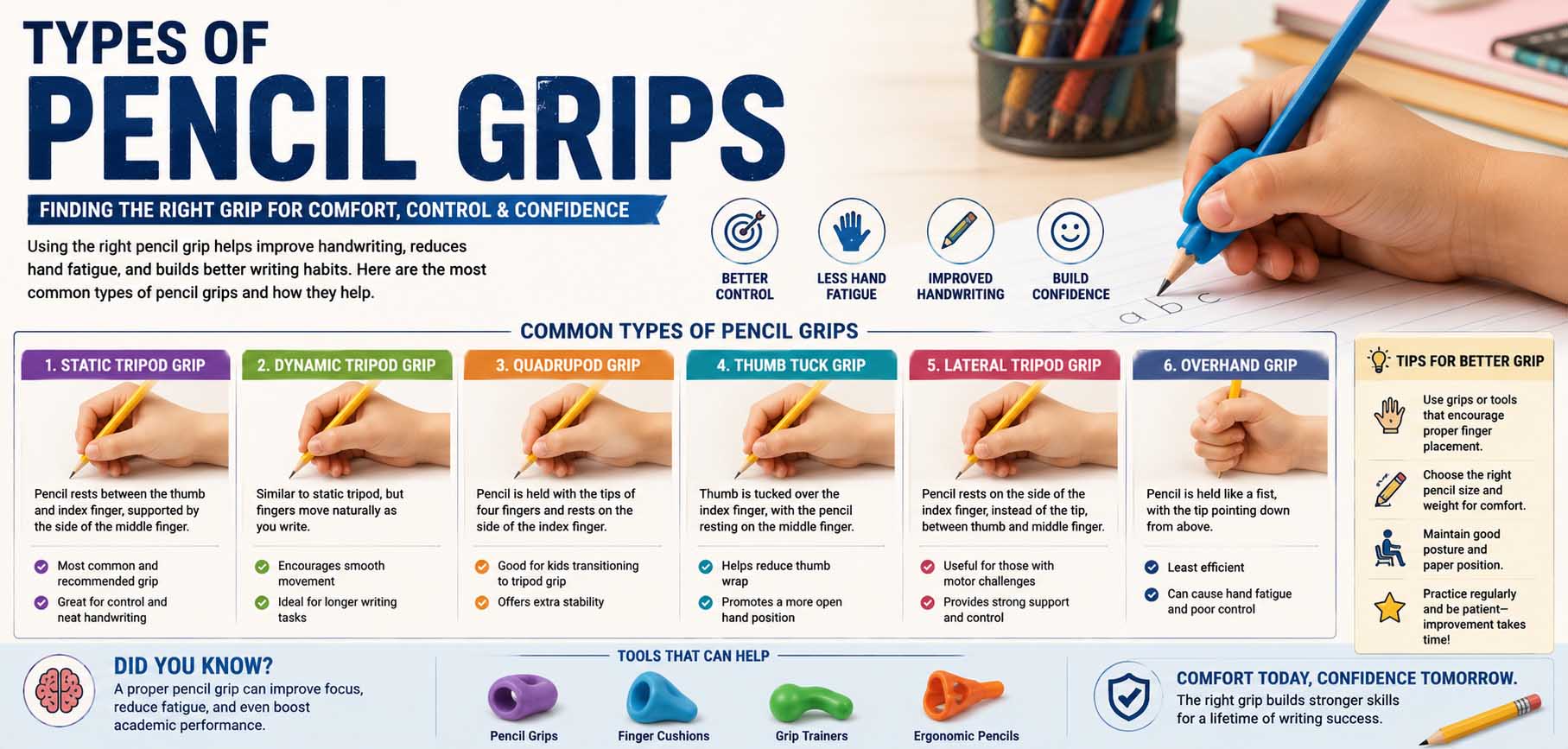
Types of Pencil Grips: A Guide to Handwriting Grasp Development
Watch a group of children draw or write, and you will quickly notice that their hands do not all look the same. The types of pencil grips children use can change with age, practice, hand development, and the demands of a writing task. Young children commonly hold crayons with their whole hand, while older children usually develop more refined finger control. Yet there is not one perfect pencil grip that every student must use.
Parents and teachers often focus on whether a grip looks “correct.” However, comfort, control, efficiency, legibility, and fatigue usually provide more useful information. A grip that looks slightly unusual may still work perfectly well for a student.
What Is a Pencil Grip?
A pencil grip, also called a pencil grasp, describes how the fingers and hand hold and control a pencil, crayon, marker, or similar writing tool.
Children do not usually begin with the mature tripod grasp seen in many handwriting examples. Instead, their grasp develops as their hand strength, coordination, finger control, and experience with drawing and writing improve.
Early grips rely heavily on movement from the shoulder and arm. Later, children generally gain greater control through the wrist, hand, and fingers.
Understanding the Muscles of the Arm can provide useful background because handwriting is not produced by the fingers alone. The shoulder, arm, forearm, wrist, hand, and fingers work together to stabilize and move a writing tool.
Types of Pencil Grips by Developmental Stage
Pencil-grasp development often progresses from whole-hand patterns toward more refined finger movements. However, children develop at different rates, so these stages work better as general patterns than strict deadlines.
| Pencil Grip | General Pattern | Main Movement |
|---|---|---|
| Palmar supinate grasp | Pencil held in a fist | Shoulder and arm |
| Digital pronate grasp | Fingers hold pencil with palm facing downward | Arm and shoulder |
| Static tripod grasp | Three fingers position pencil | Wrist and hand |
| Dynamic tripod grasp | Thumb, index, and middle fingers control pencil | Fingers |
| Dynamic quadrupod grasp | Four fingers help stabilize and control pencil | Fingers |
Other variations also occur. Therefore, this table should not label every alternative grip as incorrect.
Palmar Supinate Pencil Grasp
The palmar supinate grasp is an early pencil-holding pattern. A young child wraps the entire hand around the crayon or pencil, almost like making a fist.
The writing tool usually extends from the little-finger side of the hand. Meanwhile, movement comes mainly from the shoulder and arm rather than small finger movements.
This grip commonly appears when toddlers first experiment with scribbling.
At this stage, drawing large lines, circles, and marks is more useful than demanding precise letter formation. Large crayons and plenty of opportunities to draw can support early exploration.
Digital Pronate Pencil Grip
As control develops, children may move toward a digital pronate grasp.
Here, the fingers hold the writing tool rather than the entire fist. However, the palm often faces downward, and movement still comes largely from the arm.
This pattern represents growing control even though it does not resemble an adult handwriting grasp.
Therefore, parents usually do not need to repeatedly reposition a young child’s fingers simply because the grip looks immature. Practice with age-appropriate drawing and fine-motor activities allows grasp patterns to develop naturally for many children.
Static Tripod Pencil Grip
The static tripod is a more advanced grasp. The child typically holds the pencil using the thumb, index finger, and middle finger.
However, the fingers remain relatively still. As a result, movement may come mainly from the wrist or forearm.
This grasp often appears as children move toward more refined handwriting control.
The word “static” does not mean the grip is bad. Instead, it describes how the fingers contribute relatively little movement compared with a mature dynamic grasp.
Dynamic Tripod Pencil Grip
The dynamic tripod grasp is probably the best-known handwriting position.
In this grip, the thumb and index finger control the pencil while it rests against the middle finger. Meanwhile, the ring and little fingers help stabilize the hand against the writing surface.
The fingers make small, controlled movements while the hand moves across the page.
Many students find this grasp efficient. Still, teachers and parents should not treat it as the only acceptable way to hold a pencil.
When students progress from basic letter formation to connected handwriting, efficient finger movement can become especially helpful. A guide on How to Write Cursive can build on these skills by showing how controlled strokes connect letters smoothly across the page.
Dynamic Quadrupod Pencil Grip
A dynamic quadrupod grasp uses four fingers rather than three.
Typically, the thumb, index, middle, and ring fingers participate in holding or stabilizing the pencil. The little finger provides support against the writing surface.
Although this grip looks different from the traditional tripod, it can still function effectively.
If a student writes clearly, maintains a reasonable pace, and experiences no discomfort or excessive fatigue, changing a functional quadrupod grip may offer little benefit.
Different Types of Pencil Grips That Can Still Work
The different types of pencil grips seen in classrooms do not fit perfectly into a single developmental chart.
Some writers use a lateral tripod, for example. In this pattern, the thumb may cross over or rest against the index finger rather than remaining opposite it.
Others use a lateral quadrupod grasp.
These positions may look unconventional, yet appearance alone does not determine handwriting quality.
A useful grip generally allows the writer to control the pencil, see what they are writing, move across the page efficiently, and write without unnecessary pain or fatigue.
Therefore, teachers and parents should look at function before attempting to correct every variation.
Types of Pencil Grips for Handwriting
When evaluating types of pencil grips for handwriting, consider the entire writing task rather than the finger position alone.
Ask a few practical questions:
- Is the handwriting reasonably legible for the student’s age and experience?
- Can the student write without pain?
- Does the hand become tired unusually quickly?
- Is pencil pressure extremely heavy or very light?
- Can the student keep up with appropriate classroom writing tasks?
- Does the grip restrict finger movement?
- Does the student frequently drop or lose control of the pencil?
One isolated issue does not necessarily indicate a problem. However, several persistent difficulties may suggest that the student needs more support.
Pencil Grip Development in Early Learning
Writing development does not happen separately from other early academic skills. Young learners often develop letter recognition, sound awareness, drawing ability, hand control, and early writing at the same time.
For example, activities used in phonics for kindergarten may include tracing, labeling pictures, forming letters, or writing simple words. These tasks give children repeated opportunities to practice controlling writing tools while also building literacy skills.
However, worksheets should not provide the only fine-motor activity.
Building with blocks, manipulating play dough, using child-safe tongs, drawing on vertical surfaces, completing puzzles, and handling small classroom materials can provide varied opportunities to use the hands.
Pencil Grips and Occupational Therapy
When occupational therapy professionals evaluate a student’s pencil grasp, function is usually more meaningful than whether the grip matches a textbook picture.
An occupational therapist may observe posture, shoulder stability, hand strength, bilateral coordination, finger movement, pencil pressure, endurance, speed, and the student’s ability to complete everyday school tasks.
They may also consider the desk and chair setup.
For example, poor seating can make handwriting harder even when the fingers hold the pencil effectively. Stable feet and an appropriate working height can help provide a better base for hand movement.
The American Occupational Therapy Association’s school-based occupational therapy resources provide further information about occupational therapy’s role in supporting students and participation in school activities.
An occupational therapist can then determine whether intervention is appropriate and recommend strategies based on the individual student’s needs.
When a Pencil Grip May Be Inefficient
A grip deserves closer attention when it interferes with writing rather than simply looking different.
For example, a student may squeeze the pencil so tightly that the fingers hurt. Another student may wrap several fingers around the pencil and restrict movement so much that writing becomes slow and tiring.
Possible signs of difficulty include:
- Hand pain during writing
- Frequent complaints of fatigue
- Very heavy pencil pressure
- Consistently poor control
- Difficulty completing age-appropriate written work
- Excessively slow writing
- Avoidance of drawing or handwriting
- An unusual grasp combined with other fine-motor difficulties
Teachers can observe patterns across several tasks before drawing conclusions.
Meanwhile, parents who notice persistent problems can discuss them with the child’s teacher, pediatric healthcare professional, or occupational therapist as appropriate.
Should You Correct a Child’s Pencil Grip?
Not automatically.
If a young child uses a developmentally expected grasp, repeatedly forcing the fingers into a mature tripod position may create frustration without improving writing.
Likewise, an older student with an unconventional but comfortable and efficient grip may not need correction.
Instead, intervene when the grip clearly contributes to pain, fatigue, poor control, or difficulty participating in schoolwork.
Gentle cues often work better than constant correction. For instance, teachers can demonstrate an efficient position, offer shorter writing tools, or try an appropriate pencil-grip aid when there is a clear reason.
Pencil Grip Aids: Are They Necessary?
Commercial pencil grips slide onto pencils and provide shaped areas for the fingers.
Some students find them helpful because they offer tactile guidance. However, a grip aid is a tool rather than a universal solution.
Before buying one, identify the problem you are trying to solve.
If the issue comes from posture, hand weakness, motor coordination, or an unsuitable writing task, simply adding a rubber grip may not address the underlying difficulty.
Different grip aids also suit different hands and goals. Therefore, occupational therapy guidance can be useful when a student has persistent handwriting difficulties.
Ways to Support Better Pencil Grip and Control
Students can develop writing control through ordinary activities rather than endless handwriting drills.
Short pencils or broken crayons can sometimes encourage finger-based control because there is less space for the whole hand to wrap around the tool.
Drawing on an easel or vertical surface may also encourage useful wrist positioning and shoulder stability.
Meanwhile, activities involving tweezers, beads, construction toys, clay, and cutting with age-appropriate scissors can build broader fine-motor experience.
Writing practice still matters, though. Keep sessions manageable, especially for beginners, and focus on comfortable repetition rather than long periods of forced practice.
Common Pencil Grip Mistakes Adults Make
One common mistake is assuming every child must use a perfect tripod grasp.
Another is comparing children solely by age. Development varies, so handwriting ability, comfort, and overall fine-motor function provide better context.
Adults may also focus intensely on the fingers while ignoring posture. Yet a poorly positioned chair, dangling feet, or an unsuitable desk height can affect the entire writing process.
Finally, changing a functional grip without a clear reason can temporarily make handwriting harder. Therefore, decide what problem needs solving before attempting to modify an established grasp.
FAQs About Types of Pencil Grips
What Is the Best Pencil Grip?
The dynamic tripod is commonly taught and can be very efficient. However, other grips, including a dynamic quadrupod, can also support effective handwriting.
At What Age Should a Child Use a Mature Pencil Grip?
Pencil grasp generally becomes more refined through the preschool and early school years, but development varies.
Is a Four-Finger Pencil Grip Wrong?
No. A four-finger or quadrupod grasp can be functional when the writer has good control, comfort, endurance, and handwriting performance.
Why Does My Child Hold the Pencil So Tightly?
A child may use excessive pressure for several reasons, including habit, motor-control challenges, or an attempt to gain stability. If tight gripping causes pain, fatigue, or significant writing difficulty, consider discussing it with an appropriate professional.
Can Pencil Grips Improve Handwriting?
A pencil-grip aid can help some students position their fingers, but it does not automatically improve handwriting. Letter formation, practice, posture, motor skills, and writing experience also influence performance.
Focus on Comfortable, Functional Pencil Grips
The various types of grips when holding a pencil show that handwriting development is more flexible than a single “correct grip” diagram suggests. Early whole-hand grasps often become more refined as children gain coordination, while mature writers may use tripod, quadrupod, or other functional variations.
Therefore, focus first on what the student can do. A useful grip should support comfortable, controlled, reasonably efficient writing without unnecessary pain or fatigue.
If handwriting remains difficult despite practice and classroom support, seek individualized guidance rather than repeatedly forcing a particular finger position. The goal is not a picture-perfect grasp. Instead, the goal is a writing method that helps the learner communicate confidently and comfortably.