
Prosody in Reading: Meaning, Examples, and Ways to Improve Fluency
Prosody in Reading: Meaning, Examples, and Ways to Improve Fluency
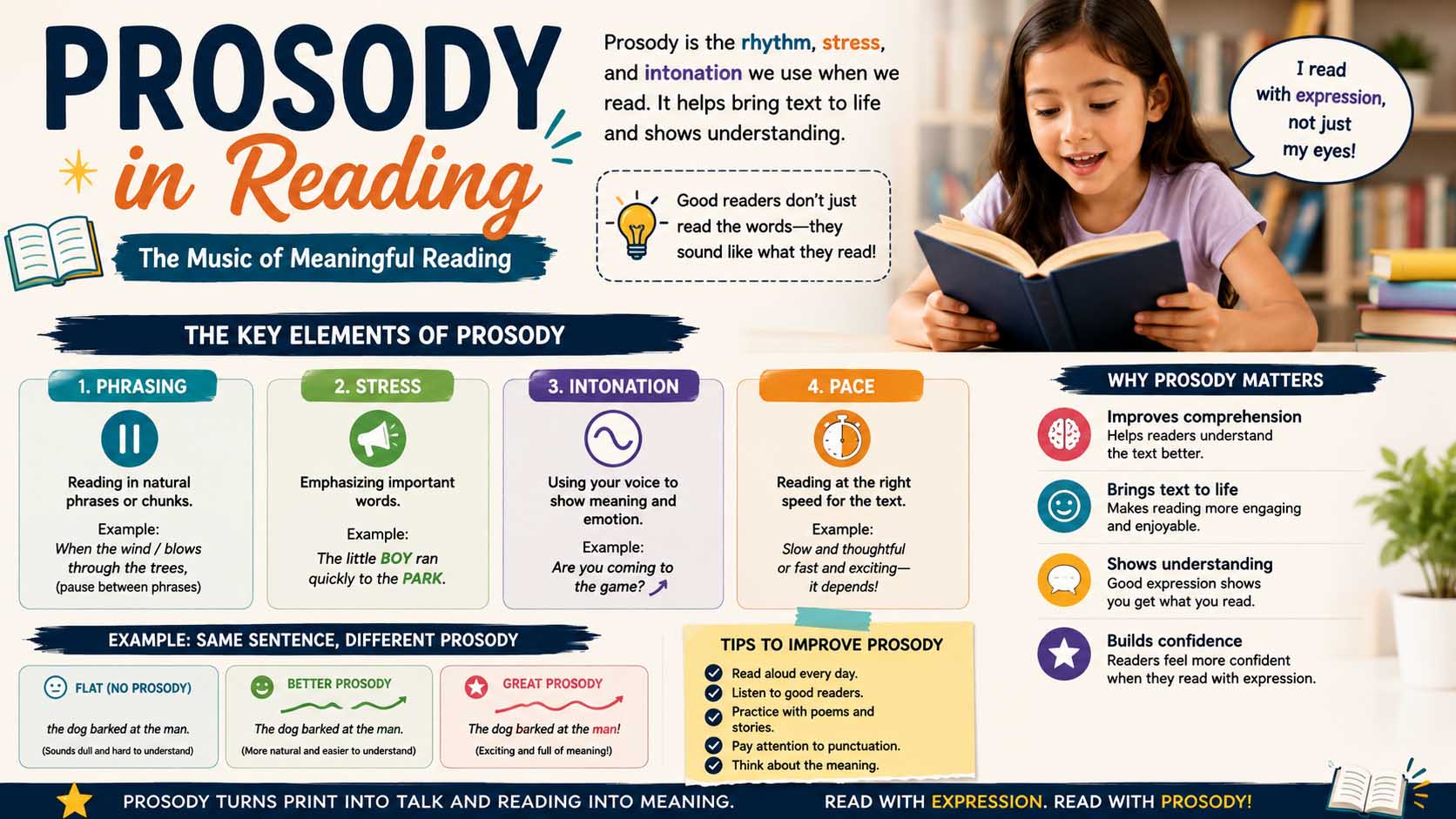
Have you ever heard someone read every word correctly but still sound flat or robotic? The missing skill may be prosody in reading, which refers to the rhythm, expression, phrasing, stress, and intonation a reader uses when reading aloud. Good prosody makes spoken reading sound more like natural conversation while also showing that the reader recognizes how words and ideas fit together.
Prosody is closely connected with reading fluency. However, it is not simply about reading quickly. A fluent reader needs accuracy, an appropriate rate, and meaningful expression. Therefore, understanding prosody can help teachers, parents, and students move beyond counting correct words and focus on how reading communicates meaning.
What Is Prosody in Reading?
If you are asking what is prosody in reading, think about how your voice changes during a normal conversation. You pause between ideas, emphasize certain words, raise or lower your pitch, and adjust your tone according to meaning.
Readers use many of those same features when reading aloud.
For example, compare these two ways of reading:
“You ate the last cookie?”
“You ate the last cookie!”
The words are nearly identical, yet punctuation and vocal expression change the meaning. In the first sentence, the speaker may sound surprised or questioning. Meanwhile, the second may communicate excitement, shock, or frustration depending on the context.
Prosody helps listeners hear those differences.
Among the many types of reading, oral reading makes prosody particularly noticeable because teachers can hear how students group words and respond to punctuation.
Prosody Definition in Reading: The Main Elements
A useful prosody definition in reading includes several connected features rather than one single skill.
These features include:
| Element | What It Means | Simple Example |
|---|---|---|
| Expression | Using the voice to reflect meaning or emotion | Sounding excited during an exciting scene |
| Phrasing | Grouping words into meaningful units | Pausing naturally between clauses |
| Intonation | Raising and lowering the voice | Raising pitch for some questions |
| Stress | Giving certain words extra emphasis | Stressing really in “I really like it” |
| Rhythm | Creating a natural flow across words and sentences | Avoiding a word-by-word pattern |
| Pausing | Stopping appropriately | Pausing at a period or between ideas |
| Rate | Reading at a suitable pace | Slowing down for difficult or dramatic text |
These elements work together. As a result, strong prosody usually sounds natural rather than exaggerated or mechanical.
Why Prosody in Reading Matters
Prosody in reading matters because fluent reading is not only about identifying printed words. Readers also need to organize those words into meaningful phrases and sentences.
Consider this sentence:
After finishing her homework, Maya went outside to play.
A developing reader might pause after every few words without considering meaning.
A more fluent reader is likely to phrase it naturally:
After finishing her homework, / Maya went outside to play.
The second version makes the sentence easier to understand because the phrasing reflects its grammatical structure.
Therefore, prosody can provide teachers with useful information about whether a student is moving beyond laborious word-by-word reading. For additional guidance on fluency instruction, Reading Rockets explains fluency instruction and oral reading practice.
What Is Prosody in Reading Fluency?
The question what is prosody in reading fluency highlights an important distinction: fluency includes more than speed.
Reading fluency is commonly understood in terms of accurate word reading, appropriate rate, and expression or prosody. These parts support one another.
When students struggle to identify words, much of their attention goes toward decoding. Consequently, they may have fewer mental resources available for natural phrasing and expression.
This is why foundational instruction still matters. Effective phonics for reading helps learners build accurate word-reading skills, which can support increasingly automatic and fluent reading as they gain practice.
However, accurate decoding does not automatically guarantee expressive reading. Students also benefit from hearing fluent models and practicing connected text.
Prosody Meaning in Reading and Comprehension
The prosody meaning in reading becomes especially clear when we consider comprehension.
A reader who understands a sentence is more likely to know where one meaningful phrase ends and another begins. Likewise, understanding a character’s emotions can influence tone and emphasis during oral reading.
At the same time, appropriate phrasing may support understanding because it organizes words into meaningful units.
For example:
The teacher said the student was ready.
Now consider:
The teacher said, “The student was ready.”
Punctuation and phrasing help readers understand how ideas relate to one another.
Still, prosody should not be treated as proof of complete comprehension. A student can sometimes imitate expressive reading without fully understanding a passage. Therefore, teachers should pair fluency observations with questions, discussion, retelling, or other comprehension checks.
How Prosody Develops
Prosody develops gradually as several reading and language skills become stronger.
Before children read independently, they already hear rhythm, stress, and intonation in spoken language. Songs, rhymes, storytelling, and everyday conversation expose them to these patterns.
Early sound awareness also supports literacy development. Parents who wonder what is phonological awareness can think of it as a broad ability to notice and work with the sound structure of spoken language, including words, syllables, rhymes, and individual speech sounds.
As children begin reading, they learn letter-sound relationships and practice decoding words. With repeated successful reading, word recognition generally becomes more efficient.
Then, as readers encounter sentences and longer passages, they gain experience using punctuation, syntax, meaning, and context to phrase text naturally.
What Does Good Reading Prosody Sound Like?
Good prosody does not mean turning every reading task into a dramatic performance.
Instead, it should fit the text.
When reading an informational passage, a fluent reader may use a steady, clear voice while emphasizing key information. Meanwhile, a story with dialogue may call for greater variation in tone.
Good prosody usually includes:
- Meaningful groups of words rather than isolated words
- Appropriate pauses
- Changes in pitch when the text calls for them
- Emphasis on meaningful words
- A comfortable reading rate
- Expression that matches the text
- Attention to punctuation
However, teachers should remember that speaking styles vary. Therefore, prosody assessment should focus on whether oral reading supports meaning rather than expecting every student to sound identical.
Signs a Student May Need Support With Prosody
Some students read accurately but still need help developing fluent expression.
Possible signs include:
- Reading one word at a time
- Using the same tone throughout a passage
- Ignoring punctuation
- Pausing in unusual places
- Reading excessively fast
- Reading so slowly that meaning becomes difficult to follow
- Giving equal emphasis to nearly every word
- Struggling to group words into meaningful phrases
However, the reason behind weak prosody matters.
A student who frequently misreads words may primarily need support with decoding rather than an expression lesson. Likewise, text that is too difficult can make normally fluent readers sound hesitant.
For that reason, educators often consider factors such as accuracy and reading levels by grade when selecting material, while recognizing that grade-level expectations are guides rather than complete descriptions of an individual student’s ability.
Practical Ways to Improve Prosody in Reading
Prosody improves through instruction, modeling, and meaningful practice. Simply telling a child to “read with expression” may not explain what to do differently.
Model Fluent Reading
First, let students hear strong examples.
A teacher or parent can read a short passage aloud while demonstrating natural phrasing, appropriate pauses, and changes in tone.
Afterward, ask what the listener noticed. For instance, students might identify where the reader paused or which word received extra emphasis.
Use Echo Reading
During echo reading, an adult or fluent reader reads a short phrase or sentence first. Then, the learner repeats it while trying to match the model’s phrasing and expression.
This method gives students an immediate example rather than requiring them to interpret a vague instruction such as “sound smoother.”
Try Choral Reading
During choral reading, a group reads the same text aloud together.
Because less confident readers have support from the group, they can practice pacing and phrasing without feeling individually exposed.
Short poems, speeches, and rhythmic texts can work particularly well.
Practice Repeated Reading
Reading an appropriate passage several times can improve familiarity with the words and sentence structure.
On the first reading, a student may focus heavily on identifying words. By a later reading, the student may have enough familiarity to pay greater attention to expression and phrasing.
However, repeated reading should have a clear purpose. Endless repetition can become frustrating, so teachers should keep practice focused and manageable.
Using Punctuation to Teach Prosody
Punctuation gives readers useful clues about phrasing.
A period signals the end of a sentence, while commas can indicate boundaries within sentences. Question marks and exclamation points also provide information about how a sentence may sound.
Teachers can take a short passage and mark natural phrase boundaries with slashes. Then, students can practice reading the marked version before trying the original text again.
For example:
Before the rain started, / we carried the chairs inside.
This technique makes invisible phrasing decisions visible to beginners.
Later, students can learn to identify phrase boundaries independently.
Prosody at Different Stages of Reading Development
Children do not all develop reading skills at exactly the same age or pace. Therefore, expectations for expressive reading should match the learner’s current stage.
Parents asking when do kids start reading should remember that early literacy develops over time. Children may begin by recognizing print, playing with sounds, learning letter-sound relationships, and decoding simple words before they can read connected text fluently.
As students become more accurate readers, instruction can place greater emphasis on phrasing and expression.
Older students can still benefit from prosody work, especially when reading complex academic texts, poetry, drama, or speeches. In these cases, phrasing can help students interpret complicated syntax and meaning.
Common Mistakes When Teaching Prosody
One common mistake is telling students to read faster. Speed alone does not create fluency, and excessive speed can actually reduce clarity.
Another mistake is focusing only on dramatic expression. Good prosody can be subtle, particularly in informational texts.
Teachers should also avoid practicing with material that is far beyond the student’s current word-reading ability. If almost every sentence contains difficult words, the learner will naturally struggle to read smoothly.
Finally, prosody should not replace comprehension instruction. Expressive oral reading is valuable, yet students still need vocabulary, background knowledge, and opportunities to discuss and understand what they read.
Frequently Asked Questions
Is prosody the same as fluency?
No. Prosody is a major feature of fluent reading, but fluency also includes accurate word reading and an appropriate rate.
Can prosody improve reading comprehension?
Prosody and comprehension are closely related. Appropriate phrasing can help organize text into meaningful units, while understanding a passage can help a reader choose suitable expression. However, prosody alone does not guarantee comprehension.
How can teachers assess reading prosody?
Teachers can listen to oral reading and observe phrasing, expression, smoothness, pauses, and attention to punctuation. Some schools also use structured fluency rubrics.
Does silent reading have prosody?
Research suggests readers may represent aspects of phrasing and rhythm internally during silent reading, although prosody is much easier to observe during oral reading.
Should students practice prosody every day?
Short, regular opportunities to hear and practice fluent reading can be useful. However, the amount of practice should depend on the learner’s needs and should remain balanced with decoding, vocabulary, comprehension, and meaningful reading.
Helping Reading Sound Meaningful
Strong prosody in reading develops when students can recognize words accurately while also understanding how language fits together. Instead of treating expression as a performance skill, teachers and parents can show learners how phrasing, pauses, stress, rhythm, and intonation communicate meaning.
Start with manageable text, model natural reading, and provide short opportunities for echo, choral, or repeated reading. Then, as word recognition becomes more automatic, encourage students to focus increasingly on how the text should sound and what it means. Over time, those small shifts can help oral reading become smoother, clearer, and more connected to genuine understanding.