
How to Find the Average: A Simple Step-by-Step Guide
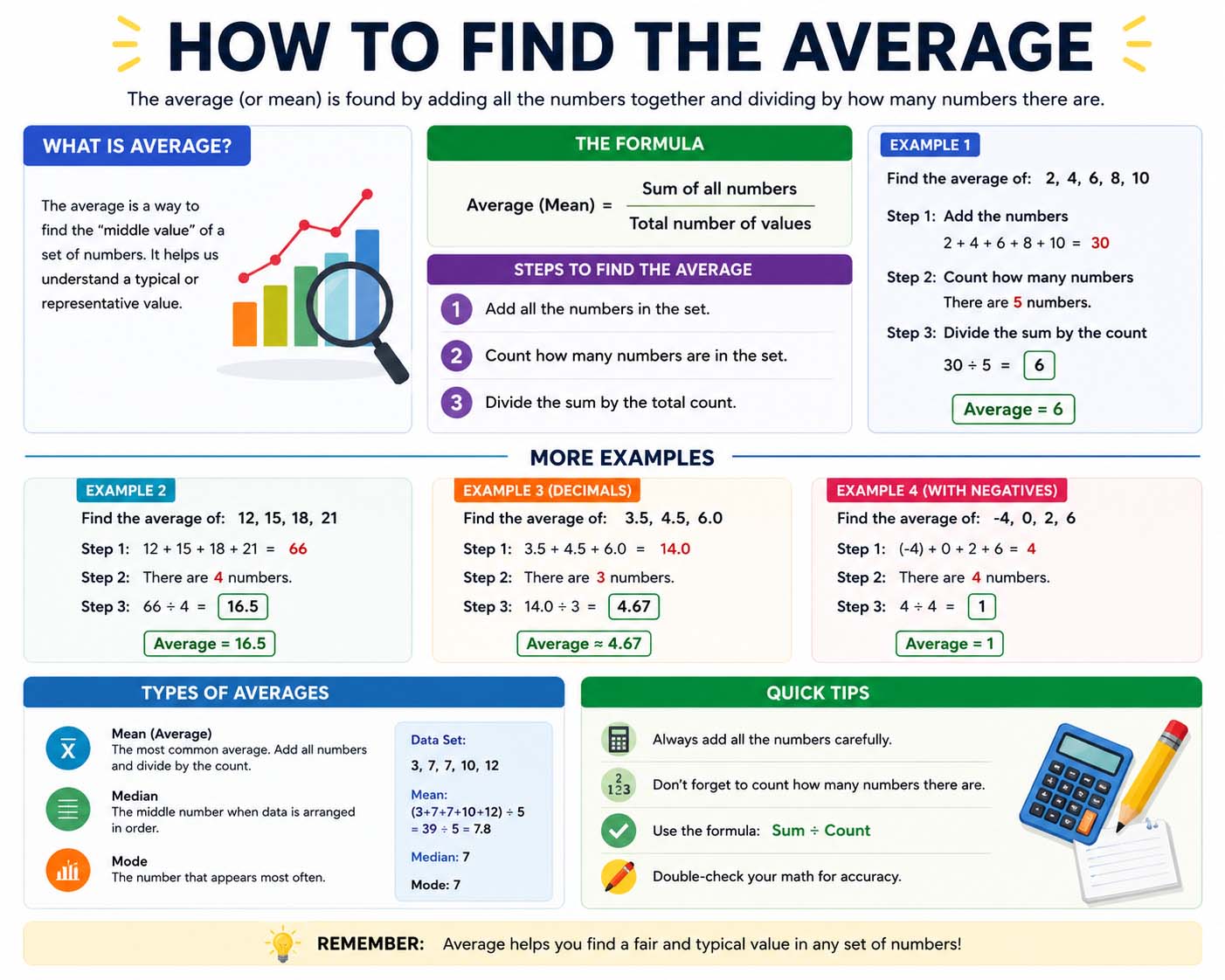
How to Find the Average: A Simple Step-by-Step Guide
If you’ve ever wondered how teachers calculate class grades or how sports statistics are compared, you’ve already come across averages. Learning how to find the average is one of the most useful math skills because it appears in school, science, business, sports, and everyday life.
Fortunately, finding an average is usually simple. Once you understand the formula, you can solve many different types of problems with confidence.
This guide explains what an average means, how to calculate it, and how to apply the formula to real-world situations. In addition, you’ll find beginner-friendly examples, practice questions, and common mistakes to avoid.
What Is an Average and How Do You Find It?
In simple terms, an average is a single number that represents a group of values.
In fact, the most common type of average is the arithmetic mean. It describes the value you would get if you distributed the total equally across all observations.
For example, imagine you received these test scores:
- 80
- 85
- 90
Instead of examining each score separately, you can calculate the mean to understand your overall performance.
First, add the scores:
80 + 85 + 90 = 255
Then, divide by the number of scores:
255 ÷ 3 = 85
Therefore, your average score is 85.
However, remember that an average does not always describe every individual value accurately, especially when the numbers vary widely.
How to Find the Average Using the Basic Formula
The formula for calculating the arithmetic mean is straightforward:
Average = Sum of all numbers ÷ Number of values
You can also write it mathematically:
Average = Total ÷ Count
For example, suppose your numbers are 10, 20, and 30.
First, calculate the sum:
10 + 20 + 30 = 60
Next, count the values:
There are three numbers.
Finally, divide:
60 ÷ 3 = 20
Average = 20
This formula works for positive numbers, negative numbers, decimals, and fractions.
However, the values should represent comparable quantities when you want the result to have a useful real-world meaning.
How to Find the Average of Numbers Step by Step
If you’re learning to calculate the mean of several numbers, follow this simple process.
Imagine you received these four test scores:
- 72
- 84
- 90
- 94
Step 1: Find the Sum of the Numbers
First, find the total:
72 + 84 + 90 + 94 = 340
Therefore, the sum is 340.
Step 2: Count the Values
Next, count how many numbers appear in the list.
There are four test scores.
Step 3: Calculate the Average
Finally, divide the sum by four:
340 ÷ 4 = 85
Average = 85
As a result, your mean test score is 85.
Step 4: Check Your Answer
You can estimate whether your result makes sense.
For example, the scores range from 72 to 94. Therefore, an average of 85 is reasonable.
For a nonempty set of numbers, the arithmetic mean must lie between the smallest and largest values.
How to Find the Average: Calculation Examples
The following table shows several examples using the same formula.
| Numbers | Total | Divide By | Average |
|---|---|---|---|
| 5, 10, 15 | 30 | 3 | 10 |
| 12, 18, 24 | 54 | 3 | 18 |
| 8, 14, 20, 22 | 64 | 4 | 16 |
| 40, 50, 60, 70 | 220 | 4 | 55 |
Although the numbers differ, the calculation process remains the same.
First, find the total. Then, divide by the number of values.
How to Find the Average of 3 Numbers
Finding the mean of three numbers requires exactly the same formula.
For example, consider these values:
- 16
- 22
- 35
Step 1: Add the Three Values
First, calculate the total:
16 + 22 + 35 = 73
Step 2: Divide by Three
Next, divide the total by three:
73 ÷ 3 = 24.333…
Therefore, the exact mean is 24⅓.
If you round to two decimal places, the answer becomes 24.33.
When your calculation produces a repeating decimal, learning how to round to the nearest hundredth can help you present the answer correctly.
However, always follow your teacher’s rounding instructions.
How to Find the Average in Everyday Life
You can use averages for much more than school assignments.
For example, suppose you record your daily steps over five days.
| Day | Steps |
|---|---|
| Monday | 5,000 |
| Tuesday | 6,000 |
| Wednesday | 7,000 |
| Thursday | 8,000 |
| Friday | 9,000 |
First, add the daily totals:
5,000 + 6,000 + 7,000 + 8,000 + 9,000 = 35,000
Next, divide by five:
35,000 ÷ 5 = 7,000
Therefore, your average daily step count is 7,000 steps.
You can apply this method to many everyday measurements, including:
- Daily temperatures
- Monthly expenses
- Test scores
- Travel distances
- Weekly allowances
- Exercise records
However, make sure you count every observation included in the calculation.
Practice Problems: How to Find the Average
For this reason, practice helps you remember the formula and avoid calculation mistakes.
Therefore, try solving these examples before checking the answers.
Example 1: Finding the Average of Three Numbers
Find the mean of:
8, 10, 12
First, add the numbers:
8 + 10 + 12 = 30
Then, divide by three:
30 ÷ 3 = 10
Answer: 10
Example 2: Finding the Average of Four Numbers
Find the mean of:
15, 25, 35, 45
First, calculate the sum:
15 + 25 + 35 + 45 = 120
Next, divide by four:
120 ÷ 4 = 30
Answer: 30
Example 3: Finding the Average of Five Numbers
Find the mean of:
100, 95, 90, 85, 80
First, add the values:
100 + 95 + 90 + 85 + 80 = 450
Then, divide by five:
450 ÷ 5 = 90
Answer: 90
As you practice, try checking each result through estimation.
How to Find the Average Rate of Change
Average rate of change is a related mathematical concept, but it uses a different formula from the arithmetic mean.
Instead of finding the typical value of a data set, it measures how much one quantity changes relative to another.
For example, you might calculate how quickly distance changes over time.
Understanding what is a unit rate can help you interpret these calculations.
Average Rate of Change Formula
The formula is:
Average Rate of Change = Change in Output ÷ Change in Input
Using coordinates, you can write:
Average Rate of Change = (y₂ − y₁) ÷ (x₂ − x₁)
Here:
- x₁ represents the starting input.
- x₂ represents the ending input.
- y₁ represents the starting output.
- y₂ represents the ending output.
However, the two input values must differ because division by zero is undefined.
Example: Finding Average Speed
Suppose a car’s distance readings show:
- 120 miles after 2 hours
- 300 miles after 5 hours
First, calculate the change in distance:
300 − 120 = 180 miles
Next, calculate the change in time:
5 − 2 = 3 hours
Then, divide:
180 ÷ 3 = 60
Average rate of change = 60 miles per hour
Therefore, the car traveled an average of 60 miles per hour during that three-hour interval.
How Average Rate of Change Relates to Slope
In algebra, the average rate of change between two points equals the slope of the secant line connecting those points on a graph.
For example, a positive result means the output increases as the input increases.
On the other hand, a negative result means the output decreases over the interval.
Therefore, average rate of change helps students understand graphs, functions, and real-world relationships.
Common Uses of Averages in Different Subjects
For example, average calculations appear across education, science, business, and everyday decision-making.
Mathematics and Statistics
Students calculate means when solving:
- Homework problems
- Data analysis exercises
- Statistical comparisons
- Word problems
For additional explanations of arithmetic means and related statistical concepts, Khan Academy offers statistics and probability lessons.
Science
Scientists often calculate the mean of repeated measurements.
For example, a student might measure the temperature of a liquid several times and calculate the average.
However, averaging measurements does not automatically eliminate systematic measurement errors.
Therefore, scientists also consider accuracy, variability, and experimental conditions.
Business and Finance
Businesses calculate averages to understand:
- Daily sales
- Monthly expenses
- Customer spending
- Employee productivity
- Inventory costs
For example, a store could calculate its average daily sales over a week.
However, measuring growth requires a different calculation, such as determining the percentage increase between two periods.
Sports
Sports statistics frequently use averages.
For example:
- Points per game
- Average running speed
- Batting averages
- Average assists
- Average distance traveled
However, different sports may define their statistics differently.
Therefore, always check which formula applies.
Everyday Activities
People use averages when:
- Comparing prices
- Planning budgets
- Tracking exercise
- Reviewing utility bills
- Calculating travel times
As a result, understanding the arithmetic mean can help you make sense of everyday information.
Average vs. Median vs. Mode
Although people often use the word “average” to mean the arithmetic mean, statistics includes several ways to describe the center of a data set.
The three common measures are mean, median, and mode.
| Term | Meaning |
|---|---|
| Mean | Add the values and divide by their count |
| Median | Find the middle value after sorting the numbers |
| Mode | Identify the value that occurs most frequently |
For example, consider this data set:
2, 4, 4, 6, 9
Finding the Mean
First, add the values:
2 + 4 + 4 + 6 + 9 = 25
Then, divide by five:
25 ÷ 5 = 5
Mean = 5
Finding the Median
The values already appear in ascending order.
Because there are five numbers, the third value is the middle one.
Median = 4
Finding the Mode
The number 4 appears twice, while every other value appears once.
Therefore:
Mode = 4
When Is the Median More Useful Than the Mean?
The median can be more representative when a data set contains extreme values.
For example, imagine these monthly expenses:
$100, $110, $120, $130, $1,000
The mean is $292, while the median is $120.
As a result, the median better represents what a typical expense looks like in this example.
How to Find the Average With Negative Numbers and Decimals
The same arithmetic mean formula also works with negative values and decimals.
However, you must pay attention to signs and decimal places.
Finding the Average of Negative Numbers
Consider:
-4, -2, 6, 8
First, add the values:
-4 + (-2) + 6 + 8 = 8
Then, divide by four:
8 ÷ 4 = 2
Average = 2
Therefore, negative numbers count just like positive numbers.
Finding the Average of Decimal Numbers
Consider:
2.5, 3.5, 4.0
First, calculate the total:
2.5 + 3.5 + 4.0 = 10.0
Next, divide by three:
10 ÷ 3 = 3.333…
Therefore, the mean is approximately 3.33 when rounded to two decimal places.
Finding the Average of Fractions
You can also calculate the mean of fractions.
For example, consider:
1/2 and 3/4
First, use a common denominator:
1/2 = 2/4
Then, add:
2/4 + 3/4 = 5/4
Next, divide by two:
5/4 ÷ 2 = 5/8
Average = 5/8
If you’re still learning fractions, understanding what is a mixed number can help you work with fractional values more confidently.
Common Mistakes When Finding the Average
Even simple calculations can produce incorrect answers when you skip a step.
Fortunately, most mistakes are easy to avoid.
Forgetting to Count Every Value
Always check how many numbers appear in the data set.
For example, if there are six values, divide the total by six rather than five.
Adding the Numbers Incorrectly
A small addition mistake changes the final result.
Therefore, write your calculations clearly and check the total before dividing.
Dividing by the Wrong Number
Some students divide by the largest value rather than the number of observations.
However, the arithmetic mean requires you to divide by the count of values.
For example, the numbers 10, 20, and 30 have three values.
Therefore, you divide their sum by three, not by 30.
Rounding Too Early
Rounding intermediate values can reduce accuracy.
Instead, keep the original numbers throughout the calculation.
Then, round the final answer according to the question’s instructions.
Confusing Mean With Median
The mean and median can produce different answers.
Therefore, read the question carefully to determine which measure you need.
Calculating an Average From an Empty Set
You cannot calculate an arithmetic mean when there are no values.
Because the formula requires division by the number of observations, an empty data set would require division by zero.
Therefore, its arithmetic mean is undefined.
Study Tips for Learning How to Find the Average
Learning to calculate averages becomes easier with regular practice.
For example, try these strategies:
- Begin with small whole numbers.
- Practice addition and division separately.
- Estimate the result before calculating.
- Check whether the mean falls within the data range.
- Use decimals and negative numbers as you improve.
- Create your own examples from everyday activities.
In addition, explain the formula to a classmate.
Teaching the process can help you identify which steps you understand and which ones need more practice.
Real-World Example: Average Weekly Allowance
Imagine receiving these weekly allowances:
- Week 1: $15
- Week 2: $20
- Week 3: $18
- Week 4: $22
First, add the amounts:
15 + 20 + 18 + 22 = 75
Next, count the weeks:
There are four weeks.
Finally, divide:
75 ÷ 4 = 18.75
Average weekly allowance = $18.75
Therefore, you received an average of $18.75 per week during that period.
This calculation can help you estimate a budget or compare spending across several weeks.
How to Find the Average Using a Calculator or Mental Math
Both calculators and mental math can help you calculate means.
However, the best method depends on the size and complexity of the numbers.
Finding the Mean Mentally
For example, consider:
6, 8, 10
First, add:
6 + 8 + 10 = 24
Then, divide:
24 ÷ 3 = 8
Average = 8
Because the numbers are small, mental math works well.
Using a Calculator
A calculator becomes useful when you work with:
- Large data sets
- Long decimal values
- Negative numbers
- Complex fractions
- Multiple calculations
However, enter every number carefully.
Even a calculator can produce an incorrect result if you enter the wrong values or divide by the wrong count.
Why Learning How to Find the Average Matters
Knowing how to calculate a mean helps you interpret numerical information.
For example, you can use averages when:
- Tracking school grades
- Comparing household expenses
- Measuring athletic performance
- Reviewing scientific measurements
- Planning personal budgets
- Understanding basic statistics
In addition, averages provide a foundation for more advanced topics, including data analysis, probability, and algebra.
However, remember that one number cannot always describe an entire data set.
Therefore, consider the range and distribution of values when interpreting the result.
Frequently Asked Questions About How to Find the Average
What Is the Easiest Way to Find the Average?
First, add all the numbers together.
Then, divide the total by the number of values.
For example, the mean of 4, 6, and 8 is:
(4 + 6 + 8) ÷ 3 = 6
Can an Average Be a Decimal?
Yes. An arithmetic mean can be a whole number, decimal, or fraction.
For example, the mean of 2 and 3 is 2.5.
What Is the Difference Between Average and Mean?
In everyday mathematics, average usually refers to the arithmetic mean.
However, the word “average” can also describe other measures of central tendency, depending on the context.
Do Negative Numbers Count When Finding an Average?
Yes. Include both positive and negative values when calculating the sum.
Then, divide by the total number of observations.
Can You Find an Average With Only One Number?
Yes. If a data set contains one value, that number is also its arithmetic mean.
For example, the mean of the single value 12 is 12.
How Do You Find the Average of Two Numbers?
Add the two values and divide by two.
For example:
(10 + 20) ÷ 2 = 15
Therefore, the mean is 15.
Is the Average Always One of the Numbers in the Data Set?
No. The arithmetic mean does not have to match any individual value.
For example, the mean of 2 and 5 is 3.5.
Can You Calculate an Average Without Knowing Every Value?
Sometimes, you can determine a mean from a known total and the number of observations.
However, if you know neither the total nor enough information to calculate it, you cannot determine the arithmetic mean accurately.
Final Thoughts: Remember How to Find the Average
Learning how to find the average becomes easier once you remember the basic formula:
Average = Sum of Values ÷ Number of Values
First, add the numbers. Next, count how many values you have. Finally, divide the total by that count.
Whether you’re working with grades, daily steps, expenses, decimals, or negative numbers, the arithmetic mean follows the same calculation process.
However, average rate of change uses a different formula because it compares changes in two quantities.
With regular practice and careful calculations, you can confidently solve average problems in mathematics, science, business, and everyday life.