
Round to the Nearest Hundredth Made Easy
Round to the Nearest Hundredth Made Easy
Rounding numbers is an important math skill used in school, business, science, and everyday life. One common task students and adults often face is learning how to round to the nearest hundredth. This means simplifying a decimal number so it has only two digits after the decimal point.
Whether you are working on homework, calculating money, measuring distances, or handling statistics, knowing how to round correctly makes numbers easier to read and use. the nearest hundredth means, simple rounding steps, examples, and common mistakes to avoid.
the right of the decimal point.
Example:
- 3.14 → 1 is tenths, 4 is hundredths
- 7.526 → 5 is tenths, 2 is hundredths, 6 is thousandths
- 12.999 → 9 is tenths, 9 is hundredths, 9 is thousandths
you keep two digits after the decimal point and decide whether to raise the second digit or leave it the same.
How to Round to the Nearest Hundredth
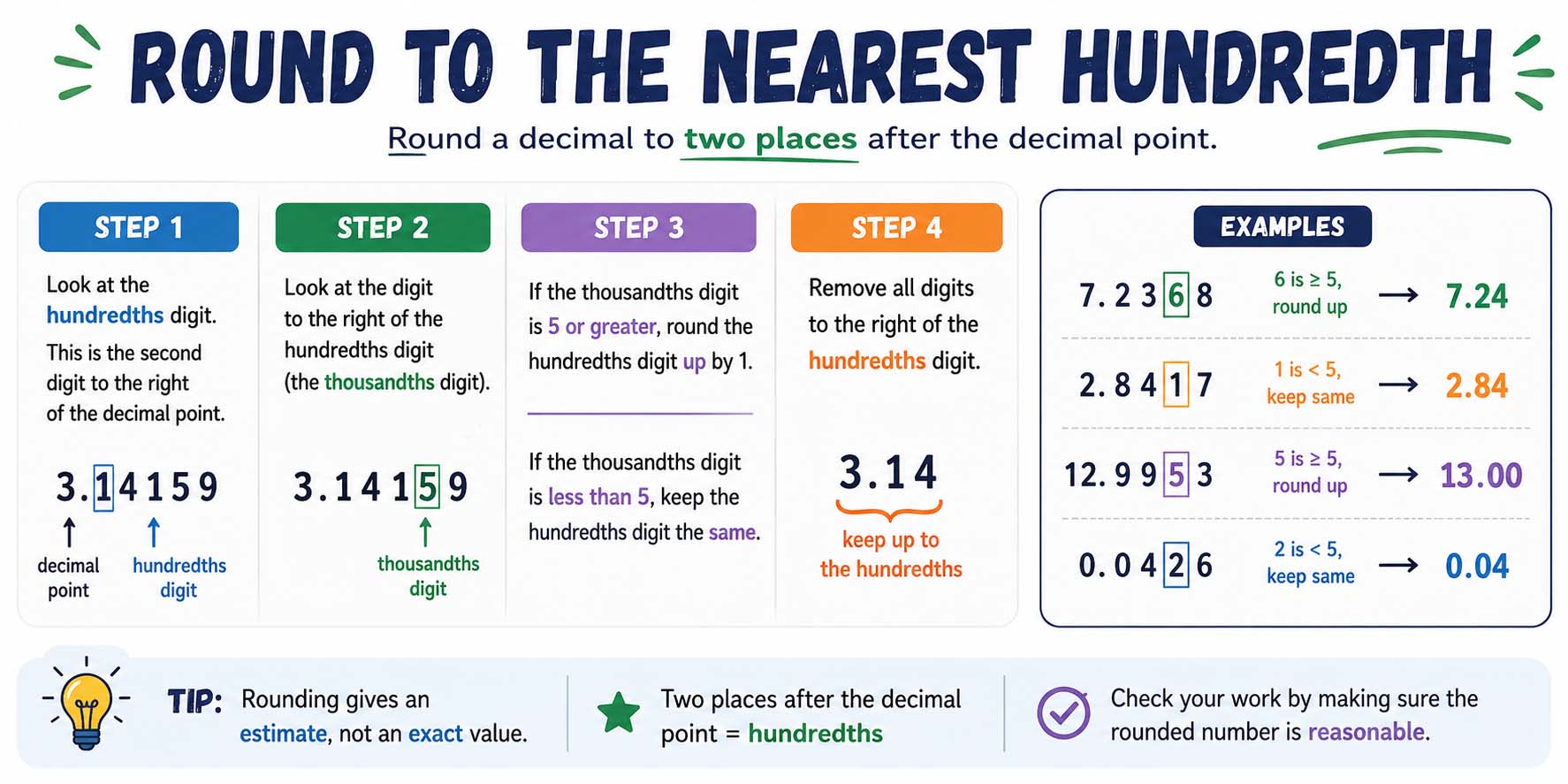
Many students ask how to round to the nearest hundredth. The process is simple if you follow these steps:
Step 1: Find the Hundredth Place
Step 2: Check the Thousandth Place
Look at the third digit after the decimal.
Step 3: Apply the Rule
- If the third digit is 5 or more, round the hundredth digit up by 1.
- If the third digit is 4 or less, leave the hundredth digit the same.
Step 4: Remove Extra Digits
After rounding, keep only two decimal places.
Examples of Rounding to the Nearest Hundredth
Example 1: 5.678
- Hundredth digit = 7
- Thousandth digit = 8
Since 8 is greater than 5, round up.
Answer: 5.68
Example 2: 3.142
- Hundredth digit = 4
- Thousandth digit = 2
Since 2 is less than 5, keep it the same.
Answer: 3.14
Example 3: 9.995
- Hundredth digit = 9
- Thousandth digit = 5
Round up.
Answer: 10.00
How Do You Round to the Nearest Hundredth?
People often ask, how do you round to the nearest hundredth when numbers are confusing. The easiest way is to focus only on the third decimal digit.
For example:
- 6.431 → third digit is 1 → answer = 6.43
- 8.786 → third digit is 6 → answer = 8.79
- 2.105 → third digit is 5 → answer = 2.11
Once you practice a few times, it becomes very easy.
Round to the Nearest Hundredth in Money
Rounding skills are also helpful in financial calculations and comparisons, especially when working with concepts like what is a unit rate in everyday math problems.
Money uses two decimal places, so rounding to the nearest hundredth is very common.
Examples:
- $12.456 becomes $12.46
- $8.123 becomes $8.12
- $19.999 becomes $20.00
This is why rounding matters in shopping, banking, and accounting.
Round to the Nearest Hundredth Calculator
If you need fast answers, a round to the nearest hundredth calculator can help. Many online calculators automatically round decimal numbers to two places.
For example:
- Enter 7.3489 → result = 7.35
- Enter 14.201 → result = 14.20
- Enter 0.876 → result = 0.88
Calculators are useful, but it is still important to understand the rule yourself.
Why Rounding Is Important
Many real-world calculations involve rounded values, including price changes and growth measurements where knowing how to find percent increase can help you understand numerical changes more clearly.
Rounding helps simplify long decimals and makes numbers easier to understand.
Everyday Uses of Rounding:
- Prices and money
- Measurements
- Grades and averages
- Science experiments
- Statistics
- Engineering calculations
Instead of writing 3.14159265, many people round it to 3.14.
Common Mistakes to Avoid
1. Looking at the Wrong Digit
Always check the third decimal place when rounding to the hundredth.
Wrong: Using the fourth decimal place.
2. Forgetting to Increase the Number
If the third digit is 5 or more, raise the second digit by one.
3. Removing Too Many Digits
Keep exactly two decimal places.
Example:
- 4.2 should become 4.20
Practice Questions
Rounding is often used when solving practice problems involving measurements, scores, and calculations, including tasks that require you to know how to find the average.
Try these yourself:
- 6.237 = ?
- 9.994 = ?
- 12.345 = ?
- 7.111 = ?
- 2.999 = ?
Answers:
- 6.24
- 9.99
- 12.35
- 7.11
- 3.00
Rounding Negative Numbers
Understanding decimals also supports other math skills, such as converting between different number forms and learning what is a mixed number.
Negative decimals follow the same rule.
Examples:
- -3.456 = -3.46
- -7.123 = -7.12
- -9.995 = -10.00
The sign stays negative.
Tips to Learn Faster
- Practice daily with 10 examples
- Use place value charts
- Check answers with a calculator
- Read digits slowly from left to right
- Focus on the third decimal place only
With repetition, rounding becomes automatic.
Final Thoughts
Learning to round to the nearest hundredth is an essential math skill used in school and real life. The rule is simple: find the second decimal place, look at the third decimal place, and decide whether to round up or stay the same.
Now you know how to round to the nearest hundredth, understand how do you round to the nearest hundredth, and can even use a round to the nearest hundredth calculator when needed.
With enough practice, rounding decimals becomes quick, accurate, and easy. these problems with confidence every time.