
Study Guide DMV Road Signs and Meanings: Everything You Need to Pass Your Permit Test
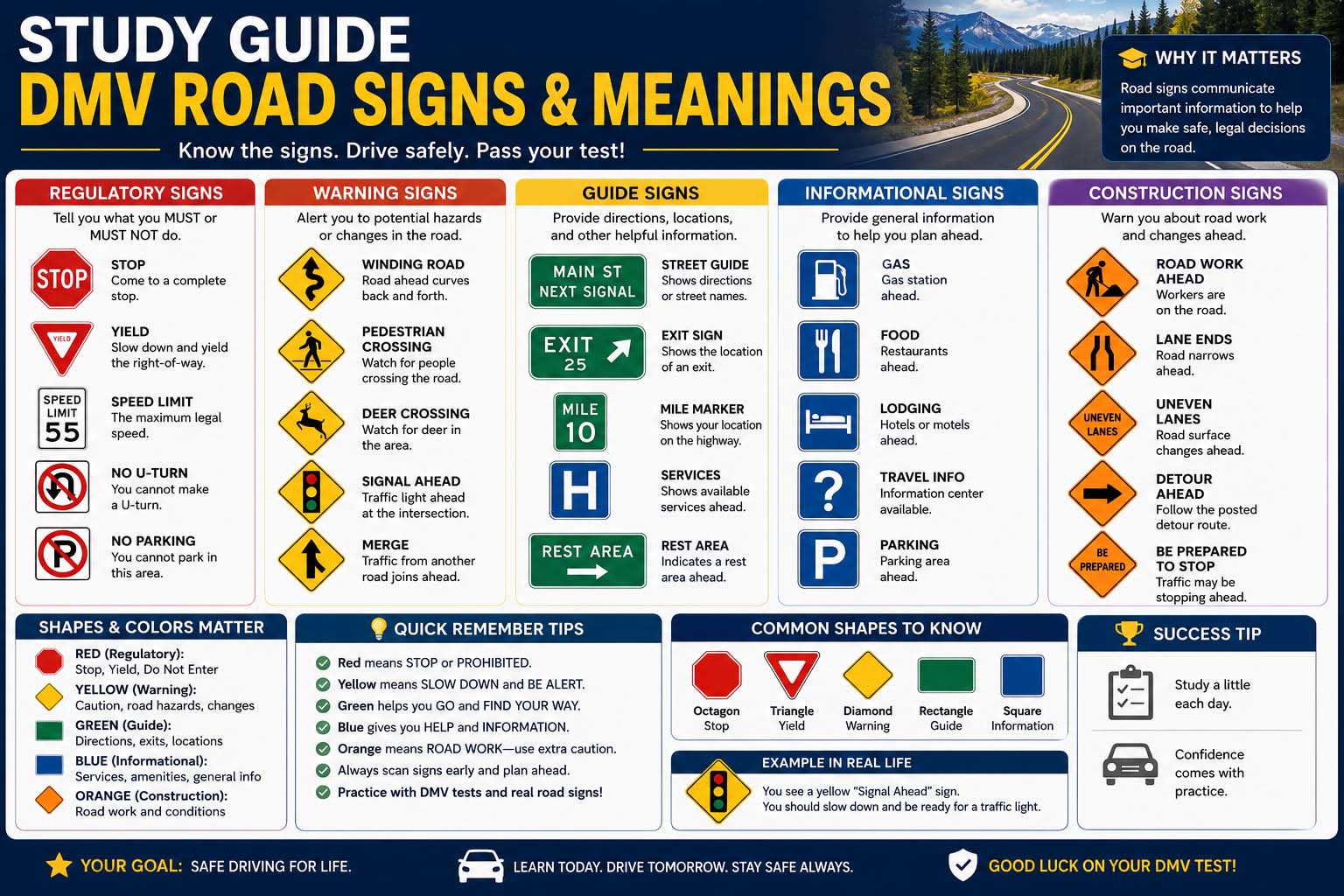
Study Guide DMV Road Signs and Meanings: Everything You Need to Pass Your Permit Test
This study guide DMV road signs and meanings helps new drivers recognize important traffic signs, understand their purpose, and prepare for the DMV permit test. Whether you’re learning to drive for the first time or reviewing before your written exam, understanding road signs is an essential skill.
Many students understand speed limits and basic driving rules but struggle to identify unfamiliar warning signs, regulatory symbols, and railroad crossings. However, recognizing signs becomes easier when you learn their shapes, colors, and meanings.
Instead of memorizing hundreds of signs individually, you can organize them into simple categories. As a result, you’ll remember important details more easily and respond confidently during your permit exam.
This guide covers common traffic signs, practical examples, memory techniques, and a five-day study plan to help you prepare.
Why DMV Road Signs and Their Meanings Matter
Road signs communicate important information that helps drivers make safe decisions.
For example, they warn about dangerous curves, indicate speed limits, and explain which movements traffic laws allow.
Road signs commonly provide information about:
- Speed limits
- Hazards ahead
- Traffic regulations
- Parking restrictions
- Road conditions
- Directions and destinations
- Construction zones
- Pedestrian crossings
In addition, signs help drivers anticipate changes before reaching intersections, school zones, or unfamiliar roads.
Therefore, learning their meanings supports both permit test preparation and everyday driving safety.
Study Guide DMV Road Signs and Meanings: Main Categories
Understanding the main sign categories makes studying more manageable.
Although signs have different designs, their colors and shapes often reveal their general purpose.
| Road Sign Category | Main Purpose | Common Colors |
|---|---|---|
| Regulatory signs | Explain traffic laws and restrictions | White, black, red |
| Warning signs | Alert drivers to upcoming hazards | Yellow |
| Guide signs | Provide directions and service information | Green, blue, brown |
| Construction signs | Warn about temporary road conditions | Orange |
| School signs | Identify school-related safety areas | Fluorescent yellow-green |
These categories cover many signs that drivers encounter during permit test preparation.
However, individual signs may have special shapes, colors, or requirements.
Therefore, learn the specific meaning of each sign rather than relying only on its category.
Regulatory Road Signs and Meanings
Regulatory signs explain what drivers must do or avoid doing.
For example, they establish speed limits, prohibit certain movements, and identify right-of-way requirements.
Ignoring regulatory signs can result in traffic violations and dangerous situations.
Stop Sign
Shape: Octagon
Color: Red with white lettering
Meaning: Come to a complete stop at the required stopping location.
After stopping, check for pedestrians, cyclists, and approaching vehicles before proceeding when safe and permitted.
Yield Sign
Shape: Downward-pointing triangle
Color: Red and white
Meaning: Give the right-of-way to traffic or pedestrians as required.
Slow down as you approach. However, you must stop when necessary to yield safely.
Speed Limit Sign
Shape: Rectangle
Color: Usually white with black lettering
Meaning: Displays the legally established speed limit.
However, poor weather, heavy traffic, or limited visibility may require driving below the posted limit.
Do Not Enter Sign
Shape: Usually a square regulatory sign
Color: Red and white
Meaning: Vehicles must not enter the roadway or area from that direction.
For example, these signs often appear at the wrong end of one-way streets or highway ramps.
One Way Sign
Shape: Rectangle
Color: Black and white
Meaning: Traffic travels only in the direction indicated by the arrow.
Therefore, check the arrow carefully before entering or turning onto the road.
Warning Signs for the DMV Permit Test
Warning signs alert drivers to possible hazards or changes in road conditions.
Most standard warning signs use a yellow background with black symbols.
However, some warning signs use other colors or distinctive shapes.
Curve Ahead Sign
This sign warns that the road curves ahead.
Therefore, adjust your speed before entering the curve when conditions require it.
Sharp Turn Sign
A sharp turn sign indicates a significant change in road direction.
Unlike a gentle curve, a sharp turn may require a substantial reduction in speed.
Deer Crossing Sign
This sign warns that deer may cross the roadway.
For example, drivers should remain especially alert around wooded areas and during periods when wildlife is active.
Slippery When Wet Sign
This warning indicates that the roadway may become slippery during wet conditions.
As a result, drivers should reduce speed when necessary and avoid sudden steering or braking.
Traffic Signal Ahead Sign
This sign warns that traffic lights are approaching.
Therefore, watch for changing signals and prepare to stop when required.
Guide Road Signs and Their Meanings
Guide signs help drivers navigate roads and locate destinations.
Unlike most regulatory signs, they generally provide information rather than direct commands.
Common examples include:
- Highway route numbers
- Exit signs
- Street names
- Hospital directions
- Gas station information
- Rest area signs
- Airport directions
For example, green guide signs commonly display destinations, highway exits, and distances.
Meanwhile, blue signs often identify traveler services such as fuel, lodging, and hospitals.
Brown signs typically provide information about recreational areas and cultural destinations.
As a result, understanding guide signs makes unfamiliar routes easier to navigate.
Construction and Work Zone Road Signs
Construction signs warn drivers about temporary roadway conditions.
Most work zone warning signs use orange backgrounds with black symbols or lettering.
Common examples include:
- Road Work Ahead
- Lane Closed Ahead
- Flagger Ahead
- Detour
- Shoulder Work
- Workers Ahead
For example, a lane closure sign warns drivers that they may need to merge before reaching the work area.
However, temporary traffic control may also include cones, barricades, signals, and instructions from authorized flaggers.
Therefore, follow posted directions, reduce speed when necessary, and remain alert around workers and equipment.
School Zone and Pedestrian Signs
School-related signs help protect children and other pedestrians.
Many use fluorescent yellow-green backgrounds to improve visibility.
Common examples include:
- School crossing
- School zone
- Pedestrian crossing
- School-related speed limit signs
For example, a school crossing sign warns that students may cross the road nearby.
However, a school warning sign does not always establish a reduced speed limit by itself.
Instead, follow the applicable posted speed limits and any time-specific restrictions.
In addition, remain alert because children may enter the roadway unexpectedly.
Understanding DMV Road Sign Colors
Colors provide important clues about a sign’s purpose.
In fact, experienced drivers often recognize the general meaning of a sign before reading its text.
| Sign Color | Common Meaning |
|---|---|
| Red | Stop, prohibition, or wrong way |
| Yellow | General warning |
| Orange | Temporary traffic control or construction |
| Green | Directions and destinations |
| Blue | Motorist services and information |
| Brown | Recreation and cultural destinations |
| White | Regulatory information |
| Fluorescent yellow-green | School, pedestrian, and bicycle warnings |
However, color alone does not explain every sign.
For example, both Stop and Do Not Enter signs use red, but they require different responses.
Therefore, combine color recognition with knowledge of shapes, symbols, and wording.
For official information about U.S. traffic sign standards, consult the Federal Highway Administration’s Manual on Uniform Traffic Control Devices.
DMV Road Sign Shapes and Their Meanings
Road sign shapes help drivers identify important instructions from a distance.
As a result, learning these shapes is one of the simplest ways to improve sign recognition.
Octagon: Stop
The familiar red octagon identifies a Stop sign.
Even when the lettering is difficult to see, its distinctive shape helps drivers recognize it.
Triangle: Yield
A downward-pointing triangle identifies a Yield sign.
Therefore, remember that this shape indicates a right-of-way requirement.
Diamond: Warning
Diamond-shaped signs commonly warn about upcoming hazards.
For example, they may indicate curves, merging traffic, or changing road conditions.
Rectangle: Regulatory or Guide Information
Rectangular signs often display speed limits, parking restrictions, directions, and other information.
However, their meaning depends on the wording, symbols, and colors.
Pentagon: School Area
A pentagon-shaped sign commonly identifies a school-related warning.
As a result, drivers should watch for children and pedestrian activity.
Circle: Railroad Crossing Warning
A circular yellow sign with a black X and the letters RR warns of a railroad crossing ahead.
Therefore, prepare to look and listen for trains as you approach.
Crossbuck: Railroad Crossing
A white X-shaped crossbuck marks a railroad crossing.
However, the crossing may also have flashing lights, gates, or other warning devices.
Always follow the applicable crossing rules and never drive around a lowered gate.
Common DMV Road Sign Symbols to Remember
Many traffic signs use symbols rather than written instructions.
Therefore, learning common symbols can help you recognize signs more quickly.
Important examples include:
- Bicycle crossing: Warns drivers about bicycle activity.
- Pedestrian crossing: Indicates an area where pedestrians may cross.
- Railroad crossing: Warns about train tracks or identifies a crossing.
- Merge: Indicates that traffic streams will join.
- Lane ends: Warns that a traffic lane will end.
- Divided highway begins: Indicates an upcoming divided roadway.
- Divided highway ends: Warns that separated traffic directions will come together.
- Two-way traffic: Warns that opposing traffic will be present.
For example, a merge warning sign may show two traffic paths joining.
Meanwhile, a lane ends sign indicates that one lane will no longer continue.
Although these signs may look similar, they communicate different road conditions.
Therefore, pay attention to the direction and arrangement of each symbol.
Easy Memory Tricks for DMV Road Signs
Simple associations can make traffic signs easier to remember.
However, memory tricks should support accurate understanding rather than replace it.
Red Means Stop or Restriction
Red often signals a serious regulatory instruction.
For example, Stop, Do Not Enter, and Wrong Way signs use red.
Therefore, treat red signs as signals to check the specific restriction immediately.
Yellow Means Warning
Yellow generally warns about road conditions or hazards ahead.
For example, a yellow diamond may indicate a curve or intersection.
As a result, you can prepare to adjust your driving when necessary.
Orange Means Road Work
Orange usually indicates temporary traffic control.
Therefore, watch for construction equipment, lane changes, and workers.
Green Means Directions
Green guide signs commonly provide route and destination information.
For example, they may show highway exits or distances to nearby cities.
Remember the Shapes
You can also associate common shapes with their purposes:
- Octagon: Stop
- Triangle: Yield
- Diamond: Warning
- Pentagon: School
- Circle: Railroad warning
Once these patterns become familiar, identifying signs takes less effort.
Common Road Sign Study Mistakes
Many students make avoidable mistakes while preparing for their permit exams.
Fortunately, a few changes to your study habits can improve accuracy.
Memorizing Pictures Without Understanding
Recognizing a picture is helpful. However, you also need to understand the required driving response.
For example, knowing that a Yield sign is triangular is not enough.
You must also understand when to slow down, stop, and give the right-of-way.
Ignoring Sign Shapes
Some students focus only on colors.
However, shapes can help identify signs when lighting or visibility makes their details difficult to read.
Therefore, practice recognizing both features.
Rushing Through Practice Questions
Reading too quickly can cause unnecessary mistakes.
Instead, examine the sign and read every answer choice before selecting a response.
Skipping Construction Signs
Temporary traffic control signs are an important part of road safety.
Therefore, include work zone warnings in your regular review sessions.
Studying Only General Road Signs
Most states follow national sign standards. However, state-specific driving rules and test requirements may differ.
As a result, your official state driver handbook should remain your primary study resource.
Five-Day Study Plan for DMV Road Signs
A short, organized study schedule can make permit test preparation more manageable.
If you need help organizing your notes, read How to Make a Study Guide for practical study planning techniques.
Day 1: Learn Regulatory Signs and Colors
First, study Stop, Yield, Speed Limit, Do Not Enter, and One Way signs.
Then, review the common meanings of red, white, yellow, and orange.
Day 2: Review Warning Signs and Shapes
Next, focus on curves, sharp turns, wildlife crossings, and slippery roads.
In addition, practice identifying octagons, triangles, diamonds, pentagons, and circles.
Day 3: Study Construction and School Signs
Review common work zone warnings and school-related signs.
For example, compare a School Crossing sign with a general Pedestrian Crossing sign.
Day 4: Practice Guide Signs and Symbols
Study highway directions, exit signs, railroad crossings, merging traffic, and lane endings.
Then, test yourself using pictures without written labels.
Day 5: Take DMV Practice Tests
Finally, complete practice questions based on your state’s official driver handbook.
After each test, review incorrect answers and identify the signs you need to study again.
Therefore, use your mistakes to guide your next review session.
How DMV Road Signs Appear on Permit Tests
Written permit exams commonly use multiple-choice questions.
Depending on the state, questions may include sign images, written descriptions, or driving situations.
For example, you may encounter questions such as:
- What does this road sign mean?
- What should a driver do when approaching this sign?
- Which sign warns of a sharp curve?
- What color commonly indicates construction?
- Which sign requires a complete stop?
Some questions test recognition, while others test the correct driving response.
Therefore, practice both identifying the sign and explaining what a driver should do.
For state-specific preparation, the Tennessee Permit Test Study Guide provides related information about Tennessee permit testing.
However, always confirm current requirements using the official handbook for your state.
Practical Tips for Remembering Road Signs
Consistent practice can improve recognition and long-term memory.
For example, try these techniques:
- Review a small group of signs each day.
- Create flashcards with pictures and meanings.
- Test yourself without looking at notes.
- Review difficult signs more frequently.
- Study the required driving response for each sign.
- Notice traffic signs while riding as a passenger.
- Practice using your state’s official driver handbook.
In addition, explain sign meanings aloud rather than simply rereading them.
For instance, when reviewing a Yield sign, describe when a driver must give the right-of-way.
As a result, you practice understanding the rule rather than memorizing only the picture.
Frequently Asked Questions About DMV Road Signs
How Many Road Signs Should I Memorize?
The number depends on your state’s driver handbook and exam requirements.
However, learning common regulatory, warning, guide, construction, and school signs provides a useful foundation.
Therefore, review every sign covered by your official state handbook.
Are Road Signs the Same in Every State?
Most U.S. traffic signs follow national standards.
However, states may have additional signs, local restrictions, or different driving rules.
As a result, state-specific study remains important.
Are Road Sign Colors Tested on the DMV Exam?
Permit exams may include questions about sign colors and their meanings.
For example, you might need to identify the color commonly associated with construction warnings.
Therefore, learn both colors and symbols.
What Is the Hardest Road Sign to Remember?
Difficulty varies among students.
However, less familiar railroad, warning, and temporary construction signs may require additional practice.
Instead of avoiding these signs, review them regularly until you can explain their meanings.
Should I Study My State’s DMV Handbook?
Yes. Your official state driver handbook is the most relevant source for local permit test preparation.
In addition, use practice questions that reflect your state’s current requirements.
Final Study Tips Before Test Day
This study guide DMV road signs and meanings provides a practical foundation for understanding common traffic signs and preparing for your written permit exam.
First, learn the main categories. Next, memorize the most recognizable shapes and colors. Then, practice identifying symbols and explaining the correct driving response.
However, don’t rely on memorization alone. Understanding why a sign exists will help you make safer decisions on real roads.
In addition, review difficult signs regularly and use your state’s official driver handbook to confirm local rules.
With consistent practice, you can recognize road signs more confidently, improve your permit test preparation, and develop skills that remain valuable long after you receive your driver’s license.