
APUSH Study Guide: Everything You Need to Prepare for AP U.S. History
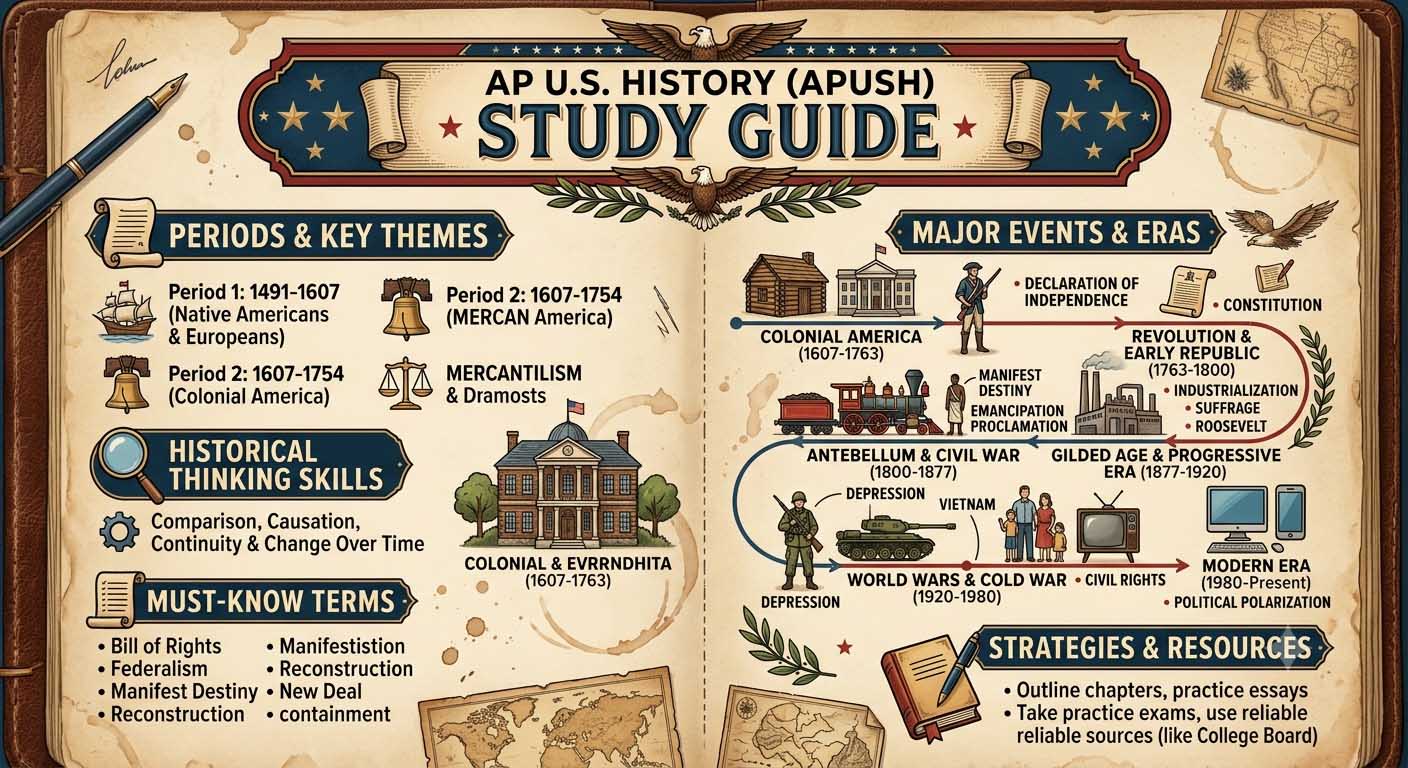
APUSH Study Guide: Everything You Need to Prepare for AP U.S. History
AP U.S. History, commonly called APUSH, covers hundreds of years of American history, including political movements, wars, economic changes, social developments, reform movements, and cultural shifts. Because the course includes so much material, students often struggle to decide what deserves the most attention. This APUSH study guide organizes the course into manageable units, key concepts, historical skills, and practical exam strategies.
Success in APUSH does not depend on memorizing every historical date. Instead, students need to understand major developments, recognize cause-and-effect relationships, compare different periods, analyze sources, and support historical arguments with evidence.
Therefore, a strong study plan should combine content review with regular practice. In addition, students should test what they remember instead of simply rereading notes. As a result, preparing for AP U.S. History becomes much more manageable.
APUSH Study Guide: What Is AP U.S. History?
APUSH stands for Advanced Placement United States History. The course examines American history from 1491 to the present while developing college-level historical analysis skills.
Rather than focusing only on memorization, APUSH teaches students to interpret historical evidence. For example, students analyze primary and secondary sources, identify historical context, compare developments, and construct evidence-based arguments.
Students study topics involving:
- Political development
- Economic systems
- Migration
- Foreign policy
- Social movements
- Constitutional change
- Cultural transformation
- Technology and innovation
As a result, students need both factual knowledge and the ability to explain why historical developments happened and why they mattered.
APUSH Study Guide for Units and Topics
A useful APUSH study guide starts with the nine-unit structure. Each unit represents an important period of U.S. history and connects political, economic, social, cultural, and international developments.
| Unit | Years | Major Focus |
|---|---|---|
| Unit 1 | 1491–1607 | Native societies and European contact |
| Unit 2 | 1607–1754 | Colonial America |
| Unit 3 | 1754–1800 | Revolution and the Early Republic |
| Unit 4 | 1800–1848 | Expansion, politics, and reform |
| Unit 5 | 1844–1877 | Civil War and Reconstruction |
| Unit 6 | 1865–1898 | Industrialization and the Gilded Age |
| Unit 7 | 1890–1945 | Progressive Era, Depression, and World Wars |
| Unit 8 | 1945–1980 | Cold War and civil rights |
| Unit 9 | 1980–Present | Contemporary America |
First, learn the general sequence of these units. Then, connect individual events to the larger developments occurring during each period. Consequently, historical facts become easier to understand and remember.
APUSH Study Guide for Key Concepts and Historical Themes
Understanding the main idea behind historical topics can improve analysis skills, similar to identifying what is a central idea when studying different types of information.
Instead of treating every event as an isolated fact, connect it to broader historical themes. In fact, this approach can make large amounts of information easier to organize.
Important APUSH themes include:
- American and national identity
- Politics and power
- Work, exchange, and technology
- Culture and society
- Migration and settlement
- Geography and the environment
- America in the world
For example, industrialization connects economic change with immigration, urbanization, labor movements, technological development, and government regulation.
Therefore, when reviewing an event, ask three questions: What caused it? What changed because of it? Which larger historical development does it represent?
APUSH Unit 1 Study Guide: Native Societies and European Contact
Unit 1 covers 1491 to 1607. Although this unit covers an early period, it provides important background for developments that appear throughout the course.
Native American Societies
First, focus on how geography influenced Indigenous societies. Climate, natural resources, agriculture, and regional environments affected settlement patterns, economic activity, and social organization.
Instead of memorizing every individual society, compare broader regional patterns. As a result, you can better understand how environmental conditions influenced different communities.
European Exploration
Next, examine the motivations and consequences of European exploration. Spain, France, England, and other European powers approached colonization differently.
For example, review economic motives, religious goals, competition among European powers, and interactions with Indigenous peoples.
Columbian Exchange
The Columbian Exchange connected the Americas with Europe and other parts of the world.
Review the movement of:
- Crops
- Animals
- Diseases
- People
- Goods
Most importantly, understand the consequences. For instance, diseases caused major demographic changes among Indigenous populations. Meanwhile, new crops and trade networks transformed economies across the Atlantic.
APUSH Unit 2 Study Guide: Colonial America
Unit 2 covers 1607 to 1754. During this period, European colonies expanded while interactions among European settlers, Indigenous peoples, and Africans reshaped North America.
Jamestown and the Chesapeake
First, study the difficulties Jamestown faced and how tobacco eventually supported its economy.
Then, connect plantation agriculture to changing labor systems and the expansion of slavery. As a result, you can better understand how economic development influenced colonial society.
New England Colonies
Puritan religious beliefs strongly influenced New England society. Therefore, review the connections among religion, community life, education, and local government.
Middle Colonies
The Middle Colonies developed significant religious and ethnic diversity. In addition, they became important agricultural and commercial centers.
Southern Colonies
In contrast, plantation agriculture strongly influenced economic and social structures in the South.
Focus on:
- Cash crops
- Enslaved labor
- Plantation systems
- Social hierarchy
Colonial Economy
Mercantilism and trade regulations connected the colonies to the British Empire. In addition, policies such as the Navigation Acts help explain later complaints about British economic control.
APUSH Unit 3 Study Guide: Revolution and Early Republic
Unit 3 covers 1754 to 1800. Therefore, this unit is essential for understanding the American Revolution and the creation of the United States.
First, review the French and Indian War and the growing conflict between Britain and its North American colonies.
Important topics include:
- British taxation
- Colonial resistance
- Declaration of Independence
- American Revolution
- Articles of Confederation
- Constitutional Convention
- U.S. Constitution
- Early political parties
When reviewing this period, pay particular attention to causation. For instance, consider how Britain’s attempts to manage its empire after the French and Indian War contributed to colonial resistance.
In addition, compare the Articles of Confederation with the Constitution. This comparison helps explain why political leaders supported a stronger federal government.
APUSH Unit 4 Study Guide: Expansion, Politics, and Reform
Unit 4 covers 1800 to 1848. During this period, the United States experienced major political, economic, territorial, and social changes.
Important topics include:
- Jeffersonian politics
- Market Revolution
- Transportation improvements
- Jacksonian democracy
- Second Great Awakening
- Reform movements
- Westward expansion
As you review, connect economic developments with social changes. For example, improved transportation encouraged migration and trade while strengthening connections among different regions.
At the same time, reform movements reflected changing ideas about religion, education, society, and individual responsibility.
APUSH Unit 5 Study Guide: Civil War and Reconstruction
Unit 5 covers 1844 to 1877. During these years, territorial expansion intensified sectional conflict over slavery and eventually contributed to the Civil War.
Focus on:
- Manifest Destiny
- Mexican-American War
- Expansion of slavery debate
- Political compromises
- Secession
- Civil War
- Emancipation
- Reconstruction amendments
- Reconstruction politics
Instead of memorizing each compromise separately, examine how political leaders attempted to manage sectional conflict.
Then, consider why those attempts eventually failed. As a result, you can better understand the long-term and immediate causes of the Civil War.
APUSH Unit 6 Study Guide: Industrialization and the Gilded Age
Unit 6 covers 1865 to 1898. During this period, rapid industrialization transformed American business, labor, immigration, cities, and everyday life.
Industrial Growth
First, study the expansion of:
- Railroads
- Steel
- Oil
- Manufacturing
- National markets
Then, consider how industrialization changed employment, transportation, consumer life, and cities.
Immigration and Urbanization
Large-scale immigration contributed to rapid urban growth.
For example, review:
- Ellis Island
- Angel Island
- Urban neighborhoods
- Nativism
- Changing labor markets
Meanwhile, expanding cities faced problems involving housing, sanitation, working conditions, and political organization.
Labor Movements
Workers organized to demand better wages, hours, and working conditions.
Important events include:
- Haymarket Affair
- Homestead Strike
- Pullman Strike
Rather than simply memorizing each strike, compare their causes, tactics, and outcomes. Therefore, you can identify broader patterns in the relationship between workers and businesses.
Big Business
Industrial leaders such as Andrew Carnegie, John D. Rockefeller, and J. P. Morgan became associated with the rise of large corporations.
However, Americans also debated monopolies, competition, wealth concentration, and government regulation.
APUSH Unit 7 Study Guide: Progressive Era to World War II
Unit 7 covers 1890 to 1945. During this period, the United States experienced reform movements, economic upheaval, and growing involvement in global affairs.
Key areas include:
- Progressive reform
- U.S. imperialism
- World War I
- 1920s society and culture
- Great Depression
- New Deal
- World War II
Because this unit contains many major developments, organize your review around continuity and change.
For example, compare the federal government’s role before and after the Great Depression. Then, consider how global conflicts changed America’s international position.
Similarly, connect Progressive reforms with earlier and later efforts to address economic and social problems.
APUSH Unit 8 Study Guide: Cold War and Civil Rights
Unit 8 covers 1945 to 1980. During these decades, international tensions and domestic social movements strongly influenced American society.
Major topics include:
- Cold War
- Containment
- Korean War
- Civil Rights Movement
- Vietnam War
- Great Society
- Social movements
- Political change
While reviewing, connect domestic and international developments. For instance, Cold War concerns influenced American politics at home, while civil rights activism challenged longstanding racial inequality.
In addition, other social movements expanded debates about equality, individual rights, and the role of government.
APUSH Unit 9 Study Guide: Contemporary America
Finally, Unit 9 covers 1980 to the present. Although this is the most recent historical period, students should still connect its developments to themes from earlier units.
Important areas include:
- Conservative political developments
- Economic change
- Globalization
- Technological development
- Demographic change
- Post-Cold War foreign policy
Instead of trying to memorize every recent event, focus on broad continuities and changes.
For example, consider how debates about immigration, federal power, economic policy, and America’s international role continued from previous periods.
APUSH Historical Thinking Skills and Exam Preparation
A complete APUSH study guide should cover more than historical facts. Students also need to develop the skills required to interpret evidence and construct historical arguments.
Therefore, include historical reasoning in your review rather than studying only names, dates, and vocabulary.
Contextualization
First, identify the broader events or conditions surrounding a historical development.
For example, westward expansion becomes easier to understand when you connect it to population growth, economic opportunity, political debates, and Manifest Destiny.
Comparison
Next, identify meaningful similarities and differences between developments.
For instance, you might compare:
- Different colonial regions
- First and Second Great Awakenings
- Reconstruction and the Civil Rights Movement
- Progressive and New Deal reforms
Causation
Then, separate immediate causes from deeper long-term causes.
Afterward, consider both short-term and long-term consequences. As a result, you move beyond simple memorization toward historical analysis.
Continuity and Change
Finally, ask what changed during a historical period and what remained relatively consistent.
For example, this approach works well when reviewing political participation, economic systems, migration, and civil rights.
APUSH Exam Study Guide and Review Strategies
Creating organized notes and review materials is an important part of exam preparation. In addition, learning how to make a study guide can help students structure their APUSH review more effectively.
Reading a textbook once is rarely enough. Instead, combine several active study methods.
Create a Master Timeline
First, create a timeline containing major turning points rather than every historical date.
Focus on:
- Causes
- Consequences
- Political shifts
- Wars
- Reform movements
- Economic changes
Then, add connections between different periods. As a result, you can understand historical sequence without depending entirely on memorization.
Review One APUSH Unit at a Time
First, identify the central story of a unit. Next, review its major events and people.
Then, connect those details to historical themes and reasoning skills. Finally, test yourself without looking at your notes.
Consequently, this process turns passive reading into active review.
Use Flashcards Selectively
Flashcards work particularly well for information requiring quick recall.
For example, use them for:
- Vocabulary
- Supreme Court cases
- Presidents
- Legislation
- Treaties
- Historical figures
However, flashcards should support deeper review rather than replace it.
Compare Historical Developments
Comparison strengthens historical reasoning.
For example, ask:
- How did colonial regions differ?
- How did industrialization affect American society?
- How did federal power change across different periods?
- How did reform movements approach social problems?
In fact, comparisons often reveal connections that are difficult to notice when studying events separately.
Practice Retrieval
After reviewing a section, close your notes and write down everything you remember.
Then, compare your response with your notes and identify missing information.
As a result, you spend more time strengthening weak areas instead of repeatedly reviewing information you already know.
APUSH Exam Format and Question Types
Students should prepare for different question formats rather than studying historical content alone. Therefore, your APUSH study guide should include regular practice with the major types of AP-style questions.
The exam assesses students through multiple-choice questions, short-answer questions, a Document-Based Question (DBQ), and a Long Essay Question (LEQ).
In addition, reviewing strong writing models such as argumentative essay examples can help students practice creating clear arguments supported by evidence.
Multiple-Choice Questions
Multiple-choice questions often require students to interpret a source before applying historical knowledge.
When practicing:
- Identify the source and period.
- Determine its main idea.
- Connect it to historical context.
- Eliminate answers that do not fit the evidence.
Therefore, do not treat these questions as simple fact recall.
Short-Answer Questions
Similarly, short-answer questions require concise responses supported by historical knowledge.
A strong response should:
- Address every part of the question
- Use specific historical evidence
- Explain the connection clearly
- Avoid unnecessary background information
First, answer the question directly. Then, add evidence that supports your response.
Document-Based Question
In contrast, the DBQ requires students to construct an argument using historical documents.
When practicing, focus on:
- Developing a clear thesis
- Understanding historical context
- Using document evidence
- Explaining rather than merely quoting evidence
- Connecting relevant outside knowledge
- Analyzing sources
First, determine exactly what the prompt asks. Then, group documents according to how they can support your argument.
Long Essay Question
Finally, the LEQ requires an evidence-based historical argument without a provided set of documents.
A useful structure includes:
- Thesis
- Historical context
- Specific evidence
- Analysis
- Historical reasoning
However, avoid memorizing an entire essay. Instead, practice constructing arguments for different prompts.
APUSH Study Tips and Common Review Mistakes
Even students who study regularly can waste time with ineffective methods. Therefore, identifying common mistakes can make your APUSH preparation more productive.
Memorizing Dates Without Context
Dates help establish chronology. However, isolated dates provide limited value without historical context.
Instead, understand the sequence and significance of major developments.
Ignoring Historical Themes
Facts become easier to remember when they fit into larger patterns.
Therefore, connect events to political, economic, social, cultural, and international developments.
Rereading Without Testing Yourself
Rereading can create a false sense of familiarity.
Instead, use retrieval practice, timelines, practice questions, and short written explanations to check what you actually remember.
Waiting Too Long to Practice Essays
Writing improves through repetition.
First, practice thesis statements and outlines. Then, progress to complete timed responses.
Skipping Primary Sources
Letters, speeches, political cartoons, maps, and photographs can provide important historical evidence.
For that reason, practice identifying perspective, historical context, purpose, and relevant evidence.
Weekly APUSH Study Guide and Review Plan
A consistent schedule can make AP U.S. History easier to manage. Therefore, spread your review across the week rather than trying to cover everything in one session.
| Day | Study Task |
|---|---|
| Monday | Review one APUSH unit or textbook section |
| Tuesday | Review key concepts and flashcards |
| Wednesday | Practice multiple-choice questions |
| Thursday | Complete an SAQ and review mistakes |
| Friday | Review notes and weak topics |
| Saturday | Practice a DBQ or LEQ |
| Sunday | Review timelines and connect major themes |
Recognizing how information is organized can also improve reading comprehension. For example, students can review different text structure examples while working with academic materials.
However, your schedule does not need to follow this exact structure. Instead, adjust it around your class assignments and weaker topics.
APUSH Key Concepts and Review Priorities
When time is limited, use your APUSH study guide to prioritize understanding rather than simply collecting more notes.
First, focus on:
- The main story of each unit.
- Major turning points.
- Cause-and-effect relationships.
- Important political and economic changes.
- Major social and reform movements.
- Connections between different periods.
- Historical reasoning and argumentation.
Then, use practice questions to identify weaker areas.
For example, if you repeatedly miss questions about Reconstruction, return to Unit 5 instead of reviewing the entire course again.
As a result, your study time focuses on areas where improvement is most useful.
Last-Minute APUSH Exam Review
During the final week before an exam, focus on consolidation rather than trying to relearn the entire course.
First, review:
- Major themes
- Unit timelines
- Important turning points
- Frequently confused events
- Historical reasoning skills
- Essay structures
In addition, complete timed practice questions so that exam pacing feels familiar.
Meanwhile, return to topics that caused difficulty during earlier practice. Then, briefly review stronger topics to keep them fresh.
Finally, get enough sleep before the exam. After all, last-minute memorization cannot replace consistent review and practice.
APUSH Study Resources and Review Materials
In addition to this APUSH study guide, students can combine several resources during exam preparation:
- Classroom notes
- Textbooks
- Teacher handouts
- AP review books
- Practice questions
- Primary sources
- Historical maps
- Flashcards
For example, official materials can help students confirm course content and exam expectations. Students can consult the College Board AP U.S. History course page for official course information.
However, avoid collecting so many resources that organizing them takes more time than studying. Instead, choose a few useful resources and use them consistently.
APUSH Study Guide FAQs
What is the best way to study for APUSH?
First, study one unit at a time and connect events to larger historical themes. Next, practice retrieving information without looking at notes. In addition, answer AP-style questions and practice historical writing regularly.
What are the nine APUSH units?
AP U.S. History covers nine chronological units from 1491 to the present. First, students study Native societies and European contact. Then, the course moves through colonial America, the Revolution, expansion, Civil War, industrialization, global conflicts, the Cold War, civil rights, and contemporary America.
How should I review APUSH key concepts?
First, organize concepts by unit and historical theme. Then, connect each concept to causes, consequences, evidence, and related developments. As a result, review becomes more meaningful than memorizing disconnected definitions.
Do I need to memorize every date for APUSH?
No. Although exact dates matter for some major events, chronology, historical context, and significance are generally more useful than memorizing every date.
Which APUSH units should I review most?
Students should understand all nine units. However, you should spend additional time on units or concepts where practice questions reveal weaknesses. Therefore, use your results to decide where extra review is necessary.
How should I prepare for APUSH unit tests?
First, review the unit’s central developments. Next, practice explaining causes, consequences, comparisons, and changes over time. Finally, answer practice questions to identify gaps in your knowledge.
Is APUSH difficult?
APUSH can feel demanding because students must manage a large amount of historical content while developing analysis and writing skills. However, consistent review and regular practice make the workload more manageable.
Build Your APUSH Knowledge One Unit at a Time
A complete APUSH study guide should help you organize American history rather than encourage you to memorize endless isolated facts. Instead, focus on how political, economic, social, and cultural developments connect across different periods.
First, learn the nine-unit structure. Then, identify the major developments and turning points in each unit. Meanwhile, practice comparison, causation, contextualization, and evidence-based argumentation.
Most importantly, use practice questions to discover what you still need to learn. As a result, a steady cycle of reviewing, retrieving, practicing, and correcting mistakes can prepare you more effectively than last-minute cramming.