
What Is a Mixed Number? A Complete Student Guide
What Is a Mixed Number? A Complete Student Guide
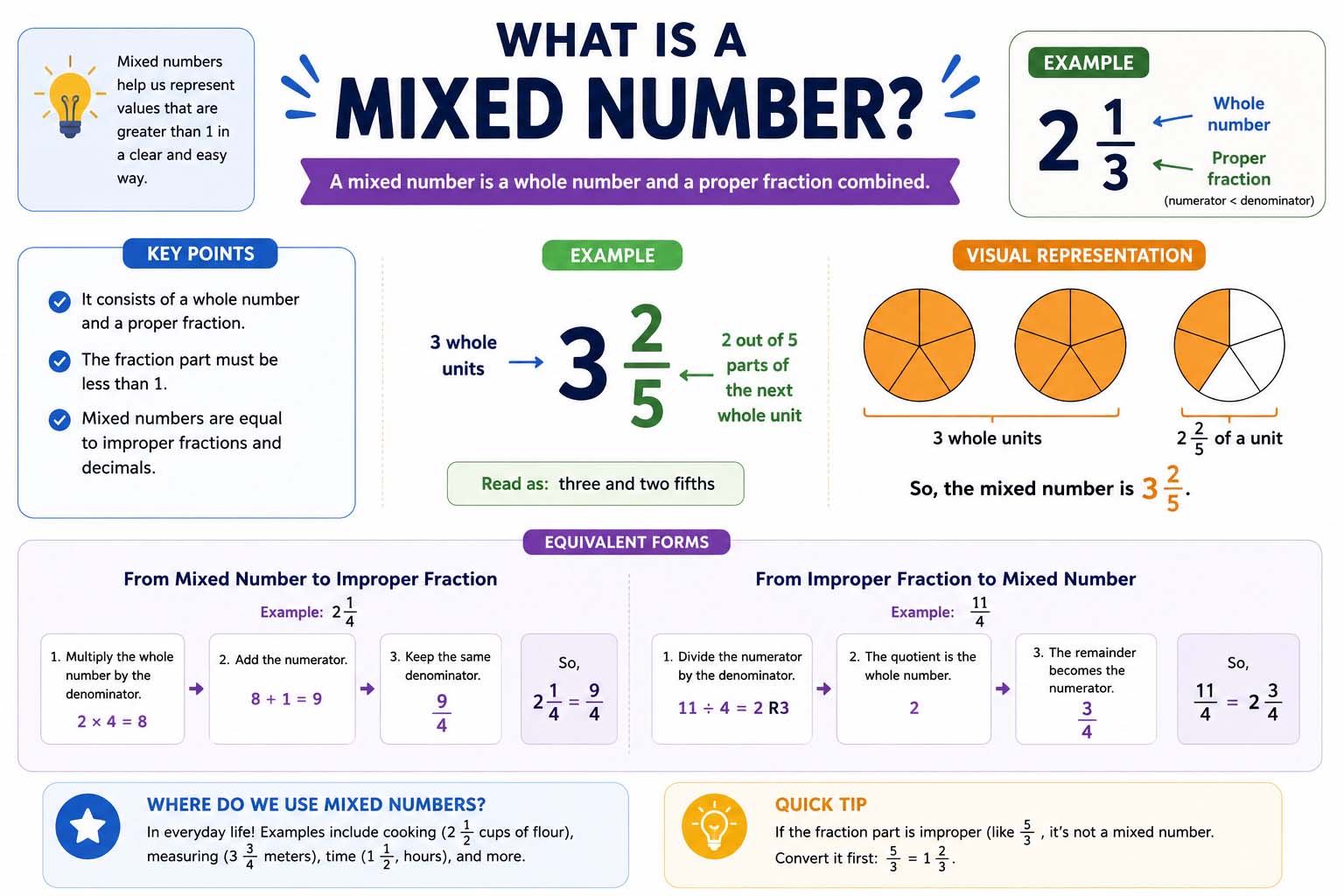
A mixed number is a number that combines a whole number and a proper fraction. It is used to represent a quantity that is greater than one whole but not a whole number. For example, 2 ½ is a mixed number because it contains the whole number 2 and the fraction ½. Mixed numbers are commonly used in everyday situations, such as measuring ingredients, distances, or portions. Understanding what is a mixed number can make it easier to work with fractions and solve mathematical problems.
Many learners ask, what is a mixed number and how it differs from a regular fraction. The good news is that mixed numbers are easy to understand once you know the basics.
What Is a Mixed Number?
A mixed number is a number that contains both a whole number and a proper fraction.
For example:
- 1 ½
- 2 ¾
- 5 ⅓
Each mixed number consists of two parts:
- A whole number
- A fraction that is less than one
Mixed numbers are often used to represent quantities that are greater than one but not completely whole.
What Is a Mixed Number in Math?
Students frequently ask what is a mixed number in math because the concept appears in many math lessons.
In mathematics, a mixed number combines a whole number with a fraction to show an exact value.
For example:
2 ½ means:
- 2 whole units
- Plus one-half of another unit
This is different from a simple fraction because it includes a whole-number portion.
Mixed numbers make certain quantities easier to read and understand.
What Is a Mixed Number in Fractions?
Another common question is what is a mixed number in fractions.
A mixed number is simply another way of writing certain improper fractions.
For example:
The improper fraction:
5/2
Can be written as:
2 ½
Both values are exactly the same.
The mixed-number form is often easier for people to visualize and use in everyday situations.
Parts of a Mixed Number
Let’s examine the mixed number:
3 ¼
It contains:
Whole Number
The number 3 represents three complete units.
Fraction
The fraction ¼ represents one-quarter of another unit.
Together they form:
3 ¼
Understanding these two components helps students work confidently with mixed numbers.
Why Are Mixed Numbers Important?
Mixed numbers are often used alongside What Is a Unit Rate problems when calculating measurements, recipes, and quantities in everyday math.
Examples include:
Cooking
Recipes often use measurements such as:
- 1 ½ cups
- 2 ¼ teaspoons
Construction
Builders frequently work with measurements involving fractions.
Shopping
Product quantities may be expressed using mixed numbers.
Education
Mixed numbers help students understand the relationship between fractions and whole numbers.
Because of these applications, mixed numbers remain an important math skill.
How to Convert an Improper Fraction into a Mixed Number
Many mixed number problems involve converting improper fractions.
Examples:
- 7/4
- 8/5
- 11/3
Step 1: Divide the Numerator by the Denominator
Perform the division.
Step 2: Identify the Whole Number
The quotient becomes the whole-number portion.
Step 3: Find the Remainder
The remainder becomes the numerator of the fraction.
Step 4: Keep the Original Denominator
The denominator stays the same.
This process converts improper fractions into mixed numbers.
What Is 8/5 as a Mixed Number?
A common student question is what is 8/5 as a mixed number.
Let’s solve it.
Divide
8 ÷ 5 = 1 remainder 3
Write the Mixed Number
- Whole number = 1
- Fraction = 3/5
Answer:
1 3/5
Therefore:
8/5 = 1 3/5
This means one whole unit plus three-fifths of another unit.
What Is 7/4 as a Mixed Number?
Students also ask what is 7/4 as a mixed number.
Let’s solve it step by step.
Divide
7 ÷ 4 = 1 remainder 3
Write the Result
- Whole number = 1
- Fraction = 3/4
Answer:
1 3/4
Therefore:
7/4 = 1 3/4
This is the mixed-number form of the improper fraction.
Converting Mixed Numbers Back to Improper Fractions
When working with fractions and decimals, you may also need to Round to the Nearest Hundredth to present answers in a simpler form when required by certain math problems.
Sometimes students need to reverse the process.
Let’s use:
2 ¾
Step 1: Multiply
2 × 4 = 8
Step 2: Add the Numerator
8 + 3 = 11
Step 3: Keep the Denominator
11/4
Answer:
2 ¾ = 11/4
Understanding both conversions is important for solving many math problems.
Mixed Numbers vs Improper Fractions
Students often wonder which form is better.
| Mixed Number | Improper Fraction |
|---|---|
| Easier to visualize | Easier for calculations |
| Includes whole number | Single fraction format |
| Common in everyday life | Common in advanced math |
| Used in measurements | Used in algebra and operations |
Both formats represent the same value.
Common Mistakes Students Make
Forgetting the Remainder
The remainder becomes the numerator of the fraction.
Changing the Denominator
The denominator stays the same during conversion.
Writing Improper Fractions Incorrectly
Always check division carefully.
Ignoring Simplification
Fractions should be simplified whenever possible.
Avoiding these mistakes improves accuracy and confidence.
Tips for Learning Mixed Numbers
Creating a personalized review sheet with examples and practice problems is easier when you know How to Make a Study Guide for math topics.
Practice Division
Strong division skills make conversions easier.
Use Visual Models
Drawing circles or rectangles helps students understand fractions.
Check Your Work
Convert mixed numbers back into improper fractions to verify answers.
Practice Real-Life Examples
Cooking measurements and construction dimensions provide practical applications.
Consistent practice is the best way to master mixed numbers.
Real-World Examples of Mixed Numbers
Mixed numbers can also appear in data analysis, where understanding How to Find the Average helps students calculate mean values involving fractions.
Mixed numbers appear frequently in everyday life.
Recipe Example
A recipe may require:
1 ½ cups of flour
Measurement Example
A piece of wood may measure:
4 ¾ feet long
Distance Example
A runner may complete:
2 ¼ miles
These examples show how mixed numbers help represent quantities clearly.
FAQ
What is a mixed number?
A mixed number combines a whole number and a proper fraction.
What is a mixed number in math?
It is a number written as both a whole number and a fraction.
What is a mixed number in fractions?
It is another way of expressing certain improper fractions.
What is 8/5 as a mixed number?
8/5 = 1 3/5.
What is 7/4 as a mixed number?
7/4 = 1 3/4.
Conclusion
Understanding what is a mixed number is an important part of learning fractions and basic mathematics. Mixed numbers combine whole numbers and fractions, making them easier to read and apply in everyday situations.