
Difference Between BA and BS: A Complete Guide for Students Choosing a Bachelor’s Degree
Difference Between BA and BS: A Complete Guide for Students Choosing a Bachelor’s Degree
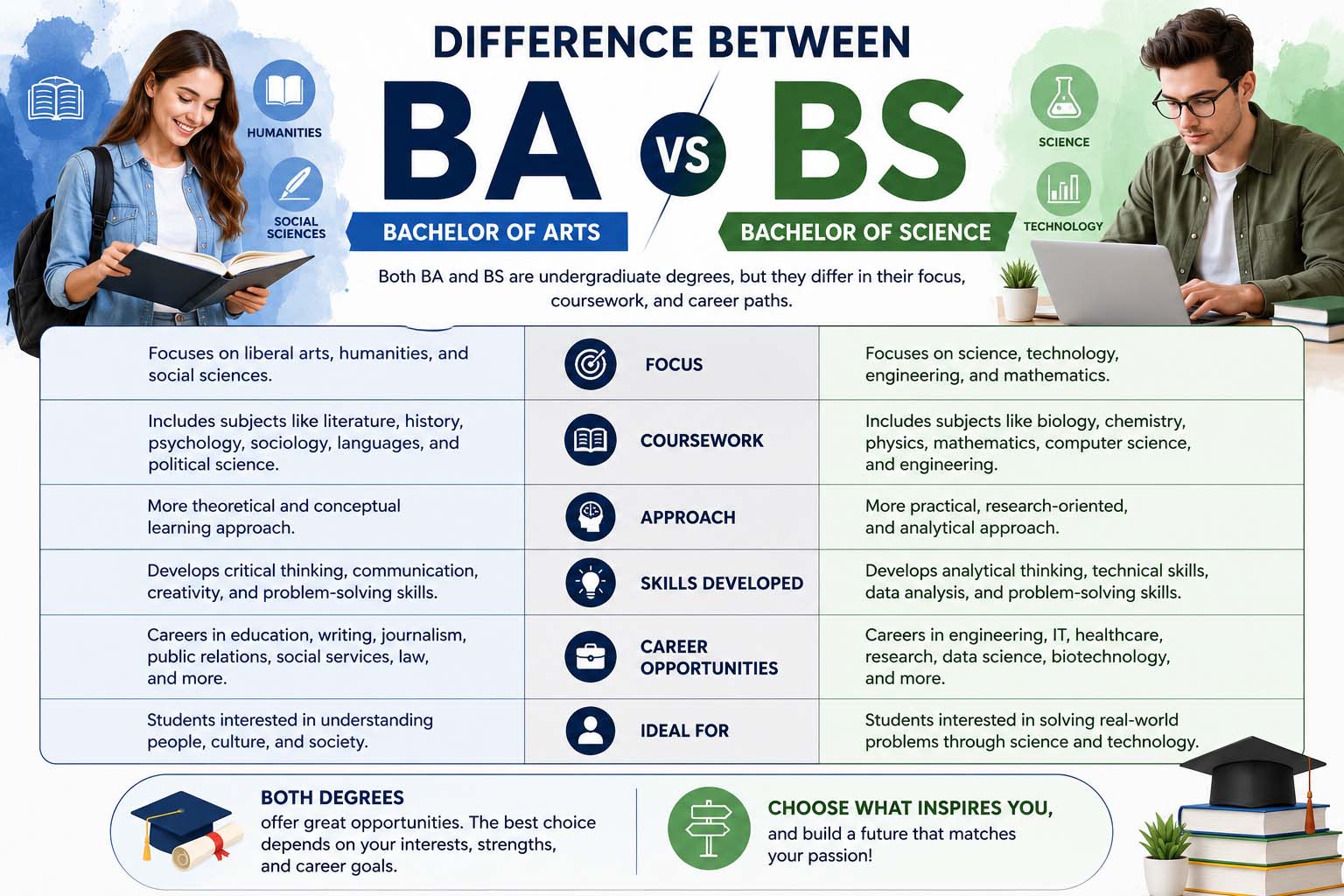
Choosing a college major is exciting, but selecting the right degree type can feel confusing. Many students discover that the same subject is offered as both a Bachelor of Arts (BA) and a Bachelor of Science (BS). Naturally, one question comes up: what is the difference between BA and BS?
The answer depends on your interests, career goals, and the type of education you want. Neither degree is better than the other. They simply focus on different learning styles and academic requirements.
This guide explains the difference between BA and BS, compares their coursework, explores career opportunities, and helps you decide which option best fits your future.
What Is a BA Degree?
A Bachelor of Arts (BA) is an undergraduate degree that emphasizes a broad education alongside your major.
BA programs usually include more courses in subjects such as:
- Humanities
- Social sciences
- Languages
- Communication
- History
- Literature
- Fine arts
The goal is to help students develop critical thinking, writing, communication, and analytical skills while still gaining expertise in their chosen field.
For students who are still deciding What Should I Major In, a BA often offers greater flexibility because it usually includes more elective courses.
What Is a BS Degree?
A Bachelor of Science (BS) is an undergraduate degree with a stronger emphasis on technical, scientific, and mathematical learning.
BS programs commonly require additional coursework in:
- Mathematics
- Statistics
- Laboratory sciences
- Computer science
- Research methods
- Technical applications
These programs often prepare students for careers that require specialized knowledge or technical skills.
Although many BS degrees include general education courses, they usually dedicate more credits to the major itself.
Difference Between BA and BS at a Glance
| Feature | BA | BS |
|---|---|---|
| Main Focus | Liberal arts and broad education | Science and technical knowledge |
| Electives | Usually more | Usually fewer |
| Math Requirements | Often lower | Usually higher |
| Laboratory Courses | Less common | Frequently required |
| Writing Emphasis | Strong | Moderate |
| Technical Skills | Moderate | Strong |
| Flexibility | High | Moderate |
| Typical Career Preparation | Communication, education, business, public service | STEM, healthcare, engineering, technology |
What Is the Difference Between BA and BS?
If you’re asking whats the difference between BA and BS, think of it this way:
A BA provides a wider educational experience, while a BS offers deeper specialization in technical subjects.
Both degrees generally require around four years of full-time study and hold equal academic value.
The biggest differences usually involve:
Course Structure
BA students spend more time studying subjects outside their major.
BS students spend more time taking advanced courses related directly to their field.
Skills Developed
BA graduates often strengthen:
- Writing
- Public speaking
- Critical thinking
- Cultural understanding
- Communication
BS graduates often build:
- Data analysis
- Scientific reasoning
- Technical problem-solving
- Research skills
- Quantitative analysis
Learning Style
BA programs encourage exploring different academic disciplines.
BS programs focus more heavily on specialized knowledge.
Which Degree Offers More Career Opportunities?
Both degrees can lead to rewarding careers.
Your major, internships, experience, and practical skills usually matter more than whether your diploma says BA or BS.
A BA may be ideal for careers in:
- Education
- Journalism
- Marketing
- Public relations
- Government
- Human resources
- International relations
A BS may be a better fit for careers in:
- Engineering
- Healthcare
- Computer science
- Environmental science
- Data analytics
- Biotechnology
- Information technology
Many employers simply require applicants to have a bachelor’s degree, regardless of whether it is a BA or BS.
Difference Between BA and BS in Psychology
One of the most common questions students ask is about the difference between BA and BS in psychology.
Both degrees teach the foundations of psychology, including:
- Human behavior
- Cognitive processes
- Development
- Social psychology
- Research methods
The main distinction lies in the supporting coursework.
BA in Psychology
A BA typically includes more electives in:
- Sociology
- Philosophy
- Languages
- Communication
- Liberal arts
Students interested in counseling, education, social work, or human services often choose this path.
BS in Psychology
A BS generally includes more classes in:
- Biology
- Statistics
- Neuroscience
- Experimental psychology
- Research design
Students considering graduate school, research careers, or healthcare-related fields may prefer the BS option.
Regardless of which path you choose, graduate education may still be required for careers such as licensed psychologist or clinical therapist.
How Employers View BA and BS Degrees
Many students worry that employers favor one degree over the other.
In reality, employers usually care more about:
- Your major
- Academic performance
- Relevant experience
- Communication skills
- Problem-solving ability
- Internships
- Leadership activities
A strong resume with internships, projects, volunteer work, and practical experience often makes a greater difference than choosing between a BA and BS.
If you gain experience through internships or campus employment, programs like What Is Work Study can also help you build professional skills while earning income during college.
How to Decide Between a BA and a BS
Choosing the right degree becomes easier when you evaluate your goals step by step.
Step 1: Think About Your Interests
Ask yourself:
- Do I enjoy writing?
- Do I like science?
- Do I enjoy research?
- Do I prefer creative work?
- Do I like solving technical problems?
Your answers can point you toward the learning environment you’ll enjoy most.
Step 2: Review Degree Requirements
Visit college websites and compare:
- Required classes
- Credit hours
- Lab requirements
- Electives
- Internship opportunities
Sometimes the difference between programs is much smaller than students expect.
Step 3: Consider Your Career Goals
Think about where you hope to work after graduation.
Some careers naturally align with one degree structure, while others accept either option.
Step 4: Compare Graduate School Requirements
If graduate school is part of your long-term plan, review admission requirements early. Reading about What Is a Master’s Degree can also help you understand how undergraduate choices connect with future education.
Common Misunderstandings About BA and BS
Many myths make this decision seem harder than it really is.
Myth: A BS Is Always Better
False.
A BS is not automatically more valuable. It simply emphasizes technical coursework.
Myth: A BA Is Easier
Not necessarily.
BA programs still require rigorous coursework, research, writing, and exams.
Myth: Employers Prefer BS Degrees
Most employers hire based on skills and experience rather than degree labels.
Myth: You Cannot Change Careers
Many graduates successfully change careers later through additional education, certifications, or work experience.
Practical Example
Imagine two students majoring in economics.
Student A (BA):
- Takes economics
- Studies political science
- Learns a foreign language
- Completes communication electives
Student B (BS):
- Takes economics
- Studies statistics
- Learns data analysis
- Completes advanced mathematics courses
Both students graduate with valuable degrees.
One may pursue international business, while the other may become a financial analyst.
Neither path is inherently better—they simply prepare students differently.
Quick Checklist Before Choosing
Before selecting your degree, ask yourself these questions:
- Do I enjoy math and science?
- Do I want more elective choices?
- Which courses sound more interesting?
- What careers am I considering?
- Does graduate school require a specific background?
- Which learning style fits me best?
If you answer these questions honestly, your decision often becomes much clearer.
Students still in high school can also benefit from opportunities like What Is Dual Enrollment, which allows them to earn college credits early and explore different academic subjects before choosing a degree program.
Frequently Asked Questions
Is a BA easier than a BS?
Not necessarily. Both degrees require dedication, studying, and completing major-specific coursework. The difficulty depends more on your strengths and interests than the degree title.
Can I get the same job with a BA or BS?
In many careers, yes. Employers often focus on your skills, experience, internships, and major rather than whether your degree is a BA or BS.
Which degree is better for graduate school?
Both degrees can prepare students for graduate study. Admission requirements vary by program, so check the prerequisites for the schools you’re interested in.
Is the difference between BS and BA significant?
The difference between BS and BA mainly comes down to curriculum. BA programs usually offer broader liberal arts education, while BS programs emphasize technical and scientific coursework.
Should I choose a BA or BS if both are available?
Choose the program that matches your interests, preferred learning style, and long-term career goals instead of assuming one is universally better.
Key Takeaways for Students
The difference between BA and BS is not about one degree being superior. It’s about finding the educational path that supports your goals.
A BA offers flexibility, broader learning, and strong communication skills. A BS provides greater technical depth and specialized training. Both degrees are respected by employers and graduate schools.
Before making your decision, compare program requirements, think about the subjects you enjoy most, and consider the career you hope to build. The best choice is the one that keeps you motivated, helps you develop valuable skills, and prepares you for the opportunities you want after graduation.