
What Is a Master’s Degree? A Complete Guide for Students
What Is a Master’s Degree? A Complete Guide for Students
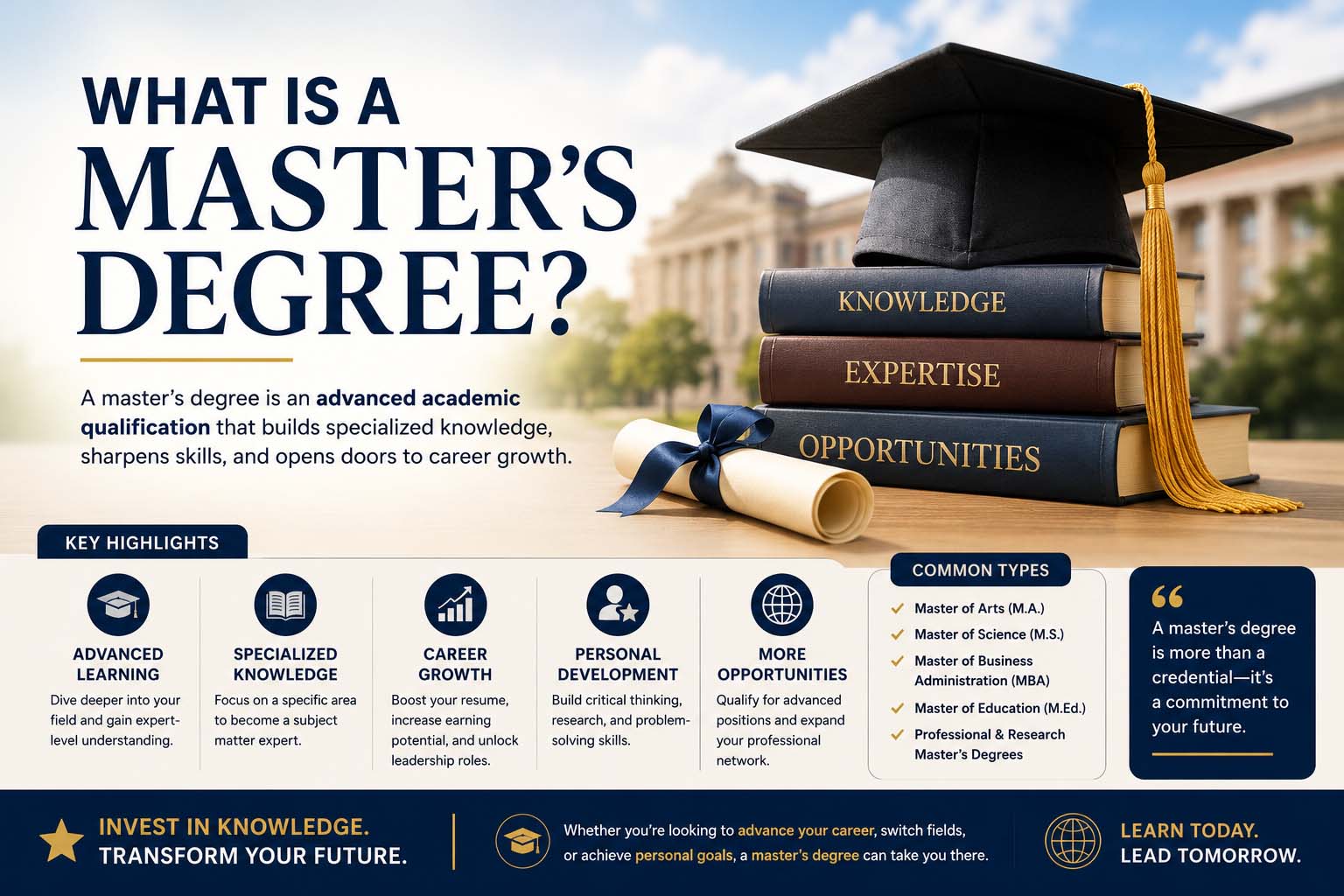
A master’s degree is a postgraduate qualification awarded by colleges and universities after completing an advanced program of study.
Unlike a bachelor’s , which introduces students to a broad field, a master’s degree focuses on deeper learning in one area.
Students typically study:
- Advanced theories
- Professional practices
- Research methods
- Critical thinking
- Leadership skills
- Problem-solving techniques
Many programs also include projects, internships, fieldwork, or research papers that prepare students for careers requiring specialized expertise.
How Does a Master’s Degree Work?
“Students planning their education early may also explore options like What Is Dual Enrollment to understand how some learners begin earning college credits before completing high school.”
Most students begin a program after earning a bachelor’s degree.
Programs usually combine classroom instruction with independent learning.
- Coursework
- Group projects
- Case studies
- Laboratory work
- Practical placements
- Comprehensive exams
- A thesis or final capstone project
Some universities offer full-time study, while others provide flexible part-time or online options for working professionals.
The length depends on the program and study schedule.
| Study Option | Typical Completion Time |
|---|---|
| Full-Time | 1–2 years |
| Part-Time | 2–4 years |
| Online Flexible Programs | Varies |
| Accelerated Programs | About 12 months in some cases |
Programs with internships or research requirements may take longer than coursework-only degrees.
Common Types of Master’s Degrees
Universities offer master’s degrees across nearly every academic discipline.
Some of the most popular include:
Master of Arts (MA)
An MA usually focuses on humanities, education, communication, psychology, history, or social sciences.
Coursework often includes research, writing, and discussion-based learning.
Master of Science (MS)
An MS emphasizes science, mathematics, engineering, technology, healthcare, and data-focused subjects.
Students often complete research projects or technical coursework.
Master of Business Administration (MBA)
An MBA prepares students for leadership and management roles.
Typical topics include:
- Marketing
- Finance
- Operations
- Human resources
- Business strategy
Master of Education (MEd)
This degree helps educators improve teaching skills, educational leadership, curriculum development, or school administration.
Professional Master’s Degrees
Many careers offer specialized master’s programs, including:
- Public Health
- Nursing
- Social Work
- Architecture
- Engineering
- Information Technology
Why Do Students Earn a Master’s Degree?
“Students who are still deciding on their academic path may find it helpful to explore What Should I Major In before choosing a field that matches their interests and future career goals.”
Students pursue graduate education for many different reasons.
Common goals include:
- Advancing their careers
- Increasing earning potential
- Changing industries
- Developing specialized expertise
- Qualifying for leadership positions
- Preparing for doctoral study
For many professions, a can open opportunities that may not be available with only a bachelor’s degree.
Admission Requirements
Although every university sets its own standards, many master’s programs require:
- A bachelor’s degree
- Official academic transcripts
- Application form
- Personal statement
- Letters of recommendation
- Resume or curriculum vitae (CV)
Some competitive programs may also request:
- Portfolio submissions
- Interviews
- Writing samples
- Professional experience
Always review admission requirements for each university before applying.
What Is a Master’s Degree Preparation Program?
Some students search for what is a master’s degree preparation program before applying.
A degree preparation program helps students build the academic skills needed for graduate-level study.
These programs may include:
- Academic writing
- Research skills
- English language support
- Study techniques
- Subject-specific foundation courses
Preparation programs are especially helpful for international students, career changers, or applicants who need additional academic support before beginning graduate school.
What Is a Terminal Master’s Degree?
Another common question is what is a terminal master’s degree.
A terminal master’s is the highest academic qualification generally required for a particular profession or field. In these areas, earning a doctorate is often optional rather than expected.
Examples may include:
- Master of Fine Arts (MFA)
- Master of Social Work (MSW)
- Master of Library Science (MLS) in some career paths
For many graduates, a terminal master’s degree provides enough education for advanced professional practice without pursuing a PhD.
What Is a Competency-Based Master’s Degree?
Some universities now offer what is a competency-based master’s degree programs.
Instead of progressing only through semesters or classroom hours, students advance by demonstrating mastery of specific skills and learning outcomes.
Students complete assessments that show they understand the required material before moving forward.
This learning model often benefits:
- Working professionals
- Adult learners
- Students with prior experience
- Self-paced learners
Because progress depends on demonstrated knowledge, some students complete competency-based programs faster than traditional degrees.
What Is a Competency Based Master’s Degree?
The phrase what is a competency based master’s degree refers to the same educational approach, simply written without the hyphen.
These programs focus on measurable abilities rather than time spent in class.
Examples of competencies may include:
- Leadership
- Project management
- Data analysis
- Communication
- Professional decision-making
Students move through coursework after proving they have mastered each required competency.
Is a Master’s Degree Right for You?
Before applying, ask yourself a few questions.
- Does your career require graduate education?
- Will the degree improve your job opportunities?
- Can you balance study with work or family responsibilities?
- Are you passionate about the subject?
- Do the financial benefits outweigh the cost?
There isn’t one right answer for everyone.
Some careers strongly value graduate education, while others place greater emphasis on work experience.
Study Tips for Master’s Students
“Creating effective study resources can also improve academic performance, and learning How to Make a Study Guide can help students organize complex graduate-level materials.”
Graduate education often requires more independent learning than undergraduate study.
These habits can help students succeed.
Stay Organized
Keep track of:
- Assignment deadlines
- Research notes
- Reading schedules
- Exam dates
Using a planner or digital calendar helps reduce stress.
Read Consistently
Graduate courses often assign more reading than undergraduate classes.
Breaking reading into smaller daily sessions makes it easier to understand complex topics.
Build Strong Research Skills
Learning how to find reliable academic sources is one of the most valuable graduate-level skills.
Become familiar with:
- Academic journals
- University libraries
- Citation styles
- Research databases
Participate in Discussions
Class discussions often deepen understanding.
Sharing ideas with classmates can strengthen critical thinking and communication skills.
Ask for Help Early
Professors, advisors, and university support centers can provide guidance before small problems become larger ones.
Career Opportunities After a Master’s Degree
A master’s degree may help graduates qualify for positions such as:
- School administrator
- Data analyst
- Project manager
- Financial analyst
- Healthcare administrator
- Marketing manager
- Software engineer
- Human resources manager
- Research specialist
- University instructor in some settings
Career outcomes depend on the field of study, work experience, and local job market conditions.
Common Misunderstandings About Master’s Degrees
Many students have misconceptions about graduate school.
“Everyone Needs One”
Not every career requires a degree.
Some industries value certifications, portfolios, or work experience just as highly.
“It Guarantees a Higher Salary”
Graduate education may increase earning potential, but salary depends on many factors, including experience, location, employer, and industry.
“Online Degrees Aren’t Respected”
Many accredited universities offer high-quality online master’s programs.
Employers often focus more on the institution’s accreditation and the student’s skills than on the learning format.
Quick Comparison: Bachelor’s vs Master’s Degree
“Understanding the basics of graduate education can help students compare degree options and make informed decisions about pursuing What Is a Master’s Degree and its potential benefits.”
| Feature | Bachelor’s Degree | Master’s Degree |
| Education Level | Undergraduate | Graduate |
| Admission | High school or equivalent | Bachelor’s degree |
| Typical Length | 3–4 years | 1–2 years |
| Learning Focus | Broad knowledge | Specialized expertise |
| Research Level | Moderate | Advanced |
| Career Preparation | Entry-level careers | Advanced or leadership roles |
Frequently Asked Questions
What is a master’s degree?
A master’s degree is a graduate-level qualification earned after completing a bachelor’s that provides advanced knowledge in a specific subject.
Can I earn a master’s degree online?
Yes. Many accredited universities offer online, hybrid, and in-person master’s degree programs.
Do all master’s programs require a thesis?
No. Some programs require a thesis, while others use capstone projects, internships, or comprehensive exams instead.
Is a master’s degree harder than a bachelor’s degree?
Graduate coursework is generally more specialized and often requires greater independence, research, and critical thinking.
Can I work while earning a master’s degree?
Yes. Many students work part-time or full-time while completing flexible evening, weekend, or online graduate programs.
Your Next Step
Understanding what is a master’s degree is the first step toward deciding whether graduate education fits your academic and career goals. A master’s program offers the chance to build advanced knowledge, strengthen professional skills, and prepare for new opportunities in many industries.
Before applying, compare programs carefully, review admission requirements, estimate the total cost, and think about how the degree aligns with your long-term plans. Taking time to choose the right program can make your graduate school experience more rewarding and help you move confidently toward your future career.