
All Types of Figurative Language: A Complete Student Guide
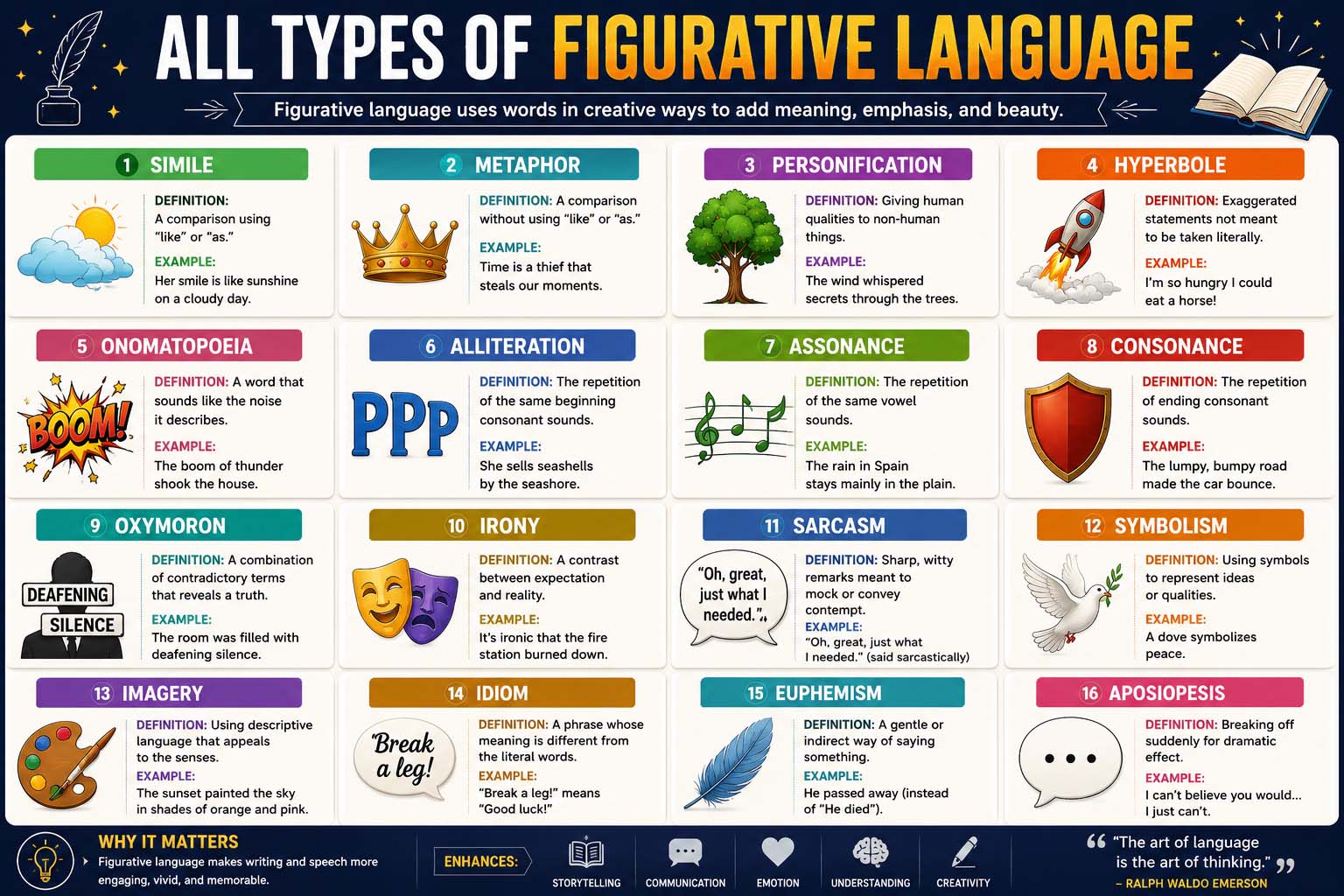
All Types of Figurative Language: A Complete Student Guide
Have you ever read a sentence like, “The wind whispered through the trees,” or “I’m so hungry I could eat a horse”? These expressions aren’t meant to be taken literally. Instead, they use figurative language to create vivid images, stronger emotions, and more engaging writing. Learning all types of figurative language helps students become better readers, writers, and communicators.
Whether you’re preparing for an English exam, writing an essay, or simply trying to understand literature, this guide explains the most common forms of figurative language with easy definitions and practical examples.
What Is Figurative Language?
Figurative language uses words or phrases in a creative way rather than their literal meaning. Writers use it to make ideas more memorable, descriptive, and emotionally powerful.
If you’re just beginning this topic, understanding What Is Figurative Language provides a strong foundation before exploring each literary device in detail.
Instead of stating facts directly, figurative language helps readers imagine, feel, and connect with the message.
All Types of Figurative Language Explained
When students ask, what are all the types of figurative language, they are usually referring to the most common literary devices taught in school. While there are many advanced techniques, the following are the ones you’ll encounter most often.
Simile
A simile compares two different things using the words “like” or “as.”
Examples:
- Her smile was as bright as the sun.
- The baby slept like a log.
- He ran as fast as lightning.
Similes make descriptions easier to picture because they compare unfamiliar ideas with familiar ones.
Metaphor
A metaphor compares two things without using “like” or “as.”
Examples:
- Time is a thief.
- The classroom was a zoo.
- Her voice was music to his ears.
Many students confuse similes and metaphors, so reviewing the difference between metaphor and simile can make recognizing each one much easier.
Personification
Personification gives human qualities to animals, objects, or ideas.
Examples:
- The flowers danced in the breeze.
- The stars winked at us.
- The alarm clock screamed all morning.
Personification helps make writing more lively and imaginative.
Hyperbole
Hyperbole is an intentional exaggeration used for emphasis.
Examples:
- I’ve told you a million times.
- This backpack weighs a ton.
- I’m starving to death.
Readers understand these statements are exaggerated rather than literal.
Onomatopoeia
Onomatopoeia uses words that imitate real sounds.
Examples:
- Buzz
- Splash
- Bang
- Pop
- Crack
- Meow
These sound words create a stronger sensory experience.
Alliteration
Alliteration repeats the same beginning consonant sound in nearby words.
Examples:
- Peter Piper picked peppers.
- Wild winds whistled.
- Busy bees buzzed.
Writers often use alliteration in poetry, speeches, and advertising because it creates rhythm.
Idiom
An idiom is a phrase whose meaning differs from the literal meaning of its words.
Examples:
- Break the ice
- Hit the books
- Piece of cake
- Spill the beans
Learning idioms often requires understanding their figurative meaning rather than translating each word individually.
Oxymoron
An oxymoron combines two opposite ideas.
Examples:
- Deafening silence
- Jumbo shrimp
- Bittersweet
- Open secret
These combinations may seem contradictory, but they express complex ideas effectively.
Symbolism
Symbolism uses objects, colors, people, or events to represent larger ideas.
Examples:
- A dove symbolizes peace.
- A heart represents love.
- A crown symbolizes power.
Authors frequently use symbols to add deeper meaning to stories.
Irony
Irony occurs when the actual result differs from what is expected.
Common forms include:
- Verbal irony
- Situational irony
- Dramatic irony
Example:
A fire station catches fire.
The unexpected outcome creates irony.
Pun
A pun is a joke based on words with multiple meanings or similar sounds.
Examples:
- I used to be a baker because I kneaded dough.
- The bicycle couldn’t stand because it was two-tired.
Puns are common in jokes, headlines, and advertising.
Euphemism
A euphemism replaces harsh or unpleasant language with softer wording.
Examples:
- Passed away instead of died
- Let go instead of fired
- Senior citizen instead of old person
Writers and speakers often use euphemisms to communicate sensitive topics respectfully.
Quick Reference: All Types of Figurative Language and Examples
| Type | Definition | Example |
|---|---|---|
| Simile | Comparison using “like” or “as” | Busy as a bee |
| Metaphor | Direct comparison | Life is a journey |
| Personification | Human qualities given to objects | The leaves waved |
| Hyperbole | Extreme exaggeration | I’ve waited forever |
| Onomatopoeia | Sound word | Boom |
| Alliteration | Repeated beginning sound | Silly snakes slither |
| Idiom | Phrase with nonliteral meaning | Under the weather |
| Oxymoron | Opposite ideas together | Living dead |
| Symbolism | Object represents idea | White flag = peace |
| Irony | Opposite of expectation | A lifeguard can’t swim |
| Pun | Wordplay | Time flies like an arrow |
Why Writers Use Figurative Language
Figurative language serves many purposes.
It helps writers:
- Create vivid images.
- Express emotions clearly.
- Make ideas memorable.
- Add humor.
- Build suspense.
- Strengthen storytelling.
- Encourage readers to think more deeply.
Without figurative language, many stories and poems would feel flat and repetitive.
Finding Figurative Language in Reading
Recognizing figurative language becomes easier with practice.
Ask yourself these questions:
- Does the sentence compare two things?
- Is something impossible happening?
- Does an object act like a person?
- Is the meaning different from the literal words?
- Does the phrase create a strong mental picture?
Looking for these clues helps students identify literary devices more quickly.
Figurative Language in Different Types of Writing
Authors use figurative language in many genres, including novels, poetry, speeches, songs, and even advertisements. Exploring different types of writing shows how each genre uses figurative language for different purposes. Poetry may rely heavily on imagery and symbolism, while persuasive writing often uses metaphors to strengthen arguments.
Understanding the writing style helps readers recognize why a particular figurative device was chosen.
How to Use Figurative Language in Your Own Writing
Learning to identify figurative language is only the first step.
To use it effectively:
Start with Simple Comparisons
Instead of saying:
“The lake was calm.”
Try:
“The lake was as smooth as glass.”
Small comparisons often create stronger descriptions.
Match the Situation
Choose figurative language that fits naturally.
For example:
- Hyperbole works well in humorous writing.
- Symbolism fits literary analysis.
- Personification enhances descriptive paragraphs.
- Similes help beginning writers create vivid images.
Avoid Overusing It
Too many figures of speech in one paragraph can distract readers.
Instead, choose one or two strong examples that support your message.
Common Mistakes Students Make
Many learners confuse similar literary devices.
Some frequent mistakes include:
- Mixing up metaphors and similes.
- Taking idioms literally.
- Assuming every comparison is a metaphor.
- Overusing hyperbole.
- Missing symbolism because it’s indirect.
- Confusing irony with coincidence.
Reading carefully and considering the author’s purpose helps avoid these errors.
Practice Activity
Read the sentence below:
“The thunder growled across the sky.”
Ask yourself:
- Does thunder actually growl?
- Is a human characteristic being assigned to nature?
The answer is yes, so this example uses personification.
Here’s another example:
“My backpack weighs a thousand pounds.”
The backpack obviously doesn’t weigh that much.
This sentence uses hyperbole.
For extra practice, creating your own Metaphor in a Sentence can help reinforce how direct comparisons work in everyday writing.
Figurative Language vs. Tone and Mood
Students sometimes confuse figurative language with tone or mood.
Figurative language is a writing technique that creates imagery or comparison.
Tone reflects the author’s attitude.
Mood describes the feeling the reader experiences.
Understanding the difference between tone and mood makes literary analysis more accurate because each concept serves a different purpose.
Study Tips for Remembering Figurative Language
Memorizing literary devices becomes easier when you use active learning.
Try these strategies:
- Make flashcards with definitions and examples.
- Highlight figurative language while reading books.
- Write one original example for each device.
- Quiz yourself regularly.
- Practice identifying devices in songs and movies.
- Explain each term to a classmate.
Using examples from everyday life often makes figurative language much easier to remember.
Frequently Asked Questions
What are all the types of figurative language?
The most commonly taught types include simile, metaphor, personification, hyperbole, onomatopoeia, alliteration, idiom, symbolism, irony, oxymoron, and pun. Some courses also include euphemism, allusion, and paradox.
What are all types of figurative language used in school?
Schools generally focus on the literary devices students encounter most often in reading and writing assignments, including similes, metaphors, personification, hyperbole, idioms, and symbolism.
What is the easiest figurative language to recognize?
Hyperbole and simile are often the easiest because exaggeration and comparison are easy to spot.
Why is figurative language important?
It helps writers create stronger imagery, communicate emotions, make ideas memorable, and keep readers engaged.
Can one sentence contain more than one type of figurative language?
Yes. A sentence can combine multiple literary devices if they work naturally together. For example, a sentence might include both alliteration and personification.
Take Your Understanding Beyond Memorization
Learning all the types of figurative language is about more than remembering definitions. The real goal is recognizing how authors use these techniques to create emotion, paint vivid pictures, and make ideas more meaningful. As you read novels, poems, articles, or speeches, challenge yourself to identify each literary device and think about why the writer chose it.
The more examples you read and create on your own, the easier it becomes to recognize figurative language in any text. With regular practice, you’ll strengthen both your reading comprehension and your writing skills, making you a more confident student and communicator.