
Muscles of the Arm Explained
Muscles of the Arm Explained
The muscles of the arm are essential for nearly every upper-body movement you make each day. From lifting groceries to typing on a keyboard, these muscles help provide strength, stability, and coordination. The arm contains several groups of muscles that work together with bones, joints, tendons, and nerves to create smooth movement. Understanding these muscles is useful for fitness training, rehabilitation, anatomy studies, and injury prevention.
Many people think only of the biceps when discussing arm strength, but the arm contains many important muscles. Some are large and powerful, while others are smaller stabilizing muscles that support precise movements. This guide explores the main arm muscle groups, their functions, and how to keep them healthy.
What Are the Muscles of the Arm?
The muscles of the arm are commonly divided into two main regions: the upper arm and the forearm. The upper arm extends from the shoulder to the elbow, while the forearm extends from the elbow to the wrist. Together, these muscles allow bending, straightening, rotating, gripping, lifting, and reaching.
The muscles are connected to the skeleton through tendons. When a muscle contracts, it pulls on a bone to create movement. Because many tasks require multiple actions at once, different muscles often work in teams.
Understanding how muscles function also requires careful observation and critical thinking, similar to solving logic-based questions like Which of the Following Statements Is False, where identifying correct information is essential.
Muscles of the Upper Arm
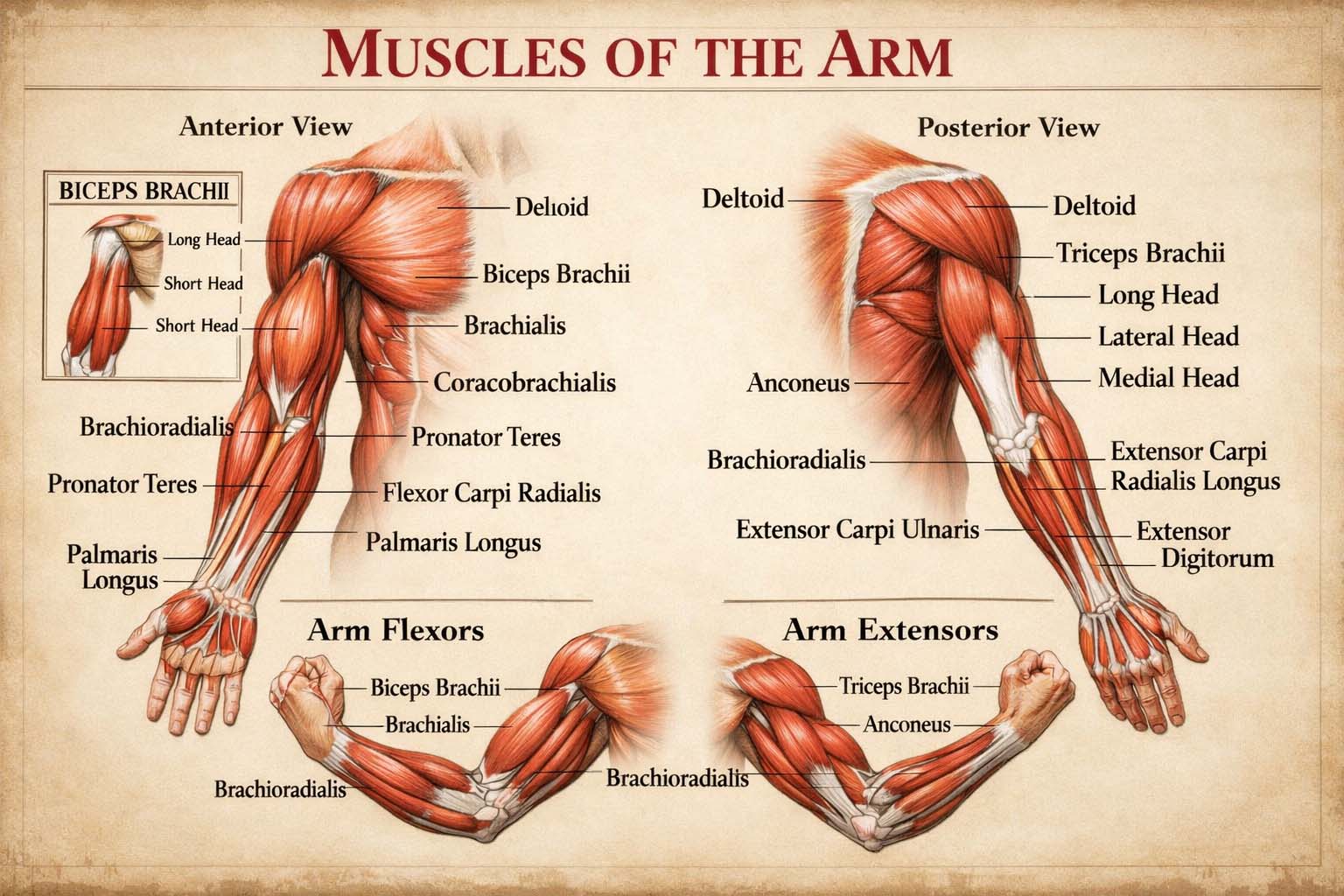
The muscles of the upper arm are among the most recognized in the body. They include the biceps brachii, triceps brachii, brachialis, and coracobrachialis. Each muscle has a specific role in arm movement and strength.
The biceps brachii is located on the front of the upper arm. It is responsible for bending the elbow and rotating the forearm so the palm faces upward. This muscle becomes active when lifting objects or performing curls.
The triceps brachii is found on the back of the upper arm. Its primary function is to straighten the elbow. It becomes active during pushing movements such as push-ups or pressing exercises.
The brachialis lies beneath the biceps and helps flex the elbow. It is an important muscle for raw pulling strength. The coracobrachialis is a smaller muscle that assists with moving and stabilizing the arm at the shoulder.
Parts of the Arm Muscles
When discussing the parts of the arm muscles, it helps to understand the body’s anatomical organization. The upper arm contains flexors in the front and extensors in the back.
The forearm contains many smaller muscles that control the wrist, hand, and fingers. Some are located on the front side and help with gripping and flexing the wrist. Others are on the back side and help extend the wrist and fingers.
Muscles also have origins and insertions. The origin is the fixed attachment point, while the insertion is the moving point. This structure allows muscles to pull bones efficiently during movement.
Muscles of the Arm and Forearm
The muscles of the arm and forearm work together constantly. For example, when lifting a dumbbell, the upper arm muscles bend the elbow while the forearm muscles stabilize the wrist and grip the handle.
Important forearm muscles include the flexor carpi radialis, flexor carpi ulnaris, extensor digitorum, pronator teres, and brachioradialis. These muscles allow gripping, wrist bending, finger movement, and forearm rotation.
The brachioradialis is especially noticeable during hammer curls. It lies on the thumb side of the forearm and assists in elbow flexion. Strong forearm muscles improve grip strength, sports performance, and daily functionality.
Without healthy forearm muscles, even strong biceps may not perform effectively because grip and wrist control are critical for lifting tasks.
Muscles of the Arm and Shoulder
The muscles of the arm and shoulder are closely connected because the shoulder joint controls arm positioning. The deltoid is the primary shoulder muscle and allows lifting the arm forward, sideways, and backward.
The rotator cuff consists of four small shoulder muscles that stabilize the shoulder joint. These include the supraspinatus, infraspinatus, teres minor, and subscapularis. They are vital for safe arm movement and injury prevention.
When reaching overhead, the shoulder muscles position the arm while the upper arm muscles provide strength. During pushing or pulling exercises, both shoulder and arm muscles work together.
Strong shoulders support healthy arm function. Weakness or imbalance may lead to poor movement patterns, pain, or reduced performance.
How Arm Muscles Function Together
No muscle works alone. Everyday actions involve multiple muscles contracting in sequence. Lifting a heavy object requires shoulder stability, biceps tension, forearm grip strength, and core support.
Developing teamwork and coordination in physical activities can also support overall well-being, much like Social Emotional Learning Activities help build cooperation, confidence, and problem-solving skills in educational settings.
Best Exercises for Arm Muscles
To build and strengthen the muscles of the arm, a variety of exercises should be used.
Some of the best exercises include:
- Biceps curls
- Hammer curls
- Triceps dips
- Triceps pushdowns
- Push-ups
- Pull-ups
- Resistance band exercises
Using proper form is more important than lifting heavy weight too soon. Controlled movement reduces injury risk and improves muscle activation.
Common Arm Muscle Injuries
Overuse, poor posture, or incorrect lifting can lead to arm muscle injuries.
Common issues include:
- Tendonitis
- Muscle strains
- Tennis elbow
- Golfer’s elbow
- Shoulder impingement
Early treatment, rest, stretching, and strengthening exercises can help reduce recovery time and prevent long-term problems.
Nutrition for Healthy Arm Muscles
Muscles need fuel to grow and recover. Protein supports muscle repair after training.
Good protein sources include:
- Eggs
- Fish
- Chicken
- Dairy products
- Beans
- Lentils
- Tofu
Staying hydrated and eating enough fruits, vegetables, and whole grains also supports muscle performance and recovery.
Tips to Build Stronger Arms
Consistency matters more than quick fixes.
To improve arm strength:
- Train arms two or three times each week.
- Allow adequate recovery between workouts.
- Gradually increase resistance over time.
- Focus on proper exercise technique.
- Sleep well to support muscle recovery.
- Eat a balanced diet rich in protein.
If you track workout progress or body measurements, rounding values accurately—such as using Round to the Nearest Hundredth—can help keep records clear and consistent.
Building physical strength is also valuable for long-term professional success, especially in careers that involve manual work or healthcare. Developing healthy habits early supports many Career Advancement Strategies by improving endurance, confidence, and overall well-being.
Conclusion
The muscles of the arm are complex, powerful, and essential for everyday life. From the muscles of the upper arm to the smaller parts of the arm muscles, every structure has an important role. The combined action of the muscles of the arm and forearm allows gripping, lifting, and precision movement, while the muscles of the arm and shoulder create strength and stability for larger tasks. Learning how these muscles function and caring for them through proper exercise, nutrition, and recovery can improve performance, reduce injury risk, and support lifelong health.