
What Is a Full Ride Scholarship? What It Covers and How to Earn One
What Is a Full Ride Scholarship? What It Covers and How to Earn One
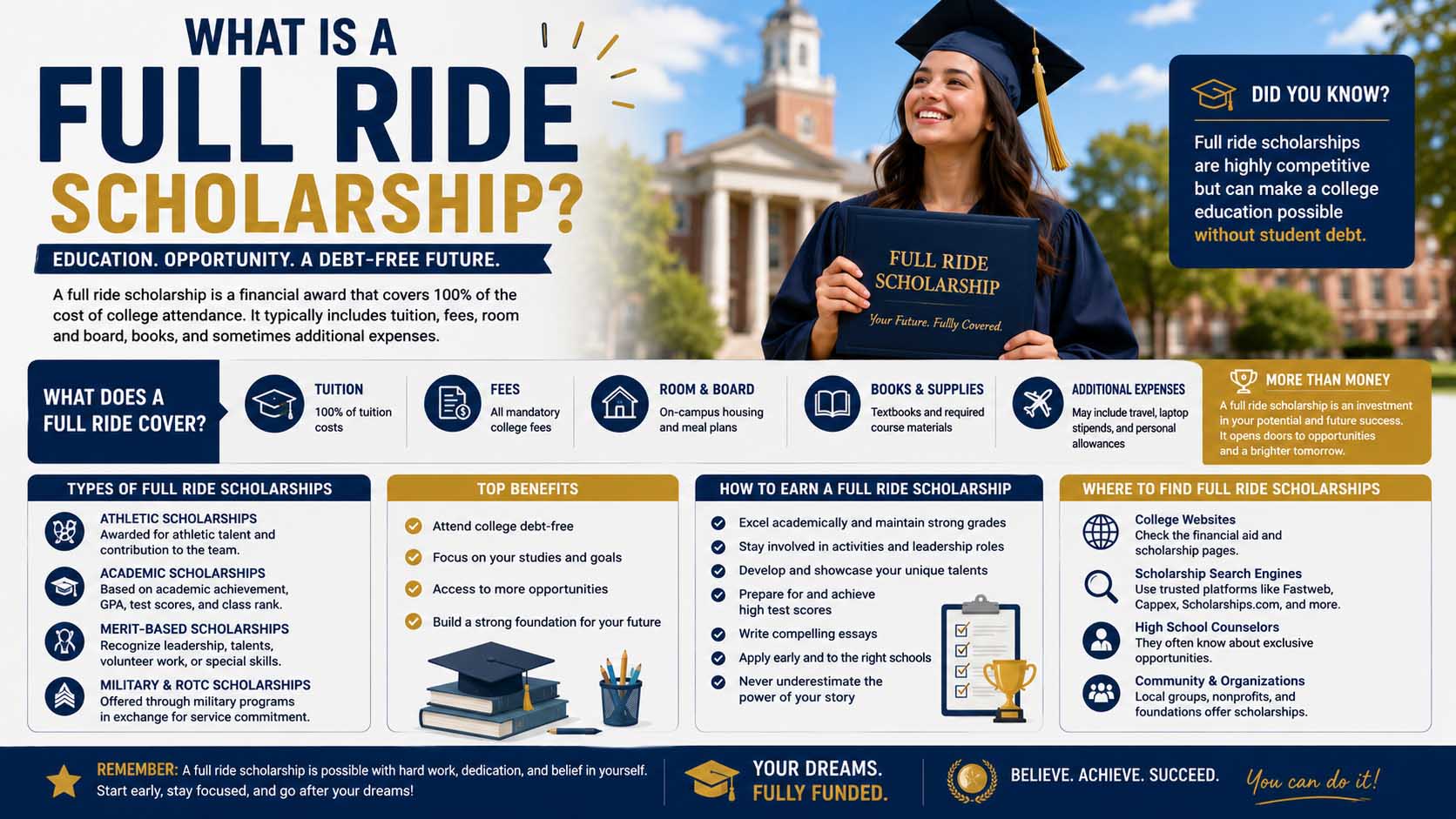
College can cost far more than tuition alone, so students often dream of finding an award that covers nearly everything. If you are wondering what is a full ride scholarship, it generally means a scholarship designed to cover most or all of the major costs associated with attending college, potentially including tuition, required fees, housing, and meals. Some awards may also provide money for books, supplies, transportation, or other educational expenses. However, every scholarship has its own terms, so students should always check exactly which costs an award covers.
Full ride scholarships can significantly reduce the amount students and families need to pay for college. Still, they are usually competitive, and there is no single qualification formula that applies to every program.
Understanding how these awards work can help you build a smarter scholarship strategy instead of focusing only on the phrase “full ride.”
What Is a Full Ride Scholarship in Simple Terms?
A full ride scholarship is a financial award intended to cover a broad range of college attendance costs rather than tuition alone.
The exact package varies by scholarship. However, a full ride may cover expenses such as:
- Tuition
- Mandatory college fees
- Campus housing or a housing allowance
- Meal plans or food expenses
- Textbooks
- Required educational supplies
Certain programs may cover other costs as well. For example, an award could include funding for transportation, a laptop, enrichment activities, study abroad, or personal expenses.
However, students should never assume these extras are included.
Instead, read the scholarship’s official terms and compare the award against the college’s published cost of attendance.
That comparison matters because students asking Why Is College So Expensive quickly discover that tuition represents only one part of the total price. Housing, meals, books, transportation, supplies, and personal expenses can substantially increase the overall cost.
What Is Considered a Full Ride Scholarship?
So, what is considered a full ride scholarship rather than simply a large scholarship?
Generally, the term describes an award that covers the major costs required to attend college. By contrast, a full-tuition scholarship normally focuses specifically on tuition.
Consider a hypothetical college where tuition costs $30,000 per year while housing, meals, fees, books, and other expenses add another $18,000.
A full-tuition scholarship might cover the $30,000 tuition bill but leave the student responsible for the remaining expenses.
A full ride could potentially cover both tuition and many or all of those other major costs, depending on the award.
Therefore, the dollar value alone does not tell you whether a scholarship is truly a full ride. The categories of expenses covered matter just as much.
Full Ride vs Full Tuition Scholarship
Students frequently confuse these two terms, yet the difference can affect their college budget considerably.
| Feature | Full Ride Scholarship | Full Tuition Scholarship |
|---|---|---|
| Tuition | Usually covered | Usually covered |
| Required fees | Often covered | May or may not be covered |
| Housing | Often covered | Usually not automatically covered |
| Meals | Often covered | Usually not automatically covered |
| Books | May be covered | Varies |
| Transportation | Sometimes covered | Usually not |
| Personal expenses | Sometimes included | Usually not |
For instance, one scholarship described as “full tuition” may include certain fees, while another may strictly pay tuition. Likewise, two full ride programs may cover different amounts for books or transportation.
Therefore, always rely on the written award details rather than the scholarship’s marketing label.
Who Can Qualify for a Full Ride Scholarship?
There is no single type of student who qualifies for every full ride.
Instead, scholarship providers may consider different combinations of academic achievement, leadership, talent, service, financial circumstances, background, career goals, or other eligibility requirements.
Academic Achievement
Some merit-based scholarships look closely at grades, course rigor, class performance, and academic accomplishments.
A high GPA can make an applicant more competitive for certain programs. However, students researching What Is the Highest GPA should remember that GPA systems vary among high schools. Scholarship committees may consider the context of your academic record rather than simply comparing one number.
Standardized Test Scores
Some scholarship programs consider SAT or ACT scores, while others are test-optional or do not use standardized tests.
Likewise, students may encounter scholarship opportunities connected to earlier standardized testing. Understanding What Is a Good PSAT Score can be useful when evaluating how PSAT performance relates to programs such as the National Merit Scholarship Program.
Still, testing policies can change. Therefore, verify the current requirements for each scholarship before investing time in test preparation solely for that award.
Leadership and Community Involvement
Academic performance is not always enough.
Some competitive scholarships want students who have demonstrated meaningful leadership, community involvement, initiative, or responsibility.
Quality often matters more than collecting a long list of activities. For example, organizing a sustained tutoring program may tell a scholarship committee more about your leadership than briefly joining many clubs.
Special Talents
Certain colleges and organizations provide substantial scholarships for athletic, artistic, musical, or other abilities.
However, eligibility rules differ greatly. A talented student should research both college-based awards and scholarships offered by outside organizations.
Financial Need
Some full ride opportunities consider demonstrated financial need.
In these cases, students may need to complete required financial aid forms and provide financial information according to the scholarship’s rules.
Other full rides are merit-based and may not use financial need as the primary selection factor.
Where Do Full Ride Scholarships Come From?
Students sometimes assume that full rides only come directly from universities. In reality, funding can come from several sources.
Colleges and Universities
Many institutions offer merit scholarships to attract students who meet particular academic, leadership, talent, or other criteria.
Some colleges automatically consider admitted students for certain scholarships, while others require separate applications.
Therefore, check the financial aid and scholarship pages of every college on your list.
Private Organizations
Foundations, nonprofit organizations, corporations, and community groups may also offer scholarships.
Large national awards can be highly competitive. Meanwhile, local opportunities may attract fewer applicants, although they often provide smaller amounts.
Specialized Programs
Some programs focus on particular fields, communities, talents, service records, or career goals.
Read eligibility requirements carefully before applying. Spending hours on an application for which you do not qualify wastes time that could be used on better opportunities.
How to Improve Your Chances of Getting a Full Ride
A full ride is rarely something students should start thinking about a week before an application deadline.
Instead, preparation can begin much earlier.
Build a Strong Academic Record
Take courses that challenge you appropriately while maintaining strong academic performance.
However, do not overload your schedule simply because you think every scholarship requires the hardest possible course combination.
Consistency matters.
Scholarship committees may also consider how you used the academic opportunities available at your particular school.
Develop Meaningful Activities
Over time, look for ways to contribute more deeply. You might lead a project, mentor younger students, organize an event, compete at a higher level, or solve a problem in your community.
This approach creates more meaningful experiences than joining activities solely to fill an application.
Keep Track of Achievements
Students often forget accomplishments when application season arrives.
Therefore, maintain a simple document listing awards, leadership positions, volunteer work, employment, competitions, major projects, and measurable accomplishments.
Later, you can use this record when completing scholarship forms and preparing essays.
Write Strong Scholarship Essays
A strong scholarship essay should help the reader understand you beyond grades and activity lists.
Start by answering the actual prompt. Although that sounds obvious, applicants sometimes reuse an essay so heavily that it no longer addresses the question.
Then, use specific examples.
Instead of writing, “I learned leadership through volunteering,” explain a situation where you had to organize people, solve a problem, or take responsibility.
Specific experiences make your application more memorable and credible.
Before submitting, proofread carefully. Also, ask a teacher, counselor, or another trusted reader to check whether your essay communicates your ideas clearly.
Understand the Financial Aid Package Around Your Scholarship
Even a large scholarship should be considered within your complete financial aid offer.
For example, receiving scholarship money can sometimes affect other components of financial aid. College policies and scholarship terms determine how those adjustments work.
Students who still have uncovered expenses may consider campus employment. Learning What Is Work Study can help you understand how Federal Work-Study differs from a scholarship and how eligible students may earn money through qualifying employment.
When comparing colleges, calculate your estimated out-of-pocket cost after grants and scholarships rather than focusing only on the largest award listed in the offer.
A $40,000 scholarship at one institution is not automatically better than a $25,000 scholarship somewhere else if the second college costs substantially less.
Look Beyond the First Year
A scholarship that appears to cover four years may still have renewal requirements.
Common conditions can include:
- Maintaining a minimum GPA
- Completing a required number of credits
- Remaining enrolled full time
- Meeting conduct standards
- Continuing an activity or program
- Making satisfactory academic progress
Before accepting an award, ask whether it is renewable and for how many semesters.
Then, find out whether the amount remains the same if tuition or housing prices increase.
This detail can affect your budget several years later.
Common Full Ride Scholarship Mistakes
One common mistake is applying only for famous national scholarships. Although those opportunities may be valuable, competition can be intense.
Instead, combine national applications with institutional, regional, local, and specialized scholarships.
Another mistake is missing deadlines. Some major merit scholarship deadlines arrive earlier than standard college application deadlines.
Students also sometimes assume excellent grades guarantee a full ride. Strong academics can help, but highly competitive scholarships may evaluate leadership, service, essays, recommendations, talents, and personal experiences as well.
Finally, never pay someone who claims they can guarantee you a scholarship. Legitimate scholarship outcomes cannot be guaranteed by an application service.
How Full Ride Scholarships Affect Your College Decision
Receiving a full ride can dramatically change the financial side of choosing a college. However, cost should not be the only factor.
You should still evaluate:
- Academic programs
- Graduation outcomes
- Campus environment
- Location
- Student support
- Internship opportunities
- Career services
- Housing
- Scholarship renewal requirements
Students considering What Will You Do to Maximize on Your Postsecondary Education Investment should look beyond the initial scholarship amount and think about how effectively a college supports their academic and career goals.
A generous scholarship at a school that does not offer the program you need may not be the strongest long-term choice.
What Is a Full-Ride Scholarship Definition for Families?
Parents often want a simple what is a full-ride scholarship definition when comparing financial aid offers.
A practical definition is: a scholarship intended to pay most or all major costs associated with attending college.
However, “full ride” should never be interpreted as an automatic promise that a family will pay absolutely nothing.
Some expenses may fall outside the award. For instance, optional travel, personal purchases, certain course materials, insurance, or costs beyond a specified allowance might remain the student’s responsibility.
Therefore, compare the scholarship terms with the institution’s official cost-of-attendance estimate.
FAQs About Full Ride Scholarships
What is a full-ride scholarship?
A full-ride scholarship generally covers tuition and other major college expenses, which may include required fees, housing, meals, books, and sometimes other costs. Exact coverage depends on the scholarship.
Does a full ride cover all four years?
Some awards are renewable for multiple years, but students usually must satisfy renewal conditions. Always verify the maximum duration and requirements.
Do you need a perfect GPA for a full ride?
No universal GPA guarantees a full ride. Each scholarship establishes its own selection criteria, and many consider factors beyond grades.
Can average students get full ride scholarships?
It depends on the scholarship. Not every full ride is based exclusively on GPA. Some programs emphasize leadership, talent, service, financial need, or other criteria.
Is housing always included?
Not necessarily. Many full ride awards include housing, but coverage varies. Some provide a fixed housing allowance, while others may have different arrangements.
Is a full ride the same as full tuition?
Usually not. Full tuition generally covers tuition charges, while a full ride commonly covers a broader range of major college costs.
Can international students receive full rides?
Some institutions and scholarship programs provide substantial aid to international students, while others restrict eligibility. Students should check citizenship and residency requirements for each opportunity.
Make Full Ride Scholarships Part of a Bigger College Strategy
Understanding what is a full ride scholarship is useful, but the smartest approach is not to build your entire college plan around winning one highly competitive award.
Instead, create a balanced list of colleges, research institutional scholarships early, maintain your academic record, develop meaningful activities, and apply to multiple legitimate funding opportunities.
Then compare each school’s real net cost after confirmed grants and scholarships. A true full ride can be an outstanding opportunity, but a combination of merit aid, need-based grants, smaller scholarships, and an affordable college can sometimes produce an equally strong financial outcome.
Start early, stay organized, and read every scholarship’s coverage and renewal terms carefully. That way, you can judge each opportunity by what it actually pays for rather than by the words printed at the top of the award letter.